


| Contents |
|---|
Introduction
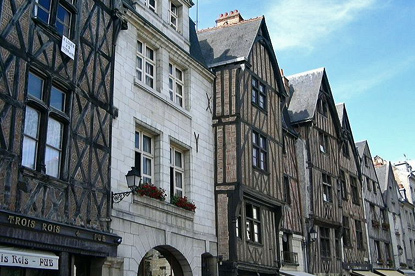
Tours (pop. 137,000) serves as a gateway to the Loire Valley's famous châteaux and is part of the third-largest wine region in France. The city boasts some noteworthy medieval architecture, including the stunning Saint-Gatien Cathedral, a masterpiece of Gothic architecture, and the Basilique Saint-Martin, a neo-Byzantine gem. Visitors can explore the charming old town, Vieux Tours, with its half-timbered houses and lively Place Plumereau. Tours also offers beautiful green spaces like the Prébendes d'Oé garden and the botanical garden, providing a serene escape. The city's culinary scene is vibrant, with local specialties such as rillettes and Touraine wines.
Famous natives of the Touraine region include François Rabelais, René Descartes, and Honoré de Balzac.
Interesting Facts about Tours
- Tours is the capital of the Loire Valley, a UNESCO World Heritage site renowned for its stunning châteaux and vineyards.
- The city boasts one of the largest amphitheatres of the Roman Empire, known as the Tours Amphitheatre.
- Tours was the birthplace of renowned French novelist Honoré de Balzac, who wrote over fifty books.
- The city's old quarter, Vieux Tours, is one of the best-preserved medieval districts in France, featuring charming cobbled streets and half-timbered houses.
- Tours is home to the final resting place of Saint Martin, the patron saint of France.
- The city is part of the third largest wine region in France, producing notable wines such as Vouvray and Chinon.
- Tours is recognised as a Cité Internationale de la Gastronomie, celebrating its rich culinary heritage and local specialities like rillettes.
- The city's Musée des Beaux-Arts features works by masters such as Rubens, Rembrandt, Mantegna, and Monet.
- Tours was once the royal capital under the Valois Kings and played a significant role in French history.
- The city hosts an annual public Loire Valley wine salon called Vitiloire, featuring over 150 winemakers.

History
Built on the ancient land of the Turones, the Celtic tribe that gave the city its name, Tours was founded by the Romans soon after the conquest of Gaul by Julius Caesar. It was originally known asCaesarodunum, or Caesar's hill fort. RenamedCivitas Turonorum ('capital of the Turones') in the 4th century, the city grew into the third largest in Gaul and had one of the five largest amphitheatres in the Roman Empire.
In 732, Frankish leader Charles Martel crushed the army of Muslim horsemen from Al-Andalus at the so-called Battle of Tours (which actually took place 20km northeast of Poitiers), putting an end to the expansion of Islam in Europe.
In the 9th century, Tours was at the heart of the Carolingian Renaissance, thanks especially to the English scholar Alcuin, invited by Charlemagne to the Carolingian court inAachen, then nominated Abbot of Saint Martin's of Tours in 796.
From the 10th century, a second city centre emerged around the Abbey of Saint Martin, west of the old Roman 'castrum', creating a "double city". Vineyards and fields separated these two centres until they eventually merged into each others in the 14th century.
The County of Tours, inherited by the Counts of Blois in 941, passed into the hands of the the Counts of Anjou in 1044 after a bitter struggle between the two. The County of Anjou passes to the House of Valois in 1290, and is elevated to the rank of duchy in 1360. The title of Duke of Anjou is inherited by a cadet branch of the Kings of France until 1551, when it becomes directly attached to the crown.
From 1450, King Charles VII elects Tours as one of his royal residences. His son Louis XI would rule mostly from Tours, as did his successors until Francis I. This explains why so many of France's royal castles from the Renaissance are to be found around Tours (Amboise, Blois, Langeais, Chenonceau, Chambord), and why the Touraine dialect of French became the reference for standard French pronunciation.
Main Attractions
Tours is a pleasant city of wide boulevards,hôtels particuliers and monuments from various centuries.
Saint-Gatien Cathedral
The Saint-Gatien Cathedral is one of the most architecturally complete Gothic cathedrals in France, although its lesser historical importance does not make of it one of the great cathedrals of France like Chartres or Reims. The cathedral was built from 1170 to 1547 , resulting in a harmonious blend of architectural styles. The cathedral's façade showcases intricate stone carvings and impressive twin towers that dominate the city skyline. Inside, visitors are greeted by soaring vaulted ceilings and a series of stunning 13th-century stained glass windows, whcih are among the most complete, elaborate and colourful from that period in all Europe. These windows depict biblical scenes and saints, bathing the interior in a kaleidoscope of colours when sunlight streams through. The cathedral also houses a unique medieval cloister, a rarity in the region, which offers a peaceful retreat from the bustling city.
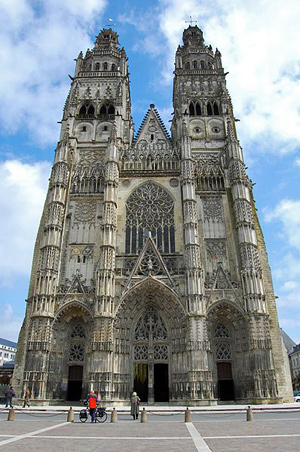
Tours Cathedral.
Château de Tours
Perched on the banks of the Loire River, the Château de Tours has witnessed centuries of French history. Originally constructed in the 11th century, it served as a residence for the Counts of Blois and later the Counts of Anjou. The castle's strategic importance grew in the 13th and 14th centuries when Tours briefly became the capital of France. Today, only two towers and a section of the curtain wall remain of the original structure. The château now serves as a cultural centre, hosting contemporary art exhibitions that contrast beautifully with its medieval architecture. Visitors can explore the grounds and enjoy panoramic views of the Loire from its elevated position.
Old Town (Vieux Tours)
The heart of Tours lies in its Old Town, centred around the picturesque Place Plumereau. This area is a living museum of medieval and Renaissance architecture, with narrow cobblestone streets lined with well-preserved half-timbered houses dating from the 12th to 15th centuries. The colourful façades and overhanging upper floors create a charming, almost fairy-tale atmosphere. Place Plumereau itself is a bustling square surrounded by cafes and restaurants with outdoor seating, perfect for people-watching and soaking in the ambiance. Wandering through the Old Town reveals hidden courtyards, artisan shops, and unexpected architectural details that transport visitors back in time.
Tour Charlemagne
The Tour Charlemagne, named after the legendary emperor Charlemagne, is a significant historical landmark in Tours. This tower was built in the 11th century over the tomb of Luitgarde, Charlemagne's wife. Standing at 56 metres tall, it was once part of the great basilica of Saint Martin, which was largely destroyed during the French Revolution. Today, the tower stands as a solitary sentinel, offering visitors a glimpse into the city's medieval past. While the interior is not open to the public, the exterior provides an impressive sight and serves as a focal point for understanding the layout of medieval Tours.
Basilica of Saint Martin
Near the Tour Charlemagne lies the Basilica of Saint Martin, a site of great religious significance. It was founded in 437 to accommodate the tomb of Martin of Tours (316-397), the famous third Bishop of Tours. This earlier structure was one of the most important pilgrimage sites in medieval Europe. King Louis XI was its abbot in the 15th century. Ravaged once by the Protestants in 1562, the old basilica was almost completely destroyed during the French Revolution, and reconstructed from 1886 to 1924. Only the 11th-century Tour Charlemagne survives from the original building. The modern basilica, while more modest in size, still attracts pilgrims and history enthusiasts. Its Neo-Byzantine style, with its distinctive domes and ornate interior, provides a stark contrast to the Gothic architecture prevalent in much of Tours. The crypt houses the tomb of Saint Martin, making it a key stop on the pilgrimage route.
Loire River Banks
The banks of the Loire River offer a tranquil escape from the urban bustle. A well-maintained urban path stretches for about 3 miles along the river, providing a pleasant walk that takes approximately 1.5 hours at a leisurely pace. This route offers stunning views of the river, including the picturesque Ile Aucard and Ile Simon, two islands that add to the Loire's charm. The path is popular among locals and visitors alike for jogging, cycling, or simply enjoying a peaceful stroll. The iconic Pont Wilson bridge, with its graceful arches spanning the Loire, provides an excellent vantage point for photographers looking to capture the essence of Tours' riverside beauty.
Botanical Garden
Established in 1843, the Botanical Garden of Tours is a verdant oasis in the heart of the city. Spanning several hectares, the garden boasts an impressive collection of plant species from around the world. Visitors can explore themed areas such as the Alpine garden, the medicinal plant section, and the tropical greenhouse. The garden also features a small animal park, home to various bird species and small mammals, making it a hit with younger visitors. Beautifully landscaped paths wind through the grounds, offering quiet spots for relaxation and contemplation. The garden serves not only as a recreational space but also as an important centre for botanical research and conservation.
Place Châteauneuf
Place Châteauneuf, nestled in the old town, is a charming square that encapsulates the architectural beauty of Tours. Surrounded by well-preserved medieval and Renaissance buildings, the square offers a glimpse into the city's rich past. The centrepiece of the square is the Fontaine de Beaune-Semblançay, a Renaissance fountain dating back to 1511. This ornate structure, with its intricate carvings and sculptures, serves as a focal point for the square. The surrounding buildings, with their half-timbered façades and ornate stone details, create a picturesque backdrop that transports visitors to another era.
Prebendes d'Oe Garden
The Prebendes d'Oe Garden, classified as a remarkable garden of France, is a testament to 19th-century landscape design. Created in 1872 by the Bühler brothers, famous landscape architects of their time, the garden follows the English landscape style. It features winding paths, expansive lawns, and carefully curated plantings that create a series of picturesque views. The garden is home to a diverse collection of trees, including many rare and exotic species. Throughout the year, the garden transforms with the seasons, from spring blossoms to autumn foliage, making it a year-round attraction for nature lovers and those seeking a peaceful retreat.
La Gloriette Park
Adjacent to the Prebendes d'Oe garden, La Gloriette Park offers a more modern take on urban green spaces. This expansive park combines recreational facilities with natural areas, creating a versatile space for various activities. One of its main attractions is La Gloriette Golf, a compact course where visitors can practice their swing or enjoy a quick round. The park also features walking and cycling paths, picnic areas, and open spaces for sports and leisure activities. Its design incorporates sustainable practices, including areas dedicated to biodiversity conservation and environmental education, making it a model of modern urban park design.
Light Trails
As night falls, Tours transforms into a magical outdoor gallery through its innovative Light Trails. This evening attraction illuminates the city's most emblematic monuments and historical sites, creating a captivating open-air spectacle. Visitors can follow two main trails: one through the old town and another along the Balzac route, named after the famous author who lived in Tours. The illuminations highlight the architectural details of buildings, bringing to life the city's rich history and culture. This unique way of experiencing Tours after dark offers a different perspective on familiar landmarks and creates a romantic and enchanting atmosphere for evening strolls.
Top Museums
Musée du Compagnonnage
Housed in 13th-century St Julian's Abbey on Rue Nationale, theMusée du Compagnonnage celebrates France's craftsmen through the ages.
Listed by the UNESCO as Masterpieces of the Oral and Intangible Heritage of Humanity, theCompagnonnage is a fraternity of French craftsmen including such professions as blacksmiths, carpenters, stonemasons, coopers, loclsmiths, weavers, tanners, or even chefs. Its origins go back to the Middle Ages and enjoyed a revival in the 19th century.
The museum displays some of the most stunning individual and collective works from most of these trades.
Museum of Fine Arts
Located in a former archbishop's palace, the Museum of Fine Arts in Tours is renowned for its extensive collection of artworks. It houses masterpieces by prominent artists such as Mantegna, Rubens, Rembrandt, Delacroix, Degas, Monet, and Rodin. The museum's courtyard features a majestic two-century-old cedar tree and an elephant named Fritz, which was killed in 1903. The garden, designed in a French style with U-shaped yew trees, offers a serene atmosphere for visitors.
Musée du Compagnonnage
Situated in the ancient Saint-Julien Abbey, the Musée du Compagnonnage showcases the traditions and craftsmanship of the Compagnonnage, a UNESCO-recognised intangible cultural heritage. The museum exhibits tools, drafts, and artefacts related to handcrafts, offering a fascinating insight into the history and skills of these journeymen. Interactive workshops and live presentations make it an engaging venue for visitors.
Centre de Création Contemporaine Olivier Debré (CCC OD)
This contemporary art centre is a significant cultural addition to Tours, featuring three exhibition spaces, two auditoriums, a café-restaurant, and a library. The CCC OD hosts a diverse range of contemporary art exhibitions and events, making it a hub for artistic expression in the region. It also houses a historical collection of works by Olivier Debré, bridging past and present artistic creations.
Château de Tours
Originally a fortress, the Château de Tours has evolved into a vibrant cultural centre hosting various exhibitions and events. Its blend of medieval and Renaissance architecture provides a picturesque backdrop for both historical and contemporary art displays. The castle's strategic location near the Loire River adds to its charm, offering serene views and a perfect setting for leisurely walks.
Prieuré Saint-Cosme
Located just outside Tours, the Prieuré Saint-Cosme is famous for being the final residence of the poet Pierre de Ronsard. The site features beautifully themed gardens and an interactive itinerary that includes tactile and sound installations, projections, and 3D models. Visitors can explore the life and works of Ronsard, as well as enjoy the poetic atmosphere of the priory.
Cloître de la Psalette
Attached to the Saint-Gatien Cathedral, the Cloître de la Psalette is an architectural gem that reflects the religious and intellectual life of the chapter. Its Renaissance-style staircase and beautifully arranged galleries make it a must-visit for those interested in historical architecture.
Muséum d'Histoire Naturelle
The Natural History Museum in Tours offers a comprehensive look at the natural world, featuring a wide range of exhibits that cater to both adults and children. It is an excellent place for those interested in science and natural history.
Local Cuisine
Visitors can savour local delicacies such asrillettes de Tours, a flavourful pork spread with visible meat fibres, andrillons, tender pieces of pork belly stewed in fat. The city is also renowned for itsandouillette, a savoury sausage made from pork offal and slow-cooked in Vouvray wine. For a unique bread experience, tryfouées, small warm breads stuffed with various fillings like goat cheese or rillettes. Cheese lovers will delight in the localSainte-Maure-de-Touraine, a delectable goat's cheese. To satisfy your sweet tooth, indulge innougat de Tours, a delightful almond-based cake filled with apricot and candied fruits, or sample themacarons de Cormery, delicate almond biscuits with a distinctive hole in the centre. Pair these local specialities with the region's excellent wines for a truly authentic Tours gastronomic experience.
Getting There & Around
Tours is easily accessible by various modes of transport. The city is well-connected by train, with direct TGV services from Paris Montparnasse taking just one hour. For those arriving by air, Tours-Val de Loire airport offers flights from several European cities, including London and Dublin. Once in Tours, getting around is a breeze thanks to the comprehensive public transport network operated by Fil Bleu. This includes an extensive bus system, a tram line connecting the north of the city to Joué-lès-Tours, and a shuttle train between Tours and Saint-Pierre-des-Corps railway stations. Cycling is also a popular option, with bike hire facilities available. For those preferring to drive, Tours is conveniently situated at the junction of three motorways: the A10, A28, and A85, making it easily reachable from various parts of France.


