


Introduction
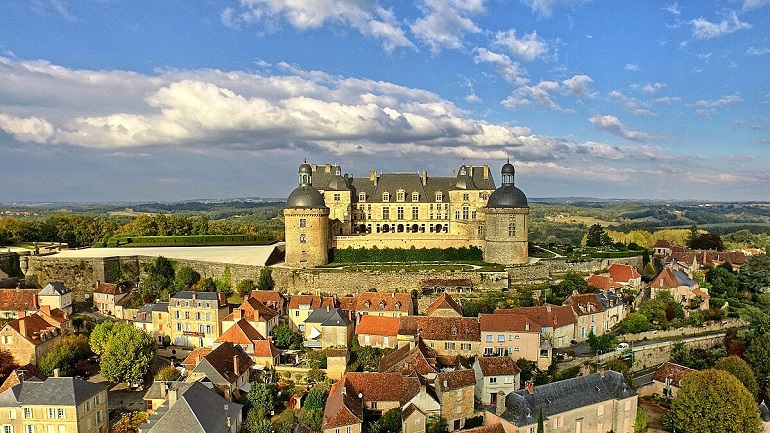
Hautefort is one of the most beautiful castles in the Dordogne region. Constructed between the 16th and the 18th century, it is the quintessence of the French château gracefully blending styles from different historical periods.
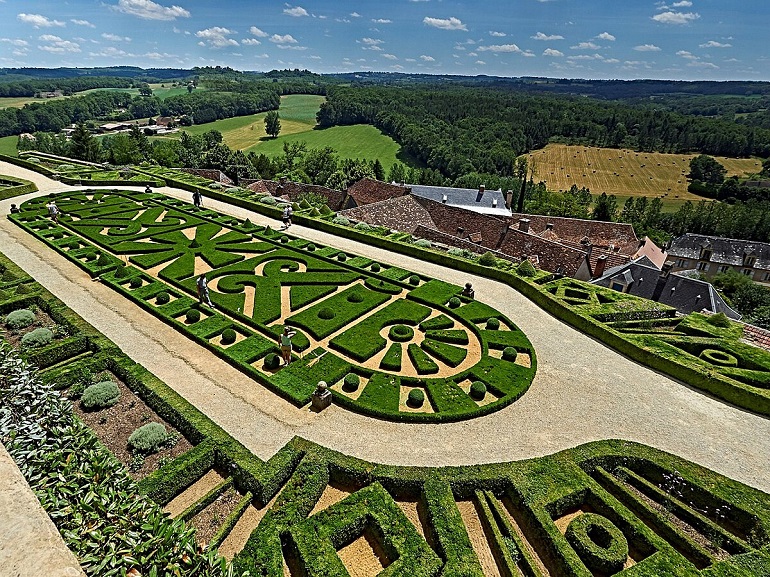
The castle has been embellished over the centuries by a garden à la française, a landscape garden, geometric flower gardens, topiary gardens, and a formal Italian garden with winding shaded paths. The gardens have been listed by the Committee of Parks and Gardens of the Ministry of Culture of France among the Notable Gardens of France.
Château de Hautefort stands as a remarkable example of classical French architecture in the Dordogne region of southwestern France, uniquely distinguished from the typical medieval fortresses that characterise the Périgord. Originally established as a medieval fortress around the year 1000 by Guy de Lastours, the castle underwent a dramatic transformation in the 17th century when the Marquis de Hautefort converted it from a defensive stronghold into an elegant residence inspired by the grand châteaux of the Loire Valley. This architectural evolution makes Hautefort the only classical château in Périgord, featuring a symmetrical design with a central corps de logis flanked by two wings and punctuated by circular towers. The estate encompasses both the restored château, which houses period furnishings from the 17th and 18th centuries, and meticulously maintained formal French gardens with geometric boxwood parterres containing over 10,000 hand-pruned trees. Despite surviving the French Revolution and a devastating fire in 1968, the château has been carefully restored and is now managed by a foundation, offering visitors insight into both its turbulent medieval past and its later incarnation as an aristocratic pleasure residence.
Interesting Facts about Hautefort Castle
- Hautefort Castle crowns a rocky spur above the Auvézère valley, commanding sweeping views that have shaped its defensive and scenic appeal since the Middle Ages.
- The site began as a medieval stronghold and was dramatically remodelled in the 17th century into a grand classical residence more akin to Loire châteaux than typical Dordogne fortresses.
- The troubadour Bertran de Born, famed in Occitan poetry and later immortalised by Dante, once held Hautefort and was besieged here by Richard the Lionheart in 1183.
- Its celebrated French formal gardens unfold in boxwood parterres and sculpted topiary, complemented by an English-style landscaped park that softens the castle’s imposing silhouette.
- The château narrowly survived the French Revolution, later declining into ruin before a 20th‑century rescue and meticulous restoration by Baron Henry and Baroness Simone de Bastard.
- A devastating fire in 1968 gutted the main corps de logis, after which the indomitable Baroness led a second, exemplary reconstruction that became a model of heritage revival.
- The design blends a dignified corps de logis and angled wings with round corner towers, creating a striking dialogue between medieval massing and classical symmetry.
- Hautefort’s 17th‑century Marquis commissioned a hospital in the village (now the Museum of the History of Medicine), reflecting an unusual social conscience for the era.
- The gardens’ modern layout draws on 19th‑century landscape ideas attributed to the Comte de Choulot, later refined with dense box hedging and elaborate topiary displays.
- Queen Elizabeth The Queen Mother visited in 1978, a gesture that cemented the château’s reputation as one of southwest France’s most elegant historic estates.
History
Medieval Origins and the Age of Troubadours
Hautefort Castle's history stretches back over a millennium, with the first traces of fortification dating to the 9th century as the "castrum de Autafort," a fortress of the Viscounts of Limoges. Around the year 1000, Guy de Lastours became the first lord to establish a proper fortress on this strategic rocky outcrop. His descendant, Gouffier de Lastours, achieved lasting fame as one of the thirty knights who entered Jerusalem alongside Godefroy de Bouillon in 1099 during the First Crusade. In the 12th century, the castle passed to the influential De Born family, becoming the centre of a bitter feud between two brothers: Constantin and the renowned troubadour Bertran de Born. This medieval stronghold, consisting of a keep and several towers linked by battlements, witnessed dramatic events in 1183 when Richard the Lionheart besieged the fortress during the brothers' conflict. Despite the destruction, Richard was so moved by Bertran's eloquent eulogy for his son Henry that he returned the castle to the troubadour. The castle remained in various noble hands until the 15th century, when it passed to the De Gontaut family, who adopted the name and coat of arms of Hautefort.
The Grand Transformation of the 17th Century
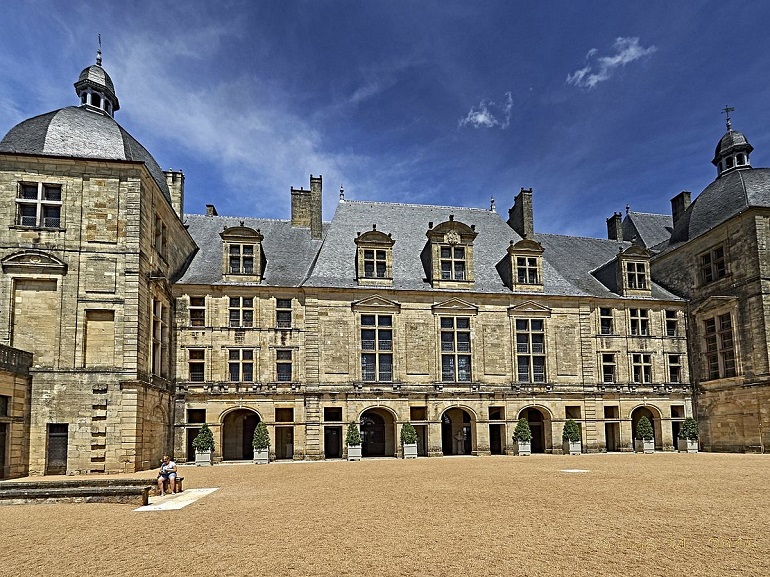
The medieval fortress underwent its most dramatic transformation during the 17th century, when it evolved from a defensive stronghold into a magnificent pleasure residence befitting the nobility of the age. François de Hautefort and his grandson Jacques-François de Hautefort, advisor to Louis XIII, orchestrated this remarkable forty-year transformation between 1630 and 1670. Working successively with two distinguished architects—Nicolas Rambourg from Lorraine and the Parisian Jacques Maigret—they stripped the château of its defensive functions and created a "modern-style" residence. The new design featured a corps de logis with two wings at right angles, punctuated by two circular towers topped with distinctive lantern domes reminiscent of Château de Chambord. This classical architecture was unique in the Périgord region, modelling itself after the grand châteaux of the Loire Valley and even Versailles. The castle gained additional renown as the birthplace of Marie de Hautefort, the Marquis's sister, who became a favourite of Louis XIII and was known at court as "la belle Aurore".
Survival Through Revolution and Modern Restoration
Unlike many aristocratic estates that fell victim to revolutionary fervour, Château de Hautefort survived the French Revolution thanks to the unwavering loyalty of local people who deeply admired the Marquis de Hautefort for his generosity. From 1793 to 1795, the château served as a "prison for suspects," which ironically saved it from the destruction that befell so many other noble residences. The castle remained in the family until 1890, when the widow of the last Hautefort descendant, Count Maxence de Damas, sold it to wealthy industrialist Bertrand Artigues. When Artigues died without heirs in 1908, the château fell into ruins until 1929, when Baron Henry de Bastard and his wife Simone purchased and began restoring the property. Tragedy struck again in 1968 when a devastating fire ravaged the main building, but the widowed Baroness de Bastard dedicated the remainder of her life to a second restoration, supported by the local community, celebrities like André Malraux, and cultural authorities. Her efforts culminated in the creation of the Fondation du Château de Hautefort in 1984, ensuring the estate's preservation for future generations.
Description
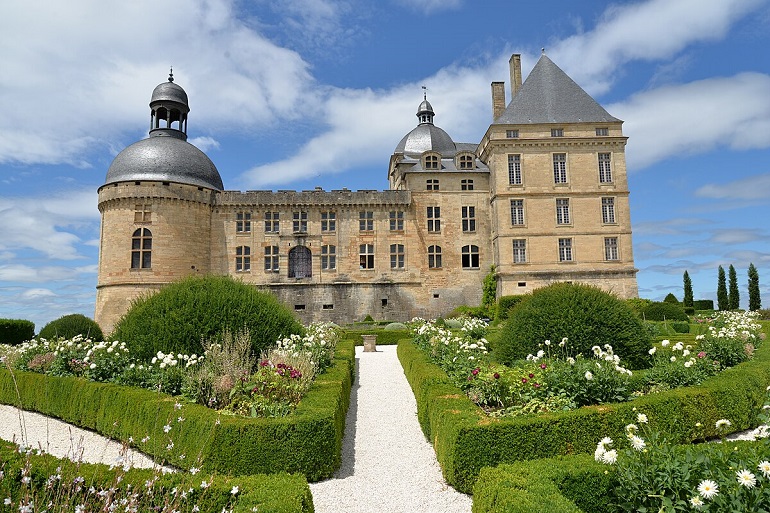
Perched on a rocky spur high above the verdant Auvézère valley, Hautefort Castle commands attention long before you reach its outer walls. Unlike the rugged, defensive strongholds typical of the Dordogne, this refined residence displays the harmonious proportions and classical symmetry more often associated with the grand châteaux of the Loire. A central corps de logis is flanked by matching wings, each terminating in a broad, circular tower crowned with a slate dome. Smooth limestone façades, rhythmic rows of tall mullioned windows and an elegant balustraded terrace combine to give the whole ensemble an air of poised sophistication.
Exterior highlights
- South Terrace: The broad stone promenade wraps around the main building, offering sweeping vistas over the village rooftops, patchwork orchards and rolling wooded hillsides below.
- Defensive echoes: While largely reimagined in the 17th century, traces of the medieval fortress endure in the mighty round towers, thick curtain walls and the lofty position that once provided strategic oversight of key trading routes.
- Ornamental details: Carved mascarons, wrought-iron finials and sculpted coat-of-arms enliven the pale stone and hint at the château’s aristocratic pedigree.
Remarkable interiors
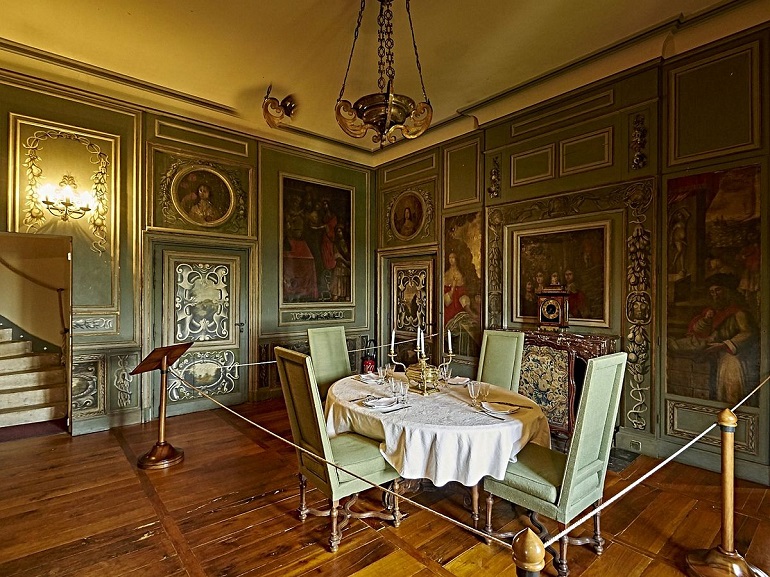
Beyond the heavy oak doors, a series of richly furnished salons unfolds in a circuit around the central courtyard. Each room is dressed in warm hues, gilded woodwork and sumptuous textiles that recreate the ambience of French noble life under Louis XIV. Expect polished parquet floors, Aubusson tapestries, intricately carved chimneypieces and period portraits that lend the spaces an intimate, lived-in feel rarely encountered in grand historic houses.
Key rooms include:
- Grand Salon: A light-filled reception chamber lined with tall windows and hung with 17th-century paintings.
- Library Tower: Circular walls fitted with floor-to-ceiling bookcases and a discreet spiral stair leading to a private reading nook beneath the dome.
- State Bedchamber: Draped in ruby damask and centred on a canopied bed, this room demonstrates the ceremonial importance once attached to the act of sleeping.
Gardens and parkland
Three distinct landscapes encircle the castle:
- French formal gardens – Closest to the walls, clipped boxwood parterres form intricate geometric patterns mirroring the château’s domes. Seasonal plantings add colour, while stone urns and statuary introduce classical accents.
- Green tunnel pergola – A 70-metre vaulted walkway of hornbeam provides leafy shade and frames postcard-perfect views back towards the towers.
- English-style park – Spreading across 30 hectares, this landscaped expanse features sweeping lawns, specimen cedars, magnolia grandiflora and meandering paths that encourage unhurried exploration.
During summer evenings the façade is softly illuminated, and theatrical night tours invite visitors to experience the château by lamplight—an atmospheric way to appreciate its noble proportions and the fragrant nocturnal scents of the gardens.
Visitor experience
Well-marked circuits guide you through furnished rooms, up the staircase to panoramic terraces and out into the gardens. Multilingual leaflets and discreet interpretation panels share anecdotes without disrupting the period atmosphere. Benches placed at strategic viewpoints encourage pausing to absorb the scenery, and a small café in a former outbuilding serves regional pastries and chilled drinks.
Practical touches
Plentiful parking sits at the foot of the hill, with a gentle footpath or electric shuttle delivering guests to the main gate. The estate welcomes picnics in the park, and leashed dogs are permitted in the landscaped areas, making Hautefort an easy half-day outing for couples, families and garden enthusiasts alike.
Getting There
By train The nearest railway stations are in Périgueux and Brive-la-Gaillarde, both served by regular SNCF services from Paris, Bordeaux and Limoges. From Périgueux station you can connect to Hautefort via the regional 321 coach line, while Brive offers car-hire desks for the final 40-minute drive.
By coach or bus Interurban buses run daily between Périgueux and Hautefort (stop: Place de l’Hospice) on the Nouvelle-Aquitaine network, and some long-distance BlaBlaCar Bus services from Paris or Limoges allow onward connection in Périgueux. Services are infrequent, so check timetables and plan for at least one transfer.
By car From Périgueux take the D6089 east to Thenon, then the D704 north to Hautefort; the castle’s signposted car park awaits at the village entrance. Drivers from Brive can follow the A89 to exit 17 before joining the D73 south-east, arriving in about 45 minutes through scenic Périgord countryside.