


| Contents |
|---|
Introduction
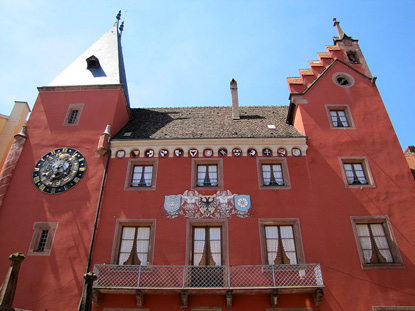
Haguenau (Hagenau in German ; pop. 35,000, with suburbs 58,000) is a second largest city in the Bas-Rhin after Strasbourg. It is tucked in the northeast corner of the French hexagon, 30 km north of Strasbourg and 35 km west of Baden-Baden in Germany. Haguenau developed during the 12th century around a castle built on an island in the River Moder and served as a favoured residence of Holy Roman Emperor Frederick I, later becoming an imperial city in 1257 and leading the medieval Decapolis union of Alsatian cities. The town centre features a rich collection of 18th-century architecture alongside medieval remnants including two 13th-century defensive towers - the Tour des Chevaliers and the octagonal red-brick Tour des Pêcheurs - as well as the 16th-century Porte de Wissembourg gate. Visitors can explore the Gothic churches of Saint-Georges and Saint-Nicolas, dating from the 12th and 14th centuries respectively, and three museums including the Alsatian Museum housed in the Renaissance Old Chancellery building from 1484.
Haguenau lies immediately south of the Northern Vosges Regional Nature Park, a wooden expanse of 130,500 hectares (1,305 km²) containing no less than 35 medieval castles and two Renaissance castles.
Interesting Facts about Haguenau
- Haguenau grew from a 12th-century hunting lodge on an island in the Moder, later favoured by Emperor Frederick Barbarossa, who granted it town rights in 1154.
- The imperial palace at Haguenau once safeguarded the Crown Jewels of the Holy Roman Empire, including the imperial crown, orb, sceptre and Charlemagne’s sword.
- In 1257 Haguenau became a Free Imperial City and later led the Alsatian Decapole, a league of ten cities for mutual defence and trade.
- The town’s fortunes swung repeatedly between France and German states, being annexed by France in 1648 and ceded to the German Empire in 1871 before returning to France in 1919.
- Haguenau retains striking medieval survivals, including the Wissembourg Gate and the Fishermen’s Tower, alongside the Gothic churches of Saint-Georges and Saint-Nicolas.
- The Haguenau Forest, one of France’s largest lowland woodlands, shelters hundreds of ancient burial mounds and is a beloved green escape north of Strasbourg.
- An early military airfield was built at Haguenau in 1916 for pilot training, reflecting the town’s strategic role in the First World War.
- The town’s synagogue, inaugurated in 1820 and restored after wartime damage, testifies to one of Alsace’s oldest continuous Jewish communities.
- Haguenau’s Historical Museum is among the largest in Bas-Rhin outside Strasbourg, complemented by the unusual Baggage Museum celebrating travel trunks and luggage.
- A noted hop market and brewing tradition hint at Haguenau’s long ties to beer culture, agriculture and festive Alsatian gastronomy.

History
Haguenau was founded at the beginning of the 12th century by Frederick II, Duke of Swabia, who set up a hunting lodge on an island in the Moder River. The Emperor Frederick I Barbarossa fortified the settlement and in 1154 granted it a charter or rights giving it the status of town. Frederick I erected a palace on the site of the hunting lodge, which became one of his favourite residence. It is in this palace that the Imperial regalia of the Holy Roman Empire, i.e. the jewelled imperial crown, scepter, imperial globe, and sword of Charlemagne, were kept.
Frederick Barbarossa chose Hagenau as the rallying point from which to launch the Third Crusade in 1189. This was a massive expedition that combined the armies of the Holy Roman Empire, France (led by king Philip Augustus) and England (under Richard the Lionheart). The grand army of 100,000 men, including 20,000 knights, left Haguenau on 1st April 1189 en route for the Holy Land. Emperor Frederick drowned in the Saleph river in Turkey the next year, plunging his army into chaos.
In 1262, Richard of Cornwall, King of Germany, elevates Hagenau to the rank of Free Imperial City, thus conferring it Imperial immediacy. In 1354 it ratifies a treaty uniting of ten Alsatian Imperial cities (Haguenau, Colmar, Wissembourg, Turckheim, Obernai, Kaysersberg, Rosheim, Munster, Sélestat and Mulhouse) to form an alliance known as the Décapole, of which Haguenau becomes the capital. The aim of the pact is both defensive and offensive, serving mostly as a protective unit against French aggression. This Alsatian League would last until 1679, when it was dissolved by the Treaties of Nijmegen.
The Peace of Westphalia (1648) marking the end of the Thirty Years War ceded most of Alsace to France. Haguenau, however, doesn't wish to leave Germany, prompting Louis XIV to resort to force. In 1677, the troops of General Montclar loot and burn Haguenau, including Frederick I Barbarossa's Imperial palace (Kaiserpfalz), and massacre the population. All other Décapole member cities are subdued by 1680.
Main Attractions
Despite its turbulent history and the destruction of 1677, Haguenau managed to preserve a fair share of historical monuments. Foremost among them are the Old Chancellery (1484), a bright red Renaissance building now housing the Alsatian Museum, and the neo-Renaissance Historical Museum, built between 1900 and 1905.
Three gates survive from the medieval city walls: the Tour des Chevaliers (Knights' Tower), the Tour des Pêcheurs (Fishermen's Tower) and the Porte de Wissembourg (Wissembourg Gate).
The churches were spared by the troops of Louis XIV. Among them are the Gothic St. George's Church and St. Nicholas' Church, both originally built in the 13th century. Unfortunately they have lost many of their artistic treasures over the centuries, especially their medieval stained glass windows and outside sculptures.
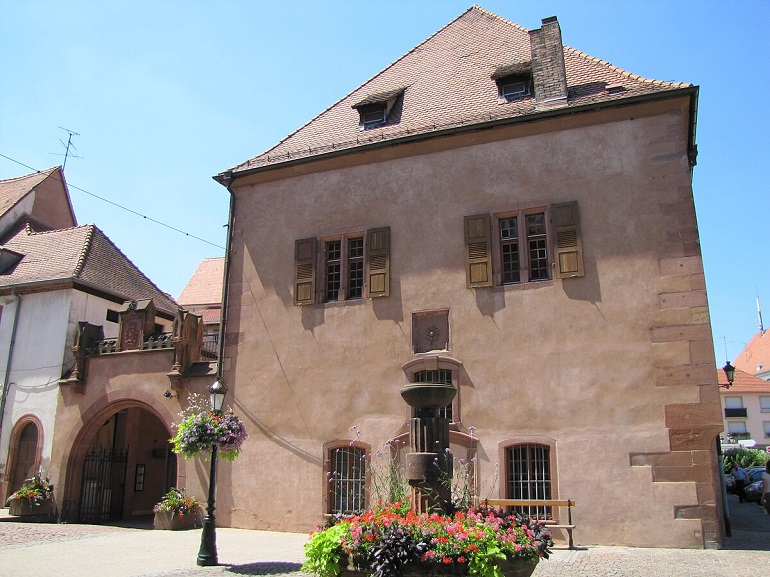
The oldest secular edifice after the old chancellery is the Old Customs House (Ancienne Douane). Located 16 Place des Armes, it was built around 1518.
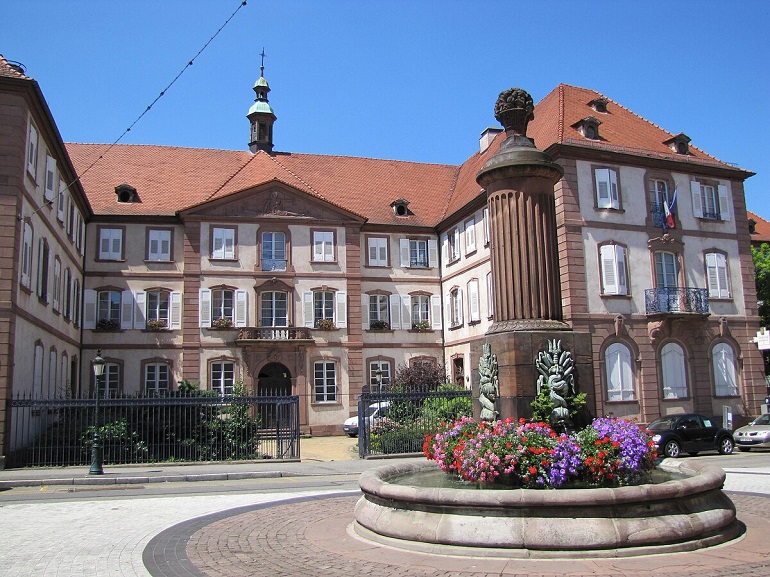
Other noteworthy buildings include the Hôtel Fleckenstein (built in 1544), the 16th-century Grenier Saint-George, 18th-century Hôtel du Préteur Royal,
Like the rest of Alsace, Haguenau is retroceded to Germany in 1871 following the Franco-Prussian War, and returned to France in 1919.
Hôtel du Bailli Hoffmann and Hôtel Barth, the Hôtel du Commandant de la Place, the Synagogue (dating from 1820), the Théâtre municipal (1846) and the Halle au houblon (1867).La Place d’Armes
La Place d’Armes is the vibrant heart of Haguenau, bordered by elegant historic buildings, lively cafés, and bustling boutiques. This large cobbled square is the focal point for public events and daily life, where visitors can sip local Alsatian wine on a terrace and watch Haguenau’s rhythm unfold. Among its standout structures is the former Customs House, which, together with beautifully restored half-timbered homes, gives the square a distinctive architectural flair. The Place d’Armes perfectly demonstrates Haguenau’s mix of hospitality and heritage.
Haguenau Forest (Forêt de Haguenau)
Embracing the town on all sides, the vast Haguenau Forest offers an oasis of tranquillity and natural exploration. With over thirty kilometres of ancient woodland, it is one of France’s largest lowland forests, criss-crossed by walking and cycling trails ideal for hiking, birdwatching, and discovering native flora and fauna. Indexes of history are also found here in the form of prehistoric burial mounds and ancient trees. Whether for a family picnic, an invigorating stroll, or an immersive retreat in nature, the forest is central to Haguenau’s outdoor appeal.
Top Museums
Principal Museums
Musée Historique de Haguenau
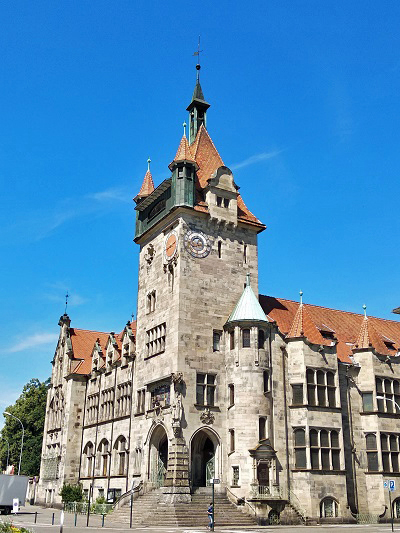
Set within a stately Neo-Renaissance building, the museum is one of Alsace’s most comprehensive historical institutions, taking visitors on a journey across millennia layered with local and regional significance. The museum was established under the patronage of mayor Xavier Nessel, whose dedication to archaeology set Haguenau’s museum apart. The building itself was constructed to house not only historical objects but also the municipal archive and library, echoing the broad cultural mission of the institution.
Permanent Collection
The exhibition unfolds over three floors, each dedicated to different epochs. The basement harbours extensive archaeology: artefacts document habitation, burial rites, and artistic achievement from the Neolithic to Bronze and Iron ages. Particularly impressive is the funerary assemblage from over 750 burial sites found in Haguenau forest, illuminating the daily lives, rituals, and beliefs of prehistoric communities. The Gallo-Roman era is represented by an array of bronze objects, including a Roman legionnaire’s helmet, ceremonial armour, religious figures, and domestic tools. Sandstone sculptures and architectural remnants evoke the town’s ancient settlements.
The ground floor guides visitors from the founding of Haguenau in the twelfth century through the Middle Ages, Renaissance and the Thirty Years’ War. This level showcases charters, precious coins, seals, and civic cups, demonstrating the administration and governance of Haguenau as a free imperial city. A notable highlight is the illuminated manuscripts and the products of Diebold Lauber’s workshop, whose video chronicles are shown alongside medieval artefacts. Medieval religious life is vividly portrayed via stained glass panels, sculptures such as the “Baiser de Judas”, and ecclesiastical furnishings. Rare faience by the Hannong family anchors the town’s artistic significance as a centre for ceramics, sharing space with coins and armaments unearthed in local excavations.
The first floor’s galleries present works and relics from modern times, including the seventeen to twentieth centuries. Among these are furniture, silverware, and paintings, as well as an impressive collection of Art Nouveau and Art Deco glassware—featuring pieces by Gallé, the Daum brothers, Lalique, and other masters—of national and regional renown. There is also a room replete with Elchinger ceramics, exemplifying Soufflenheim’s influence on Alsatian pottery. Of particular interest are displays interpreting Haguenau’s Jewish heritage, the town’s role under the Holy Roman Empire, chronicles of the town’s development, and artefacts from the World Wars. Footage and documents trace revolutionary shifts and the city’s modern transformation.
Special Exhibitions and Events
The museum marks significant anniversaries with special exhibition series—such as the “Inventer, réinventer son musée” season for its 120th anniversary—featuring curated shows on the institution’s creation, the art of Léon Elchinger’s ceramics, and historical photography tours. These thematic exhibitions provide fresh perspectives and deeper context on Haguenau’s evolving identity.
Musée Alsacien de Haguenau
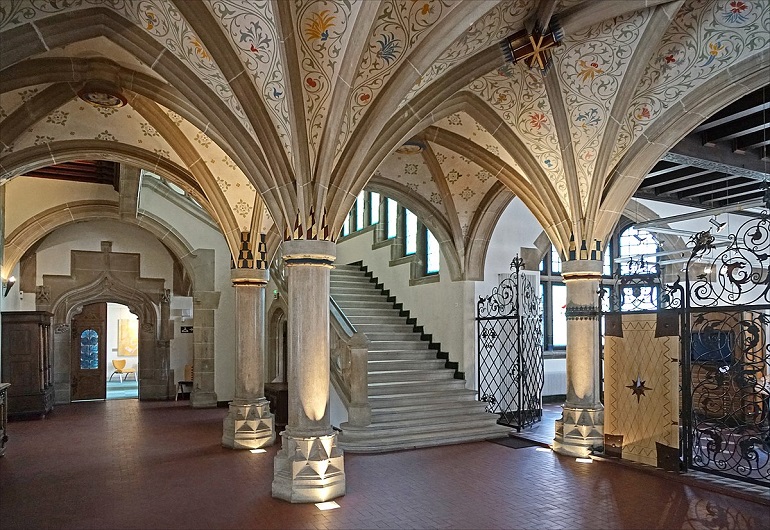
Situated within the town’s medieval chancery, this museum offers warm insight into the daily lives, customs, and crafts of Alsatian families in the nineteenth century and earlier. Its period rooms are furnished with polychrome cabinets, woodwork, and household objects, giving the sensation of stepping into a bygone world. Carefully arranged displays include costumes, regional bonnets, kitchenware, and painted glass panels, each item signalling faith, social status, and local traditions.
A replica of Isaac Habrecht’s astronomical clock, constructed in homage to Ulm’s famous timepiece, stands as a technical and artistic marvel. Other rooms feature pottery workshops and “stube” living rooms, with alcove beds typifying regional interior design. Documents such as baptismal letters and funeral souvenirs illustrate the life cycle rituals. Showcases on traditional craftmanship and rural domestic life make this museum a unique complement to Haguenau’s historical collections.
Specialist Museums
- Musée du Bagage (Luggage Museum): Traces the art and history of travel through collections of trunks, suitcases, and accessories. It celebrates the evolution of journey culture, branding Haguenau as a crossroads of travel innovation.
- Pottery Museum & Transport Conservatory: These institutions chronicle local crafts and industrial history, spotlighting Haguenau’s artisanal spirit and its link to broader economic developments.
Visitor Experience
Haguenau’s museums are praised for their well-organised and accessible displays, with friendly staff and a varied programme of guided tours and lectures. Exhibits immerse visitors in the region’s depth—from the lives of prehistoric tribes and medieval craftsmen to the artistic vibrancy of fin-de-siècle Alsace. Many displays feature impressive archaeological treasures, rare artistic objects, and fascinating insights into both everyday life and major historical milestones.
Together, these museums offer a profound exploration of Alsace’s unique identity, inviting history enthusiasts, art lovers, and those curious about cultural traditions into experiences both educational and enchanting.
Local Cuisine
The town's restaurants and brasseries serve up classic Alsatian fare, with choucroute garnie taking centre stage—a magnificent platter of sauerkraut accompanied by various sausages, bacon, and pork. Visitors shouldn't miss the iconic tarte flambée (flammekueche), a paper-thin pizza-like creation topped with crème fraîche, onions, and lardons, traditionally baked in wood-fired ovens. Sweet treats include the region's famous kougelhopf, a crown-shaped brioche cake studded with almonds and raisins, perfect alongside a cup of coffee. The local Munster cheese, with its pungent aroma and creamy texture, pairs wonderfully with a glass of Gewürztraminer from nearby vineyards, whilst hearty winter dishes like baeckeoffe—a slow-cooked casserole of lamb, pork, and potatoes—showcase the region's comforting, home-style cooking. Local bakeries also offer fresh bretzels and other Germanic breads that reflect the area's rich cultural heritage.

Getting There
By train Frequent TER Alsace services link Haguenau’s compact station to Strasbourg in about twenty minutes, allowing easy onward connections with TGVs from Paris, Lille and other major cities.
By coach Long-distance coaches arrive at Strasbourg’s gare routière, where regular regional buses (lines 67 and 317) continue north to Haguenau, a convenient option if you prefer a single ticketed journey.
By car Motorists can leave the A4 motorway at junction 46, then follow the A340 and D1340 straight into the town centre, a well-signed route that threads through gentle Alsatian countryside.
| Travel destinations in Alsace | ||||||||||||||
|---|---|---|---|---|---|---|---|---|---|---|---|---|---|---|
|
|
|
|
| ||||||||||
|
|
|
|
| ||||||||||


