


Introduction
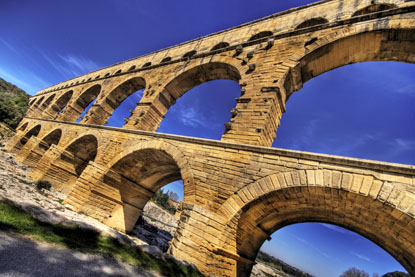
Standing 49 metres high across the Gardon River, the Pont du Gard is the world's second best preserved ancient Roman aqueduct bridge (after the one in Segovia), the tallest Roman aqueduct bridge ever constructed and the only surviving three-tiered Roman bridge. It was built in the first century CE to transport water from the springs near Uzès to the Roman colony of Nemausus, now known as Nîmes. The structure consists of three levels of arches - six large arches on the bottom tier, eleven on the middle, and thirty-five smaller arches on the top level that once carried the water channel. Built entirely without mortar using precisely fitted limestone blocks, this engineering marvel functioned for approximately 500 years until the sixth century, when calcium deposits eventually blocked the water flow. Originally part of a 50-kilometre aqueduct system conceived by Marcus Vipsanius Agrippa, Augustus Caesar's son-in-law, the Pont du Gard later served as a toll bridge during the Middle Ages and a road crossing until the 20th century. Recognised as a UNESCO World Heritage Site since 1985, it remains one of the best-preserved examples of Roman hydraulic engineering and attracts over one million visitors annually.
Interesting Facts about Pont du Gard
- The Pont du Gard is a three-tier Roman aqueduct bridge from the 1st century CE, and the tallest of its kind to survive from antiquity.
- Standing about 49 metres high, it remains the only fully intact ancient bridge with three stacked arcades.
- It once carried water over roughly 50 kilometres from Uzès to Nîmes with an extraordinarily gentle gradient engineered for continuous flow.
- Built largely without mortar, its precisely cut limestone blocks fit together by friction and gravity for remarkable stability.
- The structure is estimated to contain around 50,000 tonnes of stone, with some individual blocks weighing several tonnes.
- After the aqueduct fell out of use by late antiquity, the monument served as a toll bridge and later accommodated road traffic.
- A major conservation initiative around the year 2000 removed vehicles and modern clutter to restore its ancient setting.
- Recognised as a UNESCO World Heritage Site, it is one of France's most visited ancient monuments and a masterpiece of Roman engineering.
History
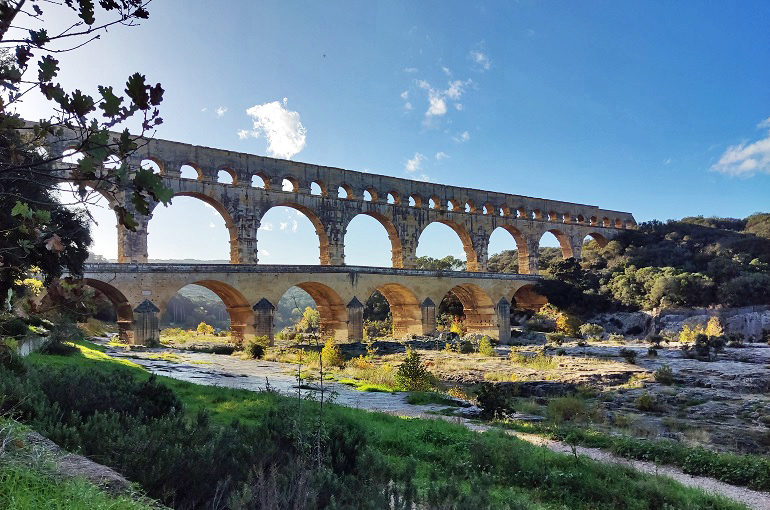
The Pont du Gard stands as one of the most remarkable achievements of Roman engineering, constructed in the 1st century CE (around 19 BCE to 60 CE) to carry water across the Gardon River valley. This magnificent three-tiered aqueduct bridge formed a crucial segment of a 50-kilometre water supply system that transported fresh water from the springs at Uzès to the flourishing Roman colony of Nemausus (modern-day Nîmes). At 49 metres high, it remains the tallest Roman aqueduct bridge ever built and the only surviving example of an ancient three-storey bridge still standing today. The structure required an estimated 50,400 tonnes of limestone extracted from the local Estel quarry, with individual blocks weighing up to 6 tonnes and assembled without mortar through precise cutting and friction. Over 1,000 workers laboured for approximately 10-15 years to complete this engineering marvel, which could transport an impressive 40,000 cubic metres of water daily to serve the fountains, baths, and homes of Nîmes' citizens.
Following the collapse of the Roman Empire, the Pont du Gard found new purpose as a toll bridge, ensuring its survival when many other Roman monuments were destroyed or abandoned. In the 13th century, the French crown granted the seigneurs of Uzès, and later the Bishops of Uzès, the right to levy tolls on travellers crossing the bridge, making them responsible for its maintenance. However, the structure suffered significant damage during the 1620s when Henri, Duke of Rohan had one side of the second row of arches cut away to accommodate his artillery during the wars between French royalists and Huguenots. Throughout the Medieval period, the bridge lost considerable stonework through looting and neglect, with twelve arches disappearing from the upstream section of the upper arcade. Despite these depredations, the bridge's robust construction and continued use as a crossing point preserved its essential structure through the centuries.
The 18th century marked the beginning of serious conservation efforts, starting with renovations in 1703 to repair cracks and replace missing stones. A significant milestone came in 1743-47 when engineer Henri Pitot constructed a new road bridge adjacent to the lower level, allowing modern traffic to cross without further damaging the ancient structure. Under Napoleon III, who visited the site in 1850, major restoration work took place between 1855-1858 under architect Charles Laisné, involving the replacement of worn stones and the addition of concrete reinforcements. The bridge's historical importance gained international recognition when it was designated a UNESCO World Heritage Site in 1985, celebrated for its technical and artistic mastery. The most recent comprehensive restoration was completed in 2000, which included the opening of a new visitor centre and the removal of all traffic from the ancient bridge, transforming it into one of France's most popular tourist attractions while preserving this 2,000-year-old testament to Roman ingenuity.
Description
Architectural Marvel
The structure rises to an impressive height of nearly 49 metres, making it the highest Roman aqueduct bridge ever constructed. Its distinctive three-storey design features precisely proportioned tiers of arches: six monumental arches form the ground level, with the central arch spanning an impressive 24.5 metres across the river. The second tier consists of eleven arches of identical proportions, whilst the uppermost level originally supported 47 smaller arches, though several have been lost over the centuries.
The bridge stretches 275 metres in length, though it originally extended to 360 metres when complete. Each tier demonstrates the Romans’ mastery of proportion and engineering, with the graceful tapering of the arches creating an extraordinarily light and airy appearance despite the structure’s massive weight.
Construction and Materials
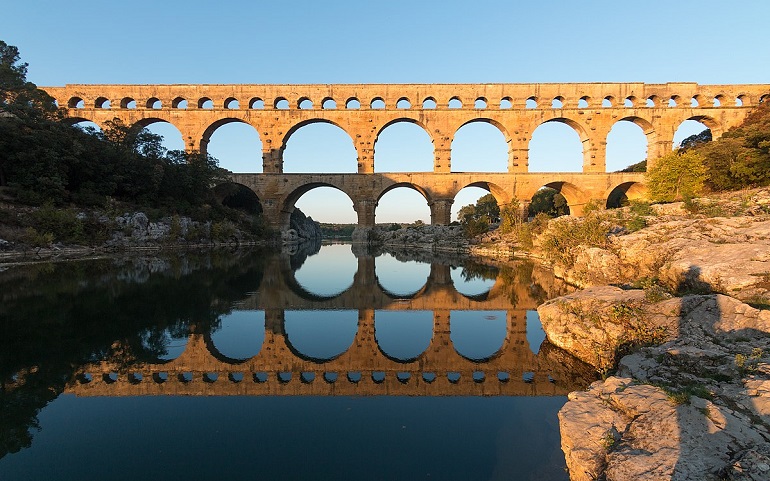
The entire structure was built using golden-hued limestone known locally as "Pierre de Vers," extracted from nearby quarries along the Gardon River. This soft, shellaceous limestone lends the bridge its distinctive warm colouration and proved ideal for precise stone cutting. Remarkably, the Romans constructed this massive edifice almost entirely without mortar, relying instead on the perfect fit of precisely cut stone blocks, some weighing up to six tonnes. The blocks were so accurately shaped that they hold together through friction and gravity alone, a testament to Roman craftsmanship.
Many stones still bear the original builders’ markings and positioning instructions, providing fascinating insights into Roman construction methods. The builders cleverly left projecting blocks that served as scaffolding supports during construction, creating the characteristic texture visible on the bridge’s faces today.
The Water Channel
At the summit of the third tier runs the specus, the covered water channel that formed the aqueduct’s vital function. This carefully engineered conduit measures approximately 1.8 metres in height and 1.2 metres in width, with walls lined with waterproof mortar and a base of crushed limestone. The channel maintains an almost imperceptible gradient of just 2.5 centimetres over the bridge’s entire length, demonstrating the precision required to ensure proper water flow by gravity alone.
Natural Setting and Environment
The Pont du Gard nestles within an exceptional natural environment that enhances its dramatic impact. The bridge spans the Gardon River at the entrance to magnificent limestone gorges, where crystalline waters flow between towering cliffs sculpted over millennia. The surrounding 165 hectares of protected landscape, classified as a UNESCO Biosphere Reserve and Natura 2000 site, harbour rich Mediterranean flora including holm oak, Aleppo pine, wild thyme, and rosemary.
The riverbanks create natural beaches during summer months, whilst the garrigue scrubland typical of Provence clothes the surrounding hillsides in fragrant vegetation. The site supports diverse wildlife, from kingfishers and grey herons along the water to peregrine falcons nesting in the cliffs above. This pristine setting transforms with the seasons, offering visitors a constantly changing palette of colours and atmospheres.
Aesthetic and Cultural Impact
Beyond its engineering significance, the Pont du Gard represents a masterpiece of aesthetic achievement. The structure’s elegant proportions and harmonious integration with its natural surroundings have inspired countless visitors throughout history. The bridge’s visual impact varies dramatically depending on viewpoint and lighting conditions, with its golden limestone glowing warmly in Mediterranean sunlight whilst casting dramatic shadows across the river below. The slight upstream curve of the upper levels, caused by centuries of thermal expansion and contraction, adds to the structure’s organic integration with its landscape setting.
Visitor Experience
Today’s visitors can explore multiple levels of the structure, walking across the lower tier on an 18th-century addition that provides safe passage. The site offers guided tours through the ancient water channel itself, allowing visitors to experience the engineering marvel from within whilst appreciating the precise gradient that once carried 40,000 cubic metres of water daily to Nîmes.
The surrounding area provides excellent vantage points for photography and contemplation, with hiking trails leading to elevated viewpoints that reveal the bridge’s full majesty within its dramatic gorge setting. The clear waters of the Gardon invite swimming and kayaking, whilst riverside areas perfect for picnicking allow visitors to savour this remarkable fusion of human achievement and natural beauty.
Getting There
By train The nearest rail hub is Nîmes, an easy high-speed ride from Paris or Marseille; from Nîmes station, local buses such as the LiO 121 shuttle or seasonal Pont du Gard coach link complete the last 25-minute leg to the aqueduct.
By coach or bus Regional services run from both Avignon and Nîmes, weaving through fragrant garrigue countryside before stopping at the Pont du Gard's designated visitor area, just a short walk from the monument's arches.
By car Drivers can follow the A9 autoroute, exiting at Remoulins and continuing on the well-signed D981, where ample parking on both riverbanks allows a leisurely, five-minute stroll to the UNESCO-listed bridge.