Introduction
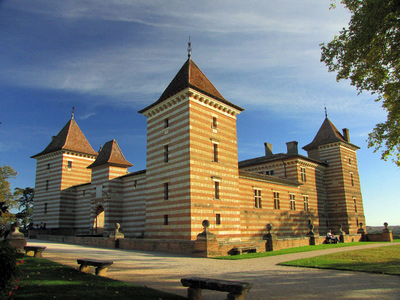
The Château de Laréole is a Renaissance castle built in 1579 by architect Dominique Bachelier for Pierre de Cheverry, a wealthy woad merchant from Toulouse. Located in the Haute-Garonne department, the château is distinguished by its striking polychrome stonework featuring alternating rows of white stone and red brick, creating the distinctive striped appearance that characterises this architectural style. The square-shaped building is fortified with four bastion towers and surrounded by defensive ditches, reflecting the turbulent period of the Wars of Religion during which it was constructed. The castle sits within 20 hectares of formal French gardens that were added in the 18th century, complete with box-bordered lawns, terraced areas, and tree-lined walkways. Since 1984, the Conseil Départemental de la Haute-Garonne has owned and restored this classified historical monument, which now serves as a cultural venue offering guided tours and contemporary art exhibitions to the public during the summer months.
Interesting Facts about Laréole Castle
- The château is famed for its striking polychrome façade, with alternating bands of red brick and white stone that create a bold striped effect.
- Built in 1579 for the wealthy woad merchant Pierre de Cheverny, it showcases the prosperity brought by Toulouse’s pastel-blue dye trade.
- Designed by Dominique Bachelier, a leading Renaissance architect of Toulouse, it blends refined residential comfort with military-style bastioned towers.
- Its plan forms a near-perfect square fortified by four corner bastions, reflecting the tensions of the Wars of Religion.
- Broad brick ditches emphasise its defensive character while framing a residence intended for grand receptions and private apartments.
- The 18th-century formal grounds extend across some 20 hectares, with terraces, box-edged lawns, lime-tree walks, fruit trees and meadows.
- The gardens were inspired by the design principles associated with André Le Nôtre, favouring long perspectives and geometric beds.
- Saved and fully restored by the Haute-Garonne departmental council from the 1980s, it now serves as a cultural venue each summer.
- Seasonal programming includes guided visits and contemporary art exhibitions that animate the Renaissance setting.
- Located about 42 km north-west of Toulouse, it offers an elegant snapshot of southern French Renaissance taste in brick-and-stone.

History
The Château de Laréole stands as a remarkable testament to Renaissance architecture and the wealth of 16th-century merchants in southwestern France. Constructed in 1579 on the commune of Laréole in the Haute-Garonne department, the château was commissioned by Pierre de Cheverry, son of a prosperous pastel merchant who had achieved considerable success in the lucrative woad trade. The architectural masterpiece was designed by Dominique Bachelier, son of the renowned Nicolas Bachelier, representing the pinnacle of Toulouse Renaissance architecture. The construction took precisely three years to complete, made possible by Cheverry's substantial financial resources, and served as a luxurious country residence where Toulouse notables would retreat for relaxation. The château's distinctive polychrome stonework, featuring alternating rows of white limestone and red brick, creates a striking visual effect that remains one of its most celebrated architectural features. Built during the tumultuous period of the Wars of Religion, the structure combines defensive elements including four bastion towers, large dry moats, and a fortified entrance with elegant Renaissance design principles.
Following Pierre de Cheverry's era, the château experienced a tumultuous period of changing ownership that reflected the broader social upheavals of French history. The Cheverry family maintained possession of their ancestral home until 1707, when François de Cheverry, Pierre's heir, found himself in financial ruin and was compelled to sell the family estate. The property was purchased by Jean-Pierre Colomès, a wealthy Toulouse banker, who discovered the château in a deplorable state and undertook extensive restoration work, refitting the apartments, repairing roofs and parquets throughout the structure. During the 18th century, the estate was further enhanced with the addition of French-style gardens designed by Marc Arcis, featuring formal lawns bordered with box hedges, terraced landscapes, lime tree walks, and twenty species of fruit trees across 20 hectares. The château's fortunes declined dramatically during the French Revolution, when it changed hands multiple times before eventually falling into the possession of Isidore de Poulhariès and later Albert de Puymirol in 1846, who attempted restoration efforts. However, by 1922, the magnificent Renaissance palace had been completely abandoned and was even temporarily converted into a barn, marking the nadir of its long history.
The modern chapter of Château de Laréole began in 1984 when the General Council of Haute-Garonne purchased the deteriorating property as part of an ambitious heritage conservation initiative. Through extensive restoration work, this historically significant monument—classified as a historical monument since 1927, with additional classifications for the outbuildings and gateway in 1991 and the park, moats, courtyards and terraces in 1993—has been transformed into a vibrant cultural centre. The château now opens its doors to the public annually from May through September, offering free guided tours, contemporary art exhibitions in the noble floor spaces, and hosting the Festival 31 Notes d'Été during August, which features circus, dance, and theatrical performances in the historic gardens. The restored interior serves as an exhibition space for contemporary art, while the meticulously maintained French gardens provide a stunning backdrop for cultural events, ensuring that this Renaissance jewel continues to serve the community as both a preserved historical monument and a living cultural venue.
Description
Architectural Highlights
- Fortified Renaissance plan – The château forms a near-perfect square measuring roughly 60 metres a side, anchored by four bastion towers whose machicolations and cannon slits remind observers of the turbulent sixteenth century.
- Monumental entrance bridge – Timber has been replaced by a fixed stone crossing, yet the double arches and flanking piers still evoke the original drawbridge system. Large bronze studs on the oak doors hint at the defensive mindset behind the building's refinement.
- Striped elevations – Alternating courses of Toulouse brick and pale Fronton limestone rise in crisp horizontal bands, capped by a continuous classical cornice resting on fluted stone consoles. The chequerboard effect changes subtly with the light, offering striking photographic opportunities from dawn until dusk.
- Coursière gallery – A covered external corridor spans the width of the entrance range at first-floor level. Its ten wide basket-handle arches give the inner courtyard a rhythmical elegance while offering visitors shaded viewpoints over the fountain parterre below.
- Grand staircase and state rooms – Inside, an airy stone staircase with an open well ascends to reception chambers featuring coffered ceilings, inlaid parquet and a vast mannerist fireplace whose carved pilasters and grotesque masks provide an unexpected flourish of Italianate fantasy.
Interior Experience
Visitors move freely through a sequence of restored rooms organised along two main axes:
- The Ceremonial Suite overlooks the eastern terraces and is used for temporary art installations ranging from sculpture to video works, taking advantage of generous wall space and natural light.
- The Private Apartments display period furniture, velvet wall hangings and artisan floor tiles; interpretive panels focus on craftsmanship and domestic routines rather than biography, allowing the rooms to speak for themselves.
Access is largely step-free, with a lift discreetly installed in one of the corner towers to reach the upper floor. QR codes beside key features offer additional detail in several languages, including English.
Gardens and Grounds
Stretching over twenty hectares, the grounds are a lesson in French formal design blended with rustic ambience:
- A central lawn parterre framed by perfectly clipped box hedges leads the eye outward from the main portal.
- Twin lime-tree allées draw elegant sight-lines toward the distant Pyrenean foothills, particularly dramatic on clear winter days.
- A series of descending terraces soften the drop towards the moat, each planted with contrasting seasonal palettes – spring bulbs, summer lavender borders, autumn asters and structural grasses for winter interest.
- An orchard of heritage fruit trees – quince, medlar, mirabelle and more – is laid out on a grid that mirrors the château's square plan; interpretive plaques describe each variety's culinary uses.
- Sculptural accents appear throughout: a stone obelisk beside the carp pond, wrought-iron arbours dripping with wisteria, and two allegorical statues attributed to Marc Arcis that lend classical gravitas to the south lawns.
Visitor Facilities
- Free admission to both château and park encourages leisurely discovery; optional guided tours operate several times daily in high season.
- A tea room nestles beneath the western arcades, serving local pâtisseries, herbal infusions and artisanal ice creams; terrace tables overlook fountain jets that playfully echo the château's symmetrical geometry.
- Picnic areas with wooden tables sit under mature plane trees beyond the moat, offering unobstructed panoramas of the striped walls.
- The shop stocks regionally produced violet pastels, craft spirits and reproductions of sixteenth-century engravings that feature Laréole's architectural motifs.
- Throughout July and August the courtyard transforms into an open-air stage for theatre, jazz and contemporary circus acts, while evening illuminations bathe the façades in gentle amber and rose hues.
Accessibility and Practical Notes
Wide gravel paths, ramped thresholds and clearly marked tactile maps ensure the site is welcoming to wheelchair users and families with pushchairs. Well-maintained restrooms, including accessible cubicles and baby-change stations, are located near the ticket hall. Free parking is available in shaded bays just outside the moat, and cycle racks line the avenue of limes for those arriving
Getting There
By train The easiest public-transport route is to take an TER Occitanie service from Toulouse-Matabiau to Mérenvielle, then connect with the local Tisseo 373 bus that stops at Laréole – Château; from the bus stop it is a five-minute walk to the castle.
By coach During summer the departmental network runs direct coaches from Toulouse’s Arnaud-Bernard coach park to Cadours, where you can change onto the same 373 service for the short hop to Laréole; this is the most convenient option if you prefer one ticket for the whole journey.
By car Drive north-west from Toulouse on the A624 then follow the D24 and D58 through scenic rolling countryside; parking is signposted in the village and the château gates are a two-minute stroll away.