


| Contents |
|---|

Introduction
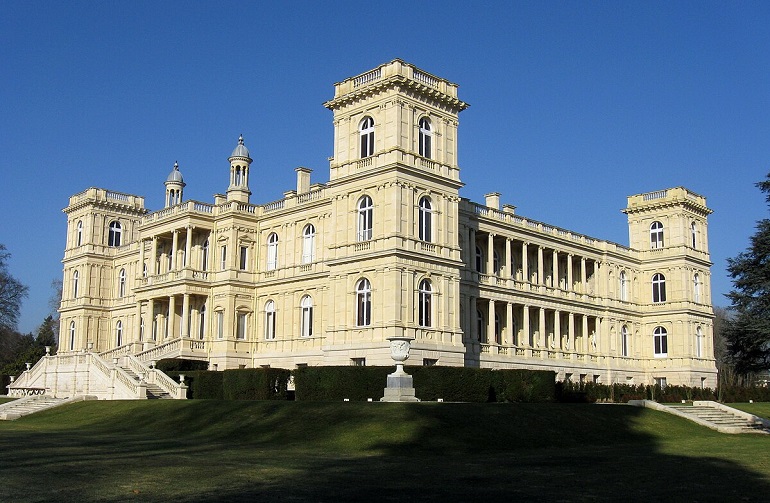
The Château de Ferrières stands as the largest and most luxurious 19th-century château in France, constructed between 1855 and 1859 for Baron James de Rothschild in the Brie region of Seine-et-Marne.
Designed by British architect Joseph Paxton, who was renowned for creating the Crystal Palace, the château was built in the Neo-Renaissance style with Italian Renaissance influences, featuring four square towers at each corner and sitting majestically on a formal terrace surrounded by 135 hectares of English-style landscaped parkland.
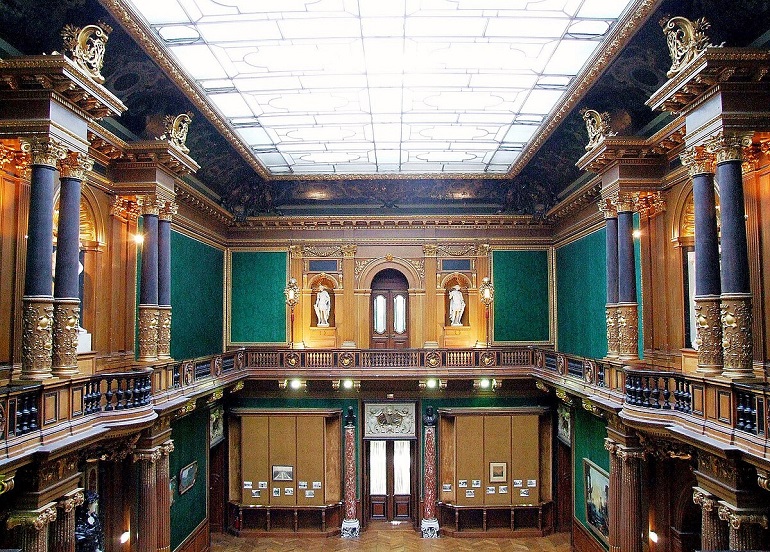
The château's most striking feature is its spectacular central hall, measuring 37 metres long and 18 metres high, crowned by a full glass skylight, whilst the interior boasts sculpted atlas columns and caryatids by Charles Henri Joseph Cordier, decorative painting supervised by Eugène Lami, and a library housing over 8,000 volumes.
Built to accommodate lavish entertaining, the château included eighty guest suites in addition to the private Rothschild apartments, and featured innovative conveniences such as hot and cold running water throughout and an underground railway system connecting the separate kitchen building to the main dining areas.
Napoleon III inaugurated the château on 16 December 1862, and it subsequently hosted numerous distinguished guests and played a notable role in history, including the 1870 meeting between Otto von Bismarck and Jules Favre during the Franco-Prussian War.
Today, the château serves as home to Ferrières Hospitality & Luxury Management School, continuing its legacy of excellence whilst preserving its magnificent 19th-century architecture.
Interesting Facts about the Château de Ferrières
- The Château de Ferrières was built between 1855 and 1859 for Baron James de Rothschild and is often described as the largest and most luxurious 19th‑century château in France.
- It was designed by the English architect Joseph Paxton, who drew inspiration from Mentmore Towers, prompting the patron’s famed brief to “build me a Mentmore, but twice the size.”
- The château’s style is Neo‑Renaissance with four square corner towers, set on a formal terrace overlooking sweeping English‑style parkland.
- Its showpiece central hall measures about 37 metres by 18 metres and is crowned by a full glass skylight that floods the interior with light.
- Interior sculptural work, including atlas columns and caryatids, was executed by Charles Cordier, with decorative painting overseen by Eugène Lami.
- Purpose‑built for lavish hospitality, the house originally included around eighty guest suites in addition to the Rothschild family apartments.
- Napoleon III inaugurated the château on 16 December 1862, cementing its standing among the grand residences of the Second Empire.
- During the Franco‑Prussian War, Otto von Bismarck used the château for high‑stakes diplomacy, hosting talks that marked a grim chapter for France.
- The estate once spanned thousands of hectares, with hunting grounds and even a model farm that attracted distinguished visitors during the season.
- To keep cooking odours away from the main house, food was prepared in separate buildings and sent via an underground service passage to the dining rooms.
- Requisitioned and looted during the Second World War, the château later revived under Guy and Marie‑Hélène de Rothschild, who hosted glittering themed balls in the 1960s and 70s.
- In the mid‑1970s the property was gifted for cultural and scientific purposes, and more recently it has hosted hospitality and events, including a hotel‑management school on the estate.
History
The Château de Ferrières stands as one of France's most magnificent 19th-century estates, built between 1855 and 1859 for Baron James de Rothschild in the distinctive Goût Rothschild style. Located in Ferrières-en-Brie, Seine-et-Marne, approximately 26 kilometres east of Paris, this grand residence was designed by the renowned English architect Joseph Paxton, creator of London's Crystal Palace. The inspiration for Ferrières came from Mentmore Towers in Buckinghamshire, which Paxton had previously built for Baron James's nephew, Mayer Amschel de Rothschild. Legend has it that upon seeing Mentmore, Baron James summoned Paxton with the memorable command: "Build me a Mentmore, but twice the size". The château was conceived not merely as a residence but as a theatrical stage for extraordinary receptions, with accommodation for 100 servants, stables for 80 horses, and an innovative underground railway system to transport food from a separate kitchen building to the main dining areas.
The architectural splendour of Ferrières exemplifies Neo-Renaissance grandeur inspired by Italian Renaissance palaces, featuring four square towers at each corner and sitting majestically upon a formal terrace. The château boasts a spectacular central hall measuring 37 metres in length and 18 metres in height, crowned by a magnificent glass skylight roof that floods the space with natural light. The interior decoration was entrusted to the finest craftsmen of the era, with atlas columns and caryatids sculpted by Charles Henri Joseph Cordier and decorative painting supervised by Eugène Lami. The château contained 28 luxury suites with revolutionary amenities for the time, including central heating and hot and cold running water, while the massive library housed over 8,000 volumes. The estate encompassed an extraordinary 4,000 hectares, including 135 hectares of English-style landscaped parkland designed to complement the château's architectural magnificence.
Ferrières officially opened on 16 December 1862 with a grand gala attended by Napoleon III, marking the beginning of its role as a centre of European high society. The château witnessed pivotal moments in European history, most notably during the Franco-Prussian War of 1870-71 when it was seized by German forces and became the site of crucial negotiations between Otto von Bismarck and French Foreign Minister Jules Favre. During the Second World War, the Germans again occupied the château and systematically looted its vast art collections, leaving the building empty until 1959. Guy de Rothschild and his wife Marie-Hélène de Zuylen van Nyevelt then undertook a magnificent restoration, transforming Ferrières into a glamorous venue for themed parties designed by luminaries such as Yves Saint Laurent and attended by international celebrities including Brigitte Bardot, Grace Kelly, and Audrey Hepburn. In 1975, the Rothschild family generously donated the château to the University of Paris, ensuring its preservation for future generations while maintaining its status as a testament to 19th-century opulence and artistic achievement.
Description
First Impressions
Approached through a long, tree-lined avenue, the château reveals itself in sudden, theatrical fashion: a palatial rectangle of pale stone crowned by mansard roofs and flanked by four perfectly proportioned corner pavilions. Symmetry governs every vista. The broad forecourt, edged by clipped box hedges and ornate lanterns, frames the central portico where monumental columns support an open loggia. Carved masks, garlands and crested cartouches adorn the façades, their fine details picked out by shifting light.
Interiors
Grand Vestibule and Entrance Hall
The imposing bronze doors open onto a circular vestibule crowned by a soaring dome painted in soft celestial blues and gold. Cream-coloured marble columns with Corinthian capitals frame the space, their fluting catching the light that streams through the glazed cupola above. The floor, a masterwork of geometric marquetry in contrasting marbles, features a central compass rose motif surrounded by radiating star patterns. Gilt bronze torchères flank doorways leading to the principal rooms, while a pair of matching console tables display seasonal flower arrangements in Sèvres porcelain urns.
Grand Staircase
The ceremonial staircase unfolds as a dramatic double-flight composition beneath an elaborate glass ceiling supported by delicate iron tracery. Each baluster of the wrought-iron railing intertwines gilded vine leaves with clusters of grapes, their metalwork so fine it appears almost organic. The marble steps—Carrara white with pale grey veining—are worn smooth by centuries of footsteps, lending them a lustrous patina. Halfway up, a landing features a vast Venetian mirror in a carved and gilded frame, doubling the impression of space and light. The ceiling above depicts allegorical scenes of the four seasons, executed in soft pastels that seem to glow when illuminated by afternoon sun.
Grand Salon (Salon d'Honneur)
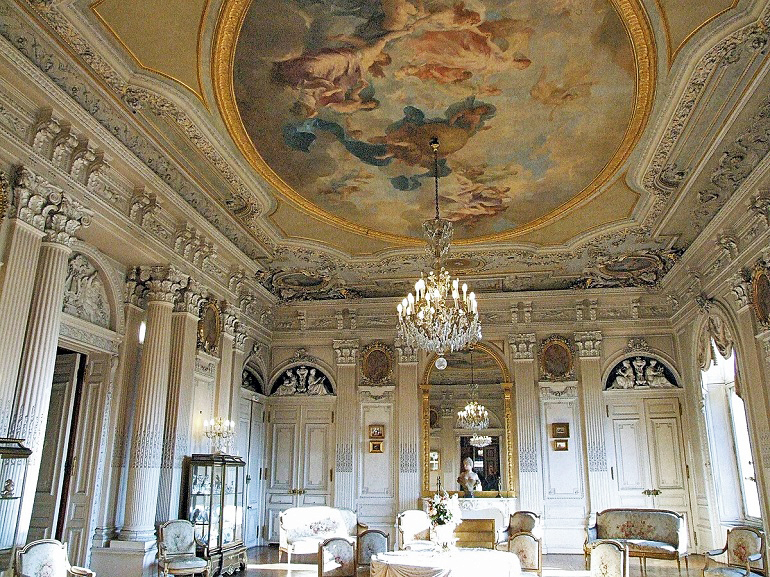
Entering this magnificent chamber feels like stepping into a jewel box. The walls, upholstered in cream silk damask with subtle gold threading, rise to meet an elaborately coffered ceiling painted in sage green and ivory. Each coffer frames a delicate rosette picked out in gold leaf. Three towering French windows, their silk draperies held back by tasselled cords, open onto the main terrace and flood the room with light that dances across the parquet de Versailles floor.
The furniture arrangement centres around a monumental marble fireplace surmounted by a gilt mirror that reaches nearly to the ceiling. Flanking the hearth, a pair of Louis XVI bergères upholstered in Aubusson tapestry face two matching canapés, their carved walnut frames gleaming with hand-applied gilt. Between them, a low table displays leather-bound volumes and crystal decanters on a silver tray. The room's pièce de résistance hangs from the centre of the ceiling: a magnificent crystal chandelier featuring hundreds of hand-cut prisms that cast rainbow fragments across the walls when sunlight strikes them.
Salon de Musique
Painted in soft sage green with white and gold accents, this intimate chamber serves as both music room and informal reception space. The walls feature delicate trompe-l'oeil pilasters framing panels of Chinese silk wallpaper depicting birds and flowering branches. A Steinway grand piano, its ebony case polished to mirror brightness, dominates one end of the room, accompanied by gilt music stands and a harp shrouded in protective silk.
Comfortable seating includes a semicircle of Louis XV fauteuils upholstered in coordinating green velvet, arranged to face the piano. The marble chimney piece, carved with musical motifs including lyres, flutes, and scrolling sheet music, supports a collection of Meissen figurines representing the Muses. Persian rugs in muted gold and blue tones warm the polished parquet, while sconces fitted with pleated silk shades provide intimate lighting for evening performances.
Salon des Roses
Perhaps the most romantic of the reception rooms, this salon takes its name from the climbing roses that frame its garden-facing windows and the rose motifs that appear throughout its decoration. The walls, covered in deep amethyst silk moiré, create a dramatic backdrop for gilt-framed portraits and landscape paintings. The ceiling, painted in soft pink and cream tones, features cherubs scattering rose petals across cloudy skies.
The furniture, predominantly Louis XV in style, includes a magnificent marquetry commode whose drawers bear inlaid scenes of garden parties and pastoral pursuits. Velvet-upholstered conversation groups are arranged around small guéridons perfect for afternoon tea or evening aperitifs. The room's showpiece is a pair of Sèvres porcelain vases nearly a metre tall, their surfaces painted with garlands of roses and mounted with ormolu handles and bases.
Library
This two-storey scholarly retreat houses over 15,000 volumes behind glass-fronted cases of dark walnut that rise from floor to ceiling. A brass-railed gallery accessible by a spiral staircase provides access to the upper shelves, while rolling ladders on each level allow browsers to reach any volume safely.
The lower level features reading areas furnished with green leather club chairs and reading tables equipped with adjustable brass lamps. The walls between bookcases display maritime prints, architectural drawings, and historical maps of the region. Persian carpets in deep burgundy and navy create cosy reading nooks, while the stone fireplace—more modest than those in the state rooms—provides warmth during winter visits.
The gallery level houses rare manuscripts and first editions in climate-controlled cases. Here, scholarly visitors may examine illuminated medieval texts, early botanical illustrations, and leather-bound atlases while seated at specially designed consultation desks with built-in magnifying lenses and adjustable lighting.
Dining Hall
The formal dining room achieves theatrical grandeur through its soaring height and elaborate ceiling fresco depicting scenes from classical mythology. The painted vault shows Jupiter presiding over a banquet of the gods, executed in rich blues, golds, and flesh tones that seem to glow in candlelight. Corinthian pilasters painted in trompe-l'oeil divide the walls into panels containing landscapes by notable 18th-century masters.
The dining table, crafted from a single enormous piece of Cuban mahogany, extends to seat 24 guests when fully extended. Its surface reflects the light from two massive bronze chandeliers, each featuring 36 candles (now electrified but maintaining their original appearance). The chairs, also mahogany with gilded details, are upholstered in deep red damask with the family's coat of arms embroidered in gold thread.
Serving alcoves built into the walls display the château's impressive collection of silver, including candelabra, serving pieces, and ceremonial vessels. The room's acoustic properties, designed to enhance dinner conversation, ensure that guests at opposite ends of the table can converse comfortably.
Orangery
This glass-walled garden room represents Victorian engineering at its finest. Cast-iron columns painted in soft green support a vaulted glass ceiling that provides perfect conditions for the collection of citrus trees in large terracotta pots. During winter months, orange, lemon, and kumquat trees fill the space with their glossy foliage and occasional fragrant blooms.
Comfortable wicker furniture with weatherproof cushions creates intimate seating areas among the plants. The stone floor, laid in a herringbone pattern, incorporates a discrete drainage system for watering the plants. French doors along the length of the garden wall can be opened completely during fine weather, effectively extending the space into the formal parterre beyond.
Private Apartments
The family quarters, when open for viewing, reveal a more intimate scale of grandeur. The Blue Bedroom features walls covered in hand-painted Chinese wallpaper depicting scenes of court life, while the four-poster bed is dressed in matching blue silk with elaborate carved and gilded canopy work. The en-suite dressing room displays period costumes and accessories in glass cases.
The Rose Bedroom, traditionally the lady of the house's domain, showcases delicate pink and cream décor with furniture by renowned ébénistes including pieces attributed to Jean-Henri Riesener. Personal effects—silver-backed brushes, porcelain trinket boxes, and miniature portraits—create an intimate glimpse into aristocratic daily life.
Contemporary Additions
Sensitively integrated modern amenities include a climate-controlled gallery for rotating exhibitions of contemporary art, its neutral walls and sophisticated lighting system providing the perfect backdrop for everything from avant-garde sculptures to photography installations. The basement houses a state-of-the-art auditorium with retractable seating for 120, equipped for film screenings, lectures, and intimate musical performances.
Each room maintains its historical integrity while incorporating carefully concealed modern systems for security, climate control, and accessibility, ensuring that these magnificent interiors can be enjoyed by visitors while preserving them for future generations.
Gardens and Parkland
Spread across nearly 140 hectares, the landscaped park blends formal parterres with wilder woodland glades.
Terraced Parterres
Immediately behind the château, box-edged borders trace geometric patterns around marble fountains. In summer, ribbons of lavender and stands of delphinium add colour and perfume.
Lakes and Water Features
Two ornamental lakes connected by a meandering stream host swans and moorhens. A folly-like boathouse provides rowing boats for leisurely paddling, while discreet wooden decks make tranquil fishing spots.
Woodland Walks
Beyond the manicured core, walking trails snake through oak groves carpeted with bluebells in spring and mushroom colonies in autumn. Signposted loops range from a gentle twenty-minute stroll to a more adventurous, hour-long circuit.
Sculpture Trail
Contemporary installations punctuate the grounds—think polished steel rings framing distant vistas or abstract stone forms juxtaposed against ancient trunks—adding a playful counterpoint to the classical setting.
Visitor Experience
Guided Tours and Audio Guides
Multilingual guides offer scheduled tours focusing on architecture, interior design or landscaping. Those preferring independence may pick up an audio guide with themed commentary—family-friendly, garden lovers, or art and décor.
Culinary Offerings
A relaxed brasserie occupies former stables, serving seasonal salads, rustic tarts and locally sourced cheeses. For finer dining, the château's gastronomic restaurant presents tasting menus that play on classic French dishes refreshed with modern techniques. Afternoon tea, served in the orangery, pairs delicate pastries with estate-blended infusions.
Events and Activities
Throughout the year, the estate hosts flower shows, open-air cinema evenings, artisan markets and candlelit classical concerts in the grand saloon. Advance booking is recommended for ticketed events.
Family-Friendly Amenities
Pushchair-friendly paths, a small adventure play area disguised within the woodland, and hands-on workshops—such as botanical drawing and chocolate tempering—ensure younger visitors are well catered for.
Accessibility
Step-free routes link principal rooms on the ground floor, and a discreet lift serves the first-floor galleries. Wheelchair-friendly car parking and accessible restrooms are available near the main entrance.
Shopping
The gift boutique stocks thoughtful souvenirs: artisanal biscuits baked to a 19th-century recipe, silk scarves reproducing ceiling fresco motifs and fine soaps infused with roses from the château gardens.
Practical Highlights
- Allow a minimum of three hours to explore interiors, gardens and the lake circuit at a relaxed pace.
- Photography is encouraged in most areas; tripods and drones require prior permission.
- Picnicking is welcome in designated meadow sections beside the lower lake.
- Dogs on leads may accompany guests in the outer park, though not within formal parterres or interior rooms.
Getting There
Getting to Château de Ferrières is straightforward whether travelling by public transport or car from Paris. The most convenient public transport option is to take the RER A train from central Paris stations such as Châtelet-Les Halles or Gare de Lyon towards Marne-la-Vallée, alighting at Val d'Europe station, then catching bus line 47 towards Ferrières-en-Brie to the 'Château' stop, which is just a short walk from the entrance. Alternatively, you can take the RER A directly to Bussy-Saint-Georges station, though this requires additional local transport to reach the château. For those travelling by car, the château is located approximately 40 kilometres east of central Paris via the A4 motorway towards Metz/Nancy; take exit 14 for Ferrières-en-Brie and follow the signs to Rue du Château, where parking facilities are available. The journey by car typically takes around 30-45 minutes depending on traffic conditions, whilst the public transport route requires approximately one hour in total.
Best Time to Visit
The best time to visit Château de Ferrières is during the spring and summer months, particularly from May through September, when the weather is most favourable and the extensive English-style gardens are in full bloom. Spring proves especially delightful for exploring the 125-hectare park, with mild temperatures perfect for leisurely strolls through the meticulously landscaped grounds that once impressed guests such as Napoleon III. Summer visitors can take full advantage of the outdoor spaces, making it an ideal time to bring a picnic and enjoy the peaceful surroundings whilst admiring the château's magnificent 19th-century architecture. The warmer months also coincide with various cultural events and exhibitions that the estate frequently hosts, providing additional reasons to experience this former Rothschild residence when the grounds are at their most spectacular and accessible.
| Travel destinations in Île-de-France | ||||||||||||||
|---|---|---|---|---|---|---|---|---|---|---|---|---|---|---|
|
|
|
|
| ||||||||||
|
|
|
| |||||||||||


