


Introduction
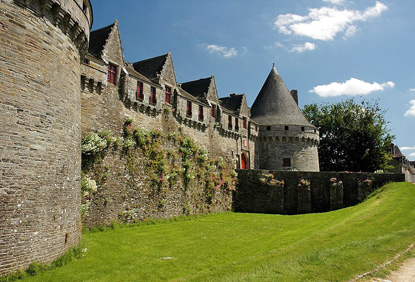
Dubbed the Castle of the Dukes of Rohan, Pontivy Castle stands as one of the last fortified castles built in Brittany during the Middle Ages, constructed between the late 15th and early 16th centuries by Jean II de Rohan, Viscount of Rohan. Built on elevated ground overlooking the town of Pontivy, this impressive fortress was designed to serve both military and residential purposes, featuring walls up to five metres thick to withstand artillery attacks and incorporating the latest defensive technologies of its era. The castle's irregular quadrangular design originally included four circular corner towers connected by high curtain walls, though only half the structure remains today, comprising two towers and two galleries. Following a partial collapse in 2014, the castle currently undergoes restoration and remains closed to the general public except for scheduled guided tours, whilst retaining its status as a historic monument and remaining in the ownership of the Rohan family.
Interesting Facts about Pontivy Castle
- Also known as the Château des Rohan, Pontivy Castle was begun by Jean II de Rohan in the late 15th century as one of Brittany’s last great fortified residences.
- The fortress blends medieval military architecture with later stately comforts, reflecting a shift from defence to aristocratic living by the 18th century.
- Its plan once featured four massive round towers and deep moats, yet today only two of the original towers and part of the galleries survive.
- The castle’s thick curtain walls and Breton machicolations were engineered to withstand early artillery, marking it as an innovative stronghold of its era.
- In 1490, the Rohans retook the castle after a brief capture by François II, Duke of Brittany, during regional power struggles.
- Pontivy’s role as the Rohan family’s capital from the late 14th century shaped the town’s growth around the castle.
- A section of the south wall dramatically collapsed after heavy rains in February 2014, prompting a long, painstaking restoration.
- Exceptional guided visits sometimes open the interior during holidays and special events, even while major conservation continues.
- The castle sits above the Blavet and near the Nantes–Brest Canal, anchoring a landscape where medieval Pontivy meets Napoleonic “Napoléonville.”
- In the 20th century and again today, the site has been a focal point for local identity, heritage initiatives, and cultural storytelling.
- In 1940, Pontivy hosted the failed declaration of independence of Brittany organised by the Breton National Committee.
History
Pontivy, a town with roots dating back to 685 CE, was founded by an English monk named Ivy who constructed a wooden bridge over the Blavet river, which gave the town its name. In the 12th century, a feudal motte castle was built as the first fortification around 1150, later replaced by a stone fortress that was destroyed by English troops in 1342 during the War of Succession in Brittany. The present-day Pontivy Castle, also known as Château des Rohan, was constructed between 1479 and 1485 by Jean II de Rohan, nicknamed the "Grand Viscount" due to his impressive wealth, making it a powerful lord's seat of the influential Rohan family.
This castle is one of the last fortified castles built in Brittany and stands as a remarkable example of late 15th century Breton military architecture. It features thick walls up to five metres wide designed to withstand artillery fire, four circular corner towers connected by 20-metre high curtains, and a large defensive trench that was never filled with water. The castle served as the political, judicial, and military headquarters of the Rohan family from 1396, and witnessed significant historical events including sieges during the Duchy of Brittany War of Independence in 1488 and occupation by Catholic forces during the French Wars of Religion in 1589.
In the 18th century, Pontivy Castle underwent significant transformations, evolving from a defensive fortress into an exclusively residential palace with enlarged openings, converted walkways to create the Duchess of Rohan's bedroom, and impressive decorated fireplaces. During the Napoleonic era, the town was renamed Napoleonville as Napoleon Bonaparte designated it a strategic military and trade centre due to its exceptional position "straddling the two seas," with General Bernadotte establishing his headquarters there to combat the Chouans in 1801. The castle subsequently housed various occupants including the sub-prefecture, courts, a girls' school run by the Sisters of Kermaria, and during World War II, Polish troops and Breton autonomists. In recent history, heavy rains in 2014 caused the collapse of part of the south curtain wall, leading to ongoing restoration work that has revealed archaeological treasures including two former furnaces in the courtyard, while the castle now opens occasionally for guided tours during special events.
Description
The imposing Château de Pontivy, also known as the Château des Rohan, stands majestically at the northern edge of Pontivy’s historic quarter, commanding spectacular views over the River Blavet and the surrounding Breton countryside. This magnificent 15th-century fortress represents one of the finest examples of late medieval military architecture in Brittany, expertly blending formidable defensive capabilities with the refined residential comfort expected by one of France’s most powerful noble families.
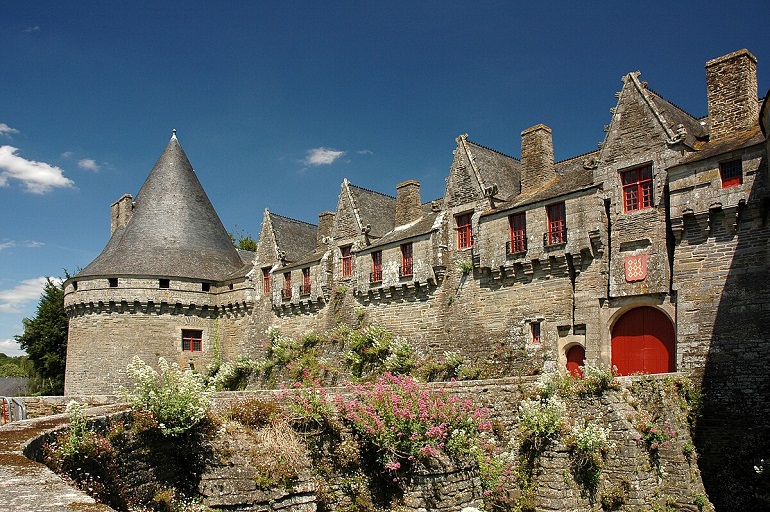
The castle presents an irregular quadrilateral plan measuring approximately 90 metres by 75 metres, its substantial walls rising from deep, dry moats that once provided formidable protection. The fortress is anchored by massive circular towers at each corner, though only two of the original four towers remain intact today – the imposing southwest and northwest towers that define the castle’s distinctive silhouette. These pepper-pot towers, constructed from local schist and granite, project boldly from the curtain walls and reach heights of over 20 metres, their sturdy forms designed to withstand the increasingly powerful artillery of the late 15th century.
The castle’s most striking architectural feature is undoubtedly its remarkable wall thickness, reaching over five metres in places – a testament to the military engineering innovations required to counter the advancing threat of cannon fire. The walls are crowned with distinctively Breton machicolations carved from granite, supported by elaborate corbels featuring typically regional projections that create an elegant yet functional parapet walk around the entire structure.
The main western façade presents a fascinating study in medieval defensive architecture, featuring the original entrance portal with both carriage and pedestrian doors positioned strategically near the southwest tower. Three vertical grooves above these doorways still bear witness to the original drawbridge lifting mechanisms that once protected access across the moat. The façade’s austere defensive character is softened by decorative elements added during the 16th century, including carved dormers with pointed pediments that pierce the roofline and elaborate stone downspouts topped with sculpted animal figures.
Within the castle’s protective embrace lies a spacious central courtyard, originally designed to accommodate the daily activities of a great noble household. The surviving residential wings – the western and northern galleries – showcase the dual nature of this remarkable structure as both fortress and palatial residence. The northern gallery retains its original mullioned windows facing the moat, restored in the 20th century after being blocked up during the 19th century, while the courtyard-facing openings were enlarged in the 18th century and adorned with wrought-iron balustrades.
The interior spaces reflect centuries of adaptation and refinement, most notably in the former Duchess of Rohan’s chamber, now converted into a small projection room but still retaining its 18th-century decorative wooden ceiling panels and neoclassical pilasters. The grand Louis XV-style double-flight staircase with ornate wrought-iron railings was added during the 18th-century renovations, crowned by a niche containing a statue of Saint Meriadec – a reminder of the Rohan family’s claimed descent from this legendary Breton saint.
The castle’s remarkable preservation allows visitors to appreciate authentic medieval architectural details, from the original pegged wooden parquet floors reconstructed using fragments discovered during restoration to the impressive fireplaces relocated from other historic châteaux and decorated with polychrome heraldic motifs. The defensive passages and embrasures remain clearly visible, providing insight into the sophisticated military engineering of the period.
Despite partial damage from a dramatic wall collapse in 2014 following severe winter storms, ongoing restoration efforts continue to preserve this architectural jewel. The castle currently houses permanent contemporary art installations, including works by Japanese artist Koki Watanabe and an exhibition dedicated to sculptor Gaston Schweitzer, creating an intriguing dialogue between medieval grandeur and modern artistic expression.
The surrounding landscape enhances the castle’s dramatic presence, with the carefully maintained moat system and remnants of the original counterscarp providing context for understanding the sophisticated defensive strategies employed by medieval military architects. From its commanding position overlooking the Blavet valley, Pontivy Castle continues to dominate the townscape much as it did when Jean II de Rohan first envisioned it as a symbol of his family’s power and prestige in the heart of Brittany.
Getting There
By train, Pontivy no longer enjoys a passenger rail link, so you’ll need to alight at the nearest main-line stations—Vannes, Lorient, Saint-Brieuc or Rennes—and cover the final stretch by bus, taxi or car share.
By coach or bus, BreizhGo coaches fan out across central Brittany, giving direct links from Vannes, Lorient, Saint-Brieuc and Rennes; once in town, local PondiBus and Moovitad services make light work of the last few kilometres.
By car, Pontivy sits at the crossroads of Brittany’s main east–west and north–south routes, meaning you can roll in from Rennes in under 1h30 or from Nantes in roughly two hours, with scenic roads through wooded countryside and handy parking close to the château.