


| Contents |
|---|
Introduction
Lille (pop. 240,000, metro 1.5 million) is France's 2nd largest metropolitan area (consisting of Lille, Roubaix, Tourcoing, Villeneuve d'Ascq, as well as the Belgian towns of Courtai and Tournai) after Paris. It is the capital of the Nord-Pas de Calais region, the second most densily populated region of continental France after the Île-de-France (Parisian region).
The city name comes from the Latin insula or isla, which later changed into modern French l'île (or der ijsel in Dutch), which means "the island", because it was originally founded on an island on the River Deule.
Geographically and historically, Lille is located in Flanders (French Flanders, that is). The region therefore has strong historical and cultural connections with Belgium, as the architectural style, traditional crafts, cuisine and dialects (Flemish and Picard).
The University of Lille is the third largest in France (after Paris and Toulouse) in terms of student population (144,000 students).
Interesting Facts about Lille
- Lille's Braderie de Lille is Europe's largest flea market, dating back to the 12th century and attracting three million visitors annually.
- The Palais des Beaux-Arts in Lille houses France's second-largest art collection after the Louvre, featuring works from Rubens to Monet.
- Lille's 17th-century Citadel, designed by military architect Vauban, is a UNESCO World Heritage Site nicknamed the "Queen of Citadels".
- The city's historic Old Town (Vieux Lille) showcases Flemish Renaissance architecture, including the striking contemporary Notre-Dame de la Treille Cathedral.
- Lille was designated European Capital of Culture in 2004, celebrating its position as a crossroads of French and Flemish heritage.
- With over 100,000 students, Lille ranks as France's third-largest university centre, creating a vibrant youth culture.
- The Hôtel de Ville's Art Deco belfry forms part of a UNESCO-listed group of 23 historic bell towers in northern France.
- Strategically located near the Belgian border, Lille lies within a 1-hour train journey of Paris, Brussels and London via Eurostar.
- Local specialities include carbonnade flamande (beer-braised beef) and Welsh rarebit, reflecting Flemish culinary influences.
- Known as the "Capital of Flanders", Lille's architecture and culture blend French and Northern European traditions.
History
According to the legend, Lille was founded on the River Deûle (Deule in Dutch) in 640 as a town of the Merovingian kingdom of the Franks. It doesn't appear in written medieval charters until 1054.
Trading with other towns of the County of Flanders, the town became a prosperous textile centre, along with Ypres, Bruges and Ghent.
At the onset of the 14th century, the King of France, Philip IV the Fair (1268-1314), engages in open hostilities with his insubordinate vassal Guy de Dampierre (1226-1305), Count of Flanders and Namur. The Flemish first defeated the royal French armies near Courtai on 11 July 1302, at the epic Battle of the Golden Spurs (the date has been made the official "national" day of Flanders). However, Philip came back 2 years later, and the resulting Battle of Mons-en-Pévèle inflicted heavy casualties on both sides, with no clear winner. Guy de Dampierre's son, Robert de Béthune, was captured and forced to sign the Treaty of Athis-sur-Orge (23 June 1305), which recognized the independence of Flanders at the cost of the cities of Lille, Douai and Béthune, which were transferred to France.
In 1477, Lille passes to the Habsburg family, and is thus united again with the County of Flanders as part of the Southern Netherlands. After the rule of Charles V of Habsburg (Charles Quint in French), the territories of Northern France and most of modern Belgium are inherited by Charles' son, Philip II of Spain, and thus become known as the Spanish Netherlands.
Under Louis XIV of France (1638-1715), the French took back the Western half of the Spanish Netherlands, including the Lille region. From the official incorporation in 1668, dArtagnan, the famous musketeers immortalised in Alexandre Dumas' novel The Three Musketeers, is appointed governor of Lille.
In 1804 Lille was made county seat of the Nord départment. In 1846, a railway line connecting Paris and Lille was built. The city quickly became a major industrial centre for metallurgy, coal and textiles, prompting a population boom. All these industries collapsed after WWII, forcing the city to change its economy.
In 1983, the VAL, the world's first automated rapid transit underground network, was opened. In 1993, a high-speed TGV train line was opened, connecting Paris with Lille in one hour. In 1994, the opening of the Channel Tunnel gave Lille a new lease of life, thanks to its strategic location at the crossroads of Paris, London and Brussels. Started in 1991 and completed in 1994, the business district Euralille marked the success of the city's renewal.
Celebrities
Famous people from the greater Lille include :
- Jean Perrin (1870-1942), Nobel Prize in physics and creator of the French CNRS (National Center for Scientific Research).
- Charles de Gaulle (1890-1970), general, resistance fighter, President of France (1940-46, 1958-69).
- Philippe Noiret (1930-2006), actor.
- Bernard Arnault (1949-), businessman, main shareholder and CEO of LVMH and Christian Dior, and 7th richest person in the world in 2006.
- Nicolas Hulot (1955-), journalist, ecologist and writer, founder of the TV programme Ushuaïa Nature, and initiator of the Pacte écologique for the 2007 presidential elections.
Attractions
Lille is undeniably one of the most charming cities in France. Its sumptuous Flemish Renaissance architecture rival the splendours of Brussels and Antwerp's market squares, though in more colourful.
| Veille Bourse |
|---|
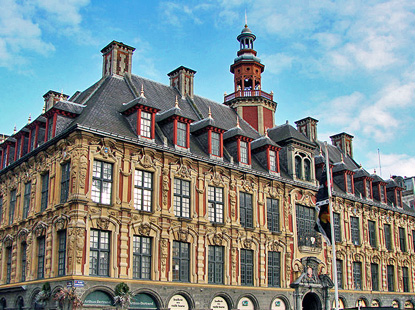
 Lille's Old Stock Exchange, built in 1652-53 in the Flemish Renaissance style. Lille's Old Stock Exchange, built in 1652-53 in the Flemish Renaissance style. |
| Rang du Beauregard |
|---|
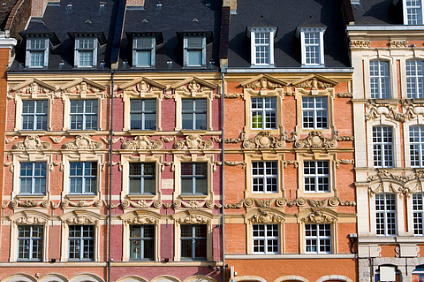 A terrace of 14 three-storey Flemish Renaissance houses from the 17th-century.
 |
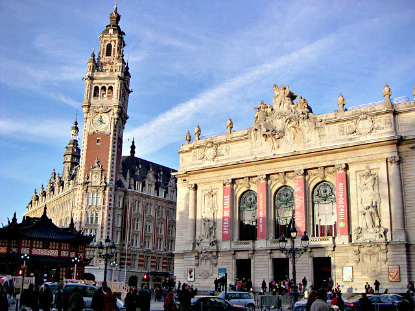
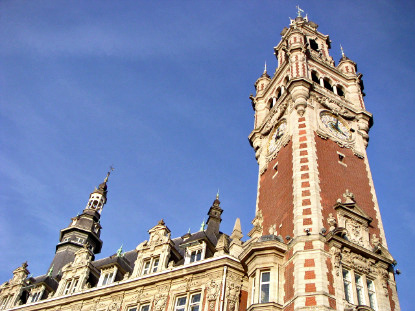
| Chamber of Commerce & Industry |
|---|
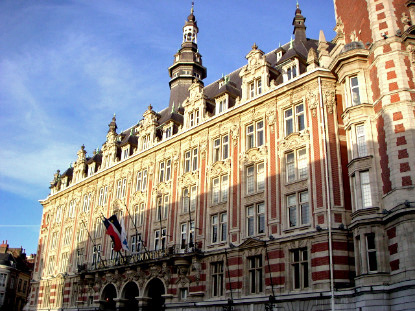 A neo-Renaissance edifice dating from 1910-1921, with its 76-metre belfry.
 |
| Opéra |
|---|
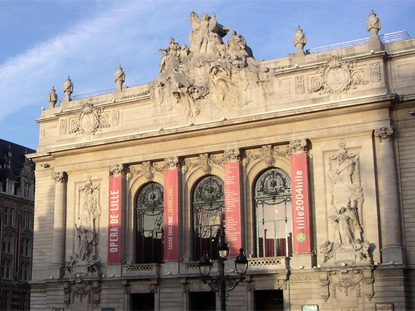
 A theater-style neo-classical opera house, built from 1907 to 1913. A theater-style neo-classical opera house, built from 1907 to 1913. |
| City Gates |
|---|
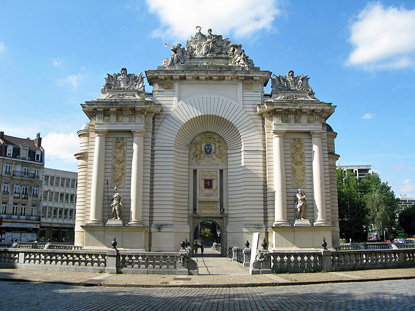 The three surviving 17th-century city gates. The most impressive is the neoclassical Paris Gate. The others are Roubaix Gate and Ghent Gate.
 |
| Citadel |
|---|
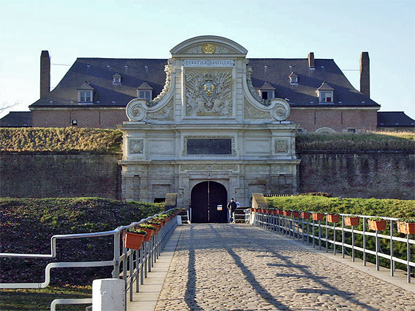 A pentagon-shaped citadel built by Vauban between 1667 and 1670, and dubbed the "Queen of the citadels" by Vauban himself.
 |
| Hôtel de Ville |
|---|
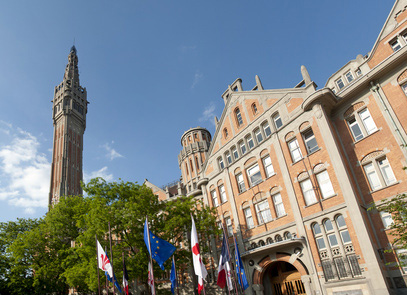 Lille's town hall. Erected between 1924 and 1932, it blends Neo-Renaissance and Art Deco styles.
 |
| Palais Rihour |
|---|
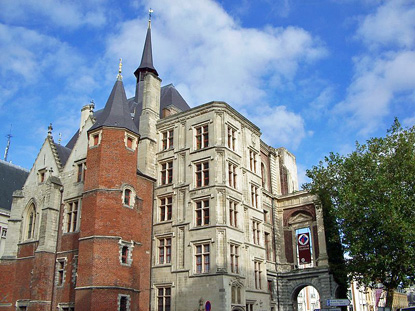 15th-century palace of the Dukes of Burgundy. It was built by Philip the Good in 1453.
 |
| Lille Cathedral |
|---|
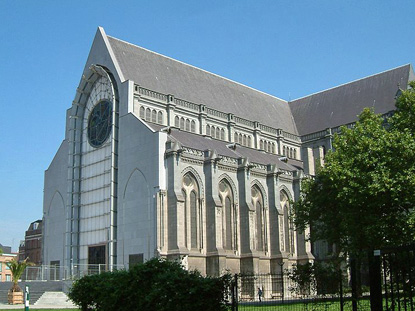
 Originally the Basilica of Notre Dame de la Treille, it was elevated to the rank of cathedral in 1913. Its construction in the Neo-Gothic style started in 1854 and was only completed in 1999. Originally the Basilica of Notre Dame de la Treille, it was elevated to the rank of cathedral in 1913. Its construction in the Neo-Gothic style started in 1854 and was only completed in 1999. |
Other sights include :
- the Grand Garde (18th-century army headquarter, now housing a theatre)
- the Art Nouveau Maison Coilliot
Top Museums
Palais des Beaux-Arts
One of France's largest fine arts museums after the Louvre, housed in a magnificent 19th-century building. The museum displays masterpieces by renowned artists including Rubens, Delacroix, Goya, and Van Dyck. The collection features an impressive array of paintings, sculptures, and antiquities spanning multiple centuries.
La Piscine Museum
Located in Roubaix, this unique museum is set in a converted Art Deco swimming pool. It houses an exceptional collection of applied and fine arts, including textiles, ceramics, paintings, and sculptures from the 19th and 20th centuries. The original pool architecture with its stunning glass windows creates a spectacular setting.
Musée de l'Hospice Comtesse
Founded in 1237, this former hospital provides a fascinating glimpse into medieval Lille. The museum features period-furnished rooms, including a beautiful tiled kitchen, chapel, and sick ward. The collection includes historical artifacts, paintings by Louis and François Watteau, and displays chronicling Lille's development from the 16th century to the French Revolution.
Maison Natale Charles de Gaulle
The birthplace of General Charles de Gaulle has been transformed into a museum that presents the bourgeois lifestyle of late 19th-century Lille. The house contains personal items including the general's cradle and christening robe.
Le TriPostal
A former post office converted into a contemporary art venue, TriPostal hosts modern art exhibitions, performances, and workshops. It's a major venue for the Lille3000 cultural festival and features a popular café.
LaM
Located in Villeneuve d'Ascq, this modern art museum showcases contemporary and outsider art. The museum offers a diverse collection of modern artistic expressions.
Villa Cavrois
An outstanding example of modernist architecture, this historical monument showcases Art Deco design and furnishings.
Institut Pasteur Museum
A scientific museum dedicated to the work of Louis Pasteur and the history of medical research in the region.
Local Cuisine
Lille's culinary scene beautifully reflects its position at the crossroads of French and Flemish cultures, offering a hearty and distinctive cuisine. The city's signature dishes include the Welsh rarebit, a beer-soaked bread topped with melted cheese and ham, and the carbonade flamande, a rich beer-braised beef stew that exemplifies the region's love for brewing. Seafood features prominently in local specialities, with moules-frites (mussels and chips) and croquettes de crevettes (shrimp croquettes) being particular favourites. The region's cheese culture shines through in dishes like Tarte au Maroilles, a savoury tart made with the pungent local Maroilles cheese. For those with a sweet tooth, Lille offers delectable treats such as the Merveilleux (meringues coated in chocolate and cream) and the distinctive Lille waffle, which is flat and filled with brown sugar. These dishes are best enjoyed in traditional establishments called estaminets, which offer a cosy, authentic atmosphere typical of Northern France.
Shopping
Lille stands as one of France's premier shopping destinations, offering an enchanting blend of haute couture fashion, local artisanal crafts, and bustling markets. The city boasts over 3,900 shops, with the charming Old Lille district (Vieux-Lille) featuring cobblestone streets lined with luxury boutiques like Louis Vuitton and Hermès alongside unique independent retailers. Shoppers can explore modern shopping centres such as Westfield Euralille, which houses 137 shops across 67,000 square metres, or venture to traditional markets like the beloved Marché de Wazemmes, where hundreds of vendors sell everything from fresh produce to vintage finds. The city's strategic location between London, Paris, and Brussels makes it particularly accessible, with most shops operating Monday through Saturday from 10:00 to 19:00, though visitors should note that many establishments close on Sundays except during the winter and summer sales period.
Nature in and around Venice
Lille offers a splendid array of natural attractions, with the magnificent Parc de la Citadelle serving as the city's largest green area. This 110-hectare park surrounds the historic Vauban-designed fortress and features walking trails, a zoo, and scenic waterways perfect for boating. The city boasts several other delightful green spaces, including the historic Jardin Vauban, a listed English-style garden complete with an artificial grotto, and the contemporary Jardin des Géants with its enchanting bamboo groves and water features. Just outside Lille, nature enthusiasts can explore the Scarpe-Escaut Regional Nature Park, France's oldest regional park, which spans 43,000 hectares of diverse landscapes including forests, meadows, and waterways. The park is particularly notable for its unique blend of natural beauty and industrial heritage, featuring transformed mining sites like the Mare à Goriaux, a former mining pit that has evolved into a thriving wildlife habitat.
Getting Around
Lille boasts an extensive and modern public transport network operated by Ilévia, making it remarkably easy to navigate the metropolitan area. The system comprises two automated metro lines spanning 45 kilometres with over 60 stations, making it the world's longest driverless metro network. Two tram lines, affectionately known as the Mongy, connect central Lille to the neighbouring communities of Roubaix and Tourcoing via 36 stations. The network is complemented by more than 90 bus routes, including eight cross-border services to Belgium. Public transport operates daily throughout the year (except 1st May) from 5:00 until midnight, with frequent services during peak hours. A single journey costs £1.80, and there are various ticket options available, including day passes and special rates for young travellers?notably, transport is free for those under 18 years of age.
Best Time to Visit
The best time to visit Lille is from late spring to early autumn, specifically between May and September, when the weather is most pleasant for exploring the city. During these months, temperatures are mild and comfortable, ranging from 15°C to 24°C, making it ideal for outdoor activities and sightseeing. May and June are particularly delightful as the city's parks and gardens burst into bloom, whilst September offers the added attraction of the famous Braderie de Lille, Europe's largest flea market. Although the city experiences occasional rainfall throughout the year, these months generally provide the most sunshine and agreeable conditions for wandering through Lille's charming cobbled streets, enjoying outdoor cafés, and visiting attractions like the Citadelle and the Old Town.
| Travel destinations in Nord-Pas-de-Calais | ||||||||||||||
|---|---|---|---|---|---|---|---|---|---|---|---|---|---|---|
|
|
|
|
| ||||||||||
|
|
|
|
| ||||||||||
| ||||||||||||||


