


Introduction
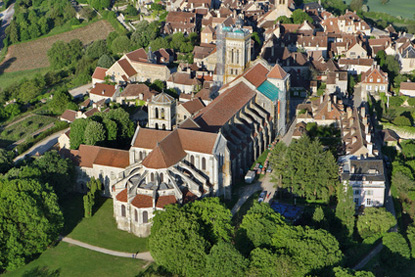
Vézelay Abbey, officially known as the Basilica of Sainte-Marie-Madeleine, is a former Benedictine monastery founded in the 9th century on a hilltop in Burgundy. The abbey gained prominence in the mid-11th century when it claimed to possess the relics of Mary Magdalene, transforming it into one of medieval Europe's most important pilgrimage destinations and a major starting point for pilgrims travelling the Santiago de Compostela route. The current church, dating primarily to the 12th century, represents one of the finest examples of Romanesque architecture in France and has witnessed significant historical events, including Saint Bernard of Clairvaux preaching the Second Crusade before King Louis VII in 1146 and the meeting of Richard the Lionheart and Philip Augustus before departing for the Third Crusade in 1190. At its medieval peak, the influx of pilgrims supported a thriving town of approximately 10,000 inhabitants, and the abbey's importance led to its designation as a UNESCO World Heritage Site in 1979. The basilica features remarkable sculptural programmes, including the famous tympanum depicting Christ with outstretched arms and 153 carved capitals throughout the nave, whilst the 9th-century crypt houses the claimed relics that continue to attract pilgrims today.
Interesting Facts about Vézelay Abbey
- Vézelay Abbey, also known as the Basilica of Sainte‑Marie‑Madeleine, rose to fame when it claimed to house the relics of Mary Magdalene, drawing vast medieval pilgrimages.
- It stands at the start of one of the main French routes to Santiago de Compostela, making it a landmark on the Way of St James.
- Bernard of Clairvaux preached the Second Crusade here in 1146, with King Louis VII in attendance.
- Richard the Lionheart and Philip II of France met at Vézelay in 1190 before departing on the Third Crusade.
- The present Romanesque basilica was largely built in the 12th century, renowned for its sculpted capitals and luminous nave.
- Its celebrated tympanum portrays Christ sending the apostles to the nations, a masterpiece of high Romanesque sculpture.
- Twice yearly at the solstices, the midday sun aligns to create striking pools of light along the nave.
- The abbey was restored in the 19th century by Viollet‑le‑Duc after post‑Revolution neglect.
- Designated a UNESCO World Heritage Site in 1979, the “church and hill” of Vézelay reflect exceptional spiritual and architectural significance.
- Though the Magdalene relics claim was later disputed, the site remained a major centre of penitential pilgrimage and European history.
History
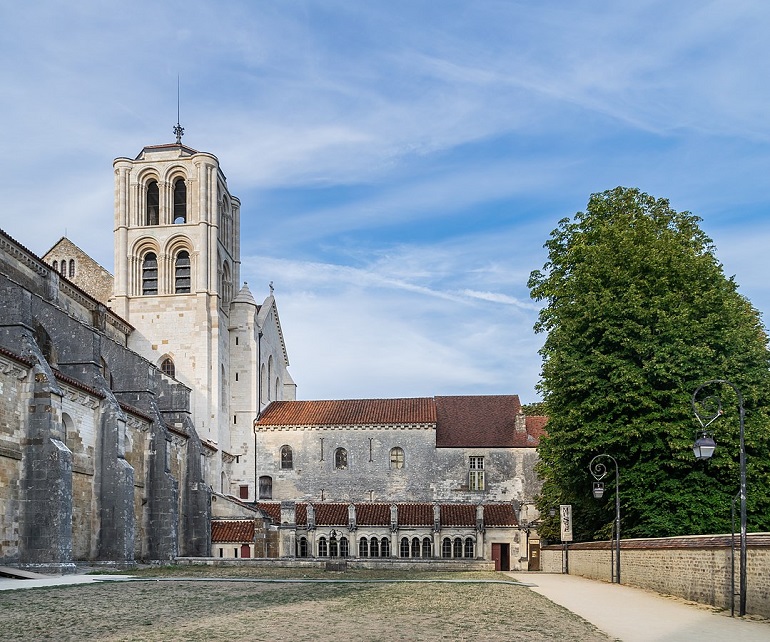
Vézelay Abbey, formally known as the Basilica of Sainte‐Marie‐Madeleine, traces its origins to the ninth century when Benedictine monks established a monastic community on the hilltop of Vézelay in Burgundy. According to tradition, the abbey’s early fame was sealed in 1058 after it claimed to possess relics of Mary Magdalene, making it one of medieval Europe’s most important pilgrimage destinations on the road to Santiago de Compostela. Rapidly enriched by offerings from pilgrims and favoured by the Dukes of Burgundy, the community began rebuilding its church in the 1090s, adopting the newest Romanesque forms and vaulting techniques that would influence sacred architecture across France.
The abbey’s renown grew further when Pope Urban II chose Vézelay as the site to preach the First Crusade in 1095, addressing a vast crowd from a wooden platform erected on the hillside. Half a century later, in 1146, Saint Bernard of Clairvaux likewise galvanised support for the Second Crusade from the abbey’s narthex, reinforcing its status as a meeting-point for Christendom. Throughout the twelfth century its sculptors produced the celebrated tympanum reliefs depicting the Mission of the Apostles and the Apocalypse, masterpieces of Burgundian Romanesque art whose expressive style and theological depth drew scholars, artists and further waves of devotees.
Although prosperity faded after the Hundred Years’ War and the Wars of Religion, the abbey endured, becoming a parish church during the French Revolution and narrowly avoiding demolition. Nineteenth-century architect Eugène Viollet-le-Duc spearheaded a meticulous restoration from 1840, rescuing its collapsing vaults and refashioning the façade, thereby pioneering modern conservation practice. In 1979 UNESCO inscribed the basilica and hill of Vézelay on the World Heritage List, recognising its exceptional testimony to the spiritual fervour of the Middle Ages and its profound influence on Romanesque art and architecture.
Description
Architectural Magnificence
The basilica presents an impressive architectural harmony, measuring 62.5 metres in length with soaring vaults that reach 19.5 metres in height. The building’s construction spans multiple architectural periods, creating a fascinating transition from Romanesque to early Gothic styles. The nave and narthex, completed between 1120 and 1150, showcase the characteristic features of Romanesque architecture, whilst the choir and transept, constructed in the late 12th century, demonstrate the emerging Gothic style.
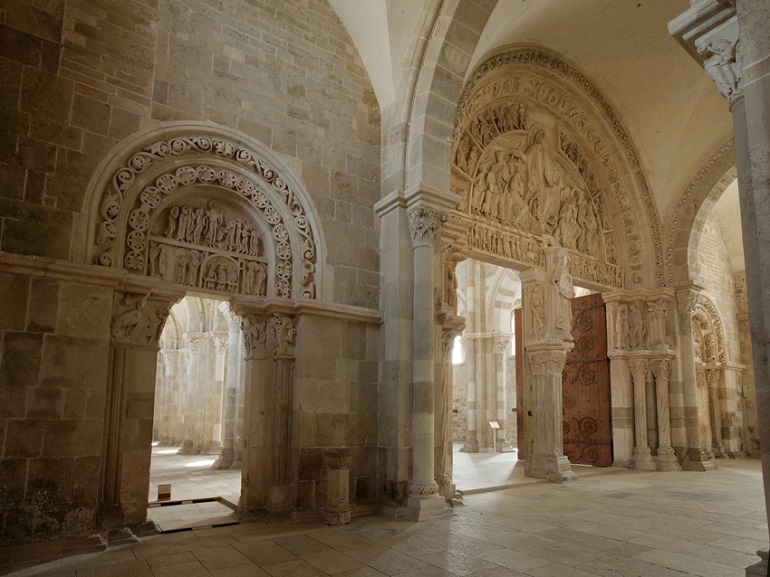
The nave captivates visitors with its distinctive alternating arches of dual-coloured voussoirs, creating a rhythmic pattern that draws the eye towards the distant altar. The structure employs innovative groin vaults throughout the nave, making Vézelay one of the earliest examples in France to utilise this advanced vaulting technique. These groin vaults, formed by the perpendicular intersection of two barrel vaults, distribute weight more effectively than traditional barrel vaults, allowing for higher walls and larger windows that flood the interior with natural light.
The Magnificent Tympanum
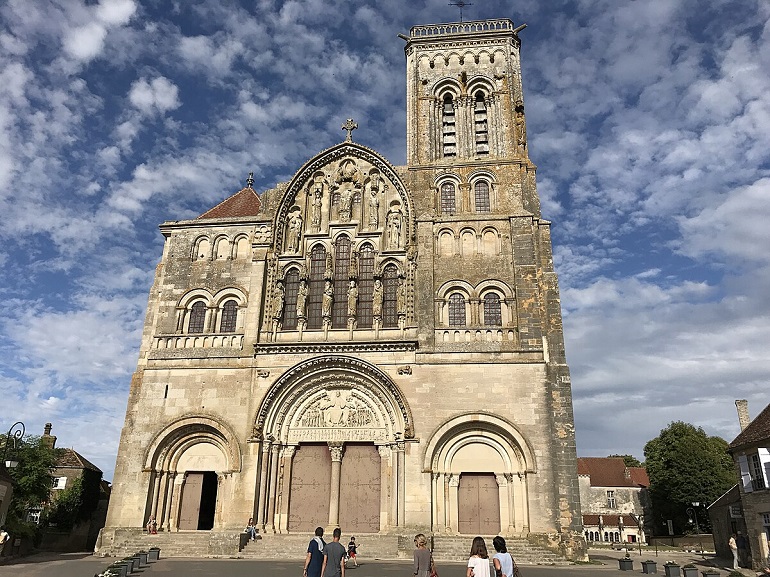
The abbey’s most celebrated feature is undoubtedly the extraordinary sculpted portal that separates the narthex from the nave. The central tympanum, standing nearly 40 feet high and 30 feet wide, depicts the Mission of the Apostles in a composition of unparalleled complexity and artistry. At the centre sits Christ in majesty, with rays of divine light emanating from his hands towards the twelve apostles positioned on either side.
This masterwork of Romanesque sculpture is unique in its iconographic programme. Unlike the typical Last Judgement scenes found on most contemporary tympana, Vézelay presents Christ sending forth his apostles to evangelise the world. The composition includes representations of the four elements in the quadrants of the tympanum, along with zodiacal signs and the months of the year, creating what scholars interpret as a macro-microcosmic vision of divine order.
The lintel below the tympanum displays a remarkable array of peoples from the known world, including fantastical races such as the Cynocephali (dog-headed people), Sciritae (pig-snouted people) and Panotii (large-eared people), representing the diverse nations awaiting conversion. This encyclopaedic approach reflects the medieval understanding of geography and ethnography, making the portal both a work of art and a testament to 12th-century knowledge.
The Capitals: A Stone Encyclopaedia
The nave houses an extraordinary collection of ninety-nine historiated capitals, each a masterpiece of medieval carving. These capitals present an eclectic mixture of biblical scenes, hagiographic narratives, classical references and allegorical subjects. Positioned approximately four metres above the floor, they are ideally placed for detailed viewing, with intricate details such as links of mail and strands of hair clearly visible.
The capital carvings display remarkable artistic sophistication, with scenes ranging from the adventures of David and Goliath to the lives of saints, classical mythology and moral allegories. Each capital demonstrates the skill of the imported workshop of master craftsmen, who created unprecedented pictorial elements and gestures that set these sculptures apart from other Burgundian Romanesque works.
The Mystical Dance of Light
Perhaps the most enchanting aspect of Vézelay Abbey is its intimate relationship with natural light. The medieval builders designed the basilica with precise astronomical calculations to create spectacular light phenomena during the solstices. During the summer solstice, nine pools of sunlight appear along the central axis of the nave at solar noon, forming a luminous pathway leading directly to the altar. This phenomenon occurs throughout the month of June, with the effect most pronounced around 21 June.
The winter solstice brings its own magical display, when sunlight illuminates the northern capitals with theatrical precision, creating what guides describe as a transformation from darkness to light. These carefully orchestrated effects demonstrate the medieval builders’ sophisticated understanding of solar movements and their desire to integrate cosmic symbolism into the spiritual experience.
Architectural Transition
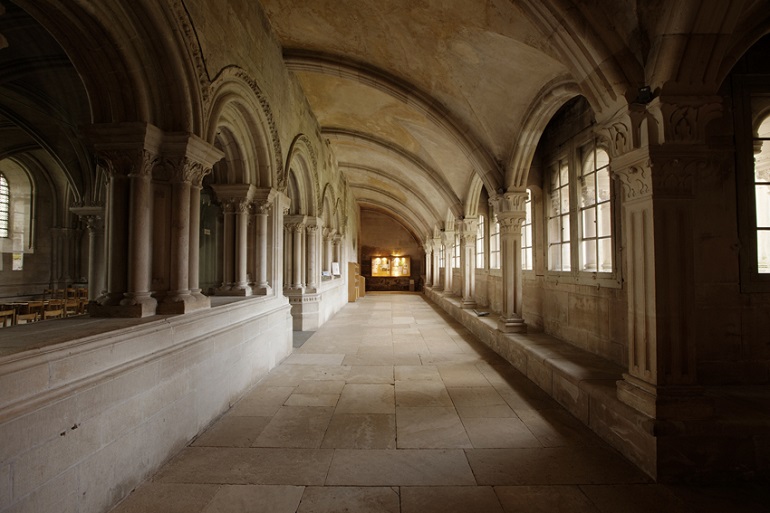
The basilica beautifully illustrates the transition from Romanesque to Gothic architecture. The nave maintains the rounded arches, thick walls and geometric precision characteristic of Romanesque design. In striking contrast, the choir and transept feature pointed arches, ribbed vaults and larger windows that herald the arrival of the Gothic style. This architectural evolution is particularly evident in the ceiling, where the Romanesque groin vaults of the nave give way to the ribbed vaulting system of the Gothic choir.
The Sacred Narthex
The narthex serves as a magnificent antechamber to the sacred space beyond. This two-storey structure, one of the great constructions of the Romanesque period, was designed to accommodate the formation of processions and the gathering of pilgrims. The narthex contains the famous central portal along with two lateral portals depicting scenes from the Nativity cycle and post-Resurrection narratives, creating a comprehensive iconographic programme that prepares visitors for the spiritual journey ahead.
Getting There
By train Vézelay has no station of its own, so the simplest rail route from Paris is to take an Intercités or TER service to Sermizelles–Vézelay; from there a short taxi or seasonal shuttle deposits you at the hilltop village.
By coach or bus Regional buses link Auxerre and Avallon with Vézelay, offering a straightforward option for travellers already exploring Burgundy; services are limited, so check timetables in advance.
By car Driving is the most flexible way to reach the abbey: leave the A6 motorway at exit 21 (Avallon), then follow signs for Vézelay through rolling Morvan countryside, with ample parking at the foot of the village.
| Travel destinations in Burgundy | ||||||||||||||
|---|---|---|---|---|---|---|---|---|---|---|---|---|---|---|
|
|
|
|
| ||||||||||
|
|
|
|
| ||||||||||
| >
| |||||||||||||


