


Introduction
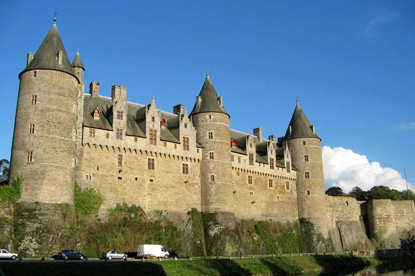
The impressive medieval Castle of Josselin, with its three round towers, has a history going back 1000 years. Once occupied by the Dukes of Brittany it has belonged to the House of Rohan for the last 500 years. Renovated in the 19th ccentury, it is now the home of the 14th duke.
The castle houses a Doll Museum featuring some 3,000 dolls dating from the 17th century to present, and 2,000 stuffed animals and other toys.
Josselin Castle stands majestically on a rocky promontory overlooking the Oust River valley in Brittany, its origins dating back to around 1008 when Guéthénoc, vicomte of Porhoët, established the first fortress on this strategic site and named it after his son Josselin. The current granite structure was largely built by Olivier de Clisson after 1370, who transformed it into an imposing fortress, though much of the original eight-tower complex was demolished in 1629 on the orders of Cardinal de Richelieu, leaving three magnificent round towers that dominate the medieval riverside façade. What makes this castle particularly remarkable is its dual architectural character: whilst the river-facing side presents a formidable medieval fortress with towering granite walls, the courtyard side reveals an exquisite Renaissance façade with intricate stone carvings, completed in the early 16th century under Jean II de Rohan. The castle remains a private residence, still owned and inhabited by the noble Rohan family—one of Brittany's oldest lineages—making it a rare example of a living historical monument that has been continuously maintained for over a millennium.
Interesting Facts about Josselin Castle
- Josselin Castle was first established around 1008 by Guéthénoc, viscount of Porhoët, taking its name from his son Goscelinus.
- Henry II of England demolished the fortress twice, in 1168 and 1175, even sowing salt into the ruins as a symbolic act.
- The castle is famed for the 1351 “Combat of the Thirty,” a chivalric duel between thirty knights on each side that ended a local stalemate.
- Olivier V de Clisson rebuilt Josselin after 1370 as a formidable stronghold with multiple towers and an immense keep.
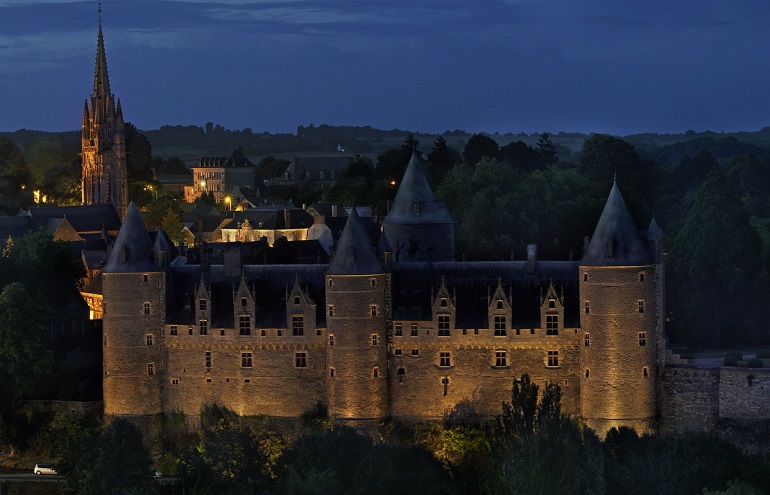
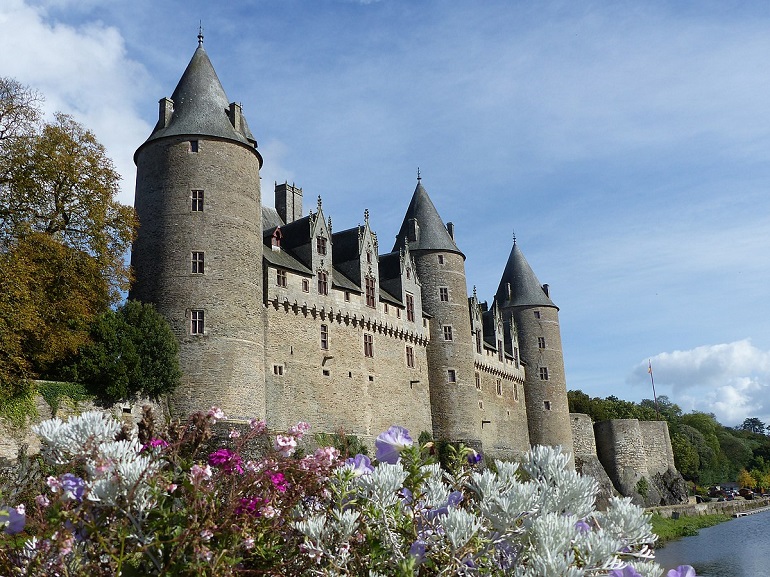
- The facade facing the Oust River presents a dramatic medieval silhouette of three great round granite towers linked by curtain walls.
- The courtyard side contrasts with an elegant late Gothic and early Renaissance residence, adorned with intricate sculpted stonework.
- Anne of Brittany influenced its Renaissance transformation, with her initial “A” carved along the richly ornamented facade.
- Cardinal Richelieu ordered much of the fortress dismantled in 1629, leaving today’s striking mix of military and residential architecture.
- The castle has long associations with the powerful Rohan family, who have maintained ties to the property across centuries.
- Built entirely in granite, the monument’s austere Breton materiality enhances its imposing riverside presence.
- The site overlooks the Oust valley and historically benefited from the nearby pilgrimage to Notre‑Dame du Roncier.
- Parts of the complex served as a prison and storehouse during turbulent periods, including the eighteenth century.
- The estate’s formal French gardens, including a charming rose garden, provide a genteel counterpoint to its martial walls.
- Recognised as a protected monument, Josselin encapsulates Brittany’s passage from feudal stronghold to Renaissance residence.
- Its dual identity—fortress on one side, refined manor on the other—makes it one of Brittany’s most photogenic castles.
History
The Early Foundations and Destruction (1008-1175)
Josselin Castle's remarkable history began in 1008 when Guéthénoc, Viscount of Porhoët, Rohan and Guéméné, chose a strategic rocky promontory overlooking the Oust valley to construct his fortress. The castle was named after Guéthénoc's son, Goscelinus, with the name recorded in the Cartulary of Redon Abbey as "castellum et castrum Goscelini" by 1080, evolving to "Castellum Joscelini" by 1108. The site proved excellent from both military and commercial perspectives, benefiting from its position at the intersection of two Roman roads and the annual September pilgrimage to the nearby Basilica of Our Lady of the Bramble, which brought considerable wealth to the lords of Josselin. However, the castle's early existence was turbulent—during a succession dispute in 1154, Henry II of England intervened to support young Conan IV, Duke of Brittany, against Odo II, Viscount of Porhoët. Henry II and his son Geoffrey systematically demolished Josselin Castle in 1168 and again in 1175, with Henry II personally leading the destruction and sowing salt into the ruins to prevent anything from growing there.
Medieval Warfare and the Rise of Clisson (1341-1488)
The castle's fortunes revived during the turbulent Breton War of Succession (1341-1364), when Josselin's garrison engaged in ongoing conflicts with the defenders of nearby Ploërmel Castle. To break this military impasse, the famous Battle of the Thirty was arranged for 26 March 1351, featuring thirty knights from each side fighting halfway between the two fortresses. The men of Josselin triumphed over Ploërmel's champions, who comprised four Bretons, six Germans, and twenty Englishmen. In 1370, the renowned Breton soldier Olivier V de Clisson, later Constable of France, acquired the lordship and transformed Josselin into one of Brittany's most formidable strongholds. Clisson constructed an imposing new fortress featuring eight towers and a massive keep spanning one hundred yards across, with a feudal enclosure of 4,500 square metres surrounded by 25-metre-high ramparts punctuated by nine towers. The castle remained with Clisson's family through his daughter Beatrice's marriage to Alain VIII of Rohan, establishing the Rohan dynasty's connection to Josselin. However, in 1488, Francis II, Duke of Brittany, captured and partially demolished the castle.
Renaissance Transformation and Modern Legacy (1488-Present)
Following the castle's partial destruction, Anne of Brittany—Francis II's daughter who became both Duchess of Brittany and Queen Consort of France—restored Josselin to Jean II of Rohan, Olivier de Clisson's great-grandson. Jean II transformed the property by constructing an impressive Renaissance mansion with a magnificent granite façade, employing Italian artists and artisans in what became an early example of Renaissance architecture in Brittany. In tribute to his patroness Anne of Brittany, Rohan incorporated her badge—the letter 'A' beneath a sculpted stone cord—at several points along the façade. The castle faced further challenges when the Protestant Rohan family was temporarily banned from residence, allowing the Duke of Mercœur to establish a Catholic League base there during conflicts with Henry IV of France. Cardinal Richelieu dealt a severe blow in 1629, dismantling the keep and four towers whilst mockingly telling Duke Henry of Rohan, "My lord, into your game of skittles I have just thrown a good ball!" During the 18th century and French Revolution, the castle served various utilitarian purposes as a prison and warehouse before Caroline, Duchess of Berry, persuaded the Duke of Rohan to undertake restoration in 1822. Today, Josselin Castle remains the residence of Josselin de Rohan, the fourteenth Duke of Rohan, who served as President of Brittany from 1998 to 2004, and houses a remarkable toy and doll museum containing over 5,000 objects.
Description
Exterior Highlights
- South-west Ramparts
Stand on the riverside towpath and the castle’s defensive might is unmistakable: three commanding drum towers, each pierced by narrow arrow-slits, rise sheer from the water’s edge. Between them, machicolations project like stone balconies, a reminder of the fortress’s once-formidable purpose. - Gatehouse Bridge
A gently cambered granite bridge replaces the original drawbridge, yet still channels visitors across the moat toward an oak portcullis bristling with wrought-iron spikes. Intricate coats of arms carved into the tympanum hint at noble lineage without delving into biography. - North Façade
Less austere, this elevation displays a tapestry of carved window surrounds, mullioned bays and decorative dormers. Ivy garlands creep up the walls, softening the stone and releasing bursts of russet and emerald as the seasons turn.

State Floor
Grand Staircase Hall
A lofty atrium where sunlight pours through stained-glass lancets, spilling ruby and sapphire pools across pale flagstones. Twin flights of chestnut steps curve to a mezzanine gallery, their balustrades carved with interlaced fleurs-de-lis. A bronze lantern chandelier swings lazily overhead, scattering warm pinpoints of light onto heraldic shields mounted high on the walls.
Great Hall
The castle’s heart: a timber-framed nave stretching the width of the keep. Hammer-beam trusses soar above a chequerboard limestone floor, while a colossal mantelpiece frames an open hearth large enough to roast a stag. Suits of armour line the walls like silent sentinels; between them, arched windows offer postcard views of the river. Long oak tables gleam beneath beeswax polish, set with pewter chargers and tall beeswax candles that scent the air with honeyed smoke.
Dining Salon
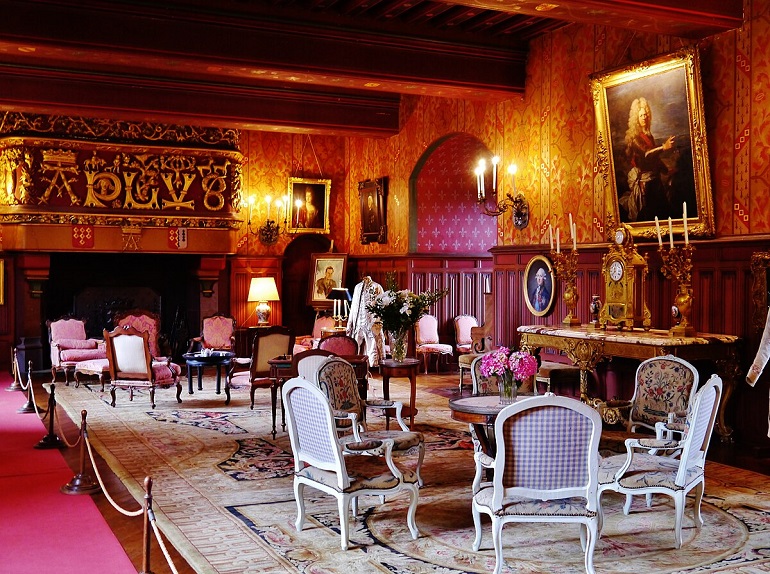
Intimate by comparison, yet richly appointed. Walls are clad in embossed Cordoba leather shimmering bronze in the lamplight. A tulipwood table stretches beneath a crystal girandole, its branches dripping prisms that fracture candle-flame into rainbow shards. Silk damask curtains in deep carmine frame a marble-topped sideboard bearing Sevres porcelain tureens.

Green Drawing Room
A sanctuary of understated elegance, panelled in moss-coloured silk trimmed with gilt braid. Wing-back chairs upholstered in sage velvet cluster around a small Rosso Verona marble fireplace. On an ormolu console, a mahogany cased clock ticks softly, its measured beat accompanied by the distant coo of doves from the castle eaves.
Music Room
Vaulted plaster ceilings painted with airy cherubs rise above parquet floors of walnut and ash. A glossy Erard grand piano commands centre stage, its lid propped open like a black wing. Rosewood music stands bear sheets of Debussy and Fauré; nearby, a harp with gilded column rests against a tapestry depicting woodland sprites, its gut strings shimmering like spun sugar.
Private Apartments
Blue Bedchamber
Draped in powder-blue damask shot with silver thread, this suite glows beneath the flicker of wall sconces. A canopied four-poster dominates the room, its tester embroidered with stars and crescent moons. Pale silk hangings puddle onto parquet floors warmed by an Aubusson carpet in azure and pearl. The scent of lavender sachets tucked between linen sheets mingles with a faint whisper of woodsmoke from the corner fireplace.
Duchess’s Boudoir
A jewel box of a room where rose-silk walls rise to a mirrored cornice. A petite escritoire in marquetry tulipwood stands beneath an oval portrait, its surface scattered with crystal scent bottles and a carved ivory fan. Sunlight flirts with gilt pier-glasses, creating a play of brightness that dances across the parquet de Versailles floor.
Library
Walnut shelves ascend to a coffered ceiling painted midnight blue and flecked with gilded constellations. Leather-bound volumes, their spines burnished in russet and gold, emit the inviting aroma of old vellum. A Jacobean refectory table serves as a reading desk, lit by brass-hooded lamps that cast buttery pools of light across tattered atlases and celestial charts. In the hush, only the soft chime of a bracket clock punctuates the silence.
Private Chapel
An intimate sanctuary sheathed in pale Caen stone. Stained-glass lancets depict saints ablaze in ruby and emerald, their colours washing over travertine floors. Almond-wood choir stalls flank a diminutive nave leading to an alabaster altar, its sculpted reredos softened by flickering beeswax candles.
Service Quarter and Curiosities
Old Kitchen
Atmospheric and cavernous, with soot-blackened beams spanning a barrel-vaulted ceiling. A vast hearth houses iron spits and cauldrons; above, bunches of dried herbs hang like suspended bouquets. The flagstone floor bears the faint imprint of bygone scullions, while an oak dresser displays copper pots buffed to a ruddy glow.
Armoury
Arched stone chambers where racks of halberds, crossbows and polished breastplates glint beneath wrought-iron lanterns. Interactive displays allow visitors to heft a replica longsword or examine the intricate chainmail hauberks whose links chime softly when disturbed.
Tapestry Gallery
A long corridor whose white-washed vault contrasts vividly with wall-length wool and silk tapestries in jewelled hues. Scenes of courtly love, medieval tournaments and mythic beasts unfurl in meticulous stitchwork. Low lighting preserves the dyes; footfall hushes upon a crimson runner.
Undercroft and Wine Cellar
Beneath pointed stone arches, oak casks slumber in cool semi-darkness. The earthy bouquet of ageing Bordeaux mingles with mineral notes from the damp walls, while flickering candle-light reveals chalk markings recording vintages dating back two centuries.
Gardens and Grounds
- Formal Parterre
From the terrace, symmetrical beds form intricate arabesques clipped from box hedging, filled with seasonal drifts of lavender, veronica and pale pink peonies. Gravel paths crunch underfoot, leading to a marble sundial at the centre. - Rose Walk
A pergola draped with climbing roses – ‘Madame Alfred Carrière’ and ‘Gertrude Jekyll’ among them – releases heady perfume throughout summer. Stone benches tucked into alcoves invite lingering repose. - Arboretum Glade
Beyond the formality lies a pocket of quiet woodland where ancient oaks, copper beeches and cedars of Lebanon create cathedral-like shade. Fern-lined trails meander to the riverbank, passing a trickling rill and a discreet boathouse. - Terrace Views
From the ramparts, the panorama sweeps across patchwork pastures, slow-moving barges and the medieval rooftops of Josselin town. At sunset, the granite walls blush rose-gold before settling into soft violet.
Getting There
By train Travellers can reach Josselin most easily by taking a high-speed TGV to either Rennes or Vannes—both cities sit on the main Paris–Brittany rail corridor and offer frequent services—then switching to the BreizhGo coach that links the station forecourt directly with Josselin’s central bus stop, a short stroll from the castle.
By coach or bus BreizhGo regional coaches run several times daily from Rennes, Vannes and other Morbihan towns such as Ploërmel, depositing passengers in Josselin’s Place du 18 Juin 1940; the route from Rennes generally takes about 1 hour 30 minutes and aligns with incoming TGV trains for smooth onward travel.
By car Motorists should follow the N24 dual carriageway that links Rennes to Lorient, exiting at Ploërmel and continuing 10 minutes along the D764 to Josselin; the drive is roughly 1 hour from Rennes and 40 minutes from Vannes, with ample free parking signposted near the château and the canal.