


| Contents |
|---|

Introduction
Gateway to the Camargue, major city of the Roman Empire, and famous work place of Vincent van Gogh, Arles (pop. 50,000) is a delightful Provençal town with a chic, laid-back atmosphere and something to offer to almost everyone.
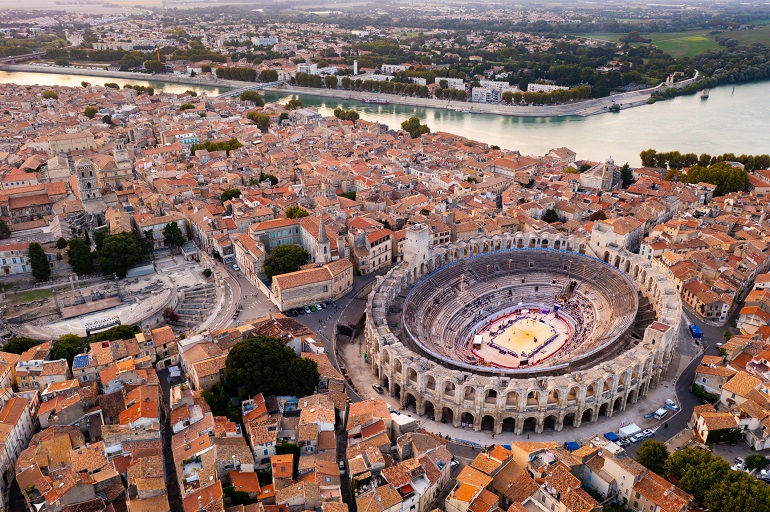
The star attractions is the superbly preserved Roman amphitheatre (Les Arènes), a witness of the importance of the Roman Arelete, which was the capital of southern Gaul, then of the whole Western Roman Empire in the 5th century.
Throughout ancient and medieval Arles was the biggest port in southern France, until the silting of the Rhône displaced maritime trade to Toulon and Marseille.
For 440 years in the Middle Ages, Arles was the seat of a Frankish Kingdom that stretched all the way to Burgundy and Switzerland in its heyday. It then served as the capital of the Counts of Provence. Teeming with Roman and Romanesque architecture, Arles was declared a World Heritage Site by the UNESCO in 1981.
The city is famously associated with Vincent van Gogh, who produced over 200 paintings during his 15-month stay, including some of his most iconic works. Beyond its rich historical and artistic heritage, Arles serves as an excellent starting point for exploring the wild Camargue region with its marshes, beaches and salt flats where visitors can observe pink flamingos and wild horses. While the city has a slightly unpolished and gritty charm compared to nearby Avignon, it offers vibrant pedestrian zones, hidden squares, and cafés that come alive during festivals.
Interesting Facts about Arles
- Arles was founded by the Ligurians around 800 BCE and later became a major Roman city.
- The Roman and Romanesque monuments of Arles have been UNESCO World Heritage Sites since 1981.
- The Arles Amphitheatre, built in 90 CE, could hold over 20,000 spectators and is still used today for events like bullfighting and concerts.
- Vincent van Gogh lived in Arles and created over 200 paintings, including "Starry Night Over the Rhône" and "Bedroom in Arles."
- The city served as the headquarters for Roman Emperors during military campaigns in the 4th and 5th centuries.
- Arles is located on the Camargue plain, where the Rhône River divides to form its delta, offering unique natural landscapes with flamingos and wild horses.
- It is the largest commune in France by land area.
- The House of the Harpist, discovered in Arles, features frescoes dating back to 70-50 BCE.
- The city hosts an annual international photography festival, which began in 1970.
- Arles was once a key trading port during the Roman era but has since shifted inland due to river silting.
- Arles is the hometown of the fashion designer Christian Lacroix.
History
The area was first inhabited by the Ligurians around 800 BCE, later experiencing Celtic and Phoenician influences before the Romans took control in 123 BCE. The Romans transformed Arles into a significant city, building a canal connecting it to the Mediterranean Sea in 104 BCE. During Julius Caesar's campaign, Arles sided with him against Pompey, and as a reward, it was established as a colony for veterans of the Roman legion Legio VI Ferrata. The city flourished under Roman rule, earning the nickname "little Rome of the Gauls" by the fourth-century poet Ausonius.
Arles reached its zenith of influence during the 4th and 5th centuries when Roman Emperors frequently used it as their headquarters during military campaigns. It became a favourite city of Emperor Constantine I, who built baths there, and was the birthplace of his son, Constantine II. After the fall of the Roman Empire, Arles experienced a tumultuous period. In the 10th century, it became the capital of the kingdom of Burgundy, later known as the kingdom of Arles. The 12th century saw Arles emerge as an independent entity similar to Italian republics, with Holy Roman Emperor Frederick Barbarossa travelling there in 1178 for his coronation. During this period, the city underwent unprecedented expansion, with a population of 15,000 to 20,000 inhabitants.
The Middle Ages witnessed significant changes to Arles' Roman structures. The magnificent amphitheatre, built around 90 CE with a capacity for 21,000 spectators, was transformed into a fortified city during this period. Four defensive towers were added, and inside the arena, houses, two chapels, and even a public square were constructed. In 1239, Arles was absorbed into Provence, with its prominence gradually eclipsed by Marseilles. Today, visitors can still marvel at the city's remarkable Roman monuments, including the amphitheatre, theatre, baths, and circus, which have been listed as UNESCO World Heritage sites since 1981. These architectural treasures stand as testament to Arles' significant role throughout European history.
Main Attractions
Roman Amphitheatre (Les Arènes d'Arles)
The UNESCO-listed Roman Amphitheatre, dating back to 90 CE, is one of the most impressive ancient monuments in Arles. Inspired by Rome's Colosseum, this elliptical structure features over 120 arches spread across two levels, with a series of galleries and staircases. The amphitheatre could originally accommodate around 20,000 to 22,000 spectators, who gathered to watch gladiatorial battles, chariot races, and theatrical performances.
During the fall of the Western Empire in the 5th century, the amphitheatre was transformed into a fortress with four towers, encircling more than 200 houses and becoming a small town within itself. It even had its own public square in the centre of the arena and two chapels. Today, the amphitheatre has been restored to its former glory and can seat up to 12,000 people. It continues to be a popular venue for bullfights, gladiator reenactments, concerts, and other cultural events.

Roman Theatre (Théâtre Antique)
Adjacent to the amphitheatre lies the Roman Theatre, another remarkable testament to Arles' Roman heritage. Built during the reign of Emperor Augustus in the 1st century BCE, this theatre could originally seat 8,000 spectators. Although much of the original structure has been lost to time, the space still retains its historical atmosphere and continues to be used for open-air theatre productions.
The theatre is now part of the UNESCO World Heritage site in Arles, along with other Roman and Romanesque monuments in the city. Visitors can explore the remaining structures and get a sense of what the grand theatre might have looked like in its heyday.
Les Alyscamps
Les Alyscamps is an ancient Roman necropolis that later became a prestigious Christian burial ground. This fascinating site was once one of the most famous necropolises of the ancient world. The name "Alyscamps" comes from the Provençal Occitan word "Aliscamps", which in turn derives from the Latin "Elisii Campi" (Elysian Fields).
From the 4th to the 12th century, Les Alyscamps became an important Christian burial site, with several bishops and Saint Genesius - a Roman civil servant beheaded in 303 CE for refusing to persecute Christians - being interred there. The necropolis was located along the final segment of the Aurelian Way leading to the city gates, showcasing elaborate monuments and sarcophagi of wealthy citizens.
Today, visitors can stroll through the tree-lined site, observing the many tombs and gravestones. While many of the structures are in a state of disrepair, they collectively create a hauntingly beautiful atmosphere. The site surrounds a 12th-century medieval church and was even the subject of one of Vincent van Gogh's paintings.
Place de la République
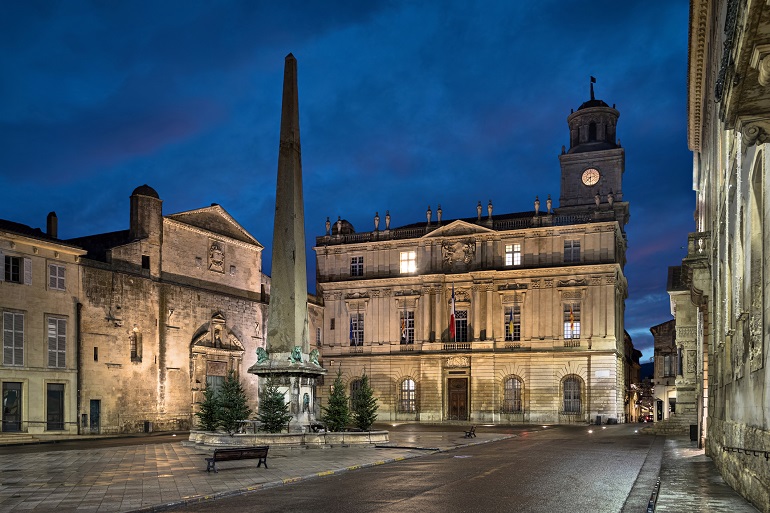
The Place de la République is the imposing central square of Arles, surrounded by several impressive buildings that showcase the city's rich architectural heritage. Notable structures around the square include the Archbishop's Palace, the Hotel de Ville (Town Hall), and the Cathédrale de St Trophime.
At the centre of the square stands a giant obelisk, which was brought from the site of the Roman Circus. Throughout the square, visitors can find 49 statues and brass plates depicting the Lion, which is the ensign of Arles. This symbol was borrowed from the emblem of the Roman VI Legion that was once stationed in the city under Caesar.
The square serves as a focal point for the city and is an excellent place to begin exploring Arles' historical centre. Its grand architecture and historical significance make it a must-visit location for anyone interested in the city's past and present.
Church of St. Trophime and its Cloister
The Church of St. Trophime, located near the Place de la République, is one of the most important Romanesque monuments in Provence. Built between the 11th and 12th centuries, it exemplifies Arles' renewed prominence in the Mediterranean during this period. The church is dedicated to St. Trophimus, the first bishop of Arles.
The church's facade is particularly noteworthy, featuring intricate Romanesque sculptures depicting biblical scenes and figures. Inside, visitors can admire the nave and various chapels, each with its own unique artistic and historical significance.
Adjacent to the church is its cloister, which is equally impressive. The cloister features beautifully carved columns and capitals, showcasing various scenes from the Bible and the lives of saints. Together, the Church of St. Trophime and its cloister form an essential part of Arles' UNESCO World Heritage site.
Van Gogh Self-Guided Walking Tour
Although not a single attraction, the Van Gogh Self-Guided Walking Tour is a unique way to experience Arles through the eyes of the famous post-impressionist painter. Vincent van Gogh spent a significant period in Arles, during which he created some of his most famous works.
The tour includes 11 painting sites throughout the city, allowing visitors to stand in the very spots where Van Gogh set up his easel. Notable locations include the famous "Café Van Gogh" (also known as "The Night Café") and the site where he painted "Starry Night Over the Rhone".
This self-guided tour not only provides insight into Van Gogh's artistic process but also offers a unique perspective on the city of Arles itself. It's an excellent way to combine art appreciation with exploration of the city's streets and landmarks.
Top Museums
Musée Départemental Arles Antique
Often referred to as the "Blue Museum" due to its striking exterior, this museum houses an exceptional collection of Roman and antique artefacts. The museum showcases 1,800 objects, including some remarkable pieces such as a bust presumed to represent Julius Caesar and a 31-metre-long Roman barge recovered from the Rhone River. The Hortus garden, designed in the form of a Roman circus, provides a verdant space between the museum and the city centre. Visitors can explore the museum's well-preserved mosaics and sculptures, gaining insight into the daily lives of ancient Romans. The museum also offers temporary exhibitions that delve deeper into specific aspects of Roman history and culture.
Musée Réattu
Situated in a 15th-century priory overlooking the Rhône river, the Musée Réattu offers a diverse collection of artworks. While it features works by neo-classical painter Jacques Réattu and his uncle Antoine Raspal, the museum's true treasures lie in its contemporary pieces. It boasts an impressive collection of works by Pablo Picasso and fashion designer Christian Lacroix. Additionally, the museum holds France's first collection devoted to photography and showcases works by prominent 20th and 21st-century artists. The building itself is a work of art, with its stunning architecture and beautiful views of the river. The museum often hosts temporary exhibitions that highlight the intersection of art and culture in Arles.
Fondation Vincent van Gogh
Although it doesn't possess a permanent collection of van Gogh's works, this gallery dedicates itself to the artist's legacy. The foundation hosts ambitious exhibitions featuring loaned works by van Gogh and modern artists influenced by him, offering visitors a unique perspective on the master's enduring impact. The exhibitions are carefully curated to explore themes and motifs that were central to van Gogh's oeuvre, such as his fascination with light and colour. The foundation also organises workshops and events that encourage visitors to engage with van Gogh's artistic vision.
Muséon Arlaten
Recently reopened after an extensive renovation, the Muséon Arlaten celebrates Provençal traditions. Created by Nobel Prize-winning poet Frédéric Mistral, the museum is housed in the 15th-century Hôtel Laval Castellane. It features a stunning staircase designed by Christian Lacroix and exhibits a wide range of artefacts, including costumes, furniture, and tools from the Arles region. The museum provides a glimpse into the daily lives of people in Provence, showcasing traditional crafts and customs. Visitors can explore the beautifully restored rooms and learn about the cultural heritage of the area.
Musée de la Camargue
Located just outside Arles, this museum offers an excellent introduction to the Camargue region. Housed in a former sheep barn, it features interactive displays that explore the area's geography, history, and culture. The museum's section on bull ranching and the Camargue cowboy culture is particularly fascinating. Visitors can also explore a discovery trail through the surrounding landscape, showcasing typical Camargue features such as salt pans and wetlands. The museum highlights the unique biodiversity of the region and the importance of conservation efforts.
Chapelle Sainte Anne
This austere yet beautiful deconsecrated church in the heart of Arles now serves as a contemporary art space. The large, harmonious interior hosts visiting exhibitions by contemporary artists, providing a stark contrast to the ornate Église Saint Trophime opposite. The chapel's simplicity allows the artworks to take centre stage, creating a powerful and immersive experience for visitors. The exhibitions often feature local artists, offering a glimpse into the vibrant contemporary art scene in Arles.
These museums collectively offer a comprehensive journey through Arles' rich history, from its Roman past to its vibrant contemporary art scene, making the city a veritable open-air museum for visitors to explore. Whether you're interested in ancient history, modern art, or regional culture, Arles has something to offer.
Local Cuisine
The local cuisine is a vibrant blend of Mediterranean flavours, featuring an array of fresh produce and traditional dishes. Visitors can indulge in Taureau de Camargue, a renowned bull meat specialty often served in stews or as sausages, and Saucisson d'Arles, a sausage made from beef and pork. Other must-try dishes include Soupe de Poisson, a hearty fish soup, and Soupe Courte Arlésienne, a thick stew-like soup made with mutton and Riz de Camargue, a prized rice variety. The bustling Saturday market in Arles is a culinary highlight, offering a wide range of local delicacies such as Tellines, small clams cooked with olive oil and garlic, and Riz de Camargue. For a truly immersive experience, explore the local bakeries for Fougasse, a traditional Provençal bread.
Shopping
Arles boasts a rich shopping scene with a mix of concept stores, artisan boutiques and markets. In the historic centre, you'll find charming shops like Sol y Sombra for fashion and décor, Mosquito for Camargue-inspired gifts, and Milsix workshop for handcrafted leather bracelets. For unique local creations, visit Marius, a cooperative boutique showcasing handmade items from regional artisans. Maison Madame Presse offers locally made wares including clothing, home goods and beauty products. Food enthusiasts should explore La Cave des Saveurs for regional wines and delicacies, or La Fromagerie Arlésienne for fine cheeses and cured meats. Don't miss the vibrant markets held on Wednesdays and Saturdays along Boulevard des Lices, featuring over 450 stalls selling everything from fresh produce to clothing. For mainstream shopping, the Shopping Promenade centre in the north of the city houses major brands specialising in fashion, home décor, sports and more.
Nature in and around Arles
Arles serves as a gateway to several natural attractions. The Camargue Regional Natural Park is a notable destination, featuring vast marshes, salt ponds, and wetlands that are home to pink flamingos, Camargue white horses, and black bulls. Visitors can explore this unique ecosystem through guided tours, such as 4x4 safaris, which allow them to observe the diverse wildlife and learn about local traditions. Additionally, the Alpilles Regional Natural Park offers scenic landscapes of olive groves, vineyards, and limestone cliffs, accessible via off-road excursions. For those interested in beaches, the fine sandy shores near Arles provide a pleasant spot for relaxation. The Vaccarès pond is another highlight, known for its birdlife, including pink flamingos.
Getting There & Around
To reach Arles, you can take the train, which is a convenient option. Trains from Marseille take under an hour, while those from Avignon take about 30 minutes. If you're coming from Aix-en-Provence, you'll need to change trains at Marseille. Once in Arles, getting around is relatively easy. The city centre is pedestrian-friendly and most attractions are within walking distance. For those who prefer not to walk, there are buses available, such as the one from the train station to the city centre, which takes about four minutes and costs between €1 and €3. Alternatively, you can take a taxi for a quicker journey. If you're driving, be aware that parking can be challenging, but there are options available across the Rhône River. Overall, Arles is a charming city best explored on foot to fully appreciate its historic charm.
Best Time to Visit
The best time to visit Arles is during the spring and autumn seasons, when the weather is mild and pleasant. Spring, from March to May, offers a lovely backdrop of blooming flowers and fewer tourists, making it ideal for exploring the town's historic sites and enjoying outdoor activities. Autumn, from September to November, provides warm days with fewer crowds, allowing for a more relaxed experience of Arles' Roman ruins and cultural events. Summer is the peak tourist season, with hot weather and lively festivals, but it can be quite crowded and expensive. Winter, though mild, is less popular due to cooler temperatures and fewer outdoor activities, but it offers a peaceful atmosphere and lower prices. Overall, spring and autumn are the most recommended times for a well-rounded visit to Arles.