France Guide  |
|---|
|
| | Top French Cities |
|---|
|
| | French Regions |
|---|
|
| | Photos |
|---|
|
| | Europe Guide |
|---|
|
| | Travel Tools |
|---|
|
|
|
|
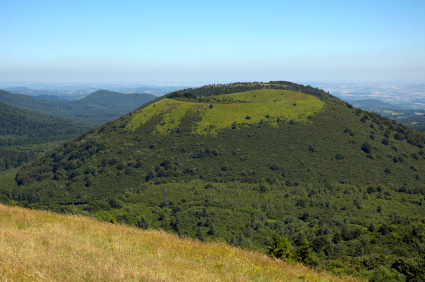 Puy de Côme, Auvergne. Puy de Côme, Auvergne.
Introduction

Expanding over much of the Massif Central, Auvergne is the land of volcanoes. Its dozens of picturesque verdant lava domes, that famously features on the bottles of Volvic mineral water, are one of France's great natural attractions.
Slightly larger than the historical province of Auvergne, the present-day region also incorporates most of the old Duchy of Bourbon, also known as Bourbonnais (now forming the Allier department), and small parts of Gévaudan, Vivarais and Forez (all within the Haute-Loire department). Auvergne is the least densely populated mainland French region after the adjacent Limousin. The Auvergnat dialect of Occitan is still widely spoken or understood by over half of the population.
Cured pork, cabbage, lentils, potatoes and cheese play an important role in the local cuisine. Culinary specialities from Auvergne include aligot (melted cheese blended into mashed potatoes), truffade (a thick pancake made with shredded potatoes mixed with thin strips of tomme cheese), potée auvergnate (stew of cabbage, potatoes, lard and sausages), tripoux (sheep offals with vegetables and herbs), and bourriol (buckwheat crêpe). In the dessert section we find the tarte de Vic (tart made with curd, eggs, sugar an tomme cheese) and piquenchâgne (a kind of pear pie). The region also possesses several renowned cheeses, such as Bleu d'Auvergne, Cantal, Chambérat, Fourme d'Ambert, Gaperon, Salers and Saint-Nectaire.
Famous people from Auvergne include (chronologically): the mathematician and physicist Blaise Pascal, the revolutionary leader Gilbert du Motier, marquis de Lafayette, the industrialists André and Édouard Michelin (founders of the Michelin company and guidebooks), President Georges Pompidou, the F1 manager and FIA president Jean Todt, and the TV presenter Claire Chazal.
History
The Auvergne region derives its name from the Arverni, a powerful Celtic tribe who established control over this volcanic landscape of central France around the Bronze Age. Archaeological evidence indicates human habitation dating back to at least 10,000 BCE, with settlements becoming more numerous during the Bronze Age when Celtic peoples arrived and formed distinct communities. The Arverni tribe became renowned for their fierce resistance to Roman expansion, culminating in Vercingetorix's legendary stand against Julius Caesar's legions. In 52 BCE, Vercingetorix initially defeated Caesar at the Battle of Gergovia, fought approximately seven miles from present-day Clermont-Ferrand, before ultimately succumbing to Roman forces at Alesia in Burgundy. Following this conquest, Auvergne was absorbed into the Roman Empire as part of Aquitaine, enjoying considerable prosperity during the Roman period through Christianisation by Saint Austremoine. After brief Visigothic rule, the region was conquered by the Franks in 507 CE, marking the beginning of its medieval transformation.
During the early medieval period, Auvergne evolved from a county within the Duchy of Aquitaine into a crucial component of the Angevin Empire before reverting to the French royal domain. The 10th to 13th centuries witnessed Auvergne's golden age of architectural and religious development, characterised by the construction of magnificent Romanesque churches and abbeys that remain amongst France's finest medieval monuments. The region became central to European Christianity when Pope Urban II convened the historic Council of Clermont in 1095, launching the First Crusade from Auvergne soil. Le Puy-en-Velay emerged as one of Christianity's most important pilgrimage destinations in 950 CE, serving as the starting point for the Via Podiensis, one of four major pilgrimage routes to Santiago de Compostela that remains a UNESCO World Heritage site today. The region's five major Romanesque churches, including the Basilique Notre-Dame-du-Port in Clermont-Ferrand and the cathedral at Le Puy-en-Velay, established the distinctive "Auvergne School" of Romanesque architecture, featuring characteristic ambulatories, radiating chapels, and polychromatic volcanic stone construction. King Philippe-Auguste formally annexed Auvergne to the French crown in 1213, ending its autonomous status whilst preserving its rich cultural heritage.
The region endured significant hardships during the Hundred Years' War, religious conflicts of the 16th century, and subsequent epidemics that forced substantial emigration to other parts of France and beyond. Economic revival arrived during the Napoleonic era, with the Second Empire bringing prosperity through the 1858 completion of the Paris-Clermont-Ferrand railway line. During World War II, Auvergne became a stronghold of French Resistance, with Mont Mouchet serving as the largest gathering point for maquisards in 1944. The fierce Battle of Mont Mouchet in June 1944 resulted in 4,000 casualties on both sides, with 238 French Resistance fighters killed and 180 wounded before German forces were ultimately repelled. The region's geological foundation rests upon the ancient Massif Central, where volcanic activity spanning millions of years created the distinctive landscape of extinct volcanoes, including the Chaîne des Puys, which experienced its last eruptions merely 3,000-4,000 years ago. In 1790, the historic province was divided into the modern départements of Puy-de-Dôme, Cantal, Haute-Loire, and Allier, though the region maintained its agricultural character renowned for distinctive products shaped by its volcanic terroir.
Cuisine
Auvergne sits on volcanic highlands whose fertile basalt soils and cool, humid climate nurture a rustic cuisine focused on sustenance for mountain farmers. The environment supports extensive cattle and pig rearing, making dairy and pork the cornerstones of local dishes. The region boasts five protected-designation cow’s-milk cheeses—Saint-Nectaire, Bleu d’Auvergne, Fourme d’Ambert, Cantal and Salers—served from aperitif to dessert. Its volcanic slopes also grow the tiny Lentilles Vertes du Puy, France’s first PDO-protected legume, prized for their nutty flavour and ability to hold shape when cooked. Aligot, a silky ribbon of mashed potato, Tomme fraîche and garlic, remains the emblematic comfort food and is traditionally twirled tableside alongside grilled sausage. Truffade sautés potato slices with Cantal or Tomme until the cheese forms a golden crust, while patranque thickens leftover bread with the same curds for a shepherd’s supper. Cabbage-based one-pot meals such as Soupe au Chou and Potée Auvergnate blend vegetables with salted pork or lard for hearty winter fare. Travellers seeking local curiosities can sample pounti, a sweet-savory loaf of minced pork, herbs and prunes, or tripoux, sheep tripe parcels slow-braised in stock. Herds of Salers cows supply both richly marbled beef and high-fat milk for cheese making. Neighbouring Charolais cattle from Allier contribute tender beef cuts prized across France. The cool mountain air is ideal for curing IGP-labelled Jambon d’Auvergne and saucisson sec d’Auvergne. Spring streams yield trout, pike and zander, while autumn menus feature venison, wild boar and forest mushrooms foraged in the chestnut woods. Sweet endings include blackberry caramels or chocolate-coated galets de la Cère, often paired with one of five Côtes d’Auvergne crus or lighter Vin de Pays du Puy-de-Dôme.
Attractions
Département de l'Allier
| Moulins |
|---|
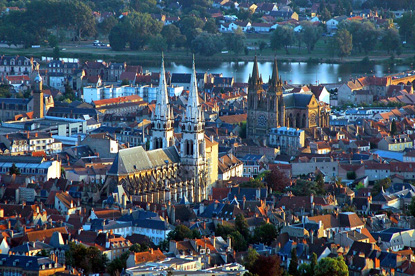
 As the historic capital of the Bourbon dukes, Moulins is a designated Town of Art and History. This charming Auvergne town features a medieval quarter with half-timbered houses, a magnificent cathedral housing the Master of Moulins' Triptych, and the unique National Centre for Stage Costume. |
Département de la Haute-Loire
| Brioude |
|---|
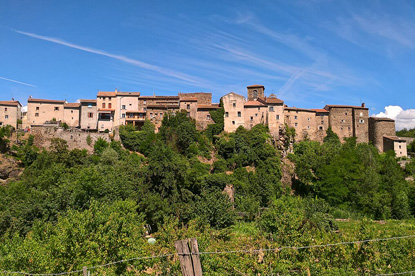
 Historic Brioude, one of France's 'Plus Beaux Détours', boasts the magnificent Saint-Julien Basilica—Auvergne's largest Romanesque church with 3 Michelin stars. This charming Haute-Loire town features colourful facades, medieval streets, vibrant arts culture, and lies on ancient pilgrimage routes. |
| Polignac |
|---|
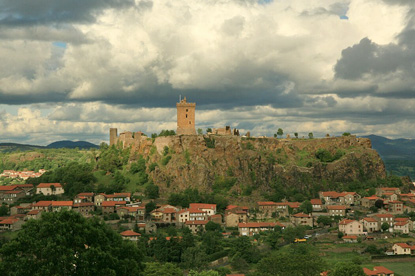
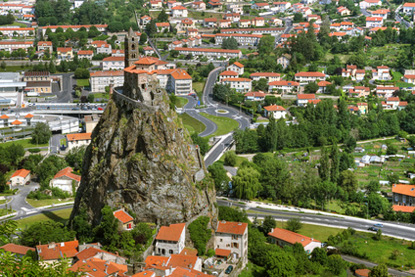
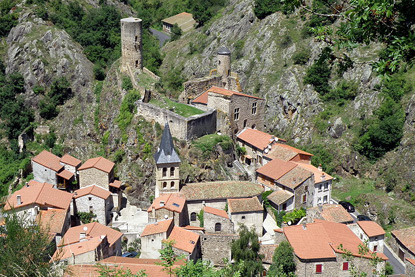
One of France's 'Most Beautiful Villages', Polignac is dominated by a colossal medieval fortress perched on a volcanic hill. The ancestral seat of an illustrious noble family, it offers breathtaking panoramic views of the Auvergne from its well-preserved 32-metre-high keep and ramparts. |
Other attractions
 Chavaniac-Lafayette Castle
Lavaudieu Abbey
Département du Cantal
| Val Castle |
|---|
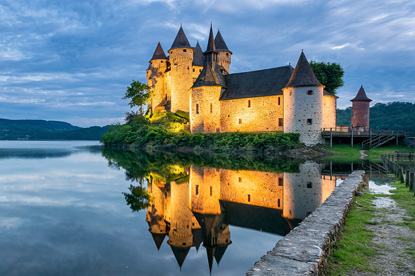
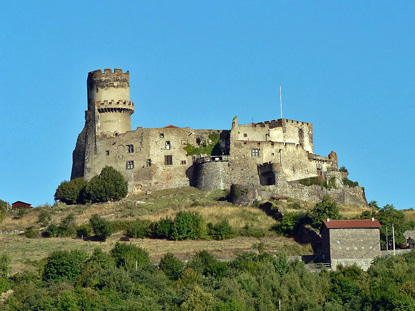
Picturesque 15th-century castle with six towers, dramatically surrounded by Lake Bort-les-Orgues waters. Built by Guillaume d'Estaing, this fairy-tale fortress offers guided tours through furnished medieval rooms, art exhibitions, and breathtaking lakeside views. |
| Gentiane express |
|---|
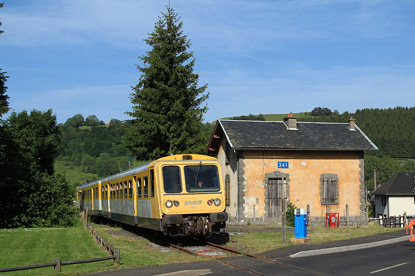
Vintage tourist railway journey through the spectacular Cézallier plateau at 1,020m altitude. This charming heritage train runs from Riom-ès-Montagnes to Lugarde, offering panoramic views of the Sancy and Cantal massifs, summer pastures, and gentian meadows. |
| Pleaux |
|---|
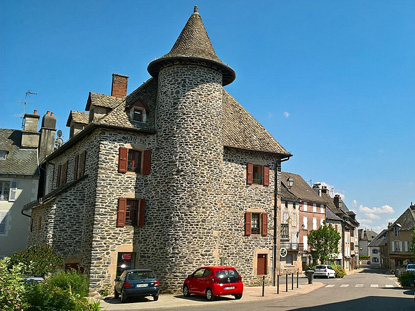
A delightful Small Town of Character in Cantal, Pleaux is a medieval bastide founded in 1289 with five historic turreted houses and a listed church. Set in the verdant bocage countryside of the Xaintrie region, it showcases traditional basalt and granite architecture. |
| Truyère Gorges |
|---|
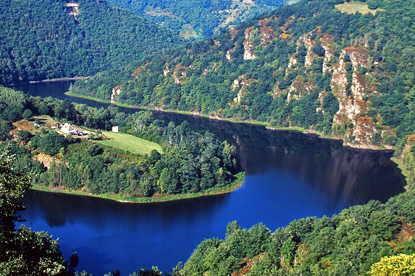
 Dramatic gorges carved by the Truyère river through granite plateaux, with cliffs up to 300m high, artificial lakes from hydroelectric dams, and Gustave Eiffel's iconic Garabit Viaduct. Offers hiking, water sports, and scenic drives with spectacular viewpoints. |
| Aurillac |
|---|
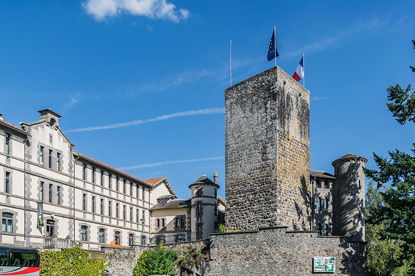
As Cantal's capital, Aurillac is a bustling town nestled at the foot of the Auvergne mountains. Its historic centre's cobbled streets come alive each August for the renowned International Street Theatre Festival, one of Europe's largest street art events. |
| Murat |
|---|
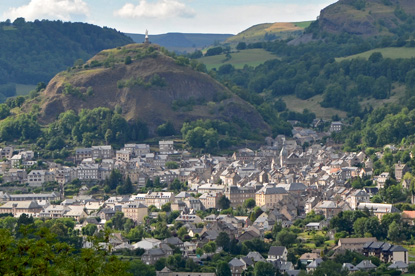
Murat is a charming medieval town nestled at the foot of Rocher de Bonnevie in the Auvergne Volcanoes Natural Park. This historic trading hub features beautiful stone houses built from local basalt and offers excellent hiking amid spectacular volcanic landscapes. |
| Tournemire |
|---|
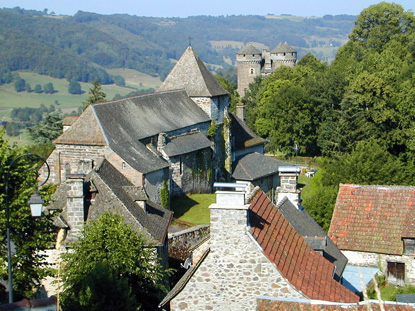
Perched dramatically on a hillside in the Doire valley, this enchanting village ranks among France's Most Beautiful Villages. The imposing 15th-century Château d'Anjony dominates the landscape, whilst a 12th-century Romanesque church and volcanic stone houses complete the picturesque scene. |
Other attractions
Alleuze Castle
Anjony Castle
Boisset
La Vigne Castle
Mauriac
Maurs
Montsalvy
Riom-ès-Montagnes
Super-Lioran
Vic-sur-Cère
Volvic
Département du Puy-de-Dôme
|
Volcanoes of Auvergne Regional Park ※ |
|---|
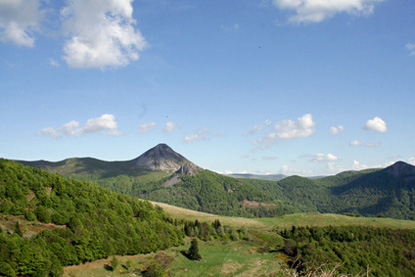
 The Auvergne Volcanoes Regional Nature Park offers visitors a unique geological experience with its 80 volcanoes spread across 395,000 hectares, making it the largest Regional Nature Park in mainland France. This UNESCO World Heritage Site features four distinct volcanic massifs—the Chaîne des Puys, the Monts Dore, the Cézallier, and the Monts Cantal—alongside the Artense granite plateau, creating a living open-air museum where ancient volcanic fires have given way to wild flower pastures, forests and brilliant greenery. Visitors can explore the iconic Puy de Dôme, where Romans built a temple to Mercury, or ascend Puy de Sancy, the highest point in the Massif Central at 1,885 metres. The park provides numerous hiking trails for all ability levels, offering breathtaking panoramic views, whilst attractions like Vulcania, the European volcanology park, provide interactive educational experiences about volcanic phenomena. Beyond its geological wonders, the park boasts exceptional biodiversity, peaceful lakes, historical sites such as Murol Castle, and the Romanesque churches of Orcival and Saint-Nectaire. |
| Royat |
|---|
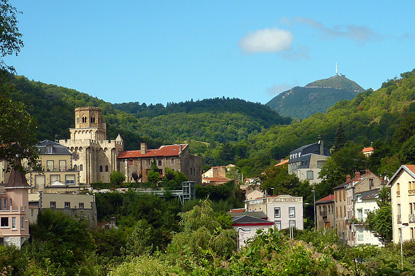
 Elegant Belle Époque spa town in Auvergne, renowned for thermal springs and 19th-century architecture. Located 3km from Clermont-Ferrand, Royat features grand thermal baths, ornate villas and palatial hotels amid volcanic Puy-de-Dôme scenery. |
| Saint-Nectaire |
|---|
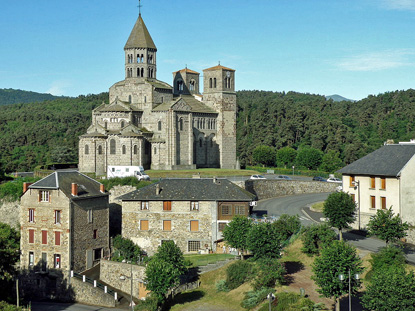
Cradle of the renowned Saint-Nectaire cheese, this Auvergne village is famed for its magnificent 12th-century Romanesque church. A historic spa town with 19th-century villas, it offers unique petrifying fountains and scenic walks in the beautiful Sancy foothills. |
| Usson |
|---|
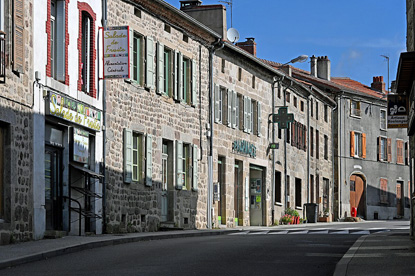
Perched atop a volcanic peak, this ‘Most Beautiful Village of France’ was famously Queen Margot’s place of exile. It offers superb panoramas of the Chaîne des Puys and a timeless atmosphere amid its historic, fortified streets, which feel frozen in time. |
|


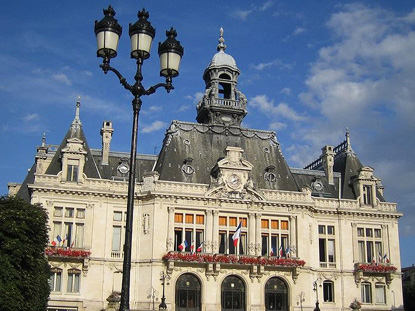

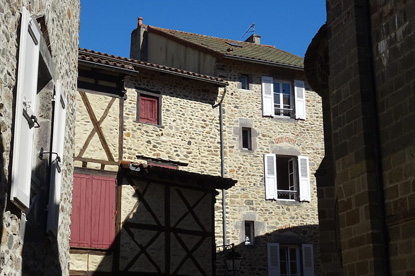
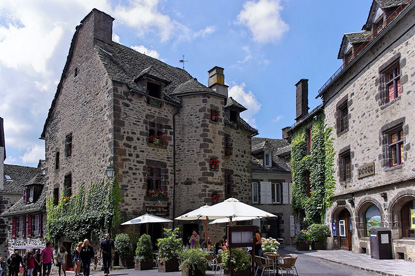
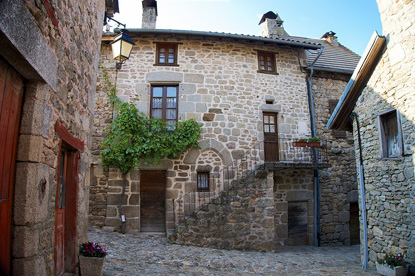
 One of France’s Most Beautiful Villages, Salers offers a journey back in time with its medieval and Renaissance architecture. Its grand houses, featuring distinctive turrets, are built from dark volcanic stone and enclosed by historic ramparts, creating a unique and atmospheric destination.
 : Local interest
 : Moderately interesting
 : Outstanding place
 : Must-see in the country
 : Top cities in Europe