


Introduction
The Château de Commercy is an 18th-century French Baroque palace commissioned in 1708 by Charles Henri de Lorraine, Prince of Vaudémont, to designs by renowned architects including Germain Boffrand, , the architect of the châteaux of Lunéville and Haroué, and Nicolas d'Orbay, with the palace completed in 1747. The château served as the principal residence for successive members of the House of Lorraine, notably Élisabeth Charlotte d'Orléans, Duchess then Regent of Lorraine and Bar, before becoming home to Stanislas Leszczyński, the former King of Poland and father-in-law of Louis XV, after whom it became known locally as Château Stanislas. During Stanislas's tenure from 1744 to 1766, the palace reached its golden age, hosting notable figures including Voltaire and Émilie du Châtelet.
Following centuries of military use and periods of neglect, including significant fire damage during the Second World War, the château was acquired by the city of Commercy in 1957 and underwent extensive restoration completed in 1977. Today, this Monument historique houses the town hall, municipal library, and various administrative offices, preserving its architectural heritage whilst serving the local community.
Interesting Facts about the Château de Commercy
- The palace was commissioned in 1708 by Charles Henri de Lorraine, Prince of Vaudémont, and designed by the celebrated architect Germain Boffrand, giving it an elegant French Baroque profile.
- Also known as Château Stanislas, it later became a favoured residence of Stanislas Leszczyński, the deposed King of Poland and father-in-law to Louis XV.
- Élisabeth Charlotte d’Orléans, niece of Louis XIV and Dowager Duchess of Lorraine, resided here and presided over a lively courtly life in the 1730s and 1740s.
- Voltaire, Émilie du Châtelet, and Saint-Lambert famously spent the summer of 1748 at Commercy, adding an Enlightenment sparkle to its salons.
- According to local legend, Madeleine Paulmier’s visit in 1755 helped lend her name to the madeleine, the little shell-shaped cake now synonymous with Commercy.
- After severe damage by fire in 1944, the palace underwent a major restoration completed in 1977, reviving its horseshoe-shaped forecourt.
- Classified as a Monument historique (site, château, and grounds) in the 20th century, it stands as a protected jewel of Lorraine’s architectural heritage.
- Today the palace serves civic life as the town hall and municipal library, uniting regal history with everyday community use.

History
The Château de Commercy boasts a remarkable history spanning over three centuries, beginning with its construction in 1708 by Charles Henri de Lorraine, Prince of Vaudémont, the legitimised son of Charles IV, Duke of Lorraine. This magnificent French Baroque palace was designed by the renowned architect Germain Boffrand, who simultaneously worked on the nearby Château de Lunéville, with additional contributions from Léopold Durand, Nicolas d'Orbay, and Emmanuel Héré de Corny. The construction took nearly four decades to complete, finishing in 1747, and served as the principal residence of the reigning Prince of Commercy. Upon Charles Henri's death without heir in 1723, the palace passed to his cousin Léopold, Duke of Lorraine, and subsequently to Léopold's son Francis III of Lorraine, who would later marry Empress Maria Theresa of Austria. The palace's early ownership remained within the prestigious House of Lorraine until the conclusion of the War of the Polish Succession in 1737.
Following the War of the Polish Succession, the palace entered its most illustrious period when the duchies of Lorraine and Bar were ceded to Stanislas Leszczyński, the former King of Poland and father-in-law to Louis XV of France. Initially, the Principality of Commercy was granted to Élisabeth Charlotte d'Orléans, the dowager duchess of Lorraine and niece of Louis XIV, who resided there until her death from a stroke on 23 December 1744. The palace then became the beloved retreat of King Stanislas, who transformed it into a centre of refined court life where etiquette was more relaxed than at the formal Château de Lunéville. During this golden age, the palace attracted distinguished visitors including the philosopher Voltaire, the brilliant mathematician Émilie du Châtelet, and the poet Jean-François de Saint-Lambert, who spent the summer of 1748 enjoying the château's hospitality. In 1755, the palace gained culinary fame when Madeleine Paulmier stayed there and, according to legend, inspired the creation of the famous gâteau Madeleine. The palace became so associated with this period that it was locally known as the Château Stanislas.
The palace's fortunes declined dramatically after Stanislas's death in 1766, when the duchies reverted to the French Crown and the building was converted into quarters for a local cavalry unit. Throughout the 19th century, the once-grand estate suffered from neglect as its magnificent gardens became overgrown, the great parterre and Grand Canal were destroyed, and the palace served various military purposes as garrison quarters. The 20th century brought further challenges when the château housed soldiers during the Second World War and was severely damaged by fire on 31 August 1944. Recognising the historical importance of this architectural treasure, the city of Commercy acquired the ruins from the state in 1957 and embarked on an ambitious restoration project that lasted twenty years until completion in 1977. The restoration included the reconstruction of the courtyard façade facing the town and the restoration of the handsome horseshoe-shaped square. Today, the palace serves a civic function, housing Commercy's town hall, municipal library, and several administrative offices, whilst maintaining its status as a Monument historique, classified in 1960.
Description
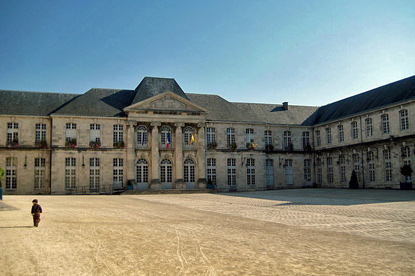
Château de Commercy, often called Château Stanislas, impresses with a perfectly balanced Baroque composition set around a broad, horseshoe-shaped forecourt that flows into the town’s main axis. The limestone façades are sober yet elegant, with rhythmic bays, tall sash windows, and restrained sculptural detail that emphasise symmetry and light. A ceremonial central pavilion and sweeping wings frame the court, while robust gateways and balustraded terraces lend a sense of theatre and approach.
Inside, the château follows a classic enfilade plan, with a sequence of stately rooms aligned for long, uninterrupted vistas and easy circulation during receptions. Floors are connected by broad staircases with wrought-iron balustrades and generous landings designed to accommodate the flow of court life. High ceilings, tall windows and reflective finishes channel natural light deep into the interiors, making the rooms feel airy and grand.
State rooms occupy the principal floor, beginning with an entrance vestibule that acts as a buffer between the bustle of the forecourt and the calmer ceremonial spaces. From here, visitors progress into the grand salon, a lofty reception room designed for musical performances and formal gatherings. Expect parquet de Versailles underfoot, stuccowork cornices, mirrored overmantels and a balanced palette of gilding and muted colour that frames the play of light from opposing windows.
Adjacent lies the salon d’apparat, a more intimate ceremonial sitting room used for presentations and private audiences. Its walls are typically articulated with boiseries—carved wooden panelling—punctuated by pier glasses and console tables, while fireplaces anchor the symmetry at either end. Decorative themes often draw on allegory and nature, with floral garlands, trophies and musical motifs that reflect the château’s role as a place of refined leisure.
A formal dining room offers a more grounded atmosphere, with darker woods, heavier draperies and fireplaces set for warmth during long meals. Here the proportions are generous but not overwhelming, designed for both convivial dinners and diplomatic entertaining. Service doors discreetly connect to corridors leading to the former kitchens and offices, ensuring staff could move unseen.
Private apartments are arranged as a suite of antechamber, bedchamber and cabinet, offering a graded transition from public to personal space. The bedchamber centres on a canopied bed placed ceremonially to command the room, with silk wall hangings and textiles softening the architecture. The cabinet—smaller and more secluded—served for reading, correspondence and conversation, often lined with bookcases or lacquered panels for a cocooning effect.
A chapel, modestly scaled yet richly detailed, provides a spiritual counterpoint to the social rooms. Light filters in to illuminate moulded pilasters, a gilded altar and restrained painted decoration, creating a contemplative atmosphere. Elsewhere, a library or reading room brings together panelled walls, tall book presses and a central table for maps and manuscripts, underlining the château’s role as both residence and seat of administration.
Throughout the interiors, the decorative language is cohesive: parquet floors set in elaborate patterns, marble chimneypieces with sculpted friezes, and chandeliers suspended from rosetted ceilings. Mirrors expand space and amplify daylight, while textiles—damask, brocade and velvet—add depth and warmth. Doorways are placed on axis to extend sightlines, reinforcing Baroque principles of order and perspective.
Secondary spaces—gallery corridors, service stairwells and mezzanine offices—are simpler, with painted plaster, stone treads and utilitarian joinery that contrast with the splendour of the formal rooms. These discreet back-of-house routes enabled smooth service during receptions and preserved the serenity of the main enfilade.
While the original gardens have largely vanished, interior rooms on the garden side still enjoy long, framed views, a reminder that the château was conceived as an interplay between architecture and landscape. Even today, the measured progression from forecourt to vestibule, from salons to private apartments, preserves the rhythm of an 18th-century residence designed for ceremony, conversation and comfort.
Practical adaptations have introduced civic functions without erasing the period character. Public rooms retain their grand proportions, historic finishes and ceremonial alignments, while offices and meeting spaces occupy former secondary areas. The result is a lived-in château that still delivers the essential experience of Baroque spatial drama: symmetry at the façade, procession in the plan, and a harmonious sequence of rooms that unfold with composure and grace.
Getting There
By train – Take the TER Grand Est service to Commercy station via the Nancy–Bar-le-Duc line; from the platform it’s a 10-minute walk straight along Avenue de la Gare to the palace gates.
By coach – Regional Fluo coaches linking Nancy, Toul and Saint-Mihiel stop at Place Charles de Gaulle, letting you off a short stroll from Commercy’s historic centre and an easy sign-posted walk to the palace.
By car – Follow the A4 autoroute to exit 30 (Void-Vaucouleurs), then continue north on the D964, which curves directly into Commercy; public parking is signed near the palace entrance, leaving only a brief walk through cobbled streets to the courtyard.
| Travel destinations in Lorraine | ||||||||||||||
|---|---|---|---|---|---|---|---|---|---|---|---|---|---|---|
|
|
|
|
| ||||||||||
|
|
|
|
| ||||||||||


