


| Contents |
|---|

Introduction
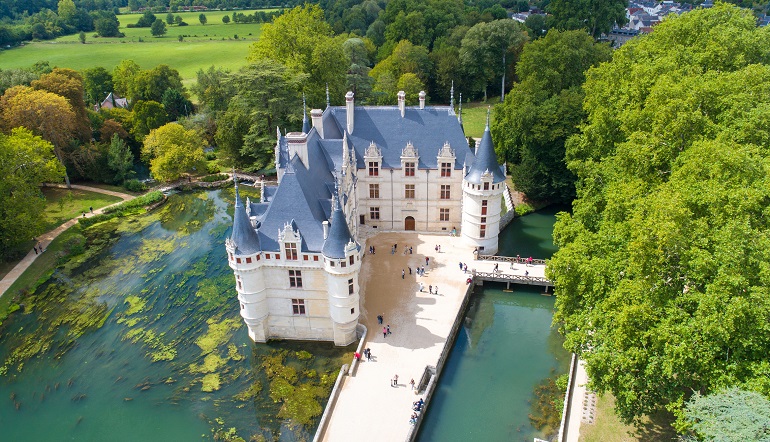
The Château d'Azay-le-Rideau is a renowned Renaissance masterpiece located in the Loire Valley, France. Constructed between 1518 and 1529 by Gilles Berthelot, a financier under King Francis I, the château combines French architectural traditions with Italian influences. It is situated on a small island in the Indre River, surrounded by a landscaped English-style park designed in the 19th century. The château features elegant façades, a grand staircase inspired by Italian designs, and interiors reflecting 19th-century restoration efforts by the Marquis de Biencourt. Since 1905, it has been owned by the French State and functions as a museum showcasing historic decorations, tapestries, and furniture. Visitors can explore its romantic grounds and learn about its architectural evolution through guided tours and exhibitions.
Interesting Facts about the château
- The Château d'Azay-le-Rideau was built between 1518 and 1527 during the reign of Francis I and is a prime example of early French Renaissance architecture.
- It is uniquely situated on an island in the Indre River, giving it a picturesque and reflective setting.
- The château was constructed by Gilles Berthelot, a financier of Francis I, but the project was overseen by his wife, Philippa Lesbahy.
- Its foundations were built on stilts driven into the damp ground of the island, showcasing remarkable engineering for its time.
- Originally planned as a quadrilateral structure, only two wings were completed, resulting in its distinctive L-shape.
- The château combines French architectural traditions with Italian Renaissance influences, making it an artistic masterpiece.
- In the 19th century, the Marquis de Biencourt restored the château, elevating it to its current architectural perfection.
- During the Franco-Prussian War, it narrowly escaped destruction when a falling chandelier was mistaken for an assassination attempt.
- In 1905, the French state purchased the château, preserving it as a historical monument and opening it to the public.
- Today, it is part of the Loire Valley UNESCO World Heritage Site and remains a symbol of Renaissance elegance.
History
The castle was built between 1518 and 1523 for Gilles Berthelot, Treasurer-General of the Finances of France under King Francis I and mayor of Tours. Berthelot's wife, Philippe Lesbahy, oversaw much of the building work, creating a masterpiece that blends traditional French architecture with innovative Italian influences. In 1523, suspected of collusion in embezzlement, Berthelot is forced to flee. The unfinished Azay-le-Rideau was then confiscated by the king, who bestowed it to Antoine de Raffin, captain of his Garde du Corps. The Raffin family remained owner of the castle until 1751.
Over the following centuries, the château passed through various noble families, each leaving their mark on the building and its surroundings. Notable visitors included King Louis XIII, who spent a night there in 1619, and his son Louis XIV. During the 19th century, the Biencourt family undertook significant renovations and created the romantic English-style park that surrounds the château today.
In 1905, facing financial difficulties, the Biencourt family sold the château to the French state. It has since been carefully preserved and restored, becoming a listed Historical Monument and part of the Loire Valley UNESCO World Heritage Site. Today, the Château d'Azay-le-Rideau is managed by the Centre des monuments nationaux and stands as a testament to the architectural splendour of the French Renaissance, attracting visitors from around the world to admire its elegant façades, grand staircase, and picturesque setting.
Description
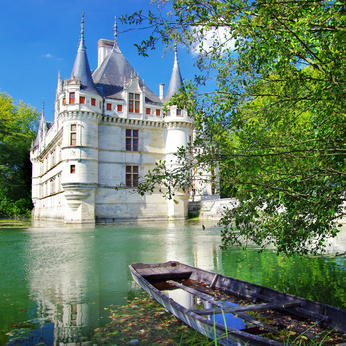
Nestled on an island in the Indre River, the Château d'Azay-le-Rideau stands as one of the most exquisite jewels in the crown of Loire Valley châteaux. This architectural masterpiece of the French Renaissance appears to float magically on the water, creating a romantic and picturesque tableau that has enchanted visitors for centuries. Built between 1518 and 1527, the château's elegant tuffeau stone façades gleam with a pearly white lustre in the sunlight, their reflections dancing on the surrounding water.
The château's exterior is a harmonious blend of French medieval tradition and innovative Italian Renaissance influences. Its distinctive L-shaped layout embraces the riverbank, whilst its corner towers, adorned with elegant conical roofs, evoke the medieval past. The façades feature exquisite decorative elements including medallions, pilasters, and dormer windows topped with pediments and finials. Particularly noteworthy are the château's ornate lucarnes (dormer windows) which punctuate the steep slate roofs, adding vertical emphasis to the structure's silhouette.
One cannot help but marvel at the perfect symmetry of the building, a hallmark of Renaissance design. The château's proportions are mathematically precise, creating a sense of balance and harmony that pleases the eye from every angle. As you approach across the stone bridge, the full splendour of this architectural gem gradually reveals itself, framed by the verdant landscape and mirrored in the tranquil waters below.
Interior Highlights
Stepping inside Azay-le-Rideau is to enter a world of Renaissance refinement and aristocratic elegance. The château's interiors have been meticulously restored to showcase the evolution of French decorative arts across the centuries. Each room tells its own story through its furnishings, artwork, and architectural details, offering visitors a glimpse into the lives of the château's various inhabitants throughout its long history.
The grand staircase, a masterpiece of French Renaissance architecture, serves as the château's centrepiece. This straight-flight staircase, revolutionary for its time, features an extraordinarily ornate carved ceiling with coffered panels. The balustrade displays delicate carved stonework with motifs including shells, candelabra, and mythological figures. As you ascend, notice how light floods in through large windows, illuminating the intricate carvings and creating a theatrical progression through the building.
The salons and royal apartments showcase an impressive collection of period furniture, tapestries, and objets d'art. The King's Chamber, prepared for a royal visit that never materialised, features a magnificent four-poster bed draped in rich fabrics. The ceiling displays the royal emblems of François I, including his famous salamander motif surrounded by his motto "Nutrisco et extinguo" ("I nourish and extinguish").
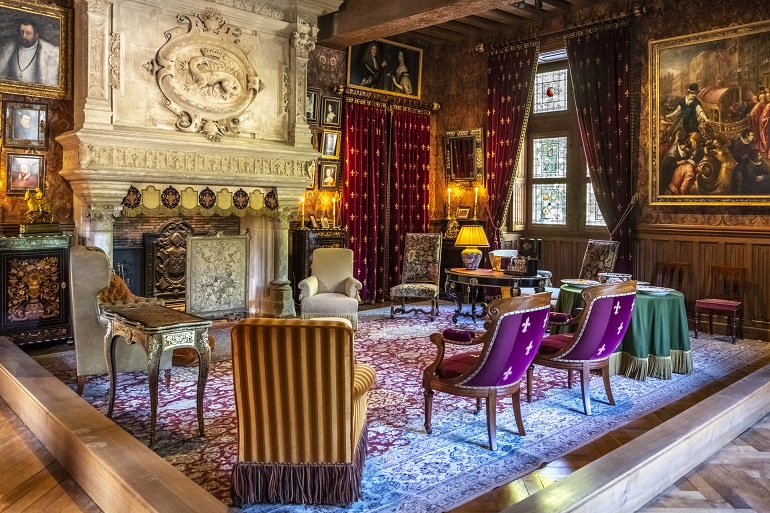
The Great Hall impresses with its monumental fireplace carved from tuffeau stone, adorned with Renaissance motifs and heraldic symbols. Above the mantelpiece, look for the coat of arms of the Berthelot family, the château's original builders. The room is furnished with imposing cupboards, tables, and chairs from the 16th and 17th centuries, while the walls display a collection of Flemish tapestries depicting hunting scenes and pastoral landscapes.
The Library, with its wood-panelled walls and collection of leather-bound volumes, offers a more intimate atmosphere. The ceiling features painted beams with floral motifs, while the parquet floor displays intricate geometric patterns. The room houses a remarkable 16th-century writing desk inlaid with mother-of-pearl and ivory, alongside comfortable reading chairs upholstered in damask.
The Romantic Park
Surrounding the château is an eight-hectare landscaped park designed in the English style during the 19th century. This verdant oasis provides the perfect setting for the architectural marvel at its heart, offering visitors a chance to experience the château from various vantage points whilst enjoying the tranquillity of nature. The park's design follows the principles of the picturesque, with carefully composed views that unfold as one strolls along its winding paths.
The landscape architect responsible for the park's redesign in the 1800s created a masterful composition that appears natural yet is meticulously planned. Gentle slopes, clumps of trees, and open meadows create a series of tableaux that frame the château from different angles. The undulating terrain guides visitors through a sensory journey, with surprises at every turn – here a glimpse of the château through a gap in the foliage, there a sudden opening revealing a panoramic vista across the water.
The park boasts an impressive arboretum featuring exotic tree species collected during the 19th century, when botanical exploration was at its height. Magnificent sequoias tower overhead, their reddish bark contrasting with the château's pale stone. Stately cedars of Lebanon spread their horizontal branches, creating natural canopies perfect for contemplation. Tulip trees display their distinctive leaf shape and produce spectacular yellow-green flowers in late spring. Perhaps most striking are the bald cypresses that stand sentinel along the riverbanks, their knees protruding from the water in curious formations.
Throughout the seasons, the park offers changing delights. In spring, drifts of narcissi and bluebells carpet the woodland floor, while flowering cherries and magnolias add splashes of colour. Summer brings lush greenery and the scent of lime blossoms, with the château's reflection shimmering in the heat haze above the water. Autumn transforms the landscape into a tapestry of russets, golds, and crimsons as the deciduous trees prepare for winter. Even in the colder months, the park retains its charm, with frost outlining each branch and mist rising mysteriously from the river.
Water Mirrors
The most enchanting feature of Azay-le-Rideau is undoubtedly its relationship with water. The château appears to rise directly from the Indre River, creating a magical effect that has inspired poets and artists for generations. To the south and west of the château, two expansive water mirrors were created by widening the river arm in the mid-20th century, enhancing this illusion and multiplying the beauty of the architecture through perfect reflections.
These water mirrors serve as liquid canvases that capture the château's image in remarkable detail. On still days, the reflection is so perfect that it creates a complete oval when combined with the actual building – a visual poetry that transforms solid stone into something ethereal and dreamlike. The play of light across these watery surfaces changes throughout the day, from the golden glow of morning to the fiery hues of sunset, each moment offering a different perspective on this architectural masterpiece.
The water mirrors also serve an ecological purpose, supporting a diverse aquatic ecosystem. Dragonflies hover above water lilies that bloom in summer, while kingfishers dart across the surface in flashes of electric blue. Grey herons can often be spotted standing motionless at the water's edge, patiently waiting for fish. This harmonious blend of architecture and nature creates a uniquely serene atmosphere that distinguishes Azay-le-Rideau from other Loire châteaux.
From certain vantage points in the park, the château and its reflection create a perfect symmetry, an optical illusion where it becomes difficult to distinguish where reality ends and reflection begins. Photographers particularly treasure the early morning hours when mist often hovers over the water, creating an otherworldly atmosphere as the château seems to float on clouds.
Exploring the Gardens
Beyond the English-style park, Azay-le-Rideau features more formal garden areas that complement the Renaissance architecture. To the east of the château lies a parterre garden divided into geometric beds edged with low box hedges. This area follows traditional French garden design principles, with symmetrical layouts and carefully clipped vegetation creating an outdoor extension of the château's ordered elegance.
The garden's central axis aligns perfectly with the château's eastern façade, creating a visual dialogue between architecture and landscape. Seasonal plantings bring colour and texture to this formal space – tulips and daffodils in spring give way to lavender and roses in summer, followed by dahlias and salvias in autumn. Ornamental urns placed at strategic intervals contain sculptural topiary, adding vertical elements that echo the château's towers.
Scattered throughout the grounds are charming garden structures that invite exploration. A rustic pavilion offers shelter and views across the park, while stone benches positioned at scenic spots encourage visitors to pause and absorb the beauty around them. An ornamental bridge spans a narrow section of the river, its elegant arch reflected in the water below, creating a perfect photo opportunity.
The park offers numerous footbridges and walkways over the river and its channels, inviting visitors to explore its peaceful corners. These crossings provide different perspectives of the château and its surroundings, from intimate glimpses through foliage to grand panoramas across the water. Sinuous alleys lead to surprising vantage points where one can admire both nature and architecture in harmony.
For those interested in horticulture, the gardens contain several rare and specimen plants labelled with botanical information. A collection of heritage roses blooms profusely in early summer, filling the air with their delicate fragrance. Elsewhere, a small kitchen garden demonstrates traditional vegetable growing techniques, with espaliered fruit trees lining its walls and herbs arranged in decorative patterns.
Architectural Details
A closer examination of Azay-le-Rideau reveals the extraordinary craftsmanship that went into its creation. The château's façades are a testament to the skill of Renaissance stonemasons who transformed the soft, creamy tuffeau limestone into intricate decorative elements. Look for the delicate sculpting around windows and doorways, where classical motifs such as acanthus leaves, egg-and-dart mouldings, and fluted pilasters demonstrate the Italian influence on French architecture of this period.
The château's windows deserve particular attention, as they showcase the evolution of architectural styles. The lower levels feature mullioned windows divided by stone crosses – a late Gothic element – while upper storeys display more classical proportions with rectangular openings framed by pilasters and pediments. This vertical progression illustrates the transition from medieval to Renaissance design principles.
Gargoyles and grotesques peer down from the roofline, their fantastical forms contrasting with the geometric precision of the architecture below. These sculptural elements served both practical and decorative purposes, channelling rainwater away from the façades while adding whimsical touches to the overall design. Each has its own distinct personality – some comical, others menacing – rewarding the observant visitor who takes time to look upward.
The château's chimneys are architectural features in their own right, rising like miniature towers from the steep roofs. Elaborately moulded and decorated with geometric patterns, they exemplify the Renaissance principle that even utilitarian elements should be aesthetically pleasing. Their tall, slender forms contribute to the château's distinctive silhouette against the sky.
Seasonal Splendours
Azay-le-Rideau is a château for all seasons, each bringing its own particular charm to this enchanting site. Spring sees the park burst into life with fresh foliage and blossoms. Magnolias unfurl their goblet-shaped flowers, while cherry trees create clouds of pink and white. Daffodils naturalised in the grass sway in the breeze, and primroses dot the woodland floor with their delicate yellow blooms.
Summer brings the château to its full glory, with lush greenery providing the perfect backdrop for the pale stone architecture. The water mirrors reflect deep blue skies and fluffy white clouds, doubling the beauty of the scene. Rose gardens reach their peak, filling the air with fragrance, while the long evenings allow for romantic sunset views when the château's stone takes on a golden glow.
Autumn transforms Azay-le-Rideau into a painter's palette of warm colours. The exotic trees in the park display particularly spectacular autumn foliage – maples turn scarlet, tulip trees glow golden yellow, and sweet gums develop deep burgundy tones. Morning mists rising from the river create an ethereal atmosphere, gradually burning off to reveal crisp, clear days perfect for photography.
Even winter has its unique appeal, when the château's architectural bones are revealed as deciduous trees shed their leaves. Frost outlines each stone detail with glittering precision, and occasional snowfalls transform the landscape into a fairy-tale scene. The reflections in the water become even more distinct against the stillness of the winter landscape, and the low angle of the sun casts dramatic shadows across the façades.
A Unique Experience
The Château d'Azay-le-Rideau offers visitors a multisensory experience that engages not just the eyes but all the senses. The sound of water lapping gently against the château's foundations creates a soothing soundtrack as one explores the grounds. Birds add their melodies – the flute-like song of blackbirds, the chattering of swallows that nest in the eaves, and occasionally the haunting cry of a peacock from a neighbouring estate.
The scents of the garden change with the seasons and the time of day – from the fresh, green fragrance after rainfall to the heady perfume of roses in June. The château itself has its own distinctive aroma, a combination of ancient stone, polished wood, and beeswax that speaks of centuries of careful stewardship.
Textures abound, from the smooth, cool stone of the façades to the rough bark of ancient trees, from velvety moss growing in shady corners to the crisp gravel of the garden paths. These tactile elements invite a slower, more mindful exploration of the site, encouraging visitors to connect with the physical reality of this historic place.
The quality of light at Azay-le-Rideau is particularly noteworthy, especially the interplay between architecture and reflection. The château seems designed to capture and enhance natural light, whether it's the golden glow of late afternoon illuminating the western façade or the way sunlight filters through the trees to create dappled patterns on the lawns. Photographers and artists have long been drawn to this luminous quality, which gives the château its reputation as one of the most photogenic in the Loire Valley.
What truly sets Azay-le-Rideau apart is the perfect harmony between human creation and natural setting. Unlike grander, more imposing châteaux, Azay-le-Rideau has an intimate scale and a poetic relationship with its landscape. The château doesn't dominate its environment but rather seems to grow from it, as if the stone itself had crystallised from the waters of the Indre.
This perfect integration of architecture, water, and landscape creates a uniquely serene atmosphere that stays with visitors long after they leave. The Château d'Azay-le-Rideau is more than just a historic monument; it's a masterpiece of balance and beauty, a place where art and nature combine to create something greater than the sum of their parts. For anyone exploring the Loire Valley, this enchanting château offers an experience of timeless elegance and tranquil beauty that simply should not be missed.
Getting There
To reach the Château d'Azay-le-Rideau, located in the heart of the village of Azay-le-Rideau in Indre-et-Loire, there are several convenient options. By car, take the A10 motorway from Paris, followed by the A85 towards Angers, exiting at junction 9, then follow the D751. From Poitiers, use the A10 to exit 25, then take the D760 and D57. For train travellers, the SNCF Tours-Chinon line serves Azay-le-Rideau, with the station just 2.1 km from the château, easily accessible on foot. Cyclists can enjoy scenic routes along "La Loire à Vélo" or "L’Indre à Vélo," with bike-friendly facilities available at the château. Parking is plentiful for those driving, and entry tickets cost €13 for individuals, with additional audioguides available in multiple languages for €3. The château’s picturesque setting on an island in the Indre River makes it a must-visit destination.
Best Time to Visit
The best time to visit Château d'Azay-le-Rideau is during the spring season from April to June or the autumn season from September to October. These periods offer a more serene experience, with fewer crowds, allowing visitors to fully appreciate the château's Renaissance architecture and picturesque surroundings. The spring and autumn seasons also provide pleasant weather, ideal for strolling through the beautiful gardens and grounds. In contrast, summer is peak season, attracting larger crowds, while winter is less ideal due to shorter opening hours and fewer outdoor activities. Visitors should note that the château is closed on certain public holidays, such as New Year's Day, Labour Day, and Christmas Day, and it will also be closed on Tuesday, 11 March 2025.


