


| Contents |
|---|
Introduction
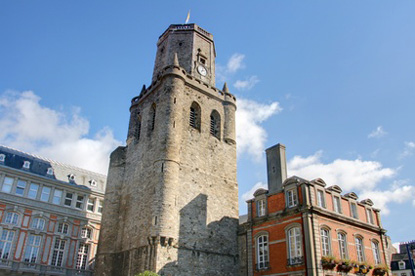
Boulogne-sur-Mer (pop. 40,000), a port town on the English Channel, is the second-largest city in the Pas-de-Calais department after Calais. Boulogne was the main port linking Britain to the continent in Roman times, and still is a passage point for ferries to/fromDover. Today it stands as France's leading fishing port, with a fleet of nearly 150 boats landing more than 70 different species of fish daily. The city is divided between the lively lower city, featuring the busy fishing port and shopping area with pedestrian streets, and the old town (Haute Ville) perched on a rocky headland, which boasts 2,000 years of history dating back to Roman times. Visitors can explore the 13th-century Château-Musée surrounded by medieval walls, the UNESCO World Heritage belfry, and the impressive Basilique Notre-Dame with one of France's largest crypts. Nausicaá, the largest public aquarium in Europe and France's second most popular tourist attraction north of Paris, offers an immersive marine experience with exhibits featuring diverse sea life.
Interesting Facts about Boulogne-sur-Mer
- Boulogne-sur-Mer is France's largest fishing port, with a fleet of nearly 150 boats and over 70 different species of fish landed daily.
- The city's old town, perched on a rocky headland, boasts 2,000 years of history and is surrounded by medieval ramparts.
- Boulogne-sur-Mer's 12th-century belfry is a UNESCO World Heritage Site and the oldest building in the upper city.
- The city is home to Nausicaá, one of Europe's largest sea centres, housing 35,000 animals of 1,000 species in 36 aquaria.
- Julius Caesar used Boulogne-sur-Mer as a strategic point for invading Britain in 51 BCE.
- The city's Notre-Dame Basilica, inspired by St. Peter's in Rome and other famous structures, houses the second-largest crypt in France.
- Boulogne-sur-Mer was the second seaside resort founded in France, becoming popular for sea bathing in the 19th century.
- Napoleon Bonaparte based his army of 120,000 men in Boulogne-sur-Mer for two years, planning to invade England.
- The Column of the Great Army, a 53-metre-high monument topped with a statue of Napoleon, stands as a reminder of the emperor's presence in the city.
- Boulogne-sur-Mer's castle-museum, dating from the 13th century, is one of the first fortified castles built without a dungeon.
History
Originally settled by the Morin tribe, it was Julius Caesar who founded the first port, then called Portus Itius, to prepare an invasion of Britain. It wasn't until a century later, in 43 CE, that Emperor Claudius successfully invaded the island. Until 296 Portus Itius (also known as Gesoriacum) was the base of the Classis Britannica, the Roman fleet of the British waters.
According to Suetonius (Life of Caligula, chap. XLVI), Caligula, the predecessor of Claudius, had built a tower of prodigious height in Boulogne, likened to the Pharos of Alexandria.
After the division of the Carolingian Empire in 843, the region is organised into a new political unit, the County of Boulogne, which belonged to the Counts of Flanders from 896 to 1025.
Eustace II of Boulogne, married to a daughter of the English king Æthelred the Unready, was one of the few proven companions of William the Conqueror, and fought on his side at the Battle of Hastings. His two sons, Godfrey ofBouillon and Baldwin of Boulogne, would become leaders of the First Crusade, and the two first successive monarchs of Jerusalem.
Another Count of Boulogne, Stephen of Blois (1096-1154), would become King of England as Stephen I. A Countess of Boulogne, Matilda II of Dammartin (1202-1259), would become queen consort of Portugal. In 1302, the marriage between Isabella of France and Edward II of England was celebrated in Boulogne. The city would be occupied by the English in the first half of the 16th century, until 1547. In 1550, the Peace of Boulogne ended the war of England with Scotland and France. After its reannexation to France, the region became part of Picardie.
In 1662, one of the most violent revolt against the French monarchy prior to the French Revolution took place in Boulogne. Thousands of peasants were massacred by Louis XIV, and 3,000 survivors sent to labour camps.
In 1800, the first vaccination against smallpox in France was performed on three girls in Boulogne. 4 years later, Napoleon assembled theGrande Armée ("Great Army") to award some of the first Légion d'honneur at the camp of Boulogne.
In the year 1905 the First Esperanto Universal Congress was held in Boulogne-sur-Mer.
Main Attractions
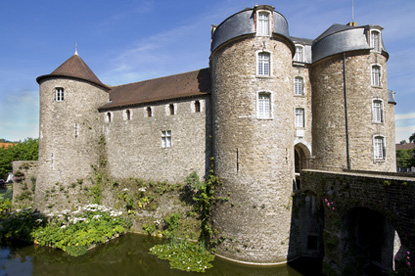
Boulogne has one of the best preserved fortified medieval town in France, surrounded by massive ramparts (built on top of the old Roman walls). The visit of the old town alone makes a trip to Boulogne a must for travellers in the region.
Within the city walls, the beautiful 13th-century castle hosts the so-called Château-Musée de Boulogne-sur-Mer, a stupendous art museum with a collection of Greek ceramics, European fine arts, as well as Amerindian objects, including 2/3 of the Kodiak (an Alaskan tribe) artifacts in the world. The highlight of the museum are the Egyptian antiques, which is the world's 5th largest collection after the Egyptian Museum in Cairo, the British Museum, the Louvre and the Museo Egizio in Turin.
The old town possesses four city gates :Portes des Dunes (west),Portes Neuve (north),Porte Gayole (east) andPorte des Degres (south). The main entrance isPortes des Dunes, where the Tourist Information Centre is located. It leads to the 12th-century Belfry (UNESCO World Heritage), which was originally the keep of the castle of the Counts of Boulogne. Built in the Roman style, the keep became the city's belfry in the 13th century, after the construction of a new castle (see above).
Next to the belfry stands the neoclassical Hôtel de Ville (town hall), completed in 1734, under Louis XV. It is the only building in the old town to be made of brick and stone (all the others are in stone only). Opposite (next toPortes des Dunes) is the Palais de Justice (court of justice), built in the Greek Revival style in 1852.
A bit further, on the main town square (Place Godefroy de Bouillon) is Napoleon's Palace, where the First Consul, then Emperor, stayed between 1801 and 1805. Near the harbour, the 54m-high Colum of the Great Army commemorates the Camp of Boulogne, from where Napoleon planned an invasion of Britain (see History above).
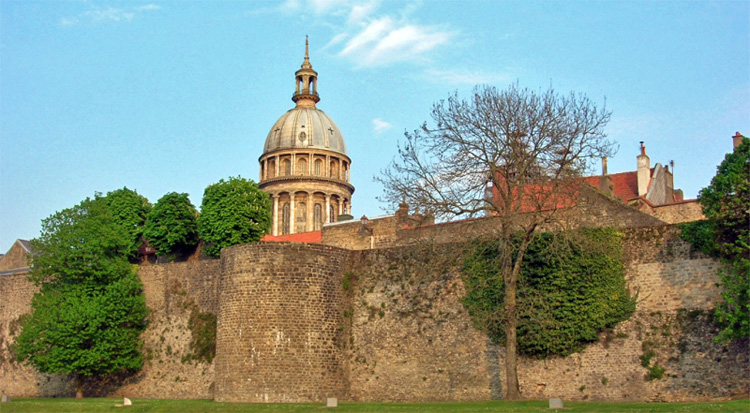
One of the greatest building in Boulogne is the neoclassical Basilica of Our Lady (Basilique Notre-Dame in French). It was errected between 1827 and 1866 on the ruins of the old cathedral, destroyed during the French Revolution. It was inspired by St. Peter of Rome, St. Paul of London as well as by the Pantheon and the Invalides in Paris.
NAUSICAÄ : the French National Sea Experience Centre
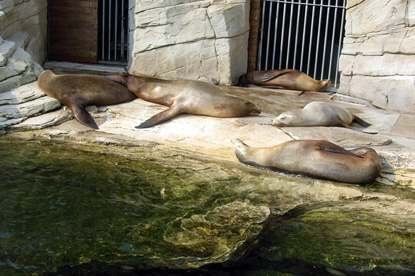
The other big attraction in town is NAUSICAÄ, a science centre entirely dedicated to the relationship between Mankind and the Sea. With its 35,000 animals of 1,000 species displayed in 36 aquaria for a total of 4.5 million liters of water, it is one of the largest sea centres in Europe. Visitors can observe, among others, penguins, sea lions, sharks, tunas, or the biodiversity of the coral reef.
Exhibitions on the marine fauna, and the exploitation and management of marine resources (fisheries, aquaculture, coastal planning, maritime transport, exploitation of energies and mineral resources, tourism...) aim at raising its awareness on the need for a good management of marine resources. The centre has been nominated Centre of Excellence by the Intergovernmental Oceanographic Commission (IOC) of UNESCO for its consciousness raising.
Top Museums
Château-Musée de Boulogne-sur-Mer
Located in the medieval castle of Boulogne-sur-Mer, this museum is a must-visit for anyone interested in history and art. It houses an eclectic collection of artefacts from around the world, including:
- Mediterranean Archaeology: Features an impressive collection of Greek ceramics and a stunning Egyptian collection with sarcophagi and a mummy.
- Non-European Ethnography: Includes unique items from Alaska, such as ceremonial Sugpiaq masks from Kodiak Island, and artefacts from Oceania and Africa.
- Fine Arts: Showcases Italian and Flemish paintings from the Renaissance, alongside French works from the 19th century by artists like Courbet, Corot, and Rodin. The museum also features works by Georges Mathieu, a renowned abstract artist from the region.
- Local History: Explores the city's rich past, from its Roman roots to its medieval significance.
The museum's setting within the ancient castle walls, built on Roman foundations, adds to its historical charm.
Musée du Libertador San Martin
This museum is dedicated to José de San Martín, the Argentine general who played a pivotal role in liberating Argentina, Chile, and Peru from Spanish rule. The museum is located in the house where San Martín lived from 1848 until his death in 1850. It offers a glimpse into his life and legacy, featuring personal belongings, uniforms, and documents that highlight his military campaigns.
The museum provides a unique insight into the life of a historical figure who, although lesser-known in France, is celebrated as a national hero in Argentina and other parts of South America.
Local Cuisine
Boulogne-sur-Mer, France's largest fishing port, is a paradise for seafood lovers. The city's culinary scene is dominated by fresh catches, with over 70 species of Atlantic fish landed daily. Local specialties include moules marinières, made with the freshest mussels, and a daring version with Roquefort cheese. Visitors should try la gainée boulonnaise, a creamy dish of mussels and white fish simmered in white wine, and waterzooï, a hearty fish stew. The region is also known for its cheeses, including the infamous Le Vieux Boulogne, dubbed the world's smelliest cheese. Other local delicacies include Dôme de Boulogne and Ecume de Wimereux. To complement these rich flavours, sample the local IPAs and blonde beers from the Silviacus microbrewery, or try chouchen, a traditional mead served as an aperitif.
Getting There & Around
Boulogne-sur-Mer is easily accessible by various modes of transport. If driving from Paris, the journey takes about two and a half hours via the A16 motorway. For those travelling by train, direct services run from Calais, Le Touquet, Lille, Amiens, and Paris, with the main station, Boulogne-Ville, conveniently located a ten-minute walk from the city centre. Visitors from the UK can reach Boulogne-sur-Mer by ferry from Dover in just under two hours. Once in the city, an extensive bus network serves the outlying suburbs and satellite towns, making it simple to explore the area. For those preferring to drive, ample parking is available along the riverside in the New Town. Additionally, a free shuttle bus called Néo operates in the city centre from Monday to Saturday, 9 AM to 7 PM, providing an ideal means of transport for shopping and sightseeing.
| Travel destinations in Nord-Pas-de-Calais | ||||||||||||||
|---|---|---|---|---|---|---|---|---|---|---|---|---|---|---|
|
|
|
|
| ||||||||||
|
|
|
|
| ||||||||||
| ||||||||||||||


