



| Contents |
|---|

Introduction
Aachen (Aken in Dutch, Oche in Ripuarian dialect, Aix-la-Chapelle in French ; pop. 257,000) is one of the oldest and most important cities in German history. Founded as a spa town by the Romans, it became the preferred residence of Emperor Charlemagne. In medieval times, Aachen was the (unofficial) capital of the Holy Roman Empire and the crowing place of German kings.
Aachen sits right across the border from Belgium and the Netherlands and could be combined with a visit of Maastricht (if you have your own wheels) or Liège (easily reached by train too).
Interesting Facts about Aachen
- Aachen was the favoured residence of Charlemagne, the first Holy Roman Emperor, and served as the capital of his empire.
- The Aachen Cathedral, a UNESCO World Heritage Site, is one of Europe’s oldest cathedrals and houses Charlemagne’s marble throne.
- The city’s thermal springs, used since Roman times, are among the hottest in Europe, with temperatures reaching up to 74°C.
- Aachen is famous for its Printen, a spiced gingerbread biscuit traditionally baked with a secret recipe since the 15th century.
- It hosts the annual International Charlemagne Prize, awarded to individuals or organisations promoting European unity since 1950.
- The CHIO Aachen, the world’s largest equestrian festival, takes place here each year, attracting top riders and horses globally.
- Over 30 German kings were crowned in Aachen between 936 and 1531, cementing its role as a medieval political hub.
- Aachen lies at the tri-border point where Germany meets Belgium and the Netherlands, making it a symbol of cross-cultural exchange.
- The RWTH Aachen University is one of Europe’s leading institutions for engineering and technology, founded in 1870.
- Aachen’s historic Rathaus (town hall) stands on the site of Charlemagne’s palace and features frescoes depicting his reign.
- The city’s cathedral treasury holds masterpieces like the 10th-century Lothair Cross and the Shrine of Charlemagne.
- Local legend claims the devil left a thumbprint on Aachen Cathedral’s door after being tricked during its construction.
- The Carolus Thermen spa complex offers modern baths fed by the same thermal springs used by Roman soldiers 2,000 years ago.
- Aachen’s name derives from the Roman settlement Aquae Granni, founded near its hot springs in the 1st century CE.
- It was a centre of the Carolingian Renaissance, fostering advancements in art, architecture, and education under Charlemagne.
- The city’s Elisenbrunnen pavilion, built in 1827, remains a landmark where visitors can taste its mineral-rich thermal waters.
- Aachen’s layout blends medieval streets with cutting-edge research centres, reflecting its history as a seat of innovation.
- The Great Fire of 1656 destroyed much of the city, leading to its reconstruction in Baroque and Rococo styles.
- Aachen Printen gained EU-protected status in 2020, ensuring only local bakeries can use the traditional name.
- The Ludwig Forum museum showcases contemporary art in a converted 1920s umbrella factory, symbolising the city’s creative spirit.
History
Roman beginnings
The area around Aachen was settled since the Neolithic period. During the Iron Age, Belgic tribes occupied the area, and were defeated by Julius Caesar in 57 BCE. The Romans channeled its sodium- and sulphur-rich hot springs into baths, known as Aquis-Granum (see also Bath in England). The 20-hectare complex was used from the first to the fourth century. A palace was destined to receive the governor of the province or the emperor. The palace and thermae were destroyed during the Germanic invasions.
It is from this Latin appellation that the city name has derived. although this is more obvious in some languages than others (e.g. Aquisgrana in Italian, Aquisgrán in Spanish, Aquisgrão in Portuguese, Akwizgran in Polish). The French exonym "Aix" results from the "i" shifting to the front of the "qu" ("Aquis" into "Aiqus"). The German and Dutch names dropped the "i" altogether and replaced the final "s" of Latin by a more Germanic "en".
The Carolingian period
In the 8th century, Pippin the Younger (714-768), ruler of the Franks (dux et princeps Francorum), who was based in nearby Liège, redeveloped the Roman villa in Aquis. His son, Charlemagne (742-814, known as Karl der Große in German) liked swimming and bathing, which motivated his choice of Aachen, with its the sulfur hot springs, for the construction of his palace. He decided to make it his winter capital, to be able to enjoy the hot springs. From 806, he broke with the Germanic tradition of moving the court along with the circumstances and established himself permanently in Aachen.
Charlemagne constructed his palace in the 790's, which he used as his principal residence, as well as for political and religious affairs. The palace was heavily influenced by Roman and Byzantine architectural styles (mosaics, Corinthian capitals, central cupola), and in particular by the Lateran Palace in Rome. It itself served as a model for religious edifices in the empire, such as the Church of Germigny-des-Prés (Loiret, France), the Church of Ottmarsheim (Alsace, France), or Essen Cathedral (North Rhine-Westphalia).
The palace, designed by Odo (or Eudes) of Metz, probably used stone salvaged from nearby Roman structures. It consisted of a square of 120x120 meter, divided in four by a north-south and an east-west axis, following the Roman pattern of the town. It comprised a dozen sections, including a tribunal, the treasury, and the thermae. The 1000m² assembly room was in the northern part, and inspired by the Roman aula palatina (now the Basilica) in Trier. The Palatine Chapel was located at the southern end, and was modelled after the 6th-century church of San Vitale in Ravenna. Most of the palace buildings have been destroyed through the ages. The Palatine Chapel survives at the core of the Aachen Cathedral.
Charlemagne founded a so-called Palatine Academy, with nine members, emulating the nine Muses (spiritual guides embodying the arts) of Ancient Greece. It is the ancestor and model for all Western academies. The members were known as the Palatine Counts and spoke only Latin between them. Apart from Charlemagne, the members were Alcuin of York, Ansegise, Adalard of Corbie, Angilbert, Clement of Ireland, Dungal of Ireland, Paul the Deacon, and Theodulphus - six of whom became saints of the Catholic Church (in addition to Charlemagne himself).
Aachen had thus become the seat of what would be called the Holy Roman Empire (800-1806), Europe's longest lasting empire, the famed 1000-year Reich. It was also from the split Charlemagne's empire in 843 that the Kingdom of France was born (=> see history of the Franks.
Charlemagne spent notably his first Christmas as King of the Franks (768) in Aachen, and also died there in 814. King Ethelwulf of Wessex (795-858), father of Alfred the Great (the first King of England), was born in Aachen during Charlemagne's rule.

Trone of Charlemagne
in the Palatine Chapel
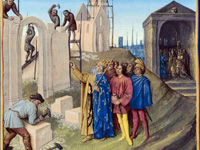
Charlemagne supervising the
construction of the Palatine Chapel
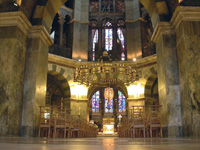
Palatine Chapel inside the cathedral
Middle Ages after Charlemagne
In 936, Otto I, was crowned king of the Germans in Aachen. He would become the first Holy Roman Emperor properly speaking. From then on, most kings of Germany destined to be emperors of the Holy Roman Empire were crowned "King of the Germans" in Aachen over the next 500 years. The last king to be crowned here was Ferdinand I (of Habsburg) in 1531. Therefore, it could be said that Aachen is to Germany what Reims is to France.
Aachen was one of the few free imperial city (i.e. responsible to the emperor only), and this since the earliest times of the Holy Roman Empire. The city was politically too weak to influence the policies of any of its neighbours, but thanks to its proximity to Flanders it achieved a modest position in the trade in woollen cloths. The city of Aachen was surrounded by the Duchy of Jülich to the east and the Duchy of Limburg to the west.
In 1372, Aachen became the first coin issuing city in the world to regularly place an Anno Domini date on a general circulation coin, a groschen.
Modern period
A spa was built by the middle of the 17th century, not so much because of the effects of its hot springs on the health of its visitors but since Aachen was then, and remained well into the 19th century, one of the centres of high-level prostitution in Europe. Visitors to Aachen had to wait the end of the 19th century for syphilis to be replaced by rheuma cures.
By the middle of the 18th century, industrialization had swept away most of the city's medieval rules of production and commerce. In 1801, Aachen became the administrative centre of the Roer department in Napoleon's Empire. The railway from Cologne to Liège passed through Aachen from 1840. The medieval city walls were abandoned as the limit for constructions in 1875. During World War II, Aachen was destroyed haphazardly, and in some parts completely, mostly by bombing. On 21 October 1944, it became the first German city to be free from Nazi rule.
Nowadays, Aachen is no longer an industrial center of major importance. It is, nevertheless, a major centre of IT development in Germany, thanks to the RWTH Aachen University. The RWTH is one of the most prestigious universities in Germany. It was established as Polytechnicum in 1870, and is a centre of technological research of worldwide importance, especially for electrical and mechanical engineering, computer sciences and physics.
The FH Aachen, Aachen University of Applied Sciences (AcUAS), and the German Army's Technical School are also located in Aachen.
Attractions
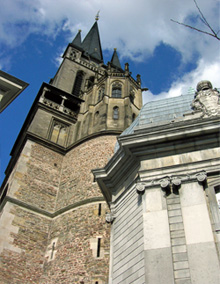
Aachener Dom
The Cathedral of Aachen, frequently referred to as the "Imperial Cathedral" (Kaiserdom in German), was constructed by Charlemagne from 786, making it one of the oldest buildings still in use in Northern Europe. Charlemagne was buried there, and his bones are still preserved in a special shrine.
The cathedral obtained its present shape in the course of more than a millennium. The core of the Aachen cathedral is the Palatine Chapel; being surprisingly small in comparison to the later additions, at the time of its construction it was the largest dome north of the Alps.
Its fascinating architecture with Classical, Byzantine and Germanic-Franconian elements is the essence of a monumental building of great importance: for 600 years, from 936 to 1531, the Aachen cathedral was the church of coronation for 30 emperors of the Holy Roman Empire.
The cathedral has been designated as a UNESCO World Heritage Site.
Aachener Rathaus
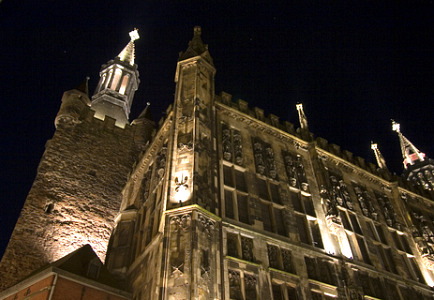
The oldest and most imposing building after the cathedral is the medieval Rathaus (town hall, pictured on the right), erected between 1330 and 1349. It burnt during the great fire of Aachen in 1656, again in 1883, and was severely damaged by Allied bombings in 1943 and 1944. It was painstakingly restored each time.
The northern facade is adorned with 50 statues of German rulers, including 31 Kings of Germany crowned in Aachen. The town hall houses a museum displaying replicas of the Imperial Crown Jewels. You can also see the sumptuous 19th-century Rethel frescoes as well as the the town hall's Gothic and Baroque furnishings.
Other sights
One hundred metres east of the cathedral is the Elisenbrunnen (Elisa's fountain), one of the city's famed thermal baths. It was built in the neoclassical style in the 1820's and named after the Prussian crown princess (and later Queen consort) Elisabeth Ludovika of Bavaria (Elise).
Following the boulevards that surround the city centre, you will stumble on the remains of the city wall (Ehrenmal). Two old city gates survive to this day: the Ponttor on Rütscher Straße (north-west) and the Marschiertor at the intersection of Boxgraben, Lagerhausstraße and Wallstraße (south).
Top Museums
Historical Museums
Aachen Cathedral Treasury
The Aachen Cathedral Treasury stands as one of Europe's most significant ecclesiastical treasures, housing an unparalleled collection of liturgical objects, reliquaries, and ceremonial items from the Middle Ages. Located adjacent to the UNESCO World Heritage Aachen Cathedral, this treasury offers visitors a profound glimpse into the religious and artistic practices of medieval Europe. The collection includes the famous Bust of Charlemagne, the Cross of Lothair, and numerous other gold and silver artefacts that showcase the exceptional craftsmanship of the period. The treasury not only highlights Aachen's importance as Charlemagne's favoured residence but also demonstrates the city's central role in European history and religious development. As you wander through the carefully curated exhibitions, you'll be transported back to a time when Aachen was the centre of the Holy Roman Empire, offering a tangible connection to this pivotal period in European history.
Centre Charlemagne
Named after Aachen's most famous historical figure, the Centre Charlemagne opened in 2014 and serves as the city's primary historical museum. Housed in a listed historical building near the cathedral, this modern museum provides an in-depth exploration of Aachen's rich and varied history. The exhibits are arranged chronologically, beginning with prehistoric settlements and continuing through Roman occupation, Charlemagne's reign, the Middle Ages, and into the modern era. Interactive displays, historical artefacts, and engaging multimedia presentations make the city's past accessible to visitors of all ages. The Centre Charlemagne excels at contextualising Aachen's local history within broader European developments, helping visitors understand how this border city has been shaped by and has influenced European history over the centuries. Special attention is given to Charlemagne's legacy and the city's development as a spa town and industrial centre.
Couven Museum
Situated in the heart of Aachen, the Couven Museum is housed in a beautifully preserved 18th-century townhouse that once belonged to a wealthy merchant family. Named after the Aachen-based architect Johann Joseph Couven, this museum offers visitors a rare opportunity to step back in time and experience the domestic life of the upper middle class during the 18th and 19th centuries. The museum features meticulously reconstructed period rooms, complete with original furniture, decorative arts, and household items that showcase the changing tastes and lifestyles of Aachen's prosperous citizens. From the elegant salon to the functional kitchen, each room tells a story of daily life in bygone eras. The museum also houses an impressive collection of Aachen furniture, silverware, and porcelain, highlighting the city's reputation for fine craftsmanship. The Couven Museum provides a fascinating counterpoint to the grand historical narratives presented in other museums, focusing instead on the intimate, domestic aspects of Aachen's cultural heritage.
Frankenberg Castle
This picturesque medieval castle, also known as Burg Frankenberg, stands as a testament to Aachen's strategic importance throughout the centuries. Dating back to the 13th century, the castle has been rebuilt and renovated multiple times, resulting in a fascinating blend of architectural styles. Today, Frankenberg Castle houses a museum that chronicles the building's varied history and its significance to the region. The exhibits feature archaeological findings, historical documents, and artefacts that illuminate the castle's role as a defensive structure, administrative centre, and aristocratic residence. The castle grounds, with their romantic gardens and ancient walls, provide a perfect setting for contemplating the passage of time and the layers of history that have shaped Aachen. Visitors can explore the castle's towers, halls, and courtyards, gaining insight into medieval military architecture and the daily life of those who once inhabited this historic fortress.
Art Museums
Suermondt Ludwig Museum
Affectionately known as Aachen's "Salon," the Suermondt Ludwig Museum is housed in the magnificent 19th-century Villa Cassalette, a neo-Renaissance mansion that is itself a work of art. This prestigious institution boasts one of Germany's most prominent collections of medieval sculptures, offering visitors an unparalleled opportunity to appreciate the craftsmanship and artistic vision of medieval sculptors. The museum's collection extends beyond sculpture to include late-Gothic German and Dutch panel paintings, works by Dutch Baroque masters, and a small but exquisite collection of 19th and early 20th-century paintings. The museum is named after its two primary benefactors: Barthold Suermondt, a 19th-century industrialist and art collector, and Peter and Irene Ludwig, whose foundation has enriched numerous museums across Germany. The Suermondt Ludwig Museum regularly hosts special exhibitions that complement its permanent collection, making it a dynamic centre for art appreciation and education in Aachen. The museum's elegant rooms, with their high ceilings and natural light, provide an ideal setting for contemplating the beauty and historical significance of European art across the centuries.
Ludwig Forum for International Art
Housed in a repurposed umbrella factory, the Ludwig Forum for International Art represents Aachen's embrace of contemporary artistic expression. This modern art museum focuses primarily on works created from the 1960s to the present day, featuring an impressive collection of American Pop Art, including significant pieces by Andy Warhol and Roy Lichtenstein. The museum owes its existence to the generous patronage of Peter and Irene Ludwig, who donated their extensive collection of contemporary art to the city. Beyond its permanent collection, the Ludwig Forum serves as a vibrant cultural centre that hosts temporary exhibitions, performances, film screenings, and educational programmes. The industrial architecture of the building, with its spacious galleries and flexible exhibition spaces, perfectly complements the innovative and often challenging works on display. For visitors interested in understanding current trends in international art and experiencing cutting-edge creative expressions, the Ludwig Forum offers a stimulating and thought-provoking environment that contrasts wonderfully with Aachen's more traditional museums.
Kunsthaus Nordrhein-Westfalen Kornelimünster
Located in the historic district of Kornelimünster, just outside Aachen's city centre, this unique art venue focuses on promoting emerging talent from the region. The Kunsthaus features regularly changing exhibitions of young artists from North Rhine-Westphalia, Belgium, and the Netherlands, making it an excellent place to discover new voices in contemporary art. In addition to showcasing emerging artists, the Kunsthaus houses a significant collection of promotional purchases in the field of visual arts from the state of North Rhine-Westphalia. This collection represents the state's commitment to supporting artistic development and preserving important works for future generations. The Kunsthaus is situated in a beautifully renovated historic building that combines traditional architecture with modern exhibition spaces, creating a dialogue between past and present that mirrors the institution's artistic mission. For visitors interested in experiencing the cutting edge of regional art and gaining insight into the creative processes shaping contemporary artistic expression, the Kunsthaus offers a more intimate and focused alternative to larger art museums.
Speciality Museums
Zollmuseum Friedrichs
Established in 1984, the Zollmuseum Friedrichs offers a fascinating look at a rarely explored aspect of European history: customs and border control. This unique museum traces the development of customs services and their role in protecting domestic economies, regulating trade, and generating revenue for governments. Located near the border with Belgium and the Netherlands, the museum is particularly relevant to Aachen's position as a crossroads of cultures and commerce. The exhibits feature historical customs uniforms, equipment, confiscated contraband, and documentation that illustrate how border controls have evolved from medieval toll gates to modern integrated European systems. Interactive displays help visitors understand the practical aspects of customs work and the challenges faced by customs officers throughout history. The museum also explores the broader economic and political contexts that have shaped customs policies, from mercantilism to free trade agreements. For those interested in economic history, international relations, or simply curious about an often-overlooked profession, the Zollmuseum provides a wealth of information presented in an engaging and accessible manner.
Tuchwerk Aachen
Formerly known as the Textilmuseum Aachen, Tuchwerk is located in the historic Stockheider Mill and celebrates Aachen's once-thriving textile industry. The museum preserves and presents the machinery, techniques, and products that made Aachen a centre of textile production from the Middle Ages until the 20th century. Visitors can see working looms, spinning machines, and other equipment that demonstrate the evolution of textile manufacturing from hand production to industrial processes. The museum's collections include samples of fine cloths, patterns, and finished garments that showcase the quality and variety of Aachen's textile output. Beyond the technical aspects of production, Tuchwerk explores the social and economic impacts of the textile industry on Aachen's development, including labour conditions, trade networks, and technological innovations. The museum's location in a former mill adds authenticity to the experience, allowing visitors to understand how water power was harnessed for industrial purposes. Through its comprehensive approach to industrial heritage, Tuchwerk offers valuable insights into an industry that shaped Aachen's identity and prosperity for centuries.
International Newspaper Museum (IZM)
In an age of digital media, the International Newspaper Museum offers a fascinating journey through the history of print journalism and its profound impact on society. Housed in a historic building in Aachen's old town, this specialised museum boasts an impressive collection of newspapers, periodicals, and printing equipment from around the world. The exhibits trace the evolution of news reporting from early broadsheets to modern tabloids, highlighting technological innovations, changing design aesthetics, and shifting journalistic practices. Visitors can learn about landmark moments in press history, censorship challenges, and the role of newspapers in shaping public opinion and political movements. The museum also features a working historical printing press where demonstrations bring the mechanical aspects of newspaper production to life. Interactive displays allow visitors to compare historical reporting of major events with contemporary coverage, encouraging critical thinking about media consumption. For anyone interested in communication, politics, or social history, the International Newspaper Museum provides a thought-provoking exploration of how information has been disseminated and consumed throughout the modern era.
Route Charlemagne
For those interested in exploring Aachen's connection to its most famous historical figure, the Route Charlemagne offers an integrated approach to experiencing the city's heritage. This cultural pathway comprises eight stations throughout the city, each highlighting a different aspect of Aachen's history and its relationship to Charlemagne. The journey begins at the Centre Charlemagne and includes the Cathedral, the Town Hall, and various thematic stations focusing on religion, power, science, and culture. Each station is equipped with informative displays and interactive elements that bring history to life for visitors of all ages. The Route Charlemagne is not a museum in the traditional sense but rather a curated urban experience that transforms the entire city into an open-air exhibition. By following this route, visitors gain a comprehensive understanding of how Charlemagne's legacy continues to influence Aachen's identity and development. The route also helps contextualise the collections housed in the city's various museums, creating connections between isolated artefacts and their broader historical significance. For visitors with limited time, the Route Charlemagne offers an efficient way to experience the highlights of Aachen's cultural heritage while enjoying the city's architectural beauty and vibrant atmosphere.
Local Cuisine
Aachen, a charming city in western Germany, boasts a delightful culinary scene that blends Rhenish and Belgian influences. The city's most famous delicacy is Aachener Printen, a type of spiced gingerbread that has EU Protected Designation of Origin status, made with a secret blend of spices including cinnamon, clove and aniseed. No visit would be complete without sampling Aachener Sauerbraten, a succulent beef dish marinated in a rich sauce often flavoured with printen, typically served with potato dumplings and red cabbage. Meat lovers should also try Öcher Puttes, a traditional blood sausage that pairs wonderfully with apple compote and mashed potatoes. For something sweet, indulge in Aachen rice cakes, a delightful treat made from yeast dough filled with rice pudding, or Aachen streusel rolls for breakfast. The city also offers unique treats like Dresse Nougat, made in the Dutch tradition. For an authentic experience, dine at one of the historic restaurants around the market square, such as Zum goldenen Einhorn, housed in a 700-year-old building where you can enjoy these regional specialities whilst soaking in the city's rich history.
Shopping
Aachen offers a diverse shopping experience with historic market places and modern shopping centres. The main shopping streets stretch along picturesque pedestrian zones, with Adalbertstrasse being the most famous, running from the Elisenbrunnen to the Kugelbrunnen and leading to the Aquis Plaza shopping centre. Around the cathedral, small streets house fine delicacies, accessories, clothing, cafés and pastry shops. Other notable shopping areas include Annastrasse with its original shops and galleries, and Körbergasse featuring traditional crafts and Germany's oldest coffee roasting company. The city centre hosts department stores like C&A, Galeria Kaufhof, and SiNN, alongside shopping arcades such as the ElisenGalerie. For souvenirs, the Tourist Information Centre at the Elisenbrunnen offers a wide selection of Aachen-themed items. Regular flea markets and the special European market, featuring designer pieces and handicrafts from across Europe, add to the shopping variety.
Nature in and around Aachen
Aachen and its surrounding region offer a variety of natural attractions for outdoor enthusiasts. The Aachen Forest (Aachener Wald), located just 3.7 km from the city centre, is one of the largest urban forests in the region, covering approximately 2,300 hectares. It provides numerous recreational activities, including hiking, cycling, and horseback riding. Within the city, Lousberg is a popular park designed in the English style during Napoleonic times, offering excellent views of Aachen and beyond. Just south of the city, visitors can explore the Hohes Venn-Eifel Nature Park, a vast area of peat bogs, heathland, and swamps spanning 4,500 hectares. The park features diverse flora and fauna, including fields of wild daffodils in the Perlenbachtal. For those interested in water features, the Diepenbenden Dam and the source of the River Wurm can be found in the Aachen Forest. Additionally, the Eifel National Park, the only national park in North Rhine-Westphalia, is within reach and home to rare and endangered species such as wildcats and beavers.
Getting There & Around
Getting There
By train is the most convenient option, with direct Eurostar services connecting Brussels to Aachen in just over an hour, alongside frequent regional trains from Belgian cities like Liège and Maastricht, plus excellent connections from major German destinations such as Cologne (52 minutes) and Bonn.
By coach offers a budget-friendly alternative, with operators like FlixBus and BlaBlaCar Bus running regular services from Brussels and other European cities, though journey times are typically around three hours.
By car provides flexibility for exploring the region, with Aachen easily accessible via the A16 from Calais and E40 motorway through Belgium—the drive from Calais takes approximately 3 hours 40 minutes via Ghent and Brussels, placing you just 40 minutes from the German border and within easy reach of other major German cities.
Getting Around
Navigating Aachen is straightforward, with its historic city centre best explored on foot to fully appreciate its charm. For journeys further afield, the city boasts a comprehensive public transport system, with a network of buses run by ASEAG connecting most areas to the central bus station, the 'Bushof'. A local train service, the Euregiobahn, also serves several stations across the city. For a more active approach, cycling is an increasingly popular way to get around, with a growing number of dedicated cycle routes. Taxis and ride-hailing services are readily available for more direct travel, though a car is generally unnecessary as much of the city centre has restricted traffic.
Best Time to Visit
The best time to visit Aachen is from late June to early September, when the weather is most pleasant for outdoor activities and sightseeing. During this period, temperatures are comfortably warm, ranging from 16°C to 24°C, with July and August being the warmest months. This time of year also offers the longest days and the most sunshine, perfect for exploring the city's historic sites and enjoying its outdoor cafés and markets. However, it's worth noting that this is also peak tourist season, so expect larger crowds and higher prices. For those seeking a quieter experience, consider visiting in May or September when the weather is still mild and tourist numbers are lower. Winter, particularly December, can be charming due to the famous Aachen Christmas Market, but be prepared for cold temperatures and possible rain or snow.
| Travel destinations in North Rhine-Westphalia | ||||||||||||||
|---|---|---|---|---|---|---|---|---|---|---|---|---|---|---|
|
|
|
|
| ||||||||||
|
|
|
|
| ||||||||||
|
| |||||||||||||


