


Introduction
Castelnau-Bretenoux is one of the largest medieval fortress in the Quercy. Its construction started in 1100 under the supervision of Hugh II, Baron of Castelnau, patriarch of a powerful lineage of barons.
Built on top of a hill above the Dordogne River, the castle has a triangular floor plan and rises to 85 metres. The interior of the castle dates mostly from the 17th and 18th centuries, when it became the residence of the Dukes of Luynes.
Castelnau-Bretenoux Castle is a medieval fortress constructed from distinctive red sandstone, perched on a hilltop overlooking the Dordogne Valley in the Lot department. Built initially around 1100 by Hugues, Baron of Castelnau, the castle served as the seat of the powerful Castelnau baronial dynasty and underwent continuous expansion and fortification between the 12th and 17th centuries. The triangular-planned fortress features massive defensive walls, circular towers, and a square keep, reflecting its strategic military importance during conflicts including the Hundred Years' War, when it was briefly captured by Henry II of England in 1159. Following centuries as a baronial stronghold, the castle later became the residence of the Dukes of Luynes in the 17th and 18th centuries, with domestic quarters and decorative elements added alongside the original military architecture. Extensively restored in the late 19th century by opera singer Jean Moulierat, the castle now houses an eclectic collection of period furniture, tapestries, religious art, and medieval artefacts that illustrate both its martial heritage and evolution into an aristocratic residence.
Interesting Facts about Castelnau-Bretenoux Castle
- Built in striking red sandstone, Castelnau-Bretenoux commands a hilltop above the Dordogne Valley and is visible for miles around.
- Its origins date to the 11th–12th centuries under the powerful barons of Castelnau, with major fortifications added through the 15th and 16th centuries.
- The castle’s plan is notably triangular, strengthened by multiple towers, bastions, and a deep moat that once featured a drawbridge.
- A massive square keep from the 13th century provided both symbolic prestige and a last line of defence during sieges.
- Henry II of England captured the fortress in 1159, underscoring its strategic value along the medieval Franco-English frontier.
- Extensive artillery upgrades in the late Middle Ages added an impressive 15th-century artillery tower and gun platforms.
- After its defensive role waned, residential wings and larger windows reflected a gradual shift toward comfort in the 17th century.
- A devastating 19th-century fire hastened its decline until Parisian tenor Jean Mouliérat bought and restored it in the 1890s.
- Mouliérat furnished the interiors with eclectic historic collections, then bequeathed the castle to the French state.
- Classified as a Monument Historique since the 19th century, it stands today as a textbook example of medieval military architecture in Quercy.

History
The Baron of Castelnau joined the First Crusade alongside the Count of Toulouse in 1096. Another baron would participate to the Seventh Crusade with Louis IX in 1248.
During the Hundred Years' War, Castelnau lied at the frontier between the territories controlled by the Kings of England and France, and as such was often disputed. The castle was taken by Henry II of England in 1159, then briefly transferred to the Viscounts of Turenne, before being returned to the Barons of Castelnau thanks to the intervention of the King of France.
The 14th century was a prosperous period for the local lords. Baron Hugh III of Castelnau-Calmont (1294-1356) marries Aiguiline Duèze, niece of Pope John XXII. After the death of his wife in 1323, he obtains the hand of Maralde de Canillac, sister of Raymond de Canillac, Archbishop of Toulouse. In 1329, his brother Peter is made Bishop of Rodez, while his son Bégon becomes Bishop of Cahors in 1370. Hugh III is succeeded by his other son, John I, who is made governor of Guyenne then capitain-general of Languedoc.
The castle then passes through different branches of the family, the Castelnau-Caylus in 1395, then the Castelnau-Clermont-Lodève in 1530. In 1502, François Guillaume de Castelnau de Clermont-Lodève (1480-1540) becomes Archbishop of Narbonne.
In 1657, Louis Guilhem de de Castelnau-Clermont weds Jeanne-Thérèse d'Albert, daughter of the Duke of Luynes. Their only son dies young, and when Jeanne-Thérèse passes away in 1756, the castle is bequeathed to the Duke of Luynes, and would remain in this family until the French Revolution.
In the 1840's the castle starts falling into disrepair. A fire destroys most of the southwest wing in 1851. In 1896, the estate is acquired by Jean Mouliérat, singer at the Paris Opéra Comique and furniture collector, who undertakes its restoration. Shortly before his death in 1932, he donates the castle to the French State, requesting that the furnishings be left as they are.
Description
First impressions
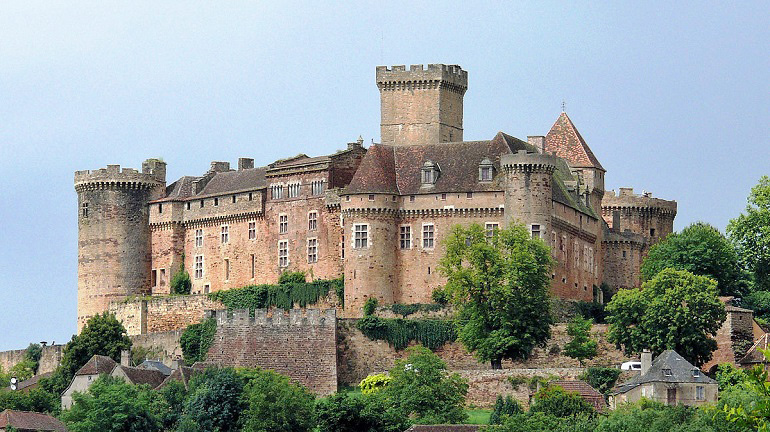
Crowning a limestone spur above the Dordogne, Cère and Bave valleys, Castelnau-Bretenoux is impossible to ignore. Its flamboyant red sandstone walls glow in the southern sun, while six mighty towers and a massive square keep carve an unmistakable outline against the rolling Quercy landscape. Even before you step inside, the panorama alone delivers a sense of drama worthy of a medieval epic.
Architecture and layout
- Triangular enceinte – Three curtain walls embrace the site, their angles reinforced by semi-circular towers and spur bastions that still look battle-ready.
- Gatehouse (châtelet) – A drawbridge once spanned the outer ditch here; today the vaulted passage remains an atmospheric threshold between countryside and fortress.
- Square keep – Ninety narrow spiral steps lead to the rooftop. The reward is a 360-degree sweep from the Dordogne gorges to the distant Causses plateaux.
- Renaissance flourishes – Later owners pierced the severe façades with mullioned windows, softening the martial mood without sacrificing security.
- Defensive details – Loopholes, murder-holes and machicolations survive in abundance, offering a textbook on medieval military engineering as you circle the ramparts.
Interior highlights
-
Grand hall and seigneurial apartments
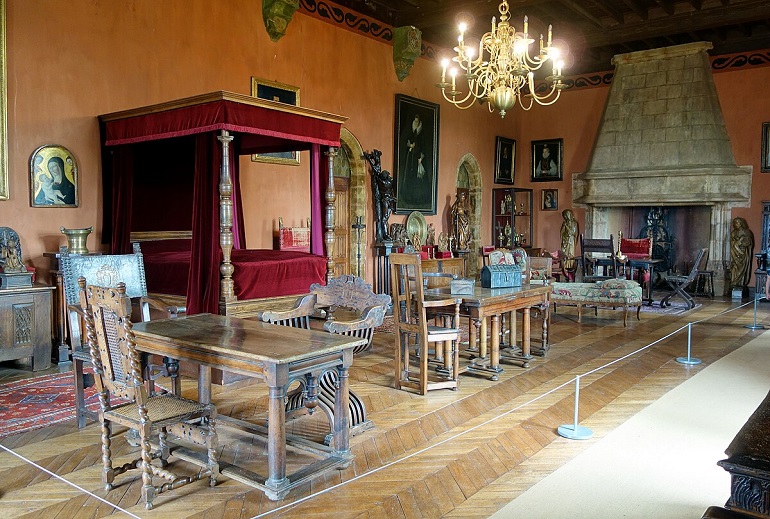
Re-created by early-20th-century owner Jean Mouliérat, these rooms present four-poster beds, carved presses and monumental fireplaces beneath oak-beam ceilings. The arrangement remains exactly as the tenor left it, right down to framed photographs on side tables.
-
Chapel
A pocket of tranquillity, with faded fresco fragments and an unusually slender stone altar. Sunlight filters through small stained-glass panels, casting jewel-like patterns across the flagstones.
-
Decorative-arts collection
Armour, liturgical silver, Aubusson tapestries, polychrome sculptures and Renaissance chests line a warren of chambers. Labels chart styles from the Romanesque to the Enlightenment, making the visit as much an art lesson as a castle tour.

Visiting experience
- Guided circuit – A concise 30-minute introduction (French-language, English hand-outs) covers the furnished apartments, after which you are free to roam the outer enceinte, climb towers and stroll the broad parade ground.
- Family-friendly touches – Children relish scampering along the ramparts, and seasonal treasure hunts turn architectural features into clues.
- Cultural calendar – July and August evenings echo with arias during the Saint-Céré Classical Music Festival; open-air performances set against floodlit battlements create an unforgettable ambience.
- Photography – Flash-free photography is welcomed in most spaces, encouraging visitors to capture both sweeping vistas and stone-carved minutiae.
- Accessibility – Gravel paths encircle the lower ward, but the keep and upper walls involve steep staircases. Strollers and dogs are permitted in external areas only.
Atmosphere
Despite its war-born origins, Castelnau-Bretenoux today feels more storybook than sombre. Swallows dart through crenellations, aromatic herbs line sun-baked terraces and echoes of musicians practising for evening concerts drift from the courtyard. Yet step into the shadowed passageways or peer through a narrow arrowslit and you are instantly reminded of centuries when these red stones guarded power, prestige and survival.
Getting There
By train The nearest rail station is Bretenoux-Biars on the Brive–Aurillac line; from there a short taxi ride (about 6 km) brings you up to the hilltop village of Prudhomat and the castle. Direct regional services also run to Souillac and Figeac, where you can connect with local buses before switching to a taxi for the final stretch.
By coach / bus Lio route 877 links Souillac to Biars-sur-Cère and stops at “Castelnau”; from the halt it is a gentle ten-minute uphill walk to the entrance, making this the simplest public-transport option during peak season when the timetable is frequent.
By car From Brive follow the D38 then D30, from Souillac take the D803 and D30, and from Figeac use the D840 then D19 to Prudhomat; a pay-and-display car park sits below the village, with a well-signposted five-minute walk up to the gates.
| Travel destinations in Midi-Pyrénées | ||||||||||||||
|---|---|---|---|---|---|---|---|---|---|---|---|---|---|---|
|
|
|
|
| ||||||||||
|
|
|
|
| ||||||||||
|
|
| ||||||||||||


