


Introduction
The Hospices de Beaune, also known as the Hôtel-Dieu, is a 15th-century hospital complex founded in 1443 by Nicolas Rolin, Chancellor to the Duke of Burgundy, and his wife Guigone de Salins as a charitable institution to care for the poor and sick following the devastation of the Hundred Years' War. This masterpiece of Flamboyant Gothic architecture, distinguished by its iconic glazed tile roof with colourful geometric patterns that has become a symbol of Burgundy, served as a functioning hospital until 1971 before being converted into a museum. Located in the historic centre of Beaune, the complex preserves its original medieval hospital wards, including the Grande Salle des Pôvres with its rows of antique beds, a historic pharmacy, and religious artifacts, whilst also maintaining its centuries-old wine estate built from vineyard donations that continues to produce renowned Burgundian wines sold at the world-famous annual charity auction each November. The institution represents one of Europe's finest examples of medieval philanthropic architecture and offers visitors insight into both Burgundy's medical heritage and its viticultural traditions spanning over 580 years of continuous operation.
Interesting Facts about the Hospices de Beaune
- Founded in 1443 by Nicolas Rolin and his wife Guigone de Salins, the Hospices de Beaune was conceived as a “palace for the poor” at the close of the Hundred Years’ War.
- The complex is famed for its flamboyant Gothic architecture and the multicoloured, geometric pattern of its glazed tile roofs, a regional emblem of Burgundy.
- The Hôtel-Dieu admitted its first patients on 1 January 1452 and continued its medical mission until the 20th century before becoming a museum.
- The institution’s renowned wine estate grew from centuries of donations and today spans around 60 hectares, producing revered cuvées from Pinot Noir and Chardonnay.
- Each November, the world’s oldest and most famous charity wine auction raises funds for healthcare and heritage, including the preservation of the Hôtel-Dieu.
- Inside the Salle des Pôvres, rows of curtained beds and a boat-keel timber roof evoke medieval hospital life, with a chapel positioned so patients could attend Mass from bed.
- The Hospices once housed Rogier van der Weyden’s celebrated Last Judgement polyptych, underscoring its blend of medical care, art, and spiritual solace.
- Sisterhoods linked to the Hospices played courageous roles in local resistance during wartime, aided by ancient underground passages.
- The Hospices’ motto “Seulle estoile,” associated with Guigone de Salins, appears in floor tiles and décor, personalising the charitable foundation’s identity.
- The setting famously appeared in classic French cinema, cementing the Hospices de Beaune as both a cultural icon and a living symbol of Burgundian wine heritage.
History
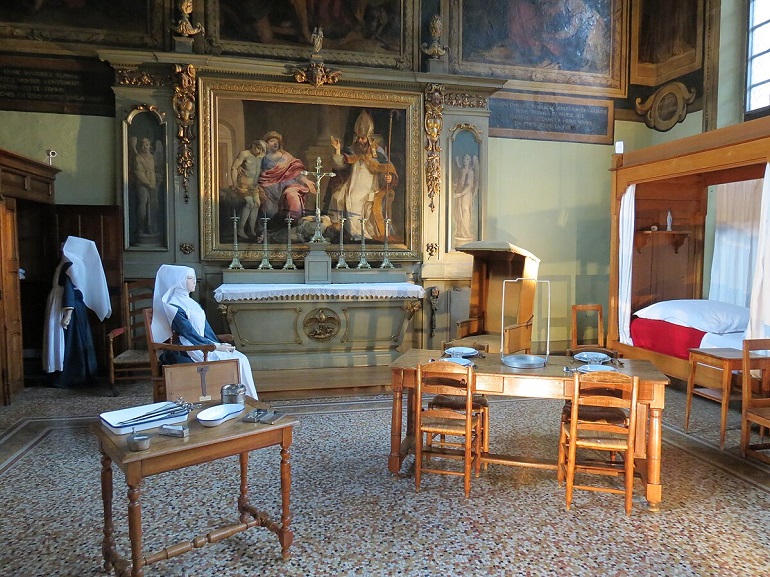
The Hospices de Beaune stands as one of Burgundy's most remarkable historical monuments, founded on 4th August 1443 by Nicolas Rolin, Chancellor to Duke Philip the Good of Burgundy, and his wife Guigone de Salins. The couple established this charitable institution during a period of profound suffering following the Hundred Years' War, when the region was plagued by famine, disease outbreaks, and marauding bands of soldiers who continued pillaging the countryside despite the Treaty of Arras being signed in 1435. Rolin, who had amassed considerable wealth in his position as Chancellor, responded to the desperate plight of Beaune's destitute population by creating what was described as "a veritable palace for the poor". Having received papal permission from Pope Eugene IV in 1441, the hospital was constructed and consecrated on 31st December 1452, welcoming its first patient on 1st January 1452. In conjunction with the hospital's founding, Rolin established the religious order "Les sœurs hospitalières de Beaune" to staff the institution.
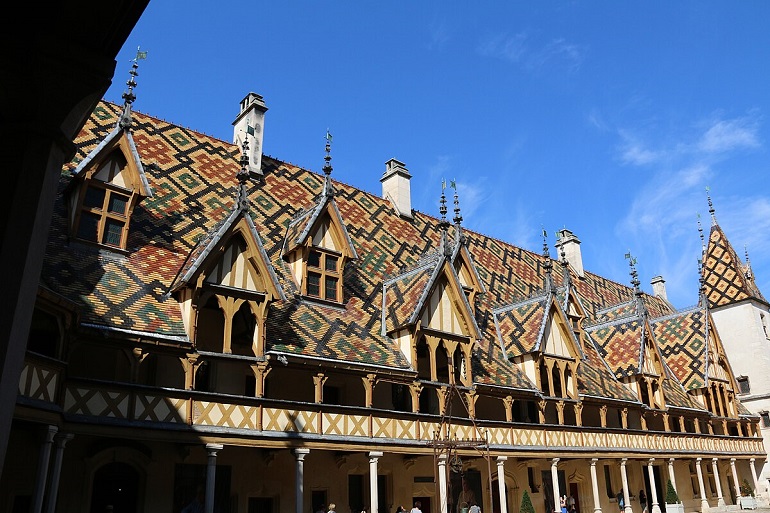
The architectural magnificence of the Hospices de Beaune represents a masterpiece of Flamboyant Gothic design with distinct Flemish influences, reflecting Rolin's inspiration from hospitals in the northern territories of the Duchy of Burgundy, from Lille to Flanders. The building was probably designed by the Flemish architect Jacques Wiscrère and constructed by a large team of Flemish and French masons, painters, and glass cutters. The complex consists of two-storey buildings arranged around a stone courtyard, featuring half-timbered galleries and the famous polychrome glazed tile roof with intricate geometric patterns in yellow, red, blue, and green that has become an iconic symbol of Burgundy. The hospital's layout was carefully planned with wings serving office, kitchen, and apothecary functions, whilst nuns and patients were housed near the chapel at the complex's centre. Among the building's treasures is the renowned Last Judgment polyptych by Rogier van der Weyden, alongside numerous portraits of Rolin, his wife, and extended family members, making the hospice a treasure trove of Northern Renaissance art.
Over the centuries, the Hospices de Beaune evolved from a medieval hospital into a unique institution combining charitable work with wine production, receiving its first vineyard donation in 1457 from Jean Guillotte le Verrier in Beaune's "Beaumont Le Franc" district, marking the birth of the Domaine des Hospices de Beaune. The institution continued its hospital function uninterruptedly until 1971, when modern medical facilities were built elsewhere in Beaune, and the original building was transformed into a museum. Throughout its history, the hospice accumulated significant donations of farms, properties, woodlands, artworks, and vineyards from grateful benefactors, eventually amassing 61 hectares of prime vineyard holdings across the Côte de Beaune and Côte de Nuits, including prestigious Grand Cru sites. The famous annual wine auction, which began in 1795 and has run regularly since 1859, takes place on the third weekend of November and has become the world's largest charity wine auction, with proceeds continuing to fund the institution's charitable activities. During World War II, the hospice played a role in the French Resistance, with nuns using the building's 13th-century underground galleries to hide prisoners and resistance members, including Maurice Drouhin who sought refuge when threatened by German police.
Description
The Spectacular Courtyard
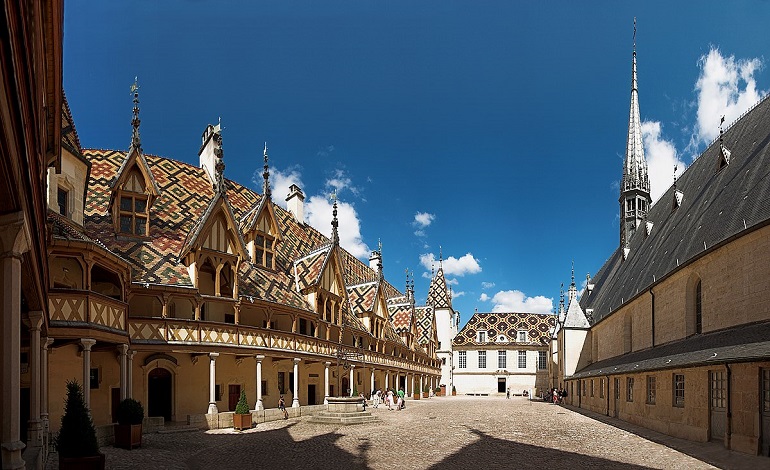
The central Cour d'Honneur serves as the heart of the complex, offering the most iconic view of the Hospices. This rectangular courtyard showcases a stunning visual contrast between different architectural elements. The buildings surrounding the courtyard feature the world-famous polychrome glazed tiles that have become synonymous with Burgundian architecture. These brilliant ceramic tiles, arranged in diamond patterns, display four distinct colours—red, brown, yellow and green—creating extraordinary geometric designs that shimmer in the light.
The courtyard architecture demonstrates remarkable attention to detail, with multiple dormer windows adorned with intricate sculptures and lead decorations that constitute genuine works of art. Two superimposed galleries with stone columns on the ground floor and timber framework above allowed the sister nurses to move around the courtyard whilst remaining sheltered from the elements. At the centre of the courtyard stands an elegant Gothic wrought-iron well, considered one of the finest examples of its kind in France.
The Grande Salle des Pôvres
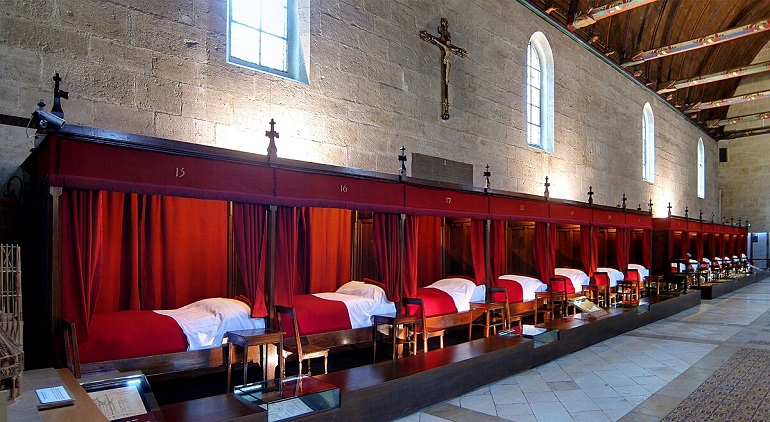
The Grande Salle des Pôvres (Great Hall of the Poor) represents the architectural and spiritual heart of the Hôtel-Dieu. This cathedral-like hall maintains its original dimensions of 50 metres in length, 14 metres in width and 16 metres in height. The room’s most striking feature is its magnificent painted timber ceiling, constructed like an inverted ship’s hull, supported by impressive oak beams.
The ceiling decoration is particularly remarkable, featuring multicoloured dragons that appear to “breathe out” the cross-beams, evoking mythical creatures of hell. Between these dramatic elements, small carved heads represent caricatures of Beaune’s medieval bourgeoisie, with human faces accompanied by animal heads symbolising their respective vices. This unexpected blend of the sacred and profane creates a uniquely compelling atmosphere.
Two rows of curtained beds lined the north and south walls, originally accommodating up to 30 patients, with 15 beds on each side. The central space was reserved for tables and benches where patients took their meals, served on pewter rather than wooden vessels—an honour typically reserved for the nobility. Behind each bed, Gothic chests allowed the nursing sisters to store patients’ clothing and bedding.
The Chapel
At the eastern end of the Grande Salle stands the chapel, designed so that patients could participate in religious services without leaving their beds. This arrangement reflected the medieval belief that spiritual care was as vital as medical treatment for recovery. The chapel features stunning stained-glass windows and serves as the original home of the famous polyptych altarpiece.
Additional Hospital Rooms
The Salle Saint-Hugues and Salle Saint-Nicolas, both constructed in the 17th century, provided additional patient accommodation. These rooms were built thanks to generous donations: the former funded by Maître Hugues Bétault, and the latter by King Louis XIV himself. The Salle Saint-Hugues features impressive wall paintings by Parisian artist Isaac Moillon.
The Historic Kitchen
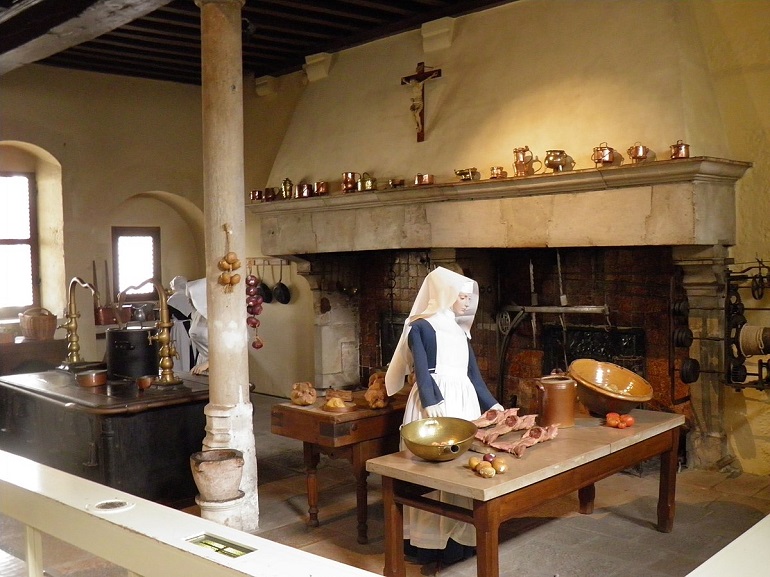
The kitchen, which remained operational until 1985, has been restored to its early 20th-century appearance. The most impressive features include a Gothic double-hearth fireplace and a brushed-steel rotisserie dating from 1698, complete with a small automaton nicknamed “Messire Bertrand”. The organisation was meticulous, designed to provide healthy, balanced meals for the sick, and the warmth from the fireplace would have been both practical and comforting.
The Pharmacy
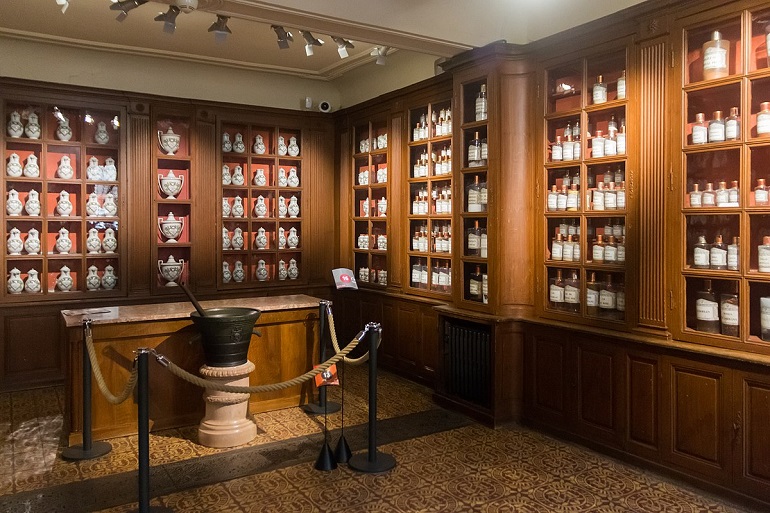
The apothecary represents a fascinating blend of copper, crockery and pewter implements. The pharmacy houses an extensive collection of earthenware pots from Franche-Comté, used to store a vast array of remedies. Visitors can discover historical treatments with evocative names such as “fish glue” and “sowbug powder”. The room features a pulley system for moving the heavy six-kilogram pestle, cooking stills, pill moulds, scales and other equipment essential for hand-making potions and medicines. This space reflects the medical practices of the era and demonstrates the importance placed on preparing remedies for patient care.
The Van der Weyden Masterpiece
The museum’s crown jewel is Rogier van der Weyden’s monumental Last Judgement polyptych, painted between 1443 and 1451. This extraordinary altarpiece consists of fifteen paintings on nine panels, with six painted on both sides. The interior panels depict the Last Judgement across two registers, with Christ seated on a rainbow in the central panel, while the Archangel Michael holds scales to weigh souls below. The outer panels, when closed, display saints and donors, including Nicolas Rolin and his wife Guigone de Salins in prayer. Originally hung above the chapel altar, the polyptych remained closed most of the time, opening only on Sundays and feast days for patients to admire.
Architectural Collections
Throughout the complex, visitors encounter an impressive collection of over 5 000 objects. These include Gothic chests, Flemish tapestries from the 16th century, stained-glass windows, religious paintings, period furniture, medical instruments and countless decorative arts that bear witness to the rich Burgundian cultural heritage. Many of these treasures were either original hospital furnishings, later acquisitions or donations from grateful benefactors and patients.
Getting There
By train: The Hospices de Beaune are easily reachable via the Beaune SNCF station, served by regular trains from Dijon and by swift TGV connections from Paris to Dijon with a simple regional transfer onward. From the station, it is only a short walk, taxi hop, or local bus ride to the Hôtel-Dieu in the historic centre.
By coach or bus: Regional Mobigo routes 113, 115, and 116 link Beaune with neighbouring towns, while Côte&Bus services run between Beaune station and stops close to the Hospices, offering a straightforward, no-car way to arrive.
By car: Beaune sits at the junction of the A6, A31, and A38 motorways; simply leave the A6 at exits 24.0 or 24.1 for Beaune-Centre/Hospices and follow the signs to central parking, a short stroll from the medieval complex.
| Travel destinations in Burgundy | ||||||||||||||
|---|---|---|---|---|---|---|---|---|---|---|---|---|---|---|
|
|
|
|
| ||||||||||
|
|
|
|
| ||||||||||
| >
| |||||||||||||


