


| Contents |
|---|

Introduction
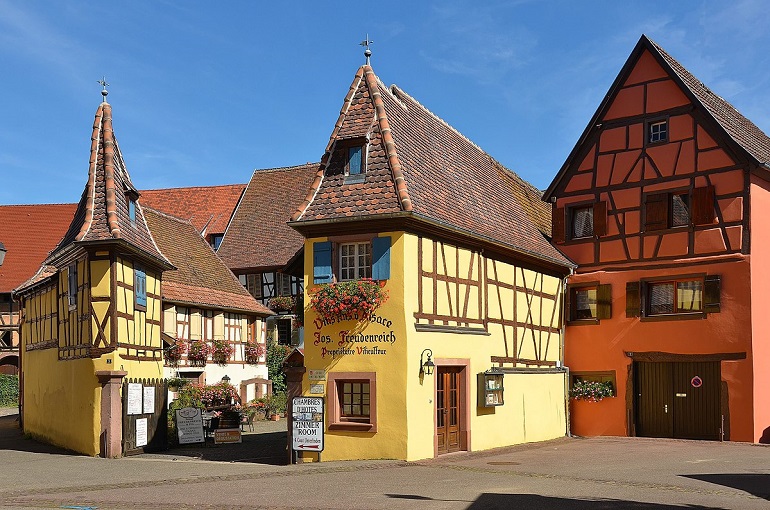
Eguisheim (pop. 1,600) is a lovely, perfectly preserved timber-framed village located just 7 kilometres southwest of Colmar. Founded in the 8th century, Eguisheim is endowed with numerous buildings dating from the 12th to the 17th century. Officially recognised as one of France's most beautiful villages and famously voted the French people's favourite village in 2013. This remarkably well-preserved settlement features a distinctive concentric layout with narrow cobblestone streets encircling the central château and Saint-Léon Square, where traditional half-timbered houses display the characteristic bright pastel colours of the Alsace region. The village sits amidst rolling vineyards along the renowned Alsace Wine Route and maintains its authentic medieval atmosphere through carefully preserved 16th and 17th-century architecture, including the Romanesque Saint-Pierre-et-Paul Church, defensive walls that once protected the settlement, and charming fountains adorned with the region's symbolic storks.
Interesting Facts about Eguisheim
- Eguisheim is famed for its concentric, medieval ring of lanes that circle a tiny castle core, creating a storybook village plan unlike most Alsatian towns.
- The village is celebrated as the birthplace of Pope Leo IX (born Bruno of Eguisheim-Dagsbourg in 1002), a key reformer of the eleventh century.
- Often dubbed a real-life “Beauty and the Beast” setting, Eguisheim’s pastel half-timbered houses and flower-laden windows have made it a darling of photographers and filmmakers.
- Eguisheim sits on the Alsace Wine Route and is renowned for distinguished white wines, including terroirs tied to the Eichberg and Pfersigberg grands crus.
- White storks frequently nest atop Eguisheim’s rooftops and church towers, giving the village a distinctive Alsatian charm in spring and summer.
- Voted “France’s Favourite Village” in 2013, Eguisheim pairs small-village intimacy with an exceptionally well-preserved medieval streetscape.
- Archaeological finds around Eguisheim point to very ancient habitation, with traces from prehistoric and Roman periods preceding the medieval town.
- The double ring of rampart streets invites a leisurely circular stroll, revealing painted façades, carved lintels, and cosy wine bars at every turn.
- Eguisheim’s central Place du Château and Saint-Léon chapel honour the village’s papal heritage amid fountains, frescoes, and cobbles.
- Just a few kilometres from Colmar, Eguisheim offers a tranquil base to sample Alsatian cuisine and Riesling or Gewürztraminer straight from surrounding vineyards.
History
The origins of Eguisheim stretch back to prehistoric times, with archaeological evidence revealing human presence as early as the Palaeolithic age. In 1865, the discovery of Neanderthal remains in the commune illuminated the ancient presence of early peoples who were drawn to the strategic position of the hills overlooking the Schlossberg Valley. Numerous Celtic sepulchres have been unearthed throughout the area, whilst the Gallo-Roman name "Exsa" or "Exa" likely denoted a defensive withdrawal or fortification relative to a common Roman thoroughfare. A significant turning point occurred in the 2nd century CE when a battalion of Roman legionaries, under the command of Emperor Diocletian, established a camp at the base of the Schlossberg. Recognising the favourable conditions of the gentle, sun-drenched slopes, these Romans pioneered wine-growing in Alsace by planting the region's first vineyard, introducing viticulture that would become central to the village's identity for centuries to come.
Eguisheim's medieval development began around 720 CE when Eberhard, a descendant of the Dukes of Alsace and nephew of Sainte-Odile, constructed the first castle of Eguisheim. During this early period, the settlement served as a fortress enclosed by wooden barriers, quite different from the vibrant flower-adorned houses that characterise it today. The village began to flourish from the 11th century onwards, particularly with the reconstruction of the castle using stone rather than wood. Despite facing territorial conflicts between the Nassau lords and the kings of France, as well as enduring numerous epidemics throughout the Middle Ages, Eguisheim continued to expand steadily. New residences and winding lanes emerged around the Château Saint-Léon, forming a distinctive concentric street layout that remains one of the village's defining architectural features to this day. The village gained particular prominence as the birthplace of Pope Leo IX, born Bruno of Eguisheim-Dagsbourg in 1002, adding religious significance to its medieval heritage.
The defensive capabilities of medieval Eguisheim were enhanced by three surveillance towers erected on Husseren Hill, located 2 kilometres southwest of the village, to oversee the surrounding plain and safeguard the settlement from potential invaders. These towers, now known collectively as the Castles of Eguisheim or "Drei Hexe" (Three Witches), were the Wahlenbourg (constructed in 1006 and the oldest of the three), the Dagsbourg (built in 1144), and the Weckmund (erected in 1226-1227). Each castle was named after its corresponding feudal family, with the Eguisheim-Dabo lineage holding dominion over the area for an extended period. The village also featured a unique administrative system known as colongères courts, with five such courts including Girsberger, Kyburg, Catharinen, Zorn, and Keiserdinghof. These medieval institutions comprised collectives of farmers under the jurisdiction of the same lord, governed by common laws and subject to the same court of justice, with each court typically including multiple houses, barns, stables, fields, and pastures. All three hilltop castles were ultimately destroyed in 1466 during the War of the Six Oboles, leaving behind the romantic ruins that overlook the village today.
Main Attractions
Medieval Village Centre and Rue du Rempart
At the heart of Eguisheim is its perfectly preserved medieval centre, with streets configured in concentric circles around the former castle site. The main lane, Rue du Rempart, takes visitors on a captivating walk past pastel-hued, half-timbered houses adorned with flowers in every season. The overall effect is quintessentially Alsatian and provides endless opportunities for leisurely exploration and photography.

Place du Château and Château Saint-Léon
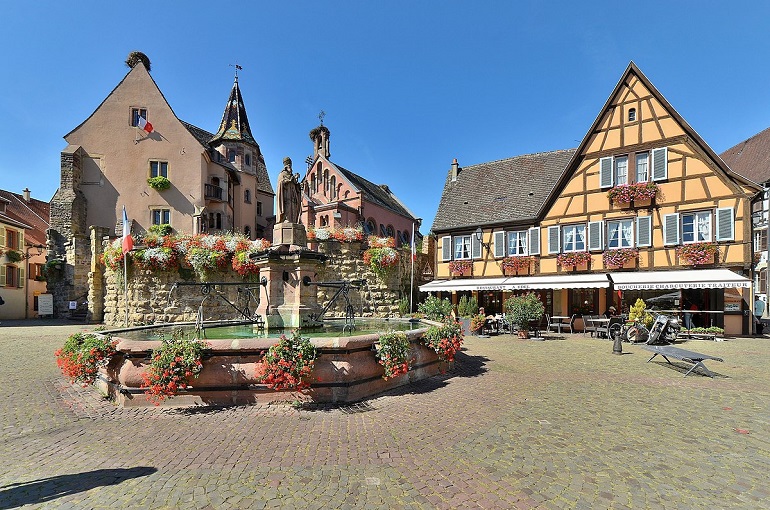
The central square, Place du Château, embodies the soul of Eguisheim. It is dominated by the modest yet evocative Château Saint-Léon, believed to be the birthplace of Pope Saint Leo IX. This 13th-century octagonal castle provides a fascinating insight into the origins of the town and houses historical remnants. The square itself is a social hub lined with cafés and shops, and is especially beautiful when decorated for local festivals or summer flower displays.
Saint-Léon Fountain
Standing proudly in Place du Château is the Saint-Léon Fountain. This large, neoclassical basin, crowned by a statue of Pope Saint Leo IX, serves as both a town symbol and a popular gathering point for residents and visitors alike. The fountain is often surrounded by vibrant blooms, enhancing its elegance and making it a prized subject for photographs.
Chapelle Saint-Léon IX
Adjacent to the castle, the Chapelle Saint-Léon IX is a serene chapel constructed in honour of the village’s most famous native, Pope Saint Leo IX. Its distinctive neo-Romanesque architecture, colourful stained glass and peaceful interior provide a touching space for reflection and appreciation of Eguisheim's spiritual heritage.

Église Saints-Pierre-et-Paul
The Église Saints-Pierre-et-Paul stands as Eguisheim’s primary church and a testament to its long religious history. Its origins date from the 11th century, showcasing a blend of Romanesque and Gothic elements. The intricately carved entrance and pink sandstone facade are highlights, and inside, visitors can view a rare 13th-century wooden statue known as the ‘Opening Virgin’, an important local relic.
Le Pigeonnier
One of the village’s most beloved sights, Le Pigeonnier is a tiny, picturesque half-timbered house found on Rue du Rempart. Often described as the most photographed building in Eguisheim, its fairytale design and flower-filled windows epitomise the region’s romantic architectural style and attract visitors seeking the classic Alsace photo.
The Three Castles (Les Trois Châteaux d’Eguisheim)
Set on a nearby hilltop, the ruins of the Three Castles—Wahlenburg, Dagsburg and Weckmund—date back to the 11th and 12th centuries. These imposing remains once formed a powerful defensive complex for the Counts of Eguisheim and now reward hikers with panoramic views over the surrounding vineyards and the Alsatian plain.
Wine Tasting and Vineyards
Eguisheim sits at the centre of the Alsace wine route and is celebrated for its excellent handcrafted wines. Prestigious local producers such as Wolfberger and Domaine Emile Beyer offer tastings and tours, providing an immersive experience in the region’s winemaking heritage. The vines themselves surround the village and offer scenic walking and cycling paths for those wishing to enjoy the landscape.
Parc à Cigognes (Stork Park)
A family-friendly highlight, the Parc à Cigognes is dedicated to nurturing Alsace’s iconic white storks, which nest freely on rooftops and admire from the park’s viewing areas. The park also serves as a pleasant green space for picnics and relaxation.
Festivals and Local Events
Eguisheim is renowned for its festive ambience, from the intimate Christmas Market—famed for its magical winter decorations—to the annual Fête des Vignerons in August, celebrating the village’s deep connection with viticulture through concerts, tastings and lively traditions.
Top Museums
Les Muses Du Rempart d’Eguisheim
Tucked within Eguisheim’s medieval ramparts, Les Muses Du Rempart d’Eguisheim is much more than a simple museum – it is a lovingly restored 17th-century half-timbered house, just steps from the iconic “Le Pigeonnier”. While primarily a premium gîte for travellers, the property is saturated with Alsatian heritage and charm, immersing visitors in the authentic spirit of the town. Its interiors showcase Alsatian craftsmanship with original wooden beams, antique furnishings, and carefully chosen decorative pieces that speak to centuries of rural life. Visitors find a series of tastefully decorated rooms over three floors, with a terrace overlooking the historic lanes. The property is not a conventional exhibition-based museum but rather a living museum home, and it often receives accolades for its atmospheric authenticity and period details, making it a singular window onto Eguisheim’s past.
Museums in the Region
Écomusée d’Alsace (nearby Ungersheim)
A short drive from Eguisheim, the Écomusée d’Alsace is open-air and immersive, recreating an authentic Alsatian village as it would have appeared from 1850 to 1950. Dozens of traditional houses—meticulously transported and reconstructed—are furnished as they would have been in their day, offering an evocative portrait of rural existence. Visitors can participate in crafts demonstrations, enjoy live performances, and observe trades such as blacksmithing, baking, and weaving. Farm animals, colourful gardens, and costumed interpreters help bring the village to life, making this destination especially delightful for families and anyone keen to understand Alsace’s rural heritage.
Museum of Natural History and Ethnography (Colmar)
Located in nearby Colmar, this museum invites exploration into the region’s natural and human history. Its varied collections range from geological specimens, fossil remains, and taxidermied animals to ethnographic displays illuminating the customs and costumes of Alsace. Careful curation provides historical context for each exhibit, revealing how the landscape and local traditions have evolved together. There is a special focus on the biodiversity of the Upper Rhine and the blending of cultural influences across generations.
Musée du Jouet (Toy Museum, Colmar)
Also in Colmar, the Musée du Jouet—set within a former cinema—offers a whimsical journey through the world of toys from the 19th century to the present. Showcase cabinets display mechanical toys, antique dolls, iconic trains, and board games from France and beyond. Interactive displays and play areas allow children (and nostalgic adults) to try out classic games, while temporary exhibitions often explore how toys mirror the lifestyles, values, and hopes of different eras.
Unterlinden Museum (Colmar)
A historic highlight, Unterlinden Museum is housed in a lovingly restored 13th-century convent in Colmar. Its collection is broad, spanning regional archaeology, religious art—including the renowned Isenheim Altarpiece—Renaissance masterpieces, and more recent European art. Walking through atmospheric cloisters and contemporary exhibition spaces, visitors encounter both deep-rooted Alsatian artistic traditions and internationally significant artworks. Unterlinden’s layered presentation makes it a cultural touchstone for anyone interested in the crossroads of local and European art history.
Local Cuisine
Eguisheim’s local cuisine is a delightful reflection of Alsace’s rich culinary traditions, offering a harmonious blend of French and German influences. Visitors can savour iconic dishes such as tarte flambée, a thin, crisp pastry topped with crème fraîche, onions, and bacon, and choucroute garnie, a hearty platter of sauerkraut accompanied by a selection of local sausages and salted meats. The village is famed for its robust white wines, particularly the aromatic Gewurztraminer and refreshing Riesling, which perfectly complement traditional fare. For a sweet finish, do not miss the buttery kougelhopf, a brioche-like cake studded with raisins and almonds, often enjoyed with a cup of local coffee.
Getting There
By train – The simplest way to reach Eguisheim is to take a regional TER train to Colmar, a major stop on the Strasbourg–Mulhouse line; from Colmar station, local buses connect to the village in about 15 minutes, or a quick taxi ride whisks you straight to the ramparts.
By coach or bus – Several regional bus routes link Strasbourg, Mulhouse, and Colmar with Eguisheim, offering a relaxed journey through Alsatian wine-country scenery; the buses halt just outside the medieval gates, placing you within a short stroll of the cobbled lanes.
By car – Drivers can follow the A35 motorway towards Colmar, exit at Herrlisheim-près-Colmar, and then follow well-signed local roads for the final 5 km to Eguisheim, where ample parking is provided on the village outskirts to keep the historic centre traffic-free.
| Travel destinations in Alsace | ||||||||||||||
|---|---|---|---|---|---|---|---|---|---|---|---|---|---|---|
|
|
|
|
| ||||||||||
|
|
|
|
| ||||||||||


