


| Contents |
|---|
Introduction
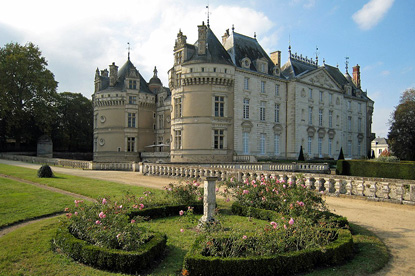
The Château du Lude stands as one of France's most architecturally diverse and historically fascinating fortresses, seamlessly blending medieval defensive structures with elegant Renaissance refinements. This remarkable château, which has remained in the same noble family for over two centuries, offers visitors a unique journey through French architectural evolution, from its imposing 13th-century keep and formidable round towers to its graceful 18th-century façades adorned with classical French design elements. Set amidst meticulously maintained formal gardens that cascade down to the River Loir, the château provides an enchanting glimpse into aristocratic life spanning nearly eight centuries. Beyond its stunning architecture, Château du Lude captivates visitors with its richly furnished interiors, featuring period tapestries, antique furniture, and family portraits that tell the story of France's turbulent history through the eyes of its noble inhabitants. The château's strategic location in the charming market town of Le Lude makes it an ideal stopping point for exploring the broader Loire Valley region, whilst its summer sound and light shows transform the ancient stones into a magical theatrical backdrop that brings centuries of French history vividly to life.
Interesting Facts about Château du Lude
- It stands at the crossroads of Anjou, Maine and Touraine, making it the most northerly château of the Loire Valley.
- Originating as a 10th–11th-century fortress on the Loir, it later evolved into a refined Renaissance residence.
- The Daillon family transformed the medieval stronghold after 1457, bringing in Italian artists to reimagine its architecture.
- Kings Henri IV and Louis XIII both stayed at the château, reflecting its prominence in royal itineraries.
- Its façades showcase four centuries of French styles, from Louis XII and François I Renaissance wings to a neoclassical front.
- The property has remained a lived-in private home for around 260 years under the same family.
- The terraced gardens blend formal French design with an English-style landscape, including a rose garden, topiary and a labyrinth.
- The historic kitchens, in service since the 15th century, are still used for traditional jam-making from the potager’s fruit.
- A rare Italianate studiolo, attributed to the School of Raphael, survives as a unique painted cabinet in a French château.
- In the late 20th century, an ambitious son et lumière with hundreds of local actors ran for decades, becoming a cultural hallmark.
History
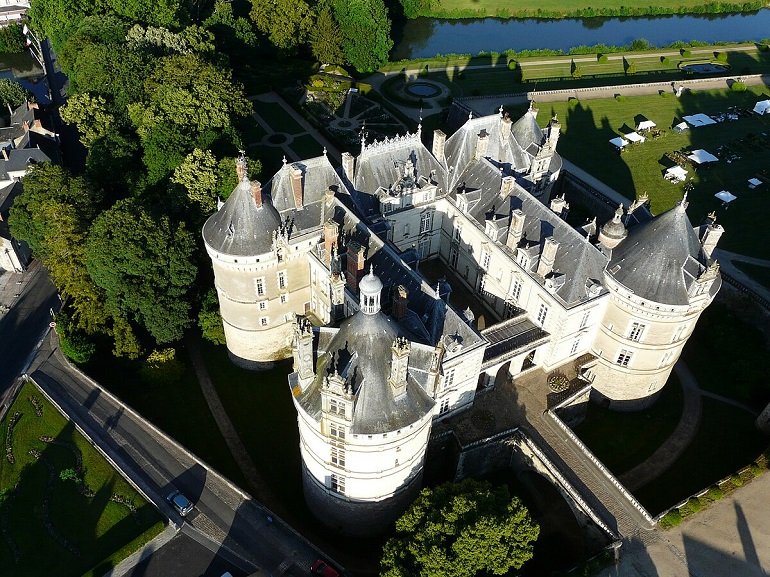
The Château du Lude traces its origins to the 10th and 11th centuries, when a formidable fortress was constructed on the banks of the River Loir to defend the Anjou Kingdom from Norman and later English incursions. This strategic stronghold, flanked by six towers and surrounded by deep dry moats and vaulted underground passages, played a crucial role during the turbulent Middle Ages, particularly throughout the Hundred Years' War when it remained under English occupation for many years. In 1427, the legendary Gilles de Rais, known as Bluebeard, besieged the fortress whilst journeying to join Joan of Arc at Orléans, marking one of the most dramatic episodes in the castle's military history. The medieval chapter concluded in 1457 when Jean de Daillon, chamberlain to King Louis XI, acquired the battle-scarred fortress and began its remarkable transformation.
Under the patronage of the influential Daillon family, who maintained close ties with the French monarchy for over two centuries, the grim medieval fortress underwent a spectacular Renaissance metamorphosis. Italian artists and architects were employed during the reign of François I to convert the military stronghold into an elegant and comfortable residence, creating one of the finest examples of Italian Renaissance architecture in France through the lavishly sculptured façades. The château's elevated status was formally recognised when the lordship of Le Lude was raised to a county by François I in May 1545, and later elevated to a duchy-peerage in 1675 in honour of Henri de Daillon, lieutenant-general of the royal armies. The castle's royal connections flourished during this period, hosting illustrious guests including King Henri IV, who attended his first procession since his conversion to Catholicism in the Church of Saint-Vincent during Corpus Christi in 1598, followed by his son Louis XIII in 1619, and the celebrated Marquise de Sévigné.
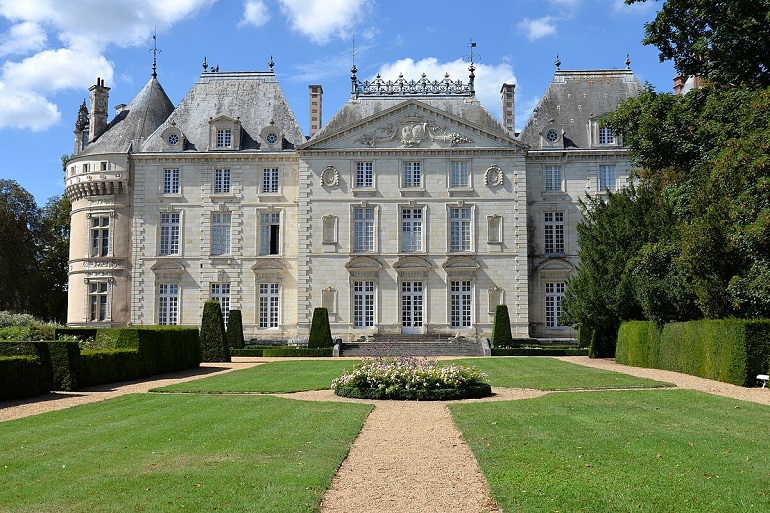
The château's evolution continued into the 18th century when it was acquired in 1751 by Joseph Duvelaër, a wealthy member of the French East India Company who had amassed his fortune in Canton and settled at Le Lude with his Chinese wife. His niece, the Marquise de la Vieuville, inherited the estate and orchestrated significant architectural modifications, including the construction of the elegant neoclassical Louis XVI façade facing the river, built from local white tuffeau stone according to plans by architect Jean-Benoît-Vincent Barré. Remarkably, she defended the castle during the French Revolution with assistance from local villagers, ensuring its preservation through the tumultuous period. The château has remained within the same family for the past 260 years, passing through the Talhouët-Roy family line and currently belonging to Count and Countess Louis-Jean de Nicolaÿ, who continue the tradition of restoration and have created renowned gardens whilst operating one of the last great inhabited castles of the Loire Valley.

Description
Perched above a broad curve of the Loir, the Château du Lude presents an elegant fusion of fortified grandeur and refined domesticity. Turrets rise from mellow tufa-stone walls, slate roofs glitter under shifting light, and a dry moat wraps the main court like a sculptural frame. Four distinct façades reveal successive waves of French design: flamboyant Gothic towers flank an Italianate Renaissance wing; a stately Louis XVI front sports classical columns, balustrades and pediment; and a romantic Neo-Gothic elevation completes the ensemble. Ornamental dormers carved with coats of arms punctuate the roofline, while a stone bridge—once drawbridge—guides visitors across the moat to an arched entrance guarded by heraldic lions.
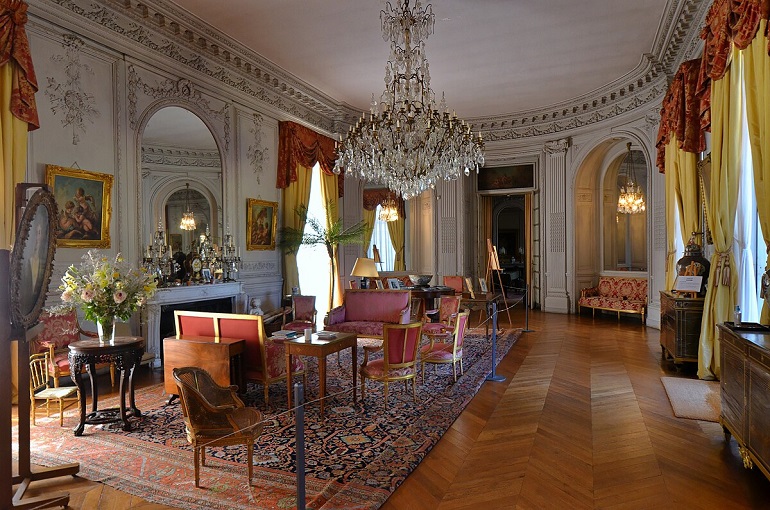
Inside, lavishly appointed rooms unfold in a stately progression. The Grand Salon glows with gilded boiseries, silk wall coverings and crystal girandoles. A rare Renaissance studiolo, hidden behind carved walnut doors, is lined with intricate intarsia panelling and ceiling paintings inspired by Raphael. The long library, lined in dark oak, houses several thousand leather-bound volumes and overlooks the river through high mullioned windows. Elsewhere, an airy Louis XV dining room features a monumental fireplace adorned with hunting trophies, while a Neo-Gothic gallery displays heraldic banners beneath fan-vaulted ceilings. Bedrooms on the piano nobile are dressed in Toile de Jouy and crowned by richly curtained four-posters.
The medieval kitchens—among the largest still in daily use—remain a highlight. Enormous bread ovens, wrought-iron spit mechanisms and a battery of burnished copper pans testify to centuries of cooking. Estate-grown produce, including rare heritage vegetables and orchard fruit, is still prepared here for seasonal events. Adjacent cellars store fine Armagnac and house a small exhibition on traditional food preservation.
Eight hectares of gardens carry the coveted ‘Remarkable Garden’ label. On the south terrace, parterre embroidery of box and santolina forms a green carpet beneath the Renaissance façade. Beyond, an English-style landscape opens into sweeping lawns dotted with cedars, plane trees and a serpentine lake that mirrors the castle walls.
Highlights include:
- The Éperon Garden—a sun-drenched spur planted with over four hundred rose varieties, many of them old or Chinese species renowned for perfume.
- A beech-shaded botanical walk showcasing hydrangeas, hostas and shade-loving perennials, punctuated by discreet interpretation panels.
- A willow-hedged labyrinth that delights younger visitors and frames glimpses of the river.
- A two-hectare kitchen garden laid out in disciplined lines of vegetables, espaliered pear and peach, soft-fruit cages and a Victorian greenhouse used for exotic citrus.
- Ornamental topiary clipped into pyramids and peacocks, lending a whimsical touch to the formal French quarter.
Throughout the season, the estate hosts plant fairs, open-air theatre and candlelit evenings, when façades glow amber and music drifts across the lawns. A tearoom in the converted stables serves light lunches, pastries and the château’s own jams, while an adjoining boutique stocks garden seeds, honey and polished copperware. For an elevated panorama, visitors may climb the fifteenth-century keep and survey the rolling Sarthe countryside—a fitting finale to an immersive exploration of one of the Loire Valley’s most characterful private domains.
Getting There
By train The nearest SNCF station is Aubigné-Racan, served twice daily from Tours and several times a day from Le Mans; both cities sit on TGV routes from Paris. From Aubigné-Racan, pre-booked taxis cover the final 15 km to Le Lude in about 20 minutes.
By coach or bus Regional line 218 (Aléop) links Le Mans to Le Lude three times daily, while Rémi coaches run once a day from Tours; both stop at Le Lude’s Place du Mail, five minutes’ walk from the château.
By car Le Lude lies midway between Le Mans and Tours; exit the A28 at junction 26, then follow the D305 west for 16 km. From Tours, take the A28 northbound to junction 27 and continue via the D938 and D24; the drive is under an hour and free parking is signposted around the château.
Best Time to Visit
The best time to visit the Château du Lude is spring (April–June) and early autumn (September–October), when mild temperatures, fresh blooms and warm foliage flatter the riverside gardens and make strolling the terraces a pleasure. Summer (July–August) brings the longest days and lively events, but also peak crowds and warmer conditions. Winter has a quieter charm, yet opening hours and garden interest are more limited. For a serene experience, weekday visits in the shoulder months outside school holidays are ideal, while keen gardeners might target early June for seasonal highlights and especially vibrant borders.