


Introduction
Founded in 1118 by Saint Bernard of Clairvaux, Fontenay Abbey stands as the oldest preserved Cistercian abbey in the world and represents one of the finest examples of Romanesque monastic architecture in France. Located in a secluded valley in Burgundy, this UNESCO World Heritage Site has retained nearly all of its original 12th-century buildings, including the church, cloister, chapter house, dormitory, and a remarkable forge that ranks among France's oldest industrial structures. The abbey exemplifies the Cistercian ideal of self-sufficiency, with its complete monastic complex designed to support a community of up to 300 monks through prayer, work, and isolation from the secular world. After the French Revolution forced the departure of the monks, the site was converted to a paper mill before being carefully restored in the early 20th century by the Aynard family, who continue to maintain the property today. The abbey's austere beauty, achieved through simple lines, perfect proportions, and the interplay of pink and white stone, offers visitors insight into medieval monastic life whilst demonstrating the technological innovations of the Cistercian order.
Interesting Facts about Fontenay Abbey
- Founded in 1118 by Saint Bernard of Clairvaux, Fontenay Abbey is among the oldest and most complete Cistercian monasteries in Europe.
- The abbey’s church was consecrated in 1147 by Pope Eugene III, himself a former disciple of Saint Bernard.
- Its austere Romanesque architecture epitomises Cistercian ideals of simplicity, with a basilican plan in the form of a Latin cross.
- Fontenay became a UNESCO World Heritage Site in 1981, one of the earliest French monuments to receive this status.
- The complex preserves key medieval spaces—including church, cloister, dormitory, chapter house, and the famed forge—largely intact.
- The abbey’s 12th‑century forge highlights the Cistercians’ role in medieval technological progress and self‑sufficiency.
- In the 18th century the site was converted into a paper mill after the monks departed during the French Revolution, which inadvertently aided its preservation.
- A private family has owned and carefully restored Fontenay since the 19th and early 20th centuries, maintaining its remarkable state.
- Set in a secluded Burgundy valley, the abbey is renowned for serene landscaped grounds, including a park classified as a “Remarkable Garden.”
- Fontenay’s pale stone and harmonious proportions create a striking visual unity that has endured for over nine centuries.
History
Founded in 1118 by Saint Bernard of Clairvaux as the second daughter-house of Clairvaux, Fontenay Abbey embodied the Cistercian ideal of austerity and self-sufficiency. The community settled permanently in the secluded Burgundian valley in 1130, and, thanks to the exile wealth of Ebrard, Bishop of Norwich, the Romanesque church rose rapidly between 1139 and 1147; Pope Eugene III—himself a former disciple of Bernard—consecrated the completed building in the latter year. By 1200, the complex already housed around 300 monks and lay brothers, all living according to the strict Rule of Saint Benedict in buildings deliberately stripped of superfluous ornament to focus the mind on prayer and manual labour.
Royal favour strengthened the abbey’s fortunes during the High Middle Ages. King Louis IX exempted Fontenay from taxation in 1259, and a royal abbey charter followed in 1269, securing valuable legal protections. Despite its privileges, the monastery could not escape the turbulence of later centuries: Edward III’s English troops pillaged the site in 1359 during the Hundred Years’ War, and the Wars of Religion inflicted further damage in the late 16th century. Yet the monks persevered until the French Revolution; the refectory had already been demolished in 1745, and the last eight monks departed in 1790 as revolutionary dechristianisation gathered pace.
Industrial re-use ironically ensured the survival of Fontenay’s austere architecture. Sold as national property in 1791, the site became a paper mill run first by the Hugot family and, from 1820, by the Montgolfier clan, famous for ballooning. Banker Édouard Aynard acquired the property in 1906, dismantled the industrial structures, and launched a meticulous restoration finished by 1911, returning the abbey to its 12th-century appearance. Recognised as a historic monument in 1862 and inscribed on the UNESCO World Heritage List in 1981 as one of Europe’s best-preserved Cistercian ensembles, Fontenay remains in private hands yet welcomes more than 100,000 visitors annually, its church, cloister, dormitory and pioneering 12th-century forge offering an almost complete window onto medieval monastic life.
Description
The Abbey Church
The abbey church dominates the complex with its imposing yet understated presence, constructed between 1139 and 1147 in local pink and white limestone that lends the building its distinctive warm colouring. The church follows a Latin-cross plan and measures an impressive 66 metres in length and 17 metres in height. The west façade displays remarkable architectural restraint, featuring a nearly flat surface relieved only by a subtle belt course and two vertical buttresses that mirror the tripartite division of the interior. A single round-arched doorway, flanked by slender columns, forms the centrepiece of a perfect square beneath two tiers of round-arched windows.
Inside, visitors are struck by the church’s profound sense of harmony and proportion. The eight-bay nave rises under a gently pointed barrel vault, while the side aisles carry perpendicular barrel vaults that create a quiet visual rhythm. Engaged columns cluster around the structural piers, capped by capitals decorated only with the subtlest foliate carvings—true to Saint Bernard’s prohibition against ostentation. Light filters through carefully positioned windows in the side aisles, the transept, and the east and west ends, casting a soft glow that heightens the atmosphere of contemplation. The choir retains glazed tiles from the twelfth and thirteenth centuries, alongside a carved altarpiece and several historic gravestones, including that of Ebrard, Bishop of Norwich, who financed the church’s construction.
The Cloister
The cloister forms the beating heart of monastic life and remains one of the finest examples of its kind. This architectural gem survives intact from the twelfth century, creating a rectangle measuring roughly 36 by 38 metres. The four galleries present an impression of remarkable homogeneity despite featuring varied pillars, columns, and capitals, all executed with restrained elegance. Serving both as a vital circulation route and a place for meditation, the cloister is bathed in natural light throughout the day and across the seasons, offering moments of quiet reflection for visitors.
The Monks’ Dormitory
Reached via a flight of stairs from the church, the monks’ dormitory stretches as a vast hall beneath one of the abbey’s most spectacular features—a magnificent fifteenth-century oak roof structure that recalls the hull of an overturned ship. This impressive timber framework replaced the original twelfth-century ceiling while maintaining the room’s monastic character. Through the dormitory’s windows, glimpses of the extensive gardens remind visitors of the contemplative setting the monks enjoyed; rows of monks once slept here on simple pallets separated by wooden dividers.
The Chapter House and Common Room
Located beneath the dormitory, these two interconnected rooms showcase extensive stone arcading that demonstrates the abbey’s architectural sophistication. The chapter house served as the community’s meeting place, where monks gathered daily to hear readings from the Bible and discuss communal affairs. The adjacent common room provided additional space for daily activities. Both rooms, with their harmonious proportions and carefully crafted stonework, exemplify the Cistercian talent for creating functional yet inspiring spaces.
The Warming Room
The warming room, or caldarium, holds special significance as one of the few heated spaces in the abbey, alongside the kitchen and infirmary. Featuring two impressive chimney-pieces, it served multiple practical purposes: scribes prepared ink here, shoes were greased, and monks underwent quarterly bloodletting treatments. A staircase links the room to the dormitory, allowing warm air to rise and provide some comfort on cold nights.
The Forge
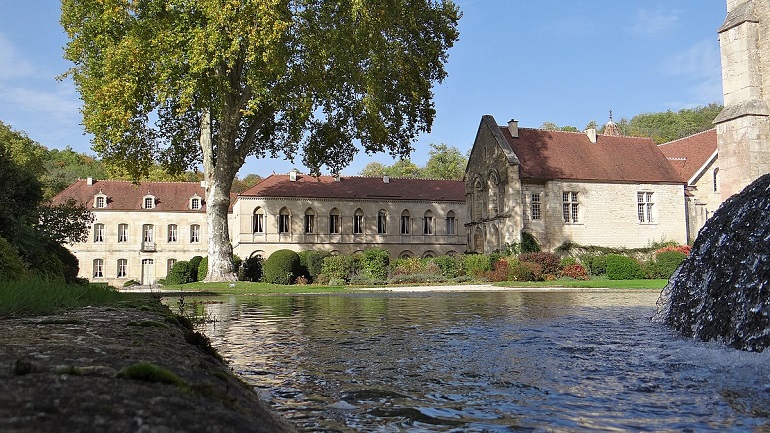
Among Fontenay’s most remarkable buildings is the forge, stretching 53 metres along the river and representing one of Europe’s earliest ironworks. Dating to the late twelfth century, this technological marvel housed the world’s first hydraulic hammer, making it a foundation of industrial iron manufacturing. The monks ingeniously diverted the stream to power a waterwheel that drove the massive hammer, enabling them to process local iron ore. Demonstrations today allow visitors to witness the ancient hammer in action, just as it functioned in the Middle Ages.
The Infirmary
The infirmary, largely reconstructed in the eighteenth century on twelfth-century foundations, provided care for sick and elderly monks. Set apart from the main buildings to prevent the spread of illness, it features an elegant terrace and surrounding garden where medicinal plants were cultivated. The building’s later architectural style harmonises with the abbey’s overall aesthetic while offering insight into medieval healthcare.
Additional Monastic Buildings
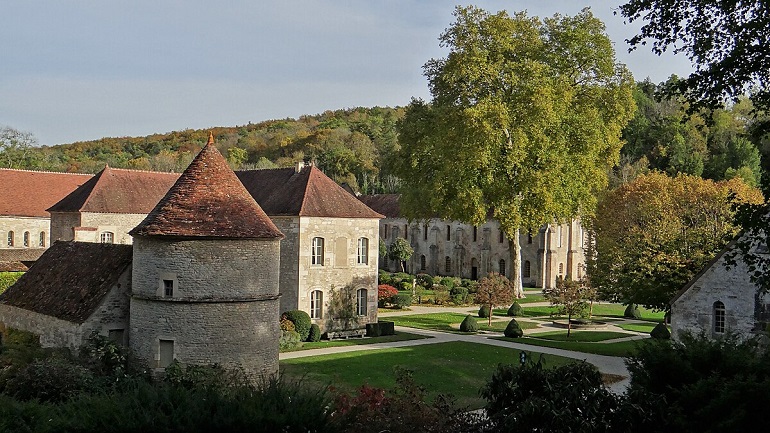
Several other structures complete the complex, including a thirteenth-century dovecote with metre-thick walls, a bakery that supplied daily bread, and various outbuildings supporting the abbey’s self-sufficient lifestyle. A visitor’s chapel accommodated laypeople, while kennels housed the abbey’s working dogs. Although not open to the public, the abbot’s house and other private quarters illustrate the completeness of this monastic “city”.
The Gardens
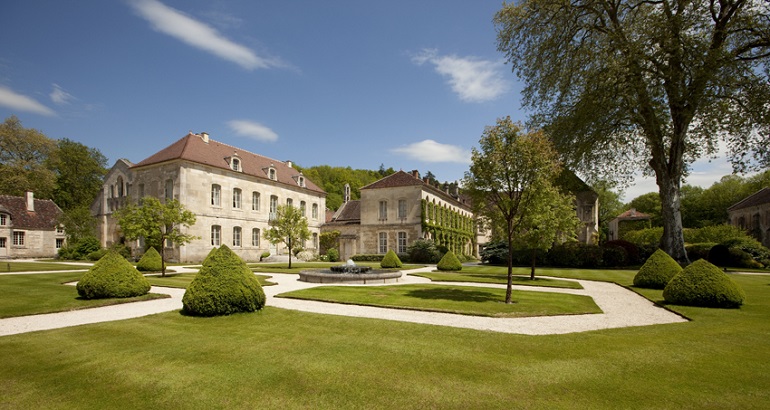
Fontenay’s gardens have been recognised as a “Remarkable Garden” by France’s National Council of Parks and Gardens. Landscape architect Peter Holmes transformed the two-hectare park in the late 1990s, creating a sophisticated blend of formal French design and naturalistic plantings. Mature collections of roses, viburnums, choisyas, and hydrangeas provide year-round interest along immaculate lawns, pristine white-gravel paths, and precisely trimmed hedges. Water features, including a large trout pond and the babbling stream that once powered the forge, add charm and serenity to the setting.
The Valley Setting
The abbey sits within a protected 1,200-hectare valley of beech and ash forest, virtually unchanged since medieval times. Seven ponds and several waterfalls throughout the valley recall the sophisticated water-management systems devised by the monks for both industry and agriculture. The site’s remote location and careful private stewardship—maintained by the same family since 1820—preserve Fontenay Abbey as an unparalleled window into medieval monastic life, where visitors can experience the full scope of Cistercian achievement in architecture, engineering, and landscape design.
Getting There
By train The nearest SNCF station is Montbard, a 20-minute taxi ride from Fontenay Abbey; regular regional TER services link Montbard with Dijon and Paris, making rail the smoothest option for visitors relying on public transport.
By coach or bus From Montbard station a local Côte-d’Or bus (line 120) runs a handful of weekday services that stop in the village of Marmagne, a short walk from the abbey entrance, while in summer a dedicated tourist shuttle operates at key visiting times.
By car Motorists can reach the abbey by following the A6 to exit 22 (Avallon), then continuing west on the D606 and D905 before joining the D128 towards Marmagne; ample parking is provided in a tree-lined area just outside the monastic precinct.
| Travel destinations in Burgundy | ||||||||||||||
|---|---|---|---|---|---|---|---|---|---|---|---|---|---|---|
|
|
|
|
| ||||||||||
|
|
|
|
| ||||||||||
| >
| |||||||||||||


