


| Contents |
|---|

Ducal Palace, Stanislas Square, Nancy.
Introduction

Long contested between France and Germany, Lorraine developed a hybrid culture of its own that gave us quiche lorraine, Mirabelle plum, rum baba, and madeleines cakes.
French is now spoken by everybody in Lorraine, but the region is bilingual in its traditional dialects. Lorraine Franconian, a dialect of Middle German, is spoken around Metz and Thionville, as well as in the German Palatinate. Lorrain, a dialect of French, was the traditional Romance language, although its usage is very limited nowadays.
Vittel, one of the world's best known bottled water, comes from the Vosges mountains of Lorraine. Other notable local companies include the crystal manufacturer Baccarat, the Clairefontaine Paper Mills, and the ceramics manufacturer Villeroy & Boch (which was founded in Audun-le-Tiche in 1748, but moved to Mettlach, just across the German border, in 1801).
Famous people from Lorraine include (chronologically): Joan of Arc, Francis I, Holy Roman Emperor & Duke of Lorraine (ancestor of all the Habsburgs since then), the poet Paul Verlaine, the mathematician Henri Poincaré, the father of sociology Émile Durkheim, and Presidents Raymond Poincaré and Albert Lebrun.
History
The area around Metz was settled by the Franks several decades before Clovis conquered northern France. In 843, the Treaty of Verdun split Charlemagne's Empire between his three grandsons. The eldest, Lothair, inherited the central part of the empire, from the Netherlands to Tuscany, and named it Lotharingia. The Kingdom of Lotharingia was further divided between his three sons, and Lothair II inherited a much reduced Lotharingia. In 959, in-fighting between brothers and cousins led to the split of Lotharingia into the Duchy of Upper Lotharingia (or Upper Lorraine), which became the French region of Lorraine and the German Palatinate, and the Duchy of Lower Lotharingia (a.k.a. Lower Lorraine or Lothier), which became the Low Countries (modern Benelux + Nord-Pas-de-Calais).
Most of Lorraine remained politically and culturally German thoughout the Middle Ages. It is only in 1552 that the three bishoprics of Metz, Toul and Verdun come under French rule, although this was not officialised until the Peace of Westphalia in 1648. The Nancy-based Duchy or Lorraine would be annexed by Richelieu in 1641.
In 1737, the War of the Polish Succession ends with an agreement between France, the House of Habsburg and the Lorraine House of Vaudémont: The Duchy is to be given to Stanislaw Leszczynski, the former king of Poland and father-in-law to King Louis XV of France. Upon Stanislaw's death in 1766, The Duchy of Lorraine and Bar is officially incorporated to France.
The German got back Alsace and Lorraine in 1871 after winning the Franco-Prussian war and would keep them until the end of WWI.
One of the First World War's bloodiest battles was the Battle of Verdun, which lasted for 10 months and concluded with a tragic death toll of 362,000 French and 336,000 German soldiers, making it one of the longest, most murderous and most traumatic battles in the history of warfare.
Cuisine
Lorraine’s cuisine is renowned for its rustic, hearty specialities, most famously quiche Lorraine—a savoury tart composed of eggs, cream and smoked bacon encased in shortcrust pastry, with its roots dating back to the sixteenth century. Local cooks also excel at pâté lorrain, originating from Baccarat, which features marinated pork and veal wrapped in crisp puff pastry, often enjoyed warm with a fresh salad. Stews such as potée Lorraine reflect the region’s affinity for pork and vegetables, combining boiled meats, cabbage, carrots, leeks and potatoes to create comforting shared meals.
Sweet treats play a prominent role in Lorraine’s food culture, with mirabelle plums serving as a signature ingredient; these golden fruits are most often transformed into tarts, jams, eau-de-vie and other desserts, prized for their flavour and rarity. Macaroons from Nancy and Boulay also make delectable souvenirs, distinguished by their almond base and characteristic cracked appearance. Other notable produce includes quetsche plums, used for eau-de-vie, as well as potato dishes, cheeses like Brouère and Munster-Géromé, and smoked meats such as fuseau Lorrain salami.
Lorraine’s gastronomy highlights resourceful use of local produce, evident in dishes such as truffe de Lorraine, potato salads, beignets de pommes de terre and various varieties of quenelles made with liver, flour or cheese. The region’s drink selection includes mirabelle and quetsche eaux-de-vie, apple and pear-based cider known locally as viez, and local sodas such as Lorina and Lorraine Cola. With its varied landscape of mountains, orchards and rivers, Lorraine offers a rich tapestry of flavours and culinary traditions, blending French techniques with Germanic influences.
Attractions
Département de la Meuse
| Bar-le-Duc |
|---|

 Capital of Meuse in Lorraine, Bar-le-Duc enchants with its Renaissance upper town featuring elegant 16th-century mansions along Rue des Ducs. Visit Gothic Saint-Étienne church for Ligier Richier's haunting 'Le Transi' sculpture and taste the famous redcurrant preserves known as 'Bar caviar'. Capital of Meuse in Lorraine, Bar-le-Duc enchants with its Renaissance upper town featuring elegant 16th-century mansions along Rue des Ducs. Visit Gothic Saint-Étienne church for Ligier Richier's haunting 'Le Transi' sculpture and taste the famous redcurrant preserves known as 'Bar caviar'. |
| Verdun |
|---|

 Verdun's name resonates as the site of one of history's worst bloodbath. Medieval fortifications, poignant war memorials, and the underground Citadel tell compelling stories of conflict and reconciliation. In 843 CE, Charlemagne's grandsons dismantled his empire at Verdun and founded the states of France and Germany. Verdun's name resonates as the site of one of history's worst bloodbath. Medieval fortifications, poignant war memorials, and the underground Citadel tell compelling stories of conflict and reconciliation. In 843 CE, Charlemagne's grandsons dismantled his empire at Verdun and founded the states of France and Germany. |
| Château de Commercy |
|---|
 This elegant French Baroque château, built in 1708, served as residence for Polish ex-king Stanislas Leszczyński and other European nobility. Now housing Commercy's town hall, the monument is famed for its royal heritage and legendary connection to madeleine cakes.
 |
Département de la Meurthe-et-Moselle
| Nancy ※ |
|---|

 Nancy, the former capital of Lorraine, centres on the magnificent Place Stanislas, a stunning UNESCO World Heritage square adorned with golden gates and ornate fountains. The city excels in Art Nouveau heritage from the École de Nancy movement and elegant 18th-century neoclassical architecture. Nancy, the former capital of Lorraine, centres on the magnificent Place Stanislas, a stunning UNESCO World Heritage square adorned with golden gates and ornate fountains. The city excels in Art Nouveau heritage from the École de Nancy movement and elegant 18th-century neoclassical architecture. |
| Château de Haroué |
|---|

 Nicknamed 'Lorraine's little Chambord', this elegant 18th-century château near Nancy was built by Germain Boffrand for Prince de Beauvau-Craon. With 365 windows symbolising a year, it's been home to the same family for eight generations and is one of France's finest castles. Nicknamed 'Lorraine's little Chambord', this elegant 18th-century château near Nancy was built by Germain Boffrand for Prince de Beauvau-Craon. With 365 windows symbolising a year, it's been home to the same family for eight generations and is one of France's finest castles. |
| Toul |
|---|

 Historic episcopal town in Lorraine, just 20km from Nancy. Features the magnificent Gothic Saint-Étienne Cathedral, impressive Vauban ramparts, charming marina on the Marne-Rhine canal, and renowned Côtes de Toul vineyards producing distinctive 'grey wines'. Historic episcopal town in Lorraine, just 20km from Nancy. Features the magnificent Gothic Saint-Étienne Cathedral, impressive Vauban ramparts, charming marina on the Marne-Rhine canal, and renowned Côtes de Toul vineyards producing distinctive 'grey wines'. |
| Château de Fléville |
|---|
 Magnificent Renaissance château near Nancy, completed in 1533 around a medieval keep from 1320. One of Lorraine's few castles spared by Cardinal Richelieu, it features Italian-influenced architecture, fully furnished period interiors, and extensive landscaped gardens.
 |
| Château de Lunéville |
|---|
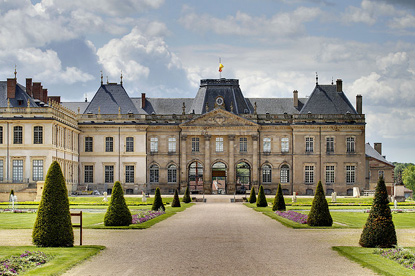 Once the residence of the Dukes of Lorraine, the Château de Lunéville is a stately Baroque palace famed as the 'Versailles of Lorraine', with formal gardens, ornamental water features and refined salons; today, its restored wings host exhibitions and seasonal events.
 |
Other attractions
 Baccarat Museum
Département de la Moselle
| Metz |
|---|
 Graceful capital of Lorraine at the Moselle-Seille confluence, renowned for its magnificent Gothic cathedral with stunning stained glass, medieval cobbled streets, the historic fortified German Gate, and contemporary Centre Pompidou-Metz art museum.
 |
Other attractions
Saint-Quirin
Département des Vosges
| Epinal |
|---|
 Épinal is a picturesque town in the Vosges region, straddling the Moselle River, renowned for its famous colourful woodcuts and prints from the historic Imagerie d'Épinal. This agreeable "ville fleurie" boasts beautiful flower displays, extensive parks and gardens, plus medieval architecture including the 13th-century Gothic St Maurice Basilica. The town serves as an excellent base for exploring the wider Vosges mountains whilst offering cultural attractions like the Musée de l'Image and historic castle ruins
 |
Other attractions
Gérardmer
Vittel
| Eupedia's Rating System |
|---|
Cities, towns, villages & historic buildings
Natural attractions
|
 : Local interest
 : Moderately interesting
 : Outstanding place
 : Must-see in the country
 : Top cities in Europe