


Introduction
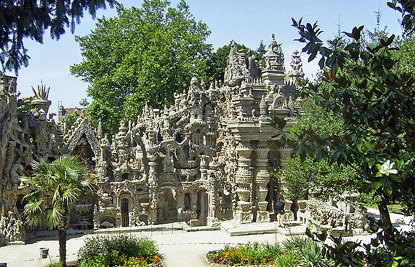
The Palais Idéal du Facteur Cheval in Hauterives stands as one of France's most extraordinary architectural monuments, built single-handedly by rural postman Ferdinand Cheval between 1879 and 1912. After stumbling upon an unusual stone during his postal rounds at age 43, Cheval spent 33 years constructing this 12-metre-high, 26-metre-long palace in his vegetable garden, using over 3,500 sacks of lime and stones collected during his daily walks. The structure combines architectural elements from various cultures and periods, featuring Egyptian temples, Hindu sanctuaries, Swiss chalets, medieval castles, and Biblical motifs, all inspired by the postcards and illustrated magazines he distributed during his work. Classified as a historical monument in 1969 and recognised as a masterpiece of naïve architecture, the palace attracts over 120,000 visitors annually and has inspired renowned artists including Picasso, André Breton, and Max Ernst. This unique monument represents the extraordinary vision of a self-taught artist who worked entirely alone, inscribing "the work of one man" upon his completed masterpiece.
Interesting Facts about Postman Cheval's Ideal Palace
- Built single-handedly by rural postman Ferdinand Cheval over 33 years, the Ideal Palace is a fantastical fusion of styles inspired by nature, postcards and illustrated magazines.
- Cheval began in 1879 after tripping over a curious stone on his delivery round, an accident he called his “stumbling block” and kept as the project’s symbolic first stone.
- The monument weaves exotic fauna and mythic figures into its façades and galleries, from elephants and flamingos to octopuses and legendary heroes.
- Cheval inscribed defiant mottos across the walls, including the famous tally “10,000 days, 93,000 hours, 33 years of struggle; let those who think they can do better try.”
- Entirely self-taught, he mixed pebbles, shells and local stones with lime and cement, pushing a wheelbarrow along his route to collect his building materials.
- The palace blends references from Hindu and Khmer temples to mediaeval castles and Biblical scenes, creating a dreamlike “museum of the world.”
- Celebrated by Surrealists and championed by André Malraux, it was listed as a French Historic Monument in 1969 as a landmark of naïve or outsider architecture.
- Cheval never lived in his palace; he built a house next door and continued night-time work for decades while keeping his day job delivering mail.
- A terrace crowns the structure with a Barbary Tower and once fed a “Source of Life” fountain via a water reservoir, a system later halted due to damage.
- The north façade marks the end of the 33-year effort, with a sculpted octopus set at the western corner as a playful final signature.
- The interior Gallery bears a poem that gave the monument its name, “Ton idéal, ton Palais,” and hosts a carved bestiary along its long corridor.
- Today the Ideal Palace draws visitors worldwide to the small Drôme village of Hauterives, testament to one person’s persistence, poetry and imagination.

History
While he was on his way to deliver mail in April 1879, Cheval trips on a large stone. Its unusual shape appealed to him, and he set about collecting other singluar stones in the area. Inspired by the sculptures made by Nature, Cheval decided that he too could create beautiful shapes with stones.
For the next 33 years, this postman who dropped from school at age 13 single-handedly constructed what he called his Temple of Nature. He used a wheelbarrow to carry stones and often worked at night with an oil lamp.
Mr Cheval also built his own mausoleum in the same style at the local cemetery.
Shortly before his death, Cheval began to receive some recognition from renowned artists like André Breton and Pablo Picasso. In 1969, André Malraux, the Minister of Culture, declared the Palais a cultural landmark and had it officially protected. In 1986, Cheval appeared on a French postage stamp.
Description
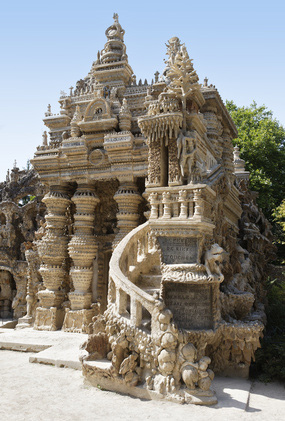
The palace is 26 metres long and reaches a height of 12 metres, with every surface covered in intricate detail. Its architecture is a whimsical fusion of styles from across the globe and throughout history. Visitors can spot elements reminiscent of a Hindu temple standing near an Egyptian tomb, a Swiss chalet, a medieval castle and an Arabian mosque.
Constructed from pebbles and stones bound together with lime and cement, the palace showcases an abundance of creativity. The main eastern façade serves as the centrepiece, presenting a “Temple of Nature” flanked by fountains known as the “Source of Life” and the “Source of Wisdom”.
A host of sculpted figures populates the structure, including giants, ostriches, eagles and flamingos. The palace also features dark, grotto-like passages and galleries, all adorned with sculptures, intricate decorations and hand-carved inscriptions. Walking through the palace is a journey of discovery, with new details revealing themselves at every turn.
Getting There
By train The easiest rail route is a TER regional service from Lyon’s Part-Dieu station to Saint-Vallier–sur-Rhône, where frequent buses cover the final 25-minute hop to Hauterives; alternatively, you can ride the train to Romans-sur-Isère and change to the local coach if timings suit your itinerary.
By coach or bus Direct long-distance coaches from Lyon Perrache occasionally run to Hauterives, but most travellers use the regional bus lines that link both Saint-Vallier and Romans-sur-Isère stations with the village, stopping just a short stroll from the palace gates.
By car From Lyon or Valence, follow the A7 to exit 12 (Chanas) or exit 13 (Tain-l’Hermitage), then weave through the scenic Drôme des Collines via the D51 and D538; parking is sign-posted in the village centre, less than 100 m from Postman Cheval’s extraordinary masterpiece.