


| Contents |
|---|
Introduction
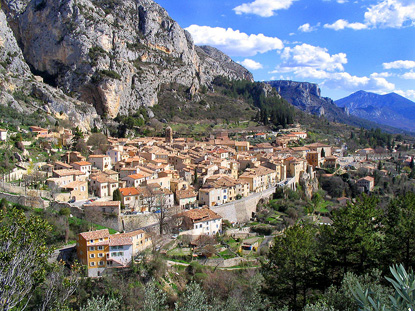
Situated at the western entrance to the Gorges du Verdon, Moustiers-Sainte-Marie (pop. 700) is nestled between two towering limestone cliffs. A spring flows out of the cliff, creating a waterfall directly out of the centre of town. The whole setting makes it one of the most beautiful villages in Europe. The settlement dates back to the 5th century and serves as a gateway to the Verdon Regional Natural Park. The village is renowned for its traditional faience pottery workshops, which flourished from the 17th century until 1873 before experiencing a revival in 1925. Built along terraced levels carved into the mountainside, Moustiers-Sainte-Marie features narrow cobblestone streets, trickling fountains, and traditional Provençal stone houses topped by terracotta tiles. A distinctive golden star suspended on a chain between the two cliff faces has watched over the village for centuries, according to local legend placed there by a returning Crusader knight. The settlement sits strategically between the dramatic Gorges du Verdon and Lac de Sainte-Croix, surrounded by olive groves and lavender fields that characterise the Haute-Provence landscape.
Interesting Facts about Moustiers-Sainte-Marie
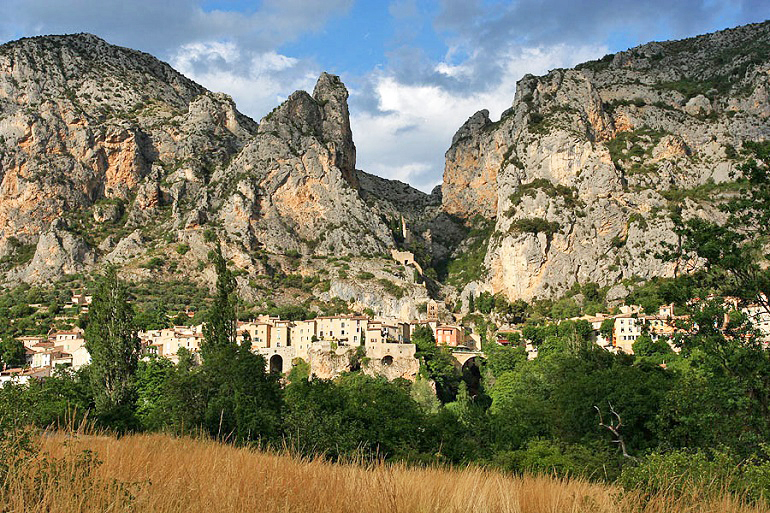
- Moustiers-Sainte-Marie is dramatically set between two towering limestone cliffs at the western entrance to the Verdon Gorge, creating a natural amphitheatre effect.
- A gilded star hangs from a long chain strung high between the cliffs, a village emblem tied to a Crusader’s vow and retold in enduring Provençal legend.
- The village has been celebrated for its delicate faïence earthenware since the seventeenth century, a craft revived in the twentieth century and still produced in local workshops.
- Notre-Dame de Beauvoir chapel crowns the heights above the village and is reached by a steep staircase of roughly 262 stone steps with sweeping views.
- A spring bursts from the cliff to form a waterfall through the centre, once powering mills and shaping everyday life in the village.
- Recognised among “Les Plus Beaux Villages de France,” the settlement preserves medieval ramparts, an aqueduct, and a Romanesque parish church in soft Provençal stone.
- At around 630 metres above sea level, the village overlooks fields of lavender and the turquoise waters feeding nearby Lake Sainte-Croix.
- The pastel-hued facades and narrow lanes recall a nativity scene, a comparison often made by travellers for the village’s almost theatrical setting.
- The star has fallen and been replaced several times over the centuries, most recently rehung by helicopter after a chain failure.
- Moustiers-Sainte-Marie’s location makes it a gateway for outdoor adventures in the Verdon, from cliff-top viewpoints and hiking to kayaking through France’s grandest canyon.
History
Early Foundations and Medieval Development
Moustiers-Sainte-Marie's origins stretch back to prehistoric times, with evidence of human presence in the area dating to 30,000 BCE when Cro-Magnon peoples roamed the plains and sought shelter in the surrounding caves, as demonstrated by hunting scenes discovered on the Ségriès Plateau. During the Bronze Age, Ligurian tribes intensified the settlement by occupying the plateaus and constructing fortified hilltop settlements called oppida. The village's true foundation, however, began in the 5th century when monks from the Abbey of Lérins, located on islands off Cannes, settled in the travertine caves and established a monastery during the 6th century, giving the settlement its name "Monasterio" (monastery) in medieval times. The Chapel of Notre-Dame de Beauvoir, constructed between the 12th and 16th centuries on the site of a Marian temple that existed as early as 470 CE, demonstrates the persistent sacred character of the village and its importance as a pilgrimage destination. During the 10th and 11th centuries, Moorish invasions forced residents to seek protection in caves, but by the 12th and 13th centuries, the village began to flourish with the construction of fortifications, houses, and mills powered by the Adou stream.
The Golden Age of Faïence and Industrial Development
The village truly began to prosper in the 16th century with the development of hydraulic-powered industries, including tanning, paper mills, pottery workshops, and various mills that took advantage of the water resources. However, Moustiers-Sainte-Marie's most famous period came with the establishment of its faïence (tin-glazed pottery) industry, which began around 1679 when Pierre Clérissy, coming from a long line of local potters, founded the first major faïence workshop after learning the technique from an Italian monk named Lazzaro Porri in 1668. The Clérissy family, assisted by renowned painters such as François, Gaspard, and Jean-Baptiste Viry, produced high-quality monochrome cobalt blue ceramics on white backgrounds that became highly sought after. The industry reached its golden age when King Louis XIV's Sumptuary Decrees of 1689, renewed in 1699 and 1709, banned gold and silver tableware, leading French nobility to replace their precious metal dinnerware with faïence, making Moustiers ceramics fashionable throughout Europe. At its peak, the village housed 14 faïence workshops and boasted a population of 2,000 inhabitants, with the pottery industry generating more revenue than all other village trades combined.
Decline, Revival, and Modern Heritage
The faïence industry began to decline in the second half of the 18th century due to changing royal tastes, particularly when King Louis XVI developed a preference for British ceramics, and the 1786 Vergennes Treaty allowed English ceramics to be imported into France. The discovery of kaolin quarries near Limoges in 1769 led to the rise of porcelain production, which further competed with traditional faïence. Severe weather conditions in the early 17th century had already damaged much of the village's infrastructure, causing significant population decline. By 1873, the golden period of Moustiers faïenceries came to an end, and the last workshop closed its doors in 1884. The art remained dormant for over 50 years until 1925-1928, when Marcel Provence (born Marcel Joannon), a journalist, writer, and ethnologist passionate about Provençal culture, resurrected the faïence industry by restoring one of the village's old kilns. He established the Academy of Moustiers to study faïence traditions and founded the Museum of Faïence, helping to revive the craft with distinctive bird motifs that became symbolic of modern Moustiers ceramics. Today, the village maintains its population at around 700 inhabitants, with seven active workshops continuing the traditional faïence craft alongside a thriving tourism industry.
Main Attractions
The Village Centre
Moustiers-Sainte-Marie captivates from the moment you enter its ancient streets, where cobbled lanes wind between pastel-hued houses, vibrant with flowers and the scent of lavender. Stone bridges arch over a lively stream that splits the village, while cafés, artisan pottery shops, and local boutiques invite leisurely exploration. Every turn reveals new panoramas of rugged cliffs and the Provençal sky, and the sound of fountains and trickling water is ever-present—mixing with the gentle buzz of village life. The centre is quintessential Provence: tranquil, photogenic, and redolent with tradition.
Notre-Dame de Beauvoir Chapel
No visit to Moustiers-Sainte-Marie is complete without climbing the legendary 262 stone steps to Notre-Dame de Beauvoir Chapel, perched dramatically above the village on a rocky escarpment. The ascent takes you through terraced gardens and ancient olive trees, culminating in one of Provence’s most breathtaking viewpoints. The chapel itself, a blend of Romanesque and Gothic architecture, has been a place of pilgrimage since the twelfth century—its weathered walls and peaceful interior a testament to centuries of devotion. The panorama from its terrace sweeps across the rooftops, valley, and surrounding hills—a reward well worth the climb.
Parish Church of Notre-Dame-de-l’Assomption
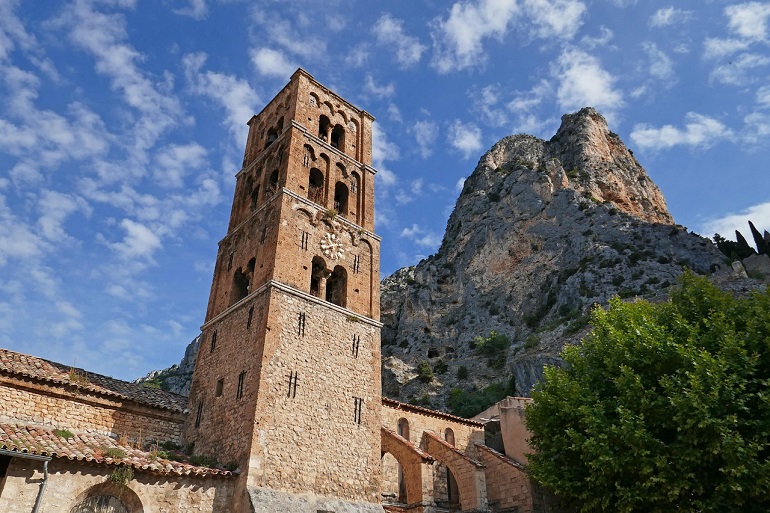
At the heart of the village, the Parish Church stands as a monumental centrepiece, its distinctive four-storey Lombard-style bell tower visible from every corner. Built in the twelfth century, the church features Romanesque architecture with Gothic elements and is renowned for its rare “swinging” tower—one of only three such towers in Europe. The cool, quiet interior provides a serene escape, while the exterior stonework and the church square capture the spirit of Provençal ecclesiastical heritage. It remains a spiritual and cultural anchor for the community, as well as a highlight for architecture enthusiasts.
The Golden Star of Moustiers
Suspended between two sheer cliffs on a chain measuring 227 metres is the iconic gilded star of Moustiers—an enduring symbol of the village, enveloped in legend and mystery. Its origins are debated, with tales ranging from medieval knights’ vows to lovers’ promises, but its striking visual presence is undisputed. Whether viewed from the village square or the path up to the chapel, the star’s gleam against the rugged limestone is unforgettable—an emblem that draws eyes and stirs imaginations, embodying the romance and resilience of Moustiers.
Waterfalls and the Riou Cascade
The mountain stream that flows through Moustiers tumbles spectacularly as the Riou Cascade, which plunges over 50 metres into a quiet pool just a short walk from the village centre. The soothing sound of rushing water reverberates through shaded pathways, creating pockets of tranquillity amid the lively village. Further upstream, the Cascades des Sirènes offer another natural retreat, with gentler falls and secluded spots ideal for contemplation. These natural features are beloved by both residents and visitors, providing refreshing respites and opportunities for quiet walks along the riverbanks.
Faïence Pottery and Artisan Boutiques
Moustiers-Sainte-Marie is world-famous for its faïence pottery, the intricate blue-and-white ceramics that have been crafted here since the seventeenth century. Dozens of artisans’ shops line the streets, offering everything from traditional Provençal motifs to contemporary designs—each piece hand-painted and glazed in the traditional way. Visitors are often welcomed into workshops to observe the process, and the opportunity to select unique, locally made ceramics is a highlight of any visit. The artistry and craftsmanship found in these boutiques are integral to the village’s identity and a treasured part of its cultural heritage.
The Provençal Market
On Friday mornings and throughout the summer, the village square transforms into a lively Provençal market, where the bounty of Haute-Provence is on full display. Vendors offer fragrant lavender honey, artisanal cheeses, local olive oil, fresh fruit, handmade soaps, and textiles—each stall a sensory delight. The market is not just a place to shop, but also a hub for socialising, with locals and visitors mingling over coffee and pastries, sampling regional specialties, and soaking in the convivial atmosphere that defines Provençal market culture.
Natural Landscapes: Verdon Gorge and Lac de Sainte-Croix
Moustiers-Sainte-Marie is the gateway to two of Provence’s most dramatic natural sites—the Verdon Gorge, often called the Grand Canyon of France, and the shimmering turquoise Lac de Sainte-Croix. The gorge offers awe-inspiring hikes with panoramic views, rock climbing, and scenic drives along vertiginous roads. Just a few kilometres away, the lake invites swimming, canoeing, paddleboarding, and picnicking along its sandy shores. Both destinations are easily accessible for day trips, and their striking beauty complements the cultural riches of the village—making Moustiers an ideal base for exploring both nature and heritage.
Pont du Galetas
A short drive leads to the Pont du Galetas, a bridge that spans the entrance to the Verdon Gorge and offers some of the most spectacular vistas in the region. From here, visitors can gaze down into the turquoise waters of Lac de Sainte-Croix and across the dramatic canyon landscape—views that are especially striking at sunset. The bridge is a favourite among photographers and sightseers, providing a panoramic perspective on the natural wonders that surround Moustiers.
Top Museums
Musée de la Faïence
The Musée de la Faïence is set within the Hôtel Berthet de la Clue, a stately former manor that itself is a monument to Provençal history and elegance. Inside, the museum hosts a collection of over 500 pieces, spanning from the earliest local productions of the 17th century through to modern interpretations by contemporary artisans. Masterpieces by Clérissy, Olérys, Laugier, and other famed faïenciers showcase the sublime artistry for which the village became renowned.
- The Grand Salon Bleu immerses visitors in the blue-and-white luminosity that defined Moustiers’ international reputation.
- A rotating selection of temporary exhibitions explores the dialogue between classic traditions and today’s ceramic innovations, featuring local and international artists.
- Thematic rooms present garland motifs, fantastical grotesques, and lively natural scenes, all crafted in the unique local style.
- Informative displays reveal the time-honoured secrets of clay-washing, wheel-turning, glazing, and firing, explaining how the particular lime-rich local clay leads to the “Moustiers ring”—the clear sound heard when tapped.
Living Tradition: Ceramic Workshops
The artistic spirit of Moustiers-Sainte-Marie extends far beyond the museum walls. The village is celebrated as a “ceramic capital,” with seven active workshops, countless galleries, and artisan studios where ancient and modern techniques are perpetuated and renewed for visitors and collectors alike. Most workshops warmly welcome guests for demonstrations, informal visits, and purchases, offering handmade pieces that reflect the continuing legacy of village faïence.
- The workshops range from traditional ateliers—many using designs and motifs passed down through generations—to innovative studios experimenting with contemporary shapes and colours.
- Essential elements of Moustiers ceramics—water, local earth, and wood—are still integral to production, maintaining continuity with centuries-old methods.
- Artisans are often happy to explain their process, and it is common to see the stages of pottery preparation, painting, glazing, and firing in action during a visit.
Local Cuisine
Moustiers-Sainte-Marie’s gastronomy blends Provençal sunshine with Alpine heartiness, drawing on fragrant herbs, lavender and the bounty of nearby farms. Sweet lovers can sample lavender honey spread on fresh bread or drizzle it over goat’s cheese, alongside crumbly almond biscuits that appear in every bakery window. Savoury snacks include olive-studded fougasse bought warm from the boulangerie, while summer stalls sell creamy scoops of lavender ice cream and brewers bottle a thyme-scented local beer. Restaurant menus turn rustic after dusk, serving pieds et paquets, parcels of tripe and trotters simmered in tomato and white wine, or a rich wild boar stew slow-cooked with Provençal herbs. For picnics, delis such as Maison Bondil offer air-dried charcuterie, olive oil and cheeses so visitors can carry Haute-Provence flavours on their onward journey.
Getting There
By train The village lacks its own station, so travellers should aim for Manosque-Gréoux-les-Bains on the Marseille–Briançon line or Aix-en-Provence TGV; from either, regional buses run via Riez to the centre of Moustiers-Sainte-Marie, with journey times of around one hour.
By coach or bus Regional ZOU! services link the village to Marseille (line 67) and Castellane (line 450); from Manosque or Aix-en-Provence you can connect to these routes, while local buses shuttle between Riez and Moustiers several times daily, making public transport the simplest option once in Provence.
By car The most flexible way is to follow the A51 from Aix-en-Provence, exiting at Manosque or Vinon-sur-Verdon before continuing on the D952 through Valensole’s lavender fields to Moustiers-Sainte-Marie; drivers coming from the Côte d’Azur can leave the A8 at Draguignan and weave north via Aups and Les Salles-sur-Verdon, enjoying dramatic views of the Verdon Gorge en route.