


| Contents |
|---|

Introduction
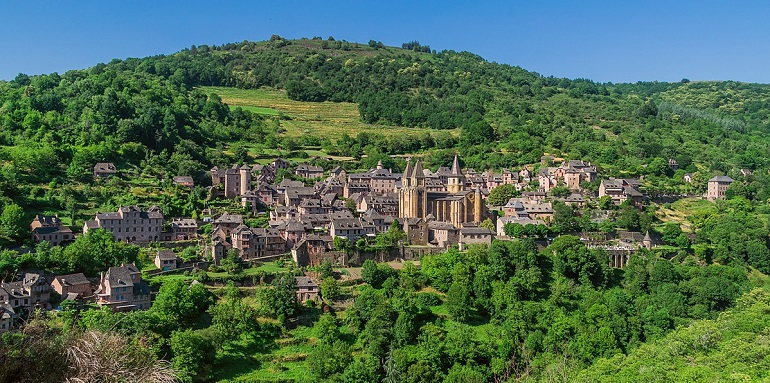
Hemmed in a lush green valley at the confluence of the Dourdou and Ouche rivers, Conques (pop. 250) is a lovely medieval village brimming with wabbly half-timbered houses and old sandstone edifices. A major stop on the Ways to St James, Conques's Romanesque Abbey-Church of St. Foy was added to the World Heritage Sites of the Routes of Santiago de Compostela in France in 1998. The settlement's origins date back to the 8th century when it was established as a monastic community, later becoming a major pilgrimage site on the Via Podiensis route to Santiago de Compostela following the arrival of the relics of Sainte Foy from Agen in 883. The village's architectural centrepiece is the Abbey Church of Sainte Foy, a UNESCO World Heritage Site with construction primarily from the 11th century, famous for its remarkable Romanesque tympanum and Pierre Soulages' modern stained glass windows. Conques continues to welcome both traditional pilgrims and modern walkers seeking cultural discovery, with its preserved cobblestone streets, ancient stone houses, and significant collection of medieval goldsmithing housed in its treasury making it an exceptional centre of art and spirituality. Conques is listed as one of the most beautiful villages of France.
Interesting Facts about Conques
- Conques grew around an 8th-century hermitage founded by the monk Dadon, whose retreat drew companions and evolved into a Benedictine community.
- The village became a major stop on the Way of St James after the relics of the young martyr Sainte Foy arrived in the 9th century, transforming its fortunes.
- The Romanesque Abbey Church of Sainte-Foy, largely 11th–12th century, is renowned for its sculpted Last Judgement tympanum with more than a hundred carved figures.
- Conques shelters one of Europe’s most remarkable medieval treasuries, highlighted by the gold-and-gems reliquary statue known as the Majesty of Sainte Foy.
- Due to its remote hillside setting above the Dourdou gorge, Conques preserved an exceptional medieval streetscape of cobbles, timber-framed houses, and fortified gates.
- The name “Conques” is linked to its shell-like basin topography, echoing the scallop shell emblem carried by pilgrims to Compostela.
- Local tradition recounts that villagers hid the abbey’s precious reliquaries during the French Revolution, secreting objects in chimneys, sheds and gardens to save them from being melted down.
- The abbey and village form part of the UNESCO recognition of the Routes of Santiago de Compostela in France, underscoring their enduring pilgrimage heritage.
- Traces of medieval polychromy survive on the abbey’s great tympanum, hinting at the vivid colours that once enlivened its sculpted scene of heaven and hell.
- Conques is officially classed among the “Most Beautiful Villages of France,” combining spiritual heritage with a remarkably intact medieval fabric.
History
The origins of Conques trace back to the late 8th century when a hermit named Dadon sought solitude at this wild and remote site, establishing himself near a sacred spring known as Plo. The spring had been considered mystical by Celtic ancestors and later revered by Romans for its purported virtues, making the location sacred even before Dadon's arrival. This reclusive monk's contemplative retreat soon attracted other like-minded religious men, including Benedictine monks fleeing the Saracens in Spain, who joined Dadon to form a small monastic community. With financial support from Charlemagne around 800, these monks built their first church dedicated to Saint Saviour, and the community officially became a Benedictine Abbey in 819. Louis the Pious later provided funding for a larger abbey structure during the same century, establishing Conques as a significant religious centre in the region.
The transformation of Conques from a modest hermitage into one of medieval Europe's most important pilgrimage destinations began in 886 with one of history's most audacious religious thefts. A monk from Conques named Ariviscus, recognising that his monastery lacked significant relics to attract pilgrims and donations, travelled to Agen where the complete remains of Saint Faith (Sainte-Foy) were housed. Saint Faith was a 12-year-old Christian girl who had been martyred by the Romans in the fourth century for refusing to renounce her faith. Ariviscus spent nearly a decade working undercover at the Agen monastery, gradually earning trust until he could successfully steal the precious relics and transport them to Conques in what was euphemistically called a "translation furtive". The relics were housed in a magnificent golden reliquary statue adorned with blue enamel eyes and precious gems donated by grateful pilgrims, and Saint Faith quickly gained a reputation for restoring sight to the blind who touched her shrine.
The arrival of Saint Faith's relics transformed Conques into one of the principal stops along the Via Podiensis route of the Camino de Santiago pilgrimage to Santiago de Compostela. Pilgrims flocked to the village in their thousands, bringing wealth that enabled the monks to construct the remarkable Romanesque abbey church that dominates the village today, built between 1030 and 1130 to replace Dadon's original modest chapel. This architectural masterpiece, extending 59 metres externally with its distinctive crossing tower rising 26.40 metres, became renowned for its spectacular carved tympanum depicting the Last Judgement. However, Conques faced significant challenges during later periods: the church suffered partial destruction during 16th-century Protestant uprisings and was vandalised during the French Revolution when parliament ordered the confiscation and melting of the abbey's treasures for gold. The resourceful villagers responded by stealing and hiding the precious artefacts throughout the village in chimneys, sheds, and buried in gardens, only returning them safely to the abbey when Napoleon came to power. The village was officially designated as a French historic site in 1838, and in 1998, the Abbey Church of Sainte-Foy was inscribed as a UNESCO World Heritage Site as part of the Routes of Santiago de Compostela in France.
Main Attractions
Medieval Village and Historic Ambience
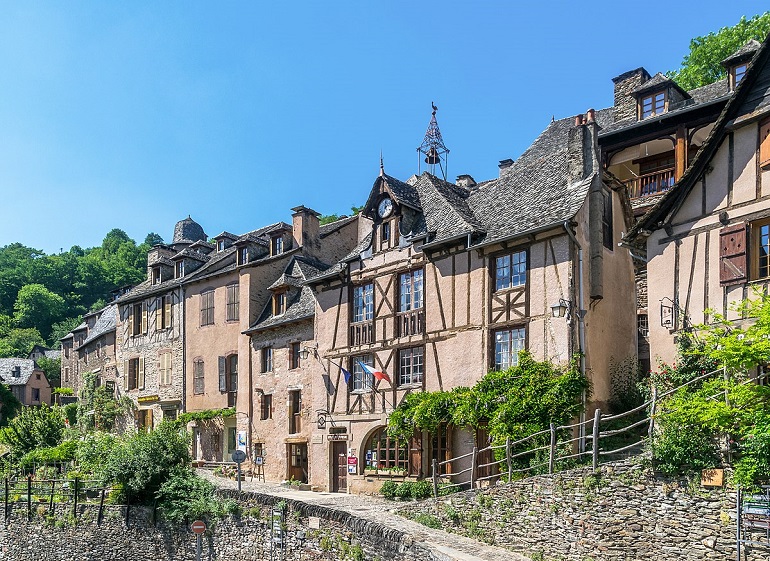
The heart of Conques is its beautifully preserved medieval village, praised as one of the most picturesque in France. Visitors stroll winding cobbled streets lined with half-timbered houses, many built from local ochre stone with distinctive slate roofs. The setting exudes authenticity, with floral displays, vine-clad façades, and a tranquil atmosphere reminiscent of centuries past. The entire village is a listed historic site, its character shaped by generations of welcoming pilgrims, artisans, and locals providing hospitality and sustenance.
Abbey Church of Sainte Foy
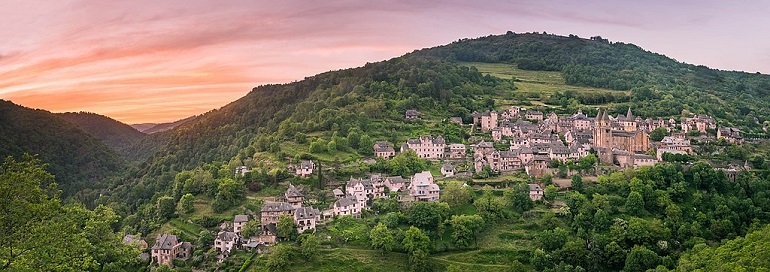
Dominating the skyline is the majestic Abbey Church of Sainte Foy (Saint Faith), a masterpiece of Romanesque architecture founded in the 10th century. The church houses relics of Sainte Foy, the village's patron saint, drawing both pilgrims and art lovers alike. Its ornate carved tympanum depicts Christ presiding over the Last Judgement—a celebrated work frequently discussed by guides and monks. The interior features luminous contemporary stained glass windows by Pierre Soulages, a striking contrast to the medieval stonework. The abbey remains the spiritual heart of Conques, hosting blessings, prayers, and memorable evening organ concerts for pilgrims and visitors throughout the year.
The Pilgrims’ Route and Chemin de Saint-Jacques
Conques is an essential halting place along the Way of Saint James (Chemin de Saint-Jacques), specifically the Via Podiensis. Pilgrims have descended through the wild landscapes of Aubrac into the Lot valley for centuries, traversing Conques upon their spiritual or cultural journey. Today, the GR65 trail and related footpaths allow modern travellers to experience this profound route, with options for walks both short and extended to enjoy the beauty and significance of the setting.
Pont sur le Dourdou (Pilgrims’ Bridge)
Crossing the tranquil Dourdou River, the Pont sur le Dourdou is a beautifully preserved Romanesque stone bridge and a UNESCO World Heritage site in its own right. For centuries it carried pilgrims arriving from the north. Approaching Conques by this bridge provides a dramatic view up towards the clustered stone homes and the abbey—among the most memorable introductions to the village. The riverside below is particularly scenic, and the route up through Rue Charlemagne and Ported du Barry is a classic approach into the old town.
Chapelle Sainte-Foy
Perched on a serene hillside outside the main village, the Chapelle Sainte-Foy is a traditional stopping place for pilgrims. Those who climb the trail to reach it are rewarded by panoramic views back towards Conques and the surrounding gorges. Tradition holds that each arriving pilgrim rings the chapel bell, sometimes answered by the echo of the abbey's bells in the valley below. This ritual and the peaceful outlook create a uniquely contemplative experience for visitors.
Viewpoints and Walking Paths
Numerous walking paths crisscross the hills above Conques, offering panoramic perspectives of the village, wooded valleys, and the graceful curve of the river below. The Point Bancarel, south of the village, is especially noted for its wide vistas at sunrise and sunset, when the golden light transforms the stonework and rooftops. Whether embarking on a section of the GR65 or sampling shorter local circuits, visitors find ample opportunities for scenic photography and moments of quiet reflection.
The Sacred Spring of Plo
Conques owes its earliest origins to the spring of Plo, once revered by Celts, then by Romans, and later sanctified by Christian hermits. It was near this site that the monk Dadon established the first hermitage in the 8th century, laying the foundations for the spiritual community that would blossom into Conques. The spring's mystical reputation adds an ancient and almost mythical dimension to any exploration of the local countryside.
European Centre for Medieval Art and Culture
Situated at the summit of the village, this centre celebrates and preserves local artistic heritage through lectures, art exhibitions, and cultural events year-round. Its presence underlines Conques’ commitment to both spiritual life and the vibrant traditions of medieval craftsmanship, music, and learning.
Top Museums
Sacred Art and Treasures
The Treasure of Conques
Nestled within the abbey precincts, the Treasure of Conques is celebrated across Europe for its sumptuous display of mediaeval craftsmanship and devotion. Here one finds rare reliquaries fashioned in gold and silver, encrusted with jewels that speak to centuries of pilgrimage and piety. The majesty of Sainte Foy constitutes the core of the exhibition—a dazzling golden figure, both enigmatic and iconic, enshrining the relics of the abbey’s patron saint. Crafted between the 9th and 10th centuries, this statue is resplendent not only for its materials but also for its timeless symbolism, embodying medieval faith and artistry. Alongside it are processional crosses, Romanesque manuscript bindings, and liturgical vessels, all marked by exceptional detail, embodying both sacred function and artistic expression. Stepping into the treasury, visitors are swept into a narrative shaped by faith, devotion, and community, as expressed through the abbey’s continuous role in the route to Santiago de Compostela.
Local History and Art
Musée Joseph-Fau
The Musée Joseph-Fau lies at the heart of the ancient village, its collection drawing visitors into an intimate exploration of Conques’s past. Occupying a characterful historic residence, the museum gathers together sculptures, painted panels, liturgical objects, and mediaeval artefacts unearthed in the vicinity. Of particular note are the restored Romanesque capitals, which once adorned the cloisters and now offer glimpses into the iconography and symbolism celebrated by medieval masons. The museum charts the artistic evolution of the village, from its earliest Christian communities to its flourishing as a stop on the pilgrimage route. Visitors will discover depictions of everyday life, religious ceremonies, and scenes from local folklore, all preserved amid the stone walls and winding corridors of the old house. The museum’s modest scale fosters reflection, allowing each visitor to appreciate the intricacy of its treasures in a setting that is both authentic and evocative.
Contemporary Art
Les Chambres de Lumière
Les Chambres de Lumière embodies Conques’s commitment to ongoing artistic innovation. The gallery is dedicated to light-based sculpture, showcasing creators such as Bastien Carré who meld contemporary vision with the timeless aura of the village’s architecture. Installations often respond to the shifting natural light, enhancing the sensory atmosphere of the stone-built surroundings. Exhibitions rotate on a regular basis, ensuring that both local residents and returning visitors experience something fresh at each visit. The interplay between light and structure here offers an encounter that is spiritual as much as it is aesthetic, bridging the ancient and the modern with subtlety and grace.
Architectural Masterpiece
The Abbey Church: Living Museum
The Abbey Church of Sainte-Foy stands as the grand narrative heart of the village, its stones bearing the imprint of a millennium of worship, art, and history. Entering the nave, visitors encounter an architectural marvel of Romanesque artistry—towering piers, intricately carved capitals, and the spellbinding tympanum above the entrance, which depicts the Last Judgement in vivid detail. This sculptural masterpiece displays over a hundred figures arranged in a dramatic tableau, capturing biblical stories, moral lessons, and the medieval imagination at its most ambitious.
The Stained Glass Windows of Pierre Soulages
A striking modern chapter unfolds within the church via the stained glass windows created by Pierre Soulages, installed in 1994 following a visionary commission by the French Culture Ministry. Soulages, famed for his mastery of deep blacks and abstract forms, deliberately chose a ‘water white’ or achromatic glass that eschews the vivid figuration typical of medieval stained glass. Instead, these 104 windows manipulate the passage of natural light, transforming its qualities depending on the time of day and the viewer’s position in the nave. The glass does not tell stories or depict biblical scenes; rather, it animates the stonework and evokes a contemplative mood, described by some as magnifying the spiritual ambience. Their minimalist design and interaction with the Romanesque architecture has stirred substantial debate: traditionalists lamented the absence of historical and narrative content, while others praised the innovative spiritual depth they brought to this sacred space. Soulages himself spoke of the windows as an effort “to serve the architecture as it came to us, in respect of the purity of its lines, the modulation of the stone tonalities, the order of the light and the life in such a space”.
Local Cuisine
Conques is renowned for its rustic and authentic gastronomy, where time-honoured recipes are still lovingly prepared using local ingredients. Visitors can delight in aligot, a creamy blend of mashed potatoes and local cheese, often served alongside grilled meats, as well as tripoux, tender parcels of tripe slow-cooked in a savoury broth. Culinary highlights also include estofinade, a hearty dish made from dried cod and potatoes, and the region's celebrated roquefort cheese, prized for its tangy and creamy character. Sweet treats such as fouace, a delicate, orange blossom-flavoured brioche, offer a fitting finish to a meal, capturing the essence of Conques’ gastronomic heritage.
Getting There
By train Conques has no railway of its own, so the simplest approach is to ride the SNCF Intercités or TER services to either Rodez (38 km away) or the smaller halt at Saint-Christophe-Vallon (23 km). From either station, regional liO bus line 223 or a pre-booked taxi completes the final leg through oak-clad valleys into the village.
By coach or bus Direct long-distance coaches are scarce, but liO’s line 223 runs several times daily between Rodez, Marcillac and Conques from April to October, while Compostelbus links Conques with Le Puy-en-Velay for pilgrims on the GR 65. Advance booking is wise, as seats are limited.
By car Drivers approach on winding scenic roads: from Rodez follow the D901 then D42, or from Toulouse take the A68 to Albi, the N88 to Rodez and finally the D901. The village is pedestrian-only, so park at La Salesse above the houses and descend on foot through the medieval gates.
| Travel destinations in Midi-Pyrénées | ||||||||||||||
|---|---|---|---|---|---|---|---|---|---|---|---|---|---|---|
|
|
|
|
| ||||||||||
|
|
|
|
| ||||||||||
|
|
| ||||||||||||


