


| Contents |
|---|
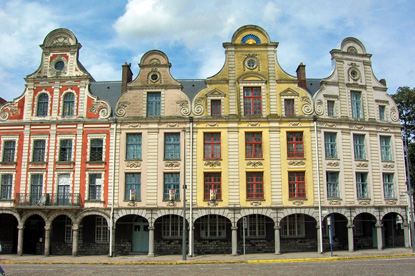
Introduction
Arras, the capital of the Pas-de-Calais department and the historic centre of the Artois region. With roots dating back to the Gallo-Roman era, Arras has evolved over centuries, showcasing its strategic importance as a major economic and military hub. The city is renowned for its architectural treasures, including the iconic Belfry of Arras, a UNESCO World Heritage Site, and the beautiful Baroque squares like La Grande Place. Visitors can explore the Cathedral of Notre-Dame, the Citadel of Arras, and numerous museums, such as the Museum of Fine Arts and Cité Nature. Arras offers a blend of historical landmarks, cultural experiences, and modern attractions, making it a vibrant destination for those interested in history and culture.
Interesting Facts about Arras
- Arras, originally known as Nemetacum in the Gallo-Roman era, was a major centre of the Celtic Atrébates people.
- The city became famous in the Middle Ages for its high-quality tapestries, which inspired the English word "arras."
- Arras was the birthplace of Maximilien de Robespierre, a key figure in the French Revolution.
- The Peace of Arras in 1482 helped define the northern frontiers of modern France.
- Its two iconic squares, the Grand'Place and Place des Héros, feature stunning Flemish Baroque architecture.
- The UNESCO-listed belfry of Arras offers panoramic views of the city from 75 metres high.
- Arras’ underground tunnels, such as the Wellington Quarry, were used during World War I and are now a museum.
- The city’s Saint-Vaast Abbey and Cathedral house the Musée des Beaux-Arts, showcasing art from various periods.
- Arras was once part of the Spanish Netherlands before becoming permanently French in 1659.
- The city hosts vibrant markets on Wednesdays and Saturdays in its historic cobbled squares.
History
Originally settled by the Celtic tribe of the Atrebates, it later became a Roman garrison town known asAtrebatum. The Artois region was then settled by the Salian Franks, around the 5th century.
Saint Vedast (or Saint Vaast, c. 453-540), who taught Clovis I (466-511) about Catholicism, was appointed as the first bishop of Arras in 499, andCambrai in 511. Saint Vedast attempted to erradicate paganism among the Franks, including their veneration for beer. St. Vaast's Abbey was founded in his honour by Saint Auburt in 667. He was was buried in the cathedral at Arras. Vedast's relics were transferred to the new abbey, which was completed by Auburt's successor and generously endowed by King Theuderic III, who together with his wife was afterwards buried there.
Upon the division of Charlemagne's Empire by the Treaty ofVerdun in 843, Arras became the seat of the County of Artois, a vassal state of the Kingdom of France. In 932, the county passed to the Counts of Flanders. In 1180, Isabella of Flanders marries Philip II of France, and the Artois becomes part of the Royal domain in 1191.
From the 12th century, Arras developed a reputed tapestry industry, known in Italy asarrazi and in England simply as "Arras". Genghis Khan himself owned tapestries from Arras. The prosperity brought by the textile industry allowed for the reconstruction of the cathedral in 1167.
The title of Count of Artois was then attributed to Louis VIII of France's second son Robert (1216-1250). His grand-daughter Mahaut of Artois married Otto IV, Count of Burgundy, then passed to the House of Flanders again, and eventually came back to the House of Burgundy, until this one was absorbed by the Habsburg family in 1477, as part of the Southern Netherlands.
In 1435, the Peace of Arras ended the 100-year war between the Kings of France and the Dukes of Burgundy. In 1526, Francis I of France, then prisoner of the Habsburgs, renounces to his rights on the Counties of Artois and Flanders (among others) by signing the Treaty of Madrid. Louis XIII reconquers Arras in 1640, which then besieged and taken by the Spaniards in 1653, and taken back by Marshal Turenne. Arras was definitely annexed to France in 1659 by the Treaty of the Pyrenees.
One of the most famous son of Arras is Maximilien de Robespierre (1758-1794). Elected member of the Academy of Arras in 1783, then Member of Parliament representing the Third Estate for the Artois in 1789, Robespierre became one of the leading voices of the French Revolution, defending Universal Suffrage and the Equality of Rights for everyone. He was one of the drafters of the Declaration of the Rights of Man and of the Citizen, as well as of the First Constitution of France. He devised the Cult of the Supreme Being, which he intended to become the state religion instead of Christianity. During this period, many religious buildings were demolished or damaged throughout France, including in his native Arras.
Another famousArrageois is Eugène-François Vidocq (1775-1857), a criminal who later became the first director of Sûreté Nationale and one of the first modern private investigators. He was Victor Hugo's inspiration for the two main characters in his novelLes Misérables.
In the late 19th century, Arras becomes a cultural city. Ironically, it is during this period that mayor Émile Legrelle has the city walls dismantled.
Arras suffered considerably from the First World War, being only 10 km from the front. All the buildings destroyed were reconstructed just as they were before the war.
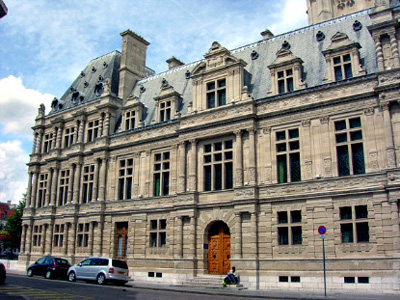
Town Hall, Arras
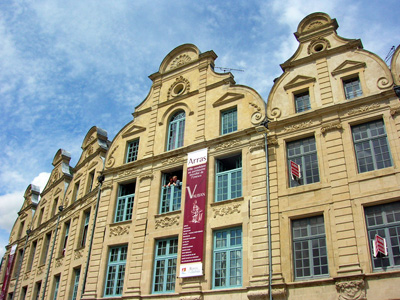
Place des Heros, Arras
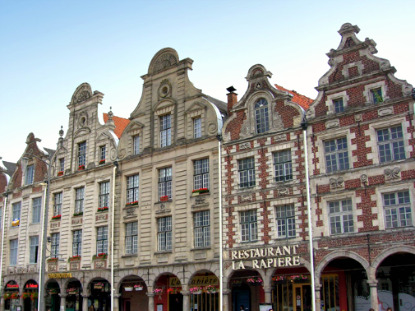
Grand Place, Arras
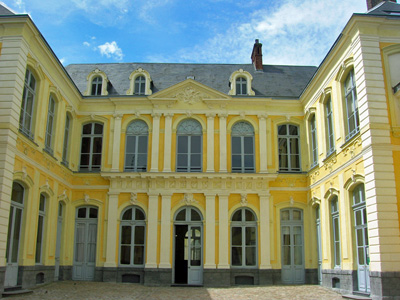
Hôtel de Guînes, Arras
Arras is renowned for its town squares. Like in most of the old Southern Netherlands, the main town square is named the Grand Place. It was built in perfectly homogenous Flemish style, and is one of the largest squares in France (if not the largest).
Unusually, the townhall and belfry are not on the Grand Place, but on Place des Héros, a square more the size of a typical market square, and designed in the same Flemish style. The construction of the original belfry started in1463, and was soon followed by the adjoining town hall (in 1502). The belfry was only completed in 1551, and reaches 75m in height. Both buildings were destroyed during WWI, and rebuilt identically afterwards.
Other notable squares include Place de l'Ancien Rivage (traditional 18th-century houses), Place de la Prefecture (with a classical church in the middle), Place du Pont de la Cité (note the baroque fountain), Place du Wetz d'Amain, Place du Théatre, and the circular Place Victor Hugo (with an obelisk in the centre).
St. Vaast's Abbey-Cathedral
Founded in 667 as a Benedictine monastry. St. Vaast Abbey was of great importance amongst the monasteries of the Low Countries. It was exempt from episcopal jurisdiction and maintained its independence until 1778, when it was aggregated to the Congregation of Cluny. The neoclassical building is stunning by its size; with 41 windows in length (on three storeys, so 123), it surpasses many princely and royal palaces in Europe.
The abbey's adjacent church, neoclassical as well, had been desecrated and partially destroyed during the French Revolution. It was rebuilt and consecrated in 1833 and now serves as the cathedral.
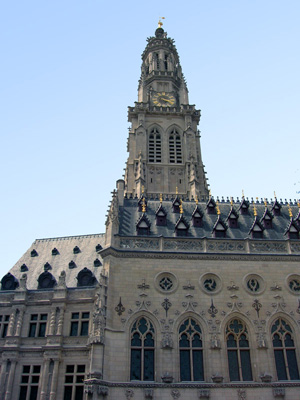
Belfry & Town Hall, Arras, Arras
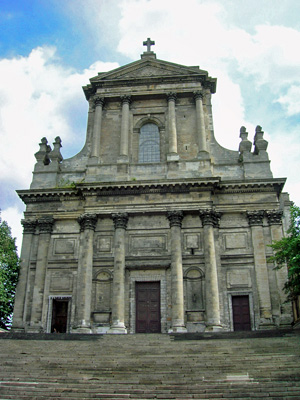
St. Vaast's Cathedral, Arras
Other attractions
Arras has a few very nice classical edifices and stately homes. The two most impressive are the Hôtel de Guînes (2, Rue des Jongleurs), the Hôtel Dubois de Fosseux (14, Rue du Marché-au-Filé). Also note the theatre (on Place du Théâtre), as well as the Hôtel de la Verdure, Hôtel de la Basecque, Hôtel du Marquis de Saluces (all on Rue des Portes-Cochères), Hôtel de Beauffort (Rue Victor Hugo), and Hôtel Deusy (87-89, Rue Saint-Aubert).
Vauban's citadel, south-west of the historical centre, was built between 1667 and 1672, and never served to defend the city, as no siege took place after its completion. It is now used by the French army and cannot be visited.
Top Museums
The Arras Museum of Fine Arts
Housed in the historic Saint-Vaast Abbey, this museum is a treasure trove of artistic and historical artefacts. Its collection spans centuries, featuring masterpieces from Flemish (Brueghel, Rubens), Italian (Bassano, Baglione), and French (Champaigne, Le Brun, Corot) schools. Unique highlights include:
- A collection of large-format French religious paintings, including seven “Mays” from Notre-Dame Cathedral in Paris.
- Medieval sculptures and Arras porcelains reflecting the city’s history.
- The famous Beaurains treasure and decorative lions from the Arras Belfry.
The museum also showcases works by 19th-century artists like Jules Breton, known for his poignant depictions of rural life, and Camille Corot with his poetic landscapes. It is not just an art museum but a conservatory of the region’s rich heritage.
The Museum Jean & Denise Letaille – Bullecourt 1917
Located in nearby Bullecourt, this museum is dedicated to the Great War. It displays over 2,000 authentic military objects unearthed by Jean and Denise Letaille from their fields. These items include personal effects of Australian and British soldiers who fought in the Battle of Bullecourt in 1917. The museum provides a deeply moving insight into the lives of soldiers during World War I.
The Louvre-Lens Museum
Just a short distance from Arras, this modern museum is an extension of the Louvre in Paris. Its *Galerie du Temps* presents 200 masterpieces spanning different civilisations and eras, from ancient times to the mid-19th century. Highlights include:
- Botticelli’s *Virgin and Child*.
- Delacroix’s *Liberty Leading the People*.
- Poussin’s *Landscape with Orpheus and Eurydice*.
The museum offers an immersive journey through humanity’s artistic evolution.
The Lewarde Mining History Centre
As France’s largest mining museum, this site offers an immersive experience into the region’s industrial past. Visitors can descend into a former coal mine and explore exhibits led by mediators trained by former miners. The museum captures the emotional and historical significance of mining in northern France.
Local Cuisine
The city's gastronomic scene is dominated by hearty, flavourful dishes that are sure to tantalise your taste buds. One of the most renowned local delicacies is the andouillette, a savoury sausage made from pork offal, celebrated annually at the Andouillette Festival in August. For those with a sweet tooth, Arras offers the Coeur d'Arras, a heart-shaped gingerbread biscuit, and the whimsical Rat d'Arras, a praline chocolate treat shaped like the city's namesake rodent. Meat lovers will relish the cochon d'Arras, a succulent pork dish slow-cooked in aromatic white wine. The city's markets are a treasure trove of local produce, perfect for sampling regional cheeses, craft beers, and the famous Merville potatoes, ideal for making crispy chips or creamy mash. Don't miss the opportunity to savour these authentic flavours that embody the essence of Arras's culinary tradition.
Getting There & Around
Travellers can reach Arras by train, with frequent services from major cities like Paris, Lille, and Lyon, making it a convenient option for those exploring the region. The town is also accessible by bus, with BlaBlaCar Bus and other operators providing intercity connections. For those driving, Arras is approximately two hours from Paris by car. Once in Arras, getting around is straightforward thanks to the Artis public transport network, which operates 30 bus lines across the area. The compact city centre is pedestrian-friendly and ideal for walking, while taxis and ride-hailing services like Uber are also available for added convenience.
| Travel destinations in Nord-Pas-de-Calais | ||||||||||||||
|---|---|---|---|---|---|---|---|---|---|---|---|---|---|---|
|
|
|
|
| ||||||||||
|
|
|
|
| ||||||||||
| ||||||||||||||


