Introduction

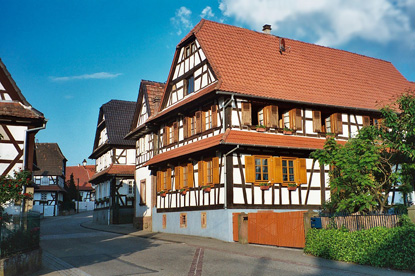
Blessed with a unique blend of Germany and France, Alsace is a pictureque strip of land hemmed by the Rhine River and the Vosges Mountains. Beyond its geranium-filled windows and storks nesting on top of timber-framed houses is a hedonistic hybrid culture of food lovers. Alsace produces both high-quality wine and beer. Its cuisine unabashedly combines foie gras and sauerkraut, macarons and gingerbread... Colmar and Strasbourg both rank among the 10 best cities to eat in France.
Alsace is the smallest French region (excluding overseas regions), the third most densely populated, the fourth wealthiest, as well as the one with the lowest unemployment rate.
Although German dialects were spoken in Alsace for most of its history, the dominant language in Alsace today is French. The traditional Alsatian language is an Alemannic dialect of Upper German and thus closely related to Swiss German and Swabian.
Famous people from Alsace include (chronologically): Nobel Peace Prize philosopher Albert Schweitzer, Nobel-prize-winning chemist Jean-Marie Lehn, pastry chef Pierre Hermé, rally driver Sébastien Loeb.
History
Alsace has been settled by Germanic people ever since the latter days of the Roman Empire. In the Middle Ages, it was one of the favourite residences of many Holy Roman Emperors, who granted the special status of Free Imperial City to ten Alsatian towns, who later form the Décapole alliance (or Zehnstädtebund in German).
While the Thirty Years' War (1618-1648) ravaged a religiously divided Germany, Louis XIV opportunistically annexed Alsace. Many cities resisted this forceful annexation for up to three decades, before resigning themselves after witnessing their homes being plundered and burned by the French.
No sooner had the Alsatians got used to French rule that they were retroceded to Germany in 1871 following the Franco-Prussian War. Alsace remained German until the end of WWI, was returned to France, then recovered again by the Germans during WWII.
Cuisine
Alsatian cuisine is a unique blend of French and German culinary traditions, shaped by the region's borderland history. Many dishes revolve around pork, such as choucroute garnie—a savoury plate of fermented cabbage served with an assortment of local sausages, smoked pork, frankfurters, and often accompanied by steamed potatoes. Alsace is also famous for delicacies like foie gras, which has roots in the region dating to the seventeenth century.
The Alsatian table features hearty, rustic fare like baeckeoffe, a slow-cooked stew combining potatoes, onions, and layers of lamb, beef, and pork, enriched with regional white wine and aromatic herbs. Another staple is flammekueche or tarte flambée, a thin, crispy pastry base spread with crème fraîche and fromage blanc, then topped with bacon strips and onions, usually baked in wood-fired ovens. Southern Alsace is known for carpe frite, deep-fried carp, alongside German-influenced specialities such as spaetzle noodles and bretzel pretzels.
In addition to savoury options, Alsace is celebrated for its sweet treats: pain d'épices (spiced gingerbread) and fruit tarts abound. Munster cheese, an iconic pungent variety, graces many cheese boards. Alsace’s cuisine is ideally matched with crisp local white wines, including Riesling and Gewurztraminer, and tradition dictates that many meals begin with cremant d’Alsace, a sparkling regional wine. The region’s culinary culture is enriched by historic winstubs—cosy taverns offering generous regional fare and showcasing the warmth of Alsatian hospitality.
Attractions
Départements are listed from North to South.
Département du Bas-Rhin
|
Wissembourg |
|---|

 Enchanting medieval town in northern Alsace on the German border, renowned for its magnificent 15th-16th century half-timbered houses, Gothic Abbey Church, historic Salt House, and ancient ramparts along the River Lauter. Gateway to Northern Vosges Regional Park. |
|
Haguenau |
|---|

Haguenau, Alsace’s fourth-largest city, pairs elegant 18th-century architecture and pocket museums with café-lined pedestrian streets, while the adjacent Haguenau Forest—one of France’s largest—invites tranquil hikes. |
| Citadel of Bitche |
|---|
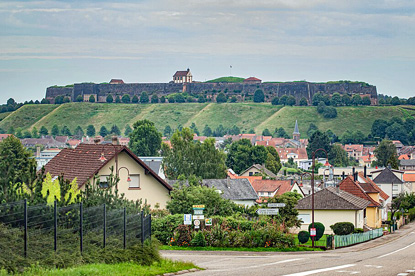
 Perched dramatically on pink sandstone cliffs, this magnificent fortress designed by Vauban stands as a masterpiece of military architecture. Famous for withstanding epic sieges, the citadel now houses fascinating museums with underground passages and offers breathtaking views across the Northern Vosges. |
| Marmoutier Abbey |
|---|

One of Alsace's oldest monasteries, founded in 590 by Irish monks. The magnificent 12th-century Romanesque west façade with three imposing towers is considered the region's finest. The Gothic nave and 18th-century choir complement this architectural gem on the Route Romane d'Alsace. |
Département du Haut-Rhin
|
Colmar |
|---|

 Colmar, in France's Alsace region, captivates with its fairytale charm. The famous 'Little Venice' boasts colourful half-timbered houses along scenic canals, whilst cobblestone streets wind through the preserved medieval centre. As Alsace's wine capital, it perfectly blends French and German heritage. |
|
Eguisheim |
|---|

 Eguisheim, a fairytale Alsatian village of concentric cobbled lanes, pastel half-timbered houses and flower boxes, voted France's Favourite Village. Sip local Grand Cru wines and wander medieval ramparts amid vineyard-clad hills. |
|
Kaysersberg |
|---|

 Kaysersberg pairs storybook half-timbered lanes and a fortified bridge over the Weiss with vine-draped hills crowned by a ruined castle, making it one of the prettiest halts along the Alsace Wine Route. |
|
Mulhouse |
|---|

Once an independent republic, Mulhouse surprises with its colourful Renaissance town hall, world-class automobile and train museums, artistic heritage including stunning street art, and strategic location near Switzerland and Germany. |
|
Riquewihr |
|---|

Riquewihr, classified among France's most beautiful villages, is a perfectly preserved medieval town in Alsace. Set between Vosges mountains and famous vineyards, this enchanting wine village features 16th-century half-timbered houses, cobblestone streets, and ancient ramparts. |
| Murbach Abbey |
|---|

Murbach Abbey in southern Alsace was founded in 727 by Count Eberhard and Saint Pirmin as a Benedictine monastery. Once one of the most powerful abbeys in the Holy Roman Empire, it was so influential that Charlemagne himself took the title "Abbot of Murbach" in 792. |
Other attractions
Oelenberg Abbey


 Spectacular 12th-century fortress perched 757m above the Alsace Plain. Rebuilt by Kaiser Wilhelm II (1900-08), this medieval stronghold features furnished chambers, weapons displays, and breathtaking panoramic views extending to the Swiss Alps on clear days.
 : Local interest
 : Moderately interesting
 : Outstanding place
 : Must-see in the country
 : Top cities in Europe