


| Contents |
|---|
Introduction
Nestled in the picturesque Eure-et-Loir countryside, Château de Maintenon stands as one of France's most enchanting aristocratic residences, forever linked to the remarkable story of Françoise d'Aubigné, better known as Madame de Maintenon, the secret second wife of Louis XIV. This elegant château, with its distinctive blend of medieval fortress and classical French architecture, offers visitors a captivating glimpse into the opulent world of 17th-century French nobility. The estate is perhaps equally famous for the spectacular ruins of an unfinished aqueduct, originally designed to supply water to the fountains of Versailles, which now creates a hauntingly beautiful backdrop across the manicured gardens. Visitors can explore the meticulously restored interiors, adorned with period furnishings and artwork that tell the tale of Madame de Maintenon's rise from governess to royal confidante, whilst the formal French gardens provide the perfect setting for a leisurely stroll amongst centuries-old trees and ornamental features. Whether you're drawn by the romantic history, the architectural splendour, or simply the tranquil beauty of the Loire Valley setting, Château de Maintenon promises an unforgettable journey through one of France's most intriguing historical chapters.
Interesting Facts about Château de Maintenon
- The château was transformed from a medieval fortress into a refined residence across eight centuries of continuous evolution.
- Françoise d’Aubigné, later known as Madame de Maintenon, bought the estate in 1674 with the support of Louis XIV.
- Madame de Maintenon secretly married Louis XIV, and her rise from governess to royal spouse is central to the château’s story.
- The dramatic, unfinished aqueduct in the grounds was commissioned by Louis XIV to channel water to Versailles but was abandoned during wartime.
- The formal gardens were designed by André Le Nôtre, showcasing classical French parterres and long perspectives.
- The property later passed to the powerful Noailles family and was modernised in the 19th century.
- The château retains a 13th‑century square keep alongside 16th‑century brick towers, reflecting a blend of Gothic and Renaissance styles.
- It has been classed as a protected historical monument since the mid‑20th century, preserving its architecture and landscape.
- The estate lies just west of Paris in Eure‑et‑Loir, making it a popular day trip paired with Chartres.
- The ruins of the aqueduct lend a romantic, grand‑scale backdrop to the gardens, especially striking at sunset.

History
The Château de Maintenon traces its origins to the 13th century, when records first attest to the existence of a fortress on this site belonging to the Amaury line, the medieval lords of Maintenon. This early castle served as a defensive stronghold protecting the passages over the River Eure, constructed initially as a simple medieval fortress with a distinctive square sandstone keep that remains the oldest surviving structure on the estate. The property remained in the Amaury family's possession until the 16th century, when financial difficulties forced them to sell the fortress in 1509. The new owner, Jean Cottereau, a wealthy financier who had served as Treasurer and Superintendent of Finance under Kings Louis XII, François I, and Henri II, immediately set about transforming the medieval stronghold into an elegant Renaissance château de plaisance in the style of the Loire Valley castles. Cottereau's ambitious renovations included adding mullioned windows, monumental chimneys, decorated dormers, and converting the defensive structure into a comfortable aristocratic residence, work that continued until his death in 1530 when he bequeathed the estate to his son-in-law, Jacques d'Angennes, Lord of Rambouillet.
The château's most illustrious chapter began in 1674 when Françoise d'Aubigné, the future Marquise de Maintenon, purchased the entire estate—including the château, lands, and farms—for 150,000 livres, using generous financial support from King Louis XIV. Born in 1635 in Niort prison where her father was imprisoned, Françoise had endured a difficult early life, including poverty in Martinique, a marriage to the older poet Paul Scarron in 1652, and widowhood in 1660. Her fortunes changed dramatically when she became governess to Louis XIV's illegitimate children by Madame de Montespan in 1669, eventually becoming the King's secret second wife. From 1686 onwards, the château underwent its most significant transformations as Madame de Maintenon, with royal backing, added new wings including a long north-eastern wing housing stables, an orangery, and first-floor apartments. The period also saw the construction of a chapel built between 1685 and 1689 by the royal architect Jules Hardouin-Mansart and Jean-Pierre Le Maistre to enable Louis XIV to attend religious services during his visits. Most remarkably, the King commissioned André Le Nôtre, the celebrated royal gardener of Versailles, to design the château's gardens, whilst simultaneously launching the ambitious but ultimately unsuccessful Maintenon Aqueduct project between 1685 and 1694, intended to supply water to Versailles' fountains at a staggering cost of nine million livres.
Following Madame de Maintenon's death, the estate passed in 1698 as a dowry to her niece Françoise Amable d'Aubigné upon her marriage to Adrien Maurice, Duke of Ayen and later Duke de Noailles, ensuring the château remained within the Noailles family for centuries. In the 19th century, Duke Paul de Noailles and his wife Alicia de Rochechouart de Mortemart—a descendant of Madame de Montespan's brother—undertook major modernisation works, entrusting the architect Henri Parent with changing the façades surrounding the cour d'honneur and adding modern comforts whilst also creating a library that was later classified as a historical monument. The 20th century brought challenges when Geneviève de Noailles married Monsieur Raindre, and the couple inherited a château severely damaged during the Second World War, dedicating their lives to restoration and developing it as a tourist attraction. In 1983, recognising the need for professional heritage management, the Raindre family bequeathed the estate to the Mansart Foundation, and in 2005, the Eure-et-Loir General Council assumed responsibility for the château's upkeep, management, and activities, ensuring the preservation of this magnificent eight-century-old architectural treasure.
Description
Exterior Architecture
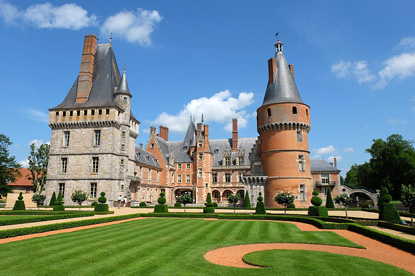
- The principal residence, or corps de logis, is flanked by three round towers and a square keep, their reflections shimmering in a broad moat fed by the River Eure.
- Bands of red brick woven through pale limestone walls create a subtle polychrome effect that underscores the blend of Gothic verticality and Renaissance symmetry.
- Pointed slate roofs, narrow turrets, and machicolations hint at its defensive origins, while large mullioned windows and sculpted surrounds proclaim later aspirations of comfort and prestige.
- After crossing a stone bridge, visitors step into a cobbled cour d’honneur that unites the main wings and frames a postcard view towards the parterres.
Interior Highlights
- Bedrooms created for Madame de Maintenon and the Marshal de Noailles retain carved oak panelling, damask wall coverings, and a four-poster bed draped in crimson velvet.
- The circular Salon du Roi combines gilded boiseries, Aubusson tapestries, and a marble fireplace surmounted by a royal portrait.
- A library in sumptuous Napoléon III style houses thousands of leather-bound volumes beneath an ornate painted ceiling.
- Two Chinese salons display lacquer panels, blue-and-white porcelain, and delicate chinoiserie screens, echoing the 18th-century fascination with the East.
- The intimate 19th-century apartments designed by Duke Paul de Noailles introduce lighter colours, parquet de Versailles flooring, and refined Empire-style furnishings.
- A private chapel, still used for concerts, is lined with Italianate stuccowork and stained-glass windows that bathe the nave in soft coloured light.

Gardens and Grounds
- André Le Nôtre’s French formal garden unfolds beyond the moat in a strict geometric pattern originally shaped as two interlaced “L”s.
- More than 6,000 boxwood plants outline arabesque scrolls filled with seasonal flowers, while clipped yews and lime trees extend vistas toward the Eure.
- Gravel allées encourage leisurely strolls, and wrought-iron benches are positioned to capture reflections of the château in the ornamental canal.
- Summer evenings often feature illuminations and classical-music soundscapes that accentuate the garden’s theatrical design.

The Monumental Aqueduct
- At the far end of the park rises the aqueduct built to carry Eure water toward Versailles; its first tier of 47 arches soars nearly 18 metres, offering a spectacular focal point for photographs.
- A riverside walkway beneath the arches frames dramatic perspectives of the château against woodland and sky.
Visitor Amenities
- Multilingual audio guides lead visitors through the furnished rooms, and staff in period costume are frequently on hand to answer questions.
- Family-friendly additions include a treasure hunt for children and an exhibition explaining the aqueduct’s engineering.
- The former orangery now houses a tearoom overlooking the south gardens, and the boutique stocks regional delicacies, books, and locally crafted gifts.
- Level access to the courtyard, shop, and ground-floor rooms, plus lifts to selected upper apartments, ensures a largely barrier-free visit for guests with reduced mobility.
- The estate welcomes roughly 90,000 visitors each year, yet the spacious grounds allow for an unhurried, tranquil experience.
Getting There
By train From Paris-Montparnasse, frequent TER Centre-Val de Loire services reach Maintenon in about 50 minutes; on arrival it's a pleasant 10-minute walk through the town to the château.
By coach or bus Regional bus line 20 (Chartres–Epernon) stops at Maintenon’s “Place Aristide Briand”, two minutes from the entrance, while seasonal shuttle coaches also run from Chartres on peak visitor days.
By car Take the A11 towards Chartres, exit 3 for Ablis, then follow the D910 and D18 west to Maintenon; plentiful signposts guide drivers to the château’s dedicated visitor car park on the town’s edge.
Best Time to Visit
The best time to visit the Château de Maintenon is spring and early autumn, when the Le Nôtre–designed formal gardens show rich seasonal colour and the views towards the unfinished aqueduct are especially photogenic. From April to June the château opens from around 10:30 to 18:30 most days, and in July and August it is open daily on the same schedule, which makes late spring and summer particularly convenient for planning. September and October keep the parterres in fine colour, with weekday visits typically in the afternoon and weekends from 10:30 to 18:30, so it remains an excellent time for balanced garden and interior touring. Guided tours run at 15:00 on weekends year‑round, with extra departures during the Easter holidays and throughout summer, and arriving for the 10:30 opening helps with the limited parking near the entrance.