


| Contents |
|---|
Introduction
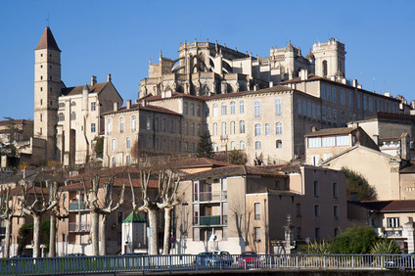
Already an important town of Roman Gascony, Auch (pop. 21,500) later developed as the seat of the Counts of Armagnac and Archbishops of Aquitaine and served as the historic capital of Gascony. The town sits majestically atop a hill and is renowned for its Cathédrale Sainte-Marie, a Gothic-Renaissance cathedral listed as a UNESCO World Heritage Site which boasts spectacular stained-glass windows, and the imposing Tour d'Armagnac, a 40-metre tower that overlooks the surrounding countryside. The Musée des Jacobins is one of the oldest museums in France.
The town is also famous for its connection to D'Artagnan, the legendary musketeer whose statue stands partway up the Monumental Staircase of 374 steps that connects the upper and lower parts of the city.
Auch combines traditional Gascon heritage with modern amenities, offering visitors a range of cultural attractions including the Musée des Amériques which houses France's second-largest collection of Pre-Columbian art, vibrant markets featuring regional specialities such as foie gras and Armagnac, and a lively town centre centred around Place de la Libération.
Interesting Facts about Auch
- Auch is the historic capital of Gascony and the prefecture of the Gers department in south-west France, famed for its d’Artagnan connections and Armagnac heritage.
- The town’s monumental 374-step staircase links the riverside to the upper old quarter, punctuated by terraces and statues with sweeping views over the Gers valley.
- Auch Cathedral (Sainte-Marie) is renowned for its radiant stained glass by Arnaud de Moles and intricately carved oak choir stalls that are considered masterpieces of Renaissance art.
- A prominent bronze statue of d’Artagnan, the most famous of Alexandre Dumas’ Three Musketeers and a historical Gascon captain, stands proudly near the grand staircase.
- The medieval heart of Auch preserves narrow “pousterles” (steep alleys) and timber-framed houses that reveal its role as a powerful seat of the archbishops of Gascony.
- The River Gers, a tributary of the Garonne, curves below the upper town, giving Auch a photogenic setting of bridges, embankments and plane-tree-lined promenades.
- Auch flourished as a Roman settlement known as Augusta Auscorum, later evolving into the spiritual and administrative centre of the Gasconlands.
- Local cuisine showcases Gascon specialities such as duck confit, foie gras and Armagnac, with Auch serving as a convivial gateway to the region’s markets and distilleries.
- The Jacobins Museum and former convent buildings reflect Auch’s monastic past and its role in preserving regional archaeology and art.
- Festivals in Auch often celebrate Gascon identity, with street performances and cultural events that bring the historic core’s squares and stairways to life.
- The Pont de la Treille and other historic bridges knit together the riverside quarters, framing classic views of the cathedral’s towers and the terraced townscape.
- Auch’s blend of Gothic, Renaissance and vernacular architecture illustrates centuries of prosperity tied to church power, river trade and Gascon pride.
- The town’s elevated promenade offers panoramic sunsets over rolling Gers countryside, dotted with bastide villages, vineyards and sunflower fields.
- Street names and plaques in Auch frequently nod to Gascon language and lore, underscoring a living regional identity alongside modern French culture.
- Markets in and around Auch brim with seasonal produce—prunes, melons, duck and Armagnac—making it a delicious base for exploring rural Gascony.

History

The name Auch derives from the pre-Roman inhabitants of the region, the Ausci, an Aquitanian tribe who spoke a language related to the ancient Basque language. The name Ausci itself seems related to the native name of the modern Basques, who call themselves Euskal.
Annexed to Rome by Julius Caesar, the old oppidum is renamed Augusta Auscorum, and becomes one of the twelve civitates of the province of Novempopulana (Gascony).
In 409, Elusa (modern Éauze), the capital of Novempopulana is destroyed by the Vandals. Auch then replaces it as the capital of Gascony and becomes the seat of the Bishopric of Auch. In 879, it is elevated to an archbishopric covering the whole of Gascony, a status quo that would last until the French Revolution.
In the 10th and 11th centuries, Auch is made the capital of the County of Armagnac. The Battle of Lectoure in 1473 would bring down the county and put the region under direct control of the Kings of France.
Main Attractions
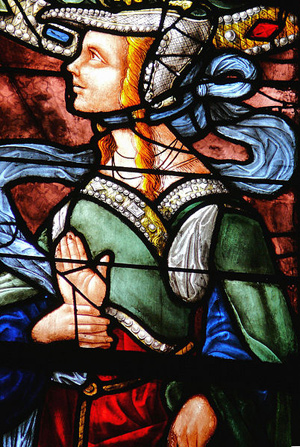
Auch cathedral (Cathédrale Sainte-Marie d'Auch) is unlike any other in France. Started in 1489 in the late Gothic style, it was only completed in 1680 and was therefore built mostly in the Renaissance style, with a touch of Neoclassical. Nowhere else in France does a white stone Corinthian façade hide a Gothic-Renaissance interior. The cathedral's greatest claim of fame are its superb 18 stained glass windows, designed by Arnaud de Moles between 1507 and 1513. The cathedral is listed as a UNESCO World Heritage Site as part of the Routes of Santiago de Compostela.
The archepiscopal archives are stored in the Tour dArmagnac, originally built as a prison in the 14th century.
At the foot of the tower and the cathedral is the so-called Monumental Staircase, connecting the old upper town with the newer lower town. It was built between 1860 and 1863 in the Neoclassical style. It has 374 steps for a total elevation of 35 metres. Halfway up the staircase is a statue of d'Artagnan, hero of Alexandre Dumas' classic novel The Three Musketeers. Although the novel is fictional, it was based on the life of a real man, Charles Ogier de Batz de Castelmore, Comte d'Artagnan, who was born in 1611 near Auch and died at the Siege of Maastricht in 1673.
The Musée des Jacobins was founded in 1793, at the height of the French Revolution. Housed in an old Dominican monastery, its collections are composed of artefacts seized by the Revolutionaries (Gallo-Roman to 18th century), 19th-century Gascon costumes, relics of the Egyptian antiquity, and pre-Columbian American art bequeathed by Guillaume Pujos in 1921. After another major donation in 2007, the museum now has the second largest collection of pre-Columbian art in France after the Musée du Quai Branly in Paris.
Top Museums
Art and History Museums
Musée des Amériques – Auch
The Musée des Amériques – Auch, formerly known as the Musée des Jacobins, stands among France’s oldest museums, inaugurated in 1793 and housed within the beautifully preserved former Jacobin convent dating from the 15th century. The museum’s exceptional setting, nestled between the Gers river and Sainte-Marie Cathedral, provides an evocative introduction to its treasures.
The permanent collection comprises over 20,000 objects, thematically divided into six major sections. Foremost is the museum’s famed Pre-Columbian collection: with over 8,000 artefacts, it is second in France only to the Musée du Quai Branly-Jacques Chirac in Paris. Visitors can admire intricately woven textiles, ceremonial ceramics, and striking goldwork, many items never before displayed. The Latin-American sacred art gallery complements this with devotional pieces blending indigenous and colonial traditions.
Antiquity is another strong focus, with impressive Egyptian artefacts—amplified by local Gallo-Roman finds including statues, mosaics, and funerary stelae. Medieval and decorative arts collections offer glimpses of religious devotion and domestic refinement, including polychrome sculptures, faïence, furnishings, and musical instruments. The traditions of Gascony are represented through regional costumes and folk objects. Upstairs, a fine arts gallery showcases paintings and sculptures from the seventeenth to twentieth centuries, with notable works by Gascon and European artists, such as Mario Cavaglieri and the Smets brothers.
The museum’s intimate scale, historic architecture, and beautifully landscaped French garden make for a serene and inspiring visit. Special exhibitions, guided tours, and family-friendly “treasure hunts” are regular features, ensuring there is something for all ages and levels of curiosity.
Cathedral Treasury (Trésor de la Cathédrale)
Within the historic Sainte-Marie Cathedral, the Cathedral Treasury offers an intimate journey through sacred art and the ecclesiastical heritage of Auch. The treasury houses an impressive collection of liturgical items, including ornate reliquaries, rare illuminated manuscripts, precious fabrics, and gold- and silverwork spanning the medieval to early modern periods.
The design and craftsmanship of these objects offer insight into the religious lives of past centuries, while the setting—a blend of spiritual solemnity and artistic splendour—makes the visit a moving experience for believers and secular visitors alike.
20th Century and Contemporary Collections
Musée de la Résistance et de la Déportation du Gers
Located in the heart of Auch, the Musée de la Résistance et de la Déportation du Gers is dedicated to the memory of the local population’s experiences during the Second World War. The museum’s galleries recount the dramatic years of occupation and liberation in the Gers, with a particular emphasis on the Resistance’s clandestine activities and the deportation of local citizens.
Visitors will encounter authentic artefacts, personal effects, and detailed displays chronicling acts of bravery, persecution, and daily resilience. Testimonies, photographs, and documents help bring the broader geopolitical context into a deeply local focus. The museum serves not only as a site of remembrance but also as an educational space, prompting reflection on values of liberty, tolerance, and civic duty.
Memento – Espace Départemental d’Art Contemporain
For those with a contemporary outlook, the Memento – Espace Départemental d’Art Contemporain occupies another distinctive re-purposed site: a former convent offering lofty exhibition spaces that lend themselves especially well to modern creativity.
Memento features regularly changing exhibitions highlighting installations, sculpture, and experimental art from French and international artists. The atmosphere is strikingly modern yet meditative, making it a popular destination for those who seek new perspectives and avant-garde approaches to artistic expression. Programmes for families and schools ensure that contemporary art is both accessible and thought-provoking for every visitor.
Special Interest Museum
Musée du Train et du Jouet Ancien
A short drive from central Auch, the Musée du Train et du Jouet Ancien invites adults and children alike to rediscover the magic of play and the golden age of railways. The museum boasts an extensive collection of model trains, vintage toys, and miniature rail systems lovingly restored and displayed.
Exhibits trace the evolution of toy making and railway technology, with many interactive elements intended to delight both nostalgic adults and young railway enthusiasts. The family-friendly ambiance, coupled with the charm of bygone eras, makes this an ideal outing for visitors of all ages.
Local Cuisine
p>Visitors can savour renowned specialities such as foie gras, magret de canard (duck breast, notably invented in Auch), and confits of duck, each made following time-honoured traditions. The region is also famed for its black pork of Gascony and tender poultry, complemented by fresh local produce like melons and the aromatic white garlic of Lomagne. For those with a sweet tooth, the delicate pastis gascon or apple croustade, scented with Armagnac, provides the perfect finish to a meal, all best enjoyed alongside the area’s robust wines and artisanal spirits.Getting There
By train Auch is served by regular TER regional trains from Toulouse Matabiau, with the journey taking just over an hour and terminating at the convenient Gare d’Auch, a short stroll from the historic centre.
By coach Coaches operated by liO Occitanie link Auch with Toulouse, Tarbes and other towns across the Gers, offering a practical alternative where rail connections are sparse, especially for smaller surrounding villages.
By car Drivers can reach Auch via the A64 motorway from Toulouse, then the N124 dual carriageway which sweeps west through rolling Gascon countryside, while those coming from Bordeaux can follow the A62 to Agen before heading south on the D931 into the heart of the Gers.
| Travel destinations in Midi-Pyrénées | ||||||||||||||
|---|---|---|---|---|---|---|---|---|---|---|---|---|---|---|
|
|
|
|
| ||||||||||
|
|
|
|
| ||||||||||
|
|
| ||||||||||||


