


Introduction
La Rochefoucauld Castle, known as "La Perle de l'Angoumois" (Pearl of Angoumois), stands as one of France's most architecturally diverse châteaux, having remained in the same family for over a millennium since Foucauld first established a fortified camp on the rocky outcrop above the River Tardoire in 980. The castle showcases seven centuries of architectural evolution, from its original 11th-century square keep to the 14th-century entrance towers, the three corner towers erected in 1453 to celebrate the end of the Hundred Years' War, and the remarkable Renaissance additions of 1520 including three-level galleries and a circular staircase attributed to designs by Leonardo da Vinci. Still inhabited by the Duke and Duchess of La Rochefoucauld, this living monument combines medieval fortress elements with Renaissance refinement and 18th-century classical additions, creating a unique architectural ensemble that reflects the political power and cultural sophistication of one of France's most distinguished noble families. The château houses notable features including an 18th-century library containing over 20,000 books, original kitchens with massive fireplaces, and a chapel decorated with ogival arches, whilst its French formal gardens complement the castle's impressive façade overlooking the historic town that bears the family name.
Interesting Facts about La Rochefoucauld Castle
- The castle’s origins trace back to around 980 when Fucaldus established a fortified camp on the rocky spur, giving rise to the name “Foucald’s Rock.”
- A square medieval keep from the early 11th century remains at the core of the present ensemble, anchoring its long architectural evolution.
- To mark the end of the Hundred Years’ War in 1453, Jean de La Rochefoucauld heightened the main tower and added three corner towers as a statement of power.
- The elegant open galleries and a famed circular staircase, often attributed to Leonardo da Vinci’s designs, were added in the early 16th century.
- The château seamlessly blends medieval fortification with French Renaissance refinement, making it a showcase of changing tastes and technologies.
- Louis XIII’s visit in 1615 prompted sweeping alterations, including opening out the courtyard to suit royal ceremony and display.
- Despite later fires leading to rebuilding in the 18th century, the site retains exceptional verticality and a picturesque skyline of turrets.
- The La Rochefoucauld family maintained possession for roughly a millennium, creating a living archive of noble lineage and patronage.
- The castle’s grand library and furnished salons evoke aristocratic life across centuries, from Gothic austerity to Enlightenment elegance.
- During the twentieth century the château underwent private restoration, ensuring its continued role as a landmark of the Charente.

History
The Château de La Rochefoucauld traces its remarkable origins back to 980, when Fucaldus, the younger brother of the Viscount of Limoges, established a fortified camp on a rocky outcrop overlooking the River Tardoire. He named this strategic position "Fucaldus in rupe," meaning "Foucald's Rock," which would eventually give the castle and surrounding region its distinctive name. Fucaldus's son continued the family's architectural legacy by constructing a square keep in the early 11th century, a structure that remains identifiable at the heart of the present castle complex. The La Rochefoucauld family lineage can be traced back to 1019, and remarkably, they have maintained uninterrupted ownership of the castle for over a millennium, making it one of France's most enduring noble residences.
The medieval period witnessed significant expansion and consolidation of both the castle and the surrounding settlement. In 1310, Baron Gui VII de La Rochefoucauld achieved a pivotal moment in local history by uniting three previously independent towns—Bourg-Budeau, Saint-Florent, and Saint-Cybard—under his authority, thus creating the unified town of La Rochefoucauld. The castle's military architecture was substantially enhanced during this era, with Aimery de La Rochefoucauld commissioning two entrance towers in 1350. The most dramatic medieval transformation occurred in 1453 when Jean de La Rochefoucauld, who served as Seneschal of Périgord and held absolute mastery over the region until 1473, celebrated the end of the Hundred Years' War by erecting three additional corner towers and significantly raising the height of the main keep. This architectural feat enabled him to survey his entire domain from greater heights, serving as a powerful symbol of his political authority following the decisive victory at the Battle of Castillon.
The 16th century marked the castle's transformation into one of the most spectacular examples of French Renaissance architecture. In 1519, François II de La Rochefoucauld and his wife Anne de Polignac embarked on an ambitious building campaign that would create the castle's most magnificent features—the ornate towers and south wing that still captivate visitors today. The couple incorporated revolutionary architectural elements, including open galleries across three levels and a breathtaking circular staircase attributed to designs by Leonardo da Vinci, completed in 1520. This Renaissance splendour reflected the family's exceptional status within the royal court, particularly as François de La Rochefouc

Description
Architectural highlights
- The Great Staircase – a soaring, self-supporting helix of pale stone that links the courtyard to the residential wings; its balustrade is carved with delicate foliage and the family’s fleur-de-lys.
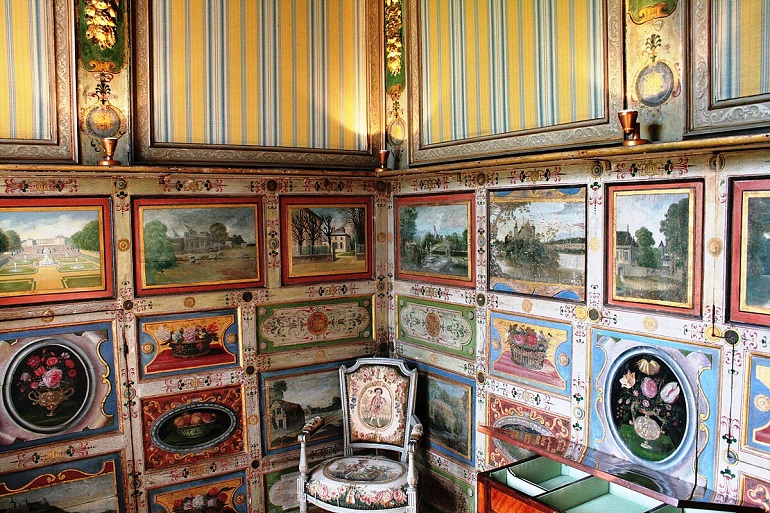
- State Apartments – seven interlinked salons dressed in Louis XIII boiseries, Florentine tapestries and portraits of illustrious Rochefoucaulds; subtle modern touches, such as family photographs, remind visitors that the duchess still resides here.
- Twin Libraries – some 20,000 volumes line walnut shelves beneath painted ceilings; look for early editions of the Maximes by François VI and 17th-century atlases annotated with the family’s military campaigns.
- Guardrooms & Dungeon – vaulted stone chambers where halberds, breastplates and ceremonial keys evoke the château’s defensive past.
Visitor experience
Exploration is refreshingly interactive. After roaming the kitchens—unchanged since copper pots last simmered over open hearths—guests are invited to a dressing-up room brimming with velvet gowns, chainmail and feathered hats. Children delight in strutting across the courtyard as knights and ladies, while adults often succumb to the same temptation.
Guided tours, offered in English and French, unlock rooms otherwise hidden behind oak doors: the gilt-panelled “golden boudoir”, a treasury of 17th-century correspondence, and a petite chapel with stained glass that glows jewel-bright in the afternoon sun. Knowledgeable guides share anecdotes of royal godchildren, wartime intrigue and literary salons hosted within these walls.
Atmosphere & setting
Despite its grandeur, the château feels lived-in rather than museum-cold. Sunlight slants through diamond-pane windows onto worn limestone floors; the scent of beeswax polish mingles with the faint must of ancient parchment. Beyond the ramparts, rolling Charente countryside frames the skyline, while the market town at the foot of the hill supplies cafés for a post-tour pause.
Practical touches
- Around twenty furnished rooms are open daily from spring through early winter, with reduced Sunday hours off-season.
- Visitors may wander independently through the courtyard, kitchens, guardrooms and dungeon; a modest supplement secures the full guided circuit of salons and libraries.
- A small boutique stocks regional cognac, locally milled soaps and reproductions of château engravings—ideal keepsakes that fit easily into hand luggage.
Getting There
By train La Rochefoucauld is easiest to reach via the regional TER service from Angoulême, where high-speed TGVs from Paris Montparnasse and Bordeaux connect; the local train glides through wooded Charente countryside and stops right below the château’s riverside walls.
By coach or bus Several weekday buses on the Charente Libre 11 line run from Angoulême’s Gare SNCF to the town centre, a five-minute stroll across the bridge to the castle gate, making this the most convenient public-transport alternative when TER frequencies dip.
By car From the N141 dual carriageway linking Angoulême and Limoges, exit at La Rochefoucauld and follow well-signed D-roads for 3km; parking is signposted along the Tardoire riverbanks just beneath the imposing Renaissance façade.