


| Contents |
|---|

Introduction
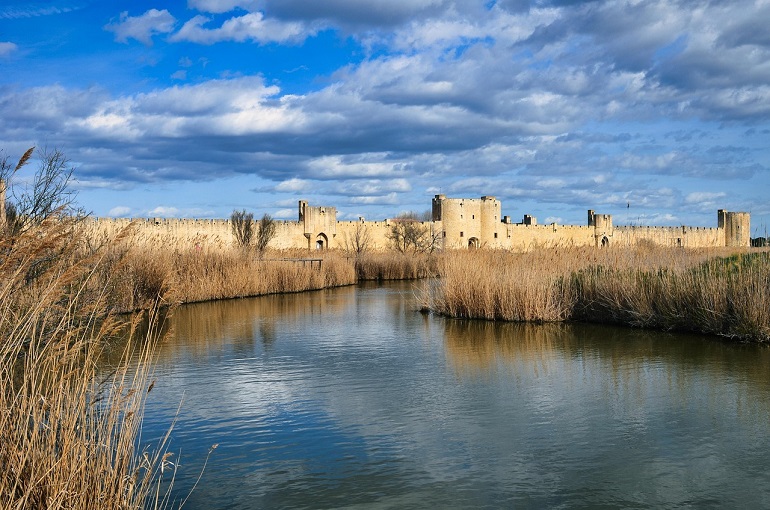
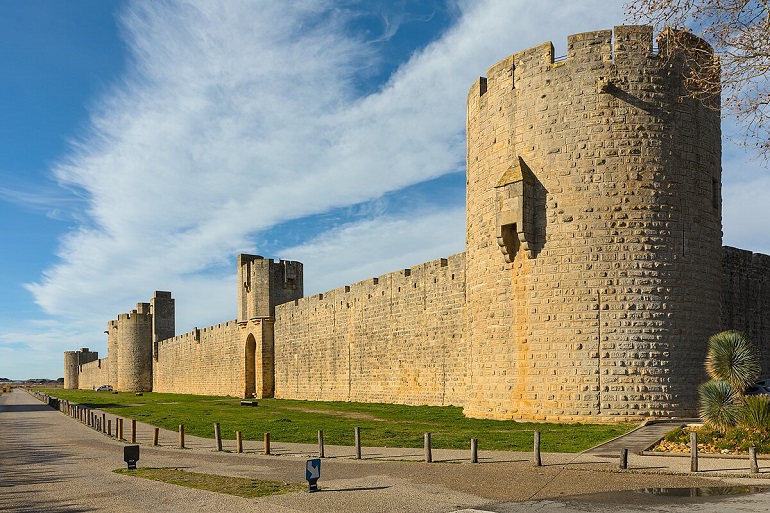
Aigues-Mortes (pop. 8,500) is a medieval fortified town situated in the Camargue region, approximately 20 kilometres from the Mediterranean coast. Originally established as a small fishing and salt-gathering hamlet in marshy terrain, the town gained prominence in the 13th century when King Louis IX (Saint Louis) transformed it into France's primary Mediterranean port for launching the Crusades. The town's remarkable rectangular fortification system, constructed during Louis IX's reign, remains virtually intact today, featuring 1,640 metres of walls enclosing the historic centre, punctuated by ten gates and six towers including the famous Tour de Constance. Built according to a planned urban layout rather than evolving organically, Aigues-Mortes represents one of Europe's finest examples of medieval military architecture and urban planning. Though the sea has since retreated several kilometres, leaving the once-vital port landlocked amongst salt marshes and lagoons, the town has preserved its medieval character and serves as an exceptional window into 13th-century French history and the era of the Crusades.
Interesting Facts about Aigues-Mortes
- Aigues-Mortes was founded by King Louis IX in the 13th century to give the French crown a direct Mediterranean port for the Crusades.
- The town’s name means “dead waters,” referring to the surrounding saline marshes of the Camargue.
- Its medieval ramparts form a near-perfect rectangle over roughly 1.6 kilometres and are among the best preserved in France.
- Louis IX embarked from Aigues-Mortes on the Seventh Crusade in 1248, cementing the town’s place in medieval history.
- The imposing Tour de Constance served variously as lighthouse, watchtower and prison, notably during the Wars of Religion.
- Over time, coastal shifts left Aigues-Mortes inland, now linked to the sea by canals rather than opening directly onto the coast.
- The surrounding Salins du Midi produce striking pink salt ponds, coloured by the micro-alga Dunaliella, and vast “salt mountains.”
- Aigues-Mortes sits at the gateway to the Camargue, a unique wetland famed for flamingos, black bulls and white horses.
- The Carbonnière Tower, set out in the marshes, acted as a forward defensive post controlling land access to the walled city.
- Local traditions include festive, non-lethal Camargue bull games and the late-summer Saint-Louis celebrations within the ramparts.
- The town’s grid of straight medieval streets remains intact, giving a vivid sense of its planned royal foundation.
- Vineyards and salt-gathering shaped the economy for centuries, and fleur de sel from Aigues-Mortes is still prized today.
- From the ramparts, panoramic views take in the marshes, canals and pink saline ponds that define the surrounding landscape.
- A small marina now connects Aigues-Mortes to the sea via Le Grau-du-Roi and to Sète via the Canal du Rhône à Sète.
- Aigues-Mortes blends Gothic military architecture with a living Provençal-Camargue culture, making it a rare, intact medieval port town inland.
History
Aigues-Mortes, whose name derives from the Occitan "Aigas Mòrtas" meaning "dead waters," began as a small hamlet of fishermen and salt gatherers surrounded by marshes and stagnant lagoons in the Camargue. Salt mining in this saline region dates back to the Hellenic period, though ancient remains were destroyed during the construction of modern salt works. In 791, Charlemagne built the Matafère Tower to protect labourers in the salt works, which was later attached to the Benedictine Abbey and used to communicate with the Magne Tower at Nîmes. The area remained under the control of Benedictine monks until Saint Louis negotiated with them in 1240, acquiring Aigues-Mortes in exchange for other lands.
The medieval city's true significance emerged when Louis IX (Saint Louis) launched his colossal project in 1240 to create a port city that would free his kingdom from dependence on foreign princes during future crusades. The king sought independence from the Holy Roman Emperor Frederick II, who reigned over Provence, and King James I of Aragon, whose possessions stretched from Montpellier to Catalonia. Within a few years, the Constance Tower and a castle were erected, attracting a population drawn by impressive privileges granted by the king for the foundation of his new city. Louis IX abolished the salt tax, linked up the marshes by road, and built the Carbonnière watchtower. Aigues-Mortes became the French kingdom's first port on the Mediterranean and served as the departure point for Louis IX's two crusades - the Seventh Crusade in 1248 and the Eighth Crusade in 1270, during which he met his death. The complete ramparts, stretching 1,643 metres around the town with three corner towers, two flanking towers, five large gates and five posterns, were not completed until some 30 years later under the reign of his grandson Philippe le Bel.
Following the crusading era, Aigues-Mortes retained its commercial importance, obtaining a monopoly on all goods entering and leaving the kingdom in 1278, which lasted until Provence became part of France in 1481. The city became embroiled in the Wars of Religion, with the region experiencing numerous clashes between Catholics and Huguenots. In 1574, Aigues-Mortes came under Protestant rule and became one of eight places of safety granted by the Edict of Beaulieu in 1576, confirmed by Henri IV's Edict of Nantes in 1598. The town retained its Huguenot garrison of around 2,000 men until 1622, when it was briefly besieged by Louis XIII and Richelieu, after which the Protestant governor surrendered in exchange for a French marshal's baton. The Constance Tower gained notoriety as a prison for Protestants, particularly during the persecution following the revocation of the Edict of Nantes in 1685, housing "preachers" and "inspired" until 1767. During the French Revolution, the city welcomed the new regime but soon became embroiled in passionate political conflicts, experiencing a reign of terror and denunciations whilst simultaneously battling serious epidemics caused by marsh exhalations.
Main Attractions
Towers and Walls of Aigues-Mortes
The formidable medieval ramparts and towers of Aigues-Mortes encircle the historic town with nearly 1,600 metres of perfectly preserved fortifications, the legacy of King Louis IX who established the city as his Mediterranean port in 1240. Visitors enter via a single paid gate and can walk the entirety of the walls, passing by majestic towers such as the Tour de Constance, whose cobbled interior and panoramic terrace offer exceptional views across the marshes and salt pans. Historical displays in each tower explain its unique defensive purpose, and the resulting circuit is both a visual spectacle and a journey through eight centuries of strategic importance. These ancient walls have withstood sieges, religious strife, and revolutions, remaining unbowed as a national monument of France and the most prominent landmark of Aigues-Mortes.
Place Saint-Louis
In the heart of the walled city lies Place Saint-Louis, a lively square named for the city’s founder, which serves as a focal point for local gatherings and events. Surrounded by picturesque cafés and shops, this animated plaza is home to a distinguished statue of Saint Louis, reminding visitors of the king’s crusading legacy. The square is also the perfect place to experience daily Provençal life, indulge in local cuisine, and enjoy the town’s festive atmosphere.
Notre-Dame des Sablons Church
Steeped in centuries of spiritual history, Notre-Dame des Sablons Church stands as an architectural gem dating to the 13th century. Its restrained Gothic façade and peaceful nave mark the spot where Crusaders once prayed before their journeys to the Holy Land. Illuminated by striking modern stained-glass windows, the interior balances solemn medieval tradition with contemporary artistry, inviting quiet contemplation away from the bustling streets.
Salin d’Aigues-Mortes
The sprawling salt marshes of Aigues-Mortes, known as Salin d’Aigues-Mortes, present a remarkable landscape of crystalline pools tinged in shades of pink, violet, and white—a natural marvel shaped by centuries-old salt production. Guided tours by little train, bike, or on foot reveal the intricacies of salt harvesting, from the first stages of crystallisation to the impressive salt dunes towering above the plains. The area’s ecological richness is immediately evident, with flamingos, herons, and other Camargue wildlife thriving in the marsh’s protected habitats. Sunrise and sunset cast magical colours across the salt pans, making it a favourite haunt for photographers and birdwatchers.
Maison du Grand Site de France de la Camargue Gardoise
The Maison du Grand Site serves as the gateway to the natural wonders of the Camargue region. Here, educational exhibits and interactive trails immerse visitors in the story of the ever-changing wetlands, the shifting Rhône, and the delicate ecosystems that support rare migratory birds and local fauna. This centre is ideal for those seeking to better understand the environmental dynamics of southern France, and forms the starting point for immersive explorations into the marshes and lagoons of the Camargue.
Tour Carbonnière
Just outside the southern walls stands the solitary Tour Carbonnière, a remote watchtower set amidst reeds and waterways. Built in the 13th century to control access from the wild marshes, it offers unparalleled views from its summit across the salt flats, fields, and lagoons of the Camargue. Approachable on foot or by bike, the tower is surrounded by a landscape rich in biodiversity, frequented by elegant egrets, herons, bulls, and the region’s iconic white horses—a setting that beautifully fuses history and nature.
Queen’s Gate and Historic Port
The Queen’s Gate (Porte de la Reine) is among the grand entrances of the fortifications, its arch marking the transition from the modern outskirts into the ancient walled centre. Aigues-Mortes originally stood on the shores of the Mediterranean, serving as the royal port, but shifting sands and marshes have since surrounded the town with an inland sea. Today, the town’s pleasure marina and canal-side promenades evoke this maritime legacy, and offer plenty of opportunities for leisurely walks, boat tours, and waterside relaxation.
Marshes and Nature Trails
Beyond the ramparts, Aigues-Mortes is enveloped by wild marshland and salt lagoons, home to a dazzling array of birdlife and rare plants. Trails for hiking and cycling introduce visitors to this vivid natural world, where pink flamingos feed in shallow waters and Provençal bulls graze alongside the famed white Camargue horses. The Etang de la Marette and other nearby reserves provide a peaceful retreat for nature-lovers and photographers, as well as prime birdwatching for migratory species.
Top Museums
The World of Camargue Salt
Musée du Sel
The Musée du Sel, nestled at the edge of the salt marshes just outside Aigues-Mortes, is a window into the unique story of salt in the Camargue. This museum forms part of the vast Salin d’Aigues-Mortes, the largest saltworks of the Mediterranean, stretching over 9,000 hectares. Here, salt is not merely a product—it is an ancient tradition that has shaped both landscape and livelihoods since Roman times.
At the museum, visitors encounter engaging displays tracing the complex processes of salt production, from water channelling and evaporation in shimmering basins, to the delicate hand-harvest of the famed Fleur de Sel. Historical photographs and traditional tools showcase centuries of saunier (salt worker) expertise. Explanatory panels and hands-on exhibits make these ancient techniques come alive, revealing the cultural and economic significance of salt to the people of Aigues-Mortes.
One of the highlights is the sight of enormous sparkling salt mounds, some rising up to twenty metres, and the chance to learn why the lakes adopt surreal pink hues during the harvest season. Interactive guided tours—often by petit train or even 4×4—offer close-up views of the salt basins and introduce visitors to the rich biodiversity of the site, which serves as a sanctuary to hundreds of bird species, including the iconic flamingo. Many tours include a stop at the museum itself, where further immersion is possible through themed workshops and seasonal events that celebrate the profession and nature of the Camargue.
The Art of Miniature Railways
Les Trains du Colorado – Musée
In the heart of the medieval centre, Les Trains du Colorado Musée delights enthusiasts young and old with its meticulous world of model railways. The museum boasts an extensive collection of miniature trains, landscapes, and scenery inspired by the sweeping panoramas of the American West. Locomotives glide through lovingly detailed dioramas, winding past miniature canyons, forests, mining camps, and wild-west towns.
The exhibits are both playful and impressively crafted, with an array of scale models that highlight technical prowess and creative storytelling. Special attention is given to the operation and history of railways, especially as they relate to the ‘Colorado’ theme. Visitors can marvel at the precision of the tracks, the authentic touches in scenery, and the myriad whimsical details—there are plenty of hidden elements to discover, making this museum especially enjoyable for repeat visits.
Designed with families in mind, the space offers a warm, welcoming atmosphere. Staff are known to encourage interaction, explain the mechanisms, and sometimes allow visitors to operate certain trains. The museum is also noted for its inclusiveness and accessibility, making it a pleasant stop for all ages.
Local Cuisine
Aigues-Mortes’ local cuisine is a celebration of Mediterranean flavours, deeply influenced by the nearby Camargue and the salt marshes that surround the town. Diners can savour fougasse d’Aigues-Mortes, a delicate sweet bread flavoured with orange blossom, as well as the region’s renowned Camargue rice served alongside dishes such as gardiane de taureau, a hearty bull stew simmered in red wine and herbs. The abundance of sea salt enhances recipes like brandade de morue, a creamy blend of salt cod and olive oil, and the town’s markets brim with fresh seafood, notably tellines, small wedge clams enjoyed in aromatic garlic and parsley sauce. Local wines and the vibrant use of regional produce further elevate the culinary experience, making Aigues-Mortes an irresistible destination for food lovers.
Getting There
By train Aigues-Mortes has its own small SNCF station on the scenic Nîmes–Le Grau-du-Roi branch line, with direct TER trains from Nîmes taking roughly three-quarters of an hour and running several times a day; if you are arriving from farther afield, change at Nîmes for onward local services.
By coach or bus Regional liO buses (notably line 606) link Montpellier and the coastal resorts with Aigues-Mortes, while other liO routes connect from Nîmes; they usually stop close to the medieval ramparts, making them handy if you prefer public transport over navigating Camargue country roads.
By car Drivers can reach Aigues-Mortes via the A9 motorway (exits for Nîmes or Montpellier) followed by well-signed D-roads across the Petite Camargue; ample parking is provided outside the walls, allowing you to explore the historic citadel on foot.