


| Contents |
|---|
Introduction
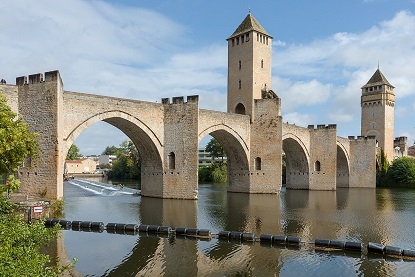
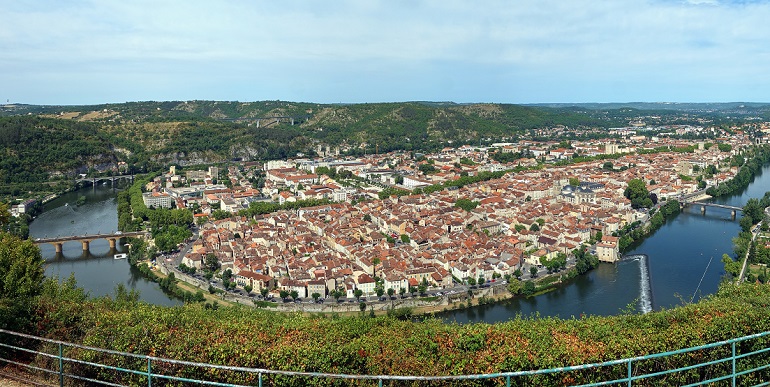
Cahors (pop. 20,000) is situated dramatically on a rocky peninsula formed by a horseshoe bend of the River Lot. The city serves as the smallest prefecture among the 13 departments that constitute the Occitanie Region. Formerly the capital of the ancient province of Quercy, Cahors boasts considerable historical significance dating back to Gallo-Roman times when it was known as Divona Cadurcorum. The city is internationally renowned for its UNESCO World Heritage-listed Pont Valentré, a magnificent 14th-century fortified bridge with three towers that was constructed during the Hundred Years War. Cahors is equally famous for its distinctive red wine produced from at least 70% Malbec grapes, which creates the characteristic dark colour that has earned it the local nickname "black wine". The historic centre features an impressive array of medieval architecture including the Romanesque Saint-Étienne Cathedral, well-preserved ramparts, and numerous merchant houses from the 13th century when the city flourished as a centre of banking and commerce. The city holds the prestigious French Towns of Art and History label and offers visitors 25 secret gardens inspired by medieval castle and abbey gardens, which have earned recognition as one of France's Jardins Remarquables.
Interesting Facts about Cahors
- Cahors sits on a dramatic peninsula almost encircled by the River Lot, earning it the nickname of an “almost island.”
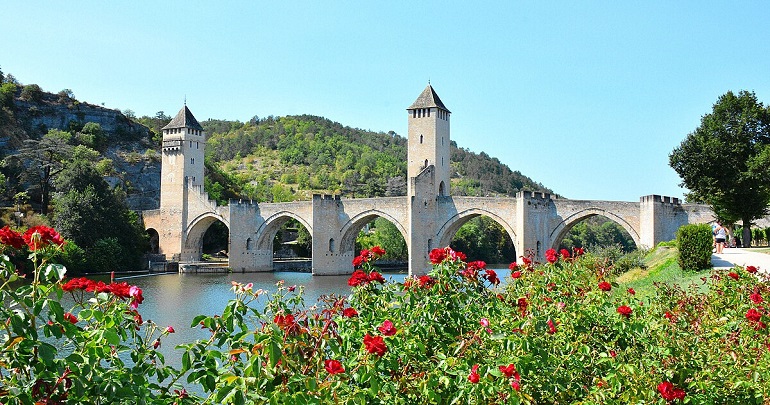
- The medieval Pont Valentré, a triple-towered fortified bridge, is the city’s emblem and carries a playful legend about a pact with the Devil.
- Cahors’ Roman predecessor was called Divona Cadurcorum, named for a revered spring that still supplies the town’s water.
- The city is famed for inky, tannic Malbec-led “black wine,” produced under the AOC Cahors appellation.
- Dante’s Inferno name-checks Cahors because its medieval moneylenders made the town synonymous with usury.
- Mont Saint-Cyr provides sweeping viewpoints over Cahors’ horseshoe meander and terracotta rooftops.
- Pope John XXII, the longest-reigning Avignon pope, was born in Cahors and founded a university there in 1331.
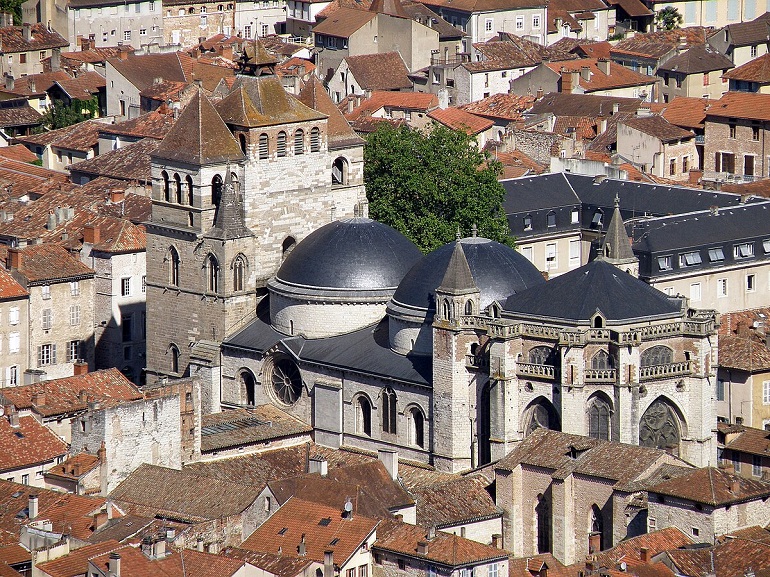
- The Cathedral of Saint-Étienne is noted for its rare double cupolas, an architectural distinction in France.
- The Pont Valentré forms part of the Camino de Santiago routes, linking Cahors to centuries of pilgrimage.
- Locally, Malbec is traditionally known as Côt or Auxerrois, reflecting Cahors’ deep winegrowing heritage.
History
Cahors boasts a remarkable history stretching back over two millennia, beginning with its Celtic origins as a sacred settlement of the Cadurci tribe. The town's original name was Divona or Divona Cadurcorum, meaning "Divona of the Cadurci," named after a sacred fountain called "la fontaine des Chartreux" that was worshipped by this Gallic people before the Roman conquest. The Cadurci were among the last Celtic tribes to resist Roman invasion during the 50s BCE, making their final stand at the Battle of Uxellodunum in 51 BCE. Following Roman annexation, Emperor Augustus founded the city of Divona Cadurcorum in the 1st century within the natural peninsula formed by the meandering River Lot. The Romans transformed Cahors into a prosperous urban centre complete with thermal baths, an amphitheatre, temples, a theatre, houses adorned with mosaics, and an aqueduct supplying water from Vers. The city became renowned for its fine linen cloth production and thrived as an important administrative hub, with remnants of Roman architecture still visible today, including the Arc de Diane and sections of the amphitheatre wall.
The medieval period marked Cahors' golden age of prosperity and architectural achievement, though it was preceded by centuries of decline following barbarian invasions. The city suffered devastating attacks from barbarian tribes in 471 and 513 CE, was largely destroyed by Merovingian Franks in 574, and endured further pillaging by Saracens in 732 and Vikings in later centuries. Recovery began under the energetic leadership of Bishop Saint Didier in the 7th century, who built the first cathedral and restored the city's splendour. By 1085, the bishops of Cahors had become counts of the city under the suzerainty of the Count of Toulouse, attracting religious communities and spurring major construction projects. The magnificent Saint-Étienne Cathedral was erected in the 11th and 12th centuries, becoming the first church in France to feature cupolas and influencing regional ecclesiastical architecture. This period also saw Cahors emerge as a major financial centre in the 13th century through its moneylenders, known as Cahorsins, who were notorious throughout Europe for charging interest on loans—a practice so controversial that Dante referenced Cahors alongside Sodom in his Inferno. The city's most famous son, Pope John XXII, was born here in 1244 as Jacques Duèze, the son of a humble shoemaker.
The construction of the legendary Pont Valentré between 1308 and 1355 represented the pinnacle of Cahors' medieval achievement, creating what is now considered the finest medieval fortified bridge in France. Pope John XXII established a university in Cahors in 1331, which operated successfully until 1751 when it was transferred to Toulouse. However, the Hundred Years' War brought significant decline as drapers and tanners abandoned their trades, reducing the population to just 5,000 inhabitants by the 14th century. The 17th century witnessed a religious renaissance under Bishop Alain de Solminihac, who was later beatified and restored the diocese whilst founding charitable institutions and rebuilding the city's hospital. Urban development accelerated in the 19th century with the construction of major boulevards, public buildings including the theatre and courthouse, and the arrival of the railway near the Pont Valentré. The industrial era brought renewed prosperity, with the population reaching nearly 20,000 by 1890, though economic challenges including phylloxera's devastation of local vineyards caused population decline in the early 20th century before recovery began in the 1950s.
Main Attractions
Pont Valentré
The Pont Valentré is the most iconic symbol of Cahors and one of France's finest examples of medieval military architecture. Completed in 1380 after decades of construction, this imposing bridge features eight arches and three fortified towers, standing majestically over the Lot River. A UNESCO World Heritage Site, it is also linked to a famous legend involving a pact with the devil, symbolised by a carved imp on its central tower. The bridge is entirely pedestrian and offers splendid views of the town and river valley.
Cathédrale Saint-Étienne
Dominating the town centre, the Cathédrale Saint-Étienne is a masterpiece of southern French Romanesque architecture, renowned for its massive cupolas that are among the largest in France. Built in the 12th century, the cathedral houses the Sainte Coiffe (a relic associated with Christ's shroud), exquisite mosaics, and a striking Gothic cloister. The cathedral square is also home to Cahors’ vibrant twice-weekly market, celebrated among the most beautiful in France, with stalls overflowing with regional treats and local specialities.
Mont Saint-Cyr
For panoramic vistas, a trip to Mont Saint-Cyr is essential. From this elevated vantage point, the full meander of the Lot River can be appreciated, encircling Cahors like a natural moat. The summit is accessible by car or on foot and is equipped with picnic facilities and walking trails, making it an ideal spot to admire the sunset or simply savour the landscape.
Historic Town Centre and Medieval Streets
Wandering through the historic town centre reveals Cahors’ medieval charm, with its winding lanes and timber-framed buildings. Streets such as Rue Nationale and Rue de la Daurade showcase preserved Renaissance and half-timbered houses, while the atmospheric squares and alleyways bring to life the city’s rich past. Be sure to look for the “Secret Gardens” scattered throughout the area—intimate green spaces each with its own character, open to the public during the warmer months.
Chartreux Fountain (Fontaine des Chartreux)
This ancient limestone spring, the Fontaine des Chartreux, has supplied Cahors with water since Roman times and was once a place of worship for the Celtic goddess Divona, giving the town its original name, Divona Cadurcorum. The fountain is steeped in myth and history, and archaeological finds of Roman coins bear witness to its sacred status. Today, it is both a tranquil spot and a testament to Cahors’ storied past.
The Market at Place de la Cathédrale
The bustling market in front of Saint-Étienne Cathedral is a beloved institution running every Wednesday and Saturday. Here, locals and visitors gather among colourful stalls filled with Quercy melons, Cahors wines, goat cheese, and various other regional delicacies. The market not only showcases the bounty of the Lot region but also immerses travellers in authentic local culture.
Horloge Monumentale à Billes
A modern curiosity, the Horloge Monumentale à Billes is a striking public kinetic clock located at Place Saint-Urcisse. Its ingenious design uses marbles to tell the time, captivating both children and adults with the mesmerising movement of its mechanics. It stands as a unique, playful contrast to Cahors’ historic monuments.
Remains of the Amphitheatre and Arc de Diane
Cahors preserves evocative traces of its Roman past, notably in the remains of the amphitheatre and the misnamed Arc de Diane. The Arc de Diane, a masonry arch, is in fact part of the frigidarium from Gallo-Roman bathhouses, a glimpse into the daily life of ancient Divona. These vestiges evoke the town’s long and layered history, accessible to those seeking more offbeat archaeological sites.
Towers and Fortifications
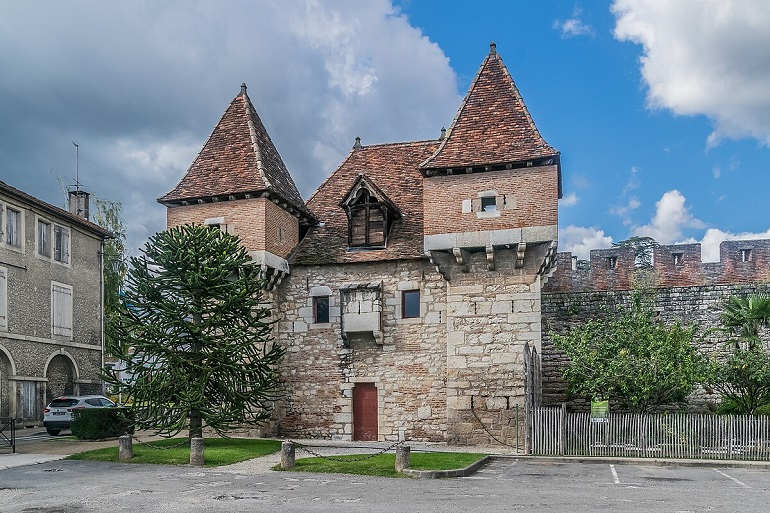
The city’s historic prowess is evident in its impressive fortified gates and towers, like the Saint-Michel gate, Jean XXII Tower, and Saint-Jean Tower. The imposing fortifications, initially erected during the Hundred Years' War, still guard parts of the old town and bring to life the atmosphere of medieval Cahors.
Top Museums
Musée Henri-Martin
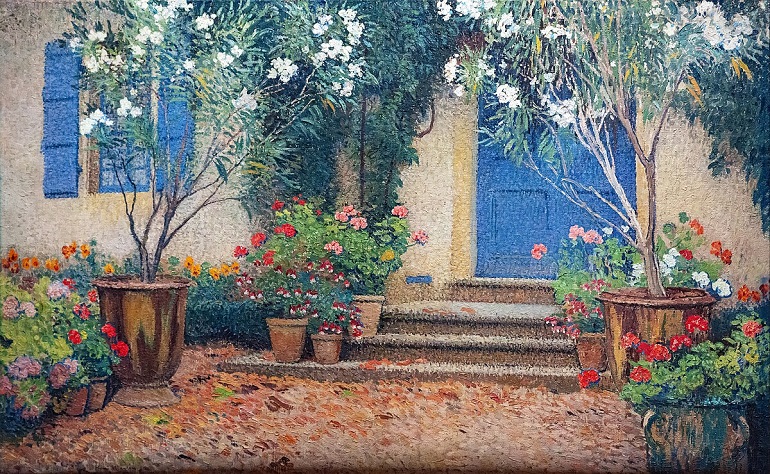
The Musée Henri-Martin stands as the flagship of Cahors’ art scene and is housed in an elegant building that beautifully melds tradition with modernity. This museum is dedicated chiefly to the works of Henri Martin, a leading figure of French Post-Impressionism, whose luminous landscapes and poetic scenes were inspired by the Lot valley. Visitors can move through bright, airy galleries featuring a substantial permanent collection of Martin’s paintings, sketches, and lithographs, alongside carefully curated temporary exhibitions by national and international artists. The museum also hosts a selection of works by other regional painters and sculptors, as well as pieces representing the broader movements of 19th- and 20th-century French art. A visit to this museum offers not only a journey into the life and evolution of Henri Martin but an insightful window into the region’s broader artistic legacy.
Musée Armand Viré
Although located in nearby Luzech, the Musée Armand Viré is closely tied to the Cahors area and merits inclusion for visitors with a keen interest in archaeology and palaeontology. The museum’s collections are split into two principal sections. The palaeontology section features an impressive array of ammonite fossils from the Upper Jurassic, revealing the ancient marine history of the Quercy region. The archaeological section draws upon discoveries made during excavations on Luzech’s Impernal hill, presenting pottery, coins, bronze artefacts, and domestic items spanning the Gallo-Roman and medieval periods. There is also a conference room regularly used for specialist lectures and educational activities. The adjacent Ichnospace Museum, dedicated to dinosaur footprints, expands the museum’s scope for those fascinated by prehistory. Together, these exhibits conjure a vivid sense of the Lot valley’s ancient landscapes and civilisations.
La Maison du Patrimoine
La Maison du Patrimoine, located in the heart of Cahors, serves as both a museum and a resource centre for those curious about the region’s evolving urban identity and built heritage. The institution curates exhibitions focused on the preservation, interpretation, and development of Cahors’ architectural landscape—from its medieval heritage to its contemporary reinventions. Through informative displays and interactive media, guests can explore how Cahors’ distinctive layout, defensive walls, and landmark buildings such as the Pont Valentré have shaped its communal persona. The centre also offers workshops and talks designed to engage visitors with issues of heritage conservation and urban development, fostering a deeper appreciation of Cahors as a living historic city.
Local Cuisine
Cahors is renowned for its rich, hearty cuisine that draws on the region’s rural traditions and exceptional local produce. Visitors can savour duck confit and magret de canard, staples of south-western French gastronomy, which delight with their depth of flavour and tender texture. The town is also famous for its robust Cahors Malbec wine, perfectly paired with the area’s signature dishes, while truffles and foie gras add a luxurious touch to seasonal menus. Don’t miss the opportunity to try rocamadour cheese, a creamy local goat’s cheese, and the traditional pastis du Quercy, a delicately layered apple pastry that provides a sweet finish to any meal.
Getting There
By train Cahors sits on the classic Paris–Toulouse main line: frequent Intercités services from Paris-Austerlitz reach the town in about five hours, while regional TER trains link it with Montauban for easy TGV connections further afield. The station is a short walk from the historic centre, making rail the most straightforward option for visitors arriving from elsewhere in France.
By coach / bus Long-distance operators such as FlixBus run direct and one-change services from Paris and Toulouse, stopping at Cahors’ De Gaulle coach station just south of the river. TER-liO buses also fan out across the Lot, providing handy links from nearby hubs like Brive-la-Gaillarde and Figeac and giving budget-minded travellers flexible access to the town.
By car Drivers will find Cahors conveniently placed on the A20 “Occitane” motorway, which threads north–south between Vierzon and Montauban; exit 57 drops you straight onto the D820 that skirts the city’s medieval heart. The journey takes roughly 1 hour 20 minutes from Toulouse and 5 hours 30 minutes from Paris, with scenic approaches through rolling Quercy countryside once you leave the autoroute.