


| Contents |
|---|
Introduction
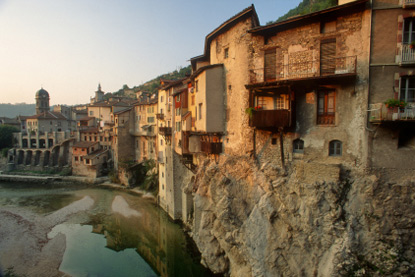
Located near the Vercors Regional Nature Park, half-way between Grenoble and Valence, Pont-en-Royans (pop. 800) is a lovely, quaint village of colourful houses suspended over a rocky protuberance along the river. It is renowned for its extraordinary suspended houses, colourful 16th-century dwellings built directly onto the rockface with wooden balconies and projections extending over the Bourne River, which have been classified as Historic Monuments since 1944. Originally constructed to support the local timber trade that transported logs from the Vercors forests downstream, these architectural curiosities exemplify medieval ingenuity in maximising space within the narrow gorge setting. The settlement's strategic importance dates to the 11th century with its historic bridge that once served as a toll crossing point, whilst the riverbanks housed up to seven mills that harnessed hydraulic power for grinding flour and nuts before later becoming home to one of France's earliest hydroelectric facilities in 1879. Today, the village features a Water Museum housed in a former hydroelectric building, medieval streets carved into the rock, and developed riverbanks with bathing areas, all set within the spectacular Gorges de la Bourne landscape that once impressed the writer Stendhal during his 1838 travels.
Interesting Facts about Pont-en-Royans
- Famous for its colourful 16th-century hanging houses, Pont-en-Royans seems to defy gravity as façades jut out over the jade-green Bourne River.
- The village grew around timber trading, with ingenious cliff-hugging architecture maximising scarce space at the gorge’s narrow foot.
- Its suspended houses were classified as Historical Monuments in 1944, recognising their unique construction and heritage value.
- The spectacular Gorges de la Bourne road links Pont-en-Royans to Villard-de-Lans, carved into sheer rock with dramatic cornices and tunnels.
- The Water Museum celebrates H2O with interactive exhibits and a quirky “water bar” offering tastings of waters with distinct mineral profiles.
- Nearby Choranche Cave dazzles with an underground lake and thousands of needle-fine fistulous stalactites in cathedral-like chambers.
- Writer Stendhal praised the Bourne’s limpid waters after visiting, charmed by the village’s intimate medieval lanes and river scenery.
- The Picard Bridge gives one of the best vantage points for photographing the cliff-perched houses and river bends below.
- Troglodyte dwellings and remnants of a medieval bridge recall the village’s strategic past at the gateway to the Vercors.
- Weekly markets, riverside bathing spots and picnic terraces make this tiny alpine outpost as liveable as it is photogenic.
History
Medieval Origins and Strategic Importance
Pont-en-Royans traces its origins to ancient Celtic and Gallo-Roman settlements, with the territory positioned at the strategic border between the Allobroges, Segovellaunes, and Voconces tribes. The village's name derives from its famous bridge, originally dating to the 11th century, which provided crucial passage across the treacherous Bourne gorge to reach the Vercors plateau. During medieval times, feudal lords controlled this vital crossing point, levying tolls from travellers seeking passage to the plains. The settlement was fortified with three separate castles built across different periods, surrounded by defensive walls that included the Tour de l'horloge and multiple gates such as the porte de France, porte Agnès, and porte du Merle. The Royans territory was conquered during 10th-century campaigns against the Saracens by lords "de Peyrins" and "de Royans," later passing through inheritance to the Bérenger and Sassenage families, who became vassals of the Dauphin de Viennois. The village's economic foundation rested on its seven water mills positioned along the Bourne River, which harnessed hydraulic power to grind flour and nuts, press fruit, and later generate electricity.
Religious Upheaval and the Suspended Houses
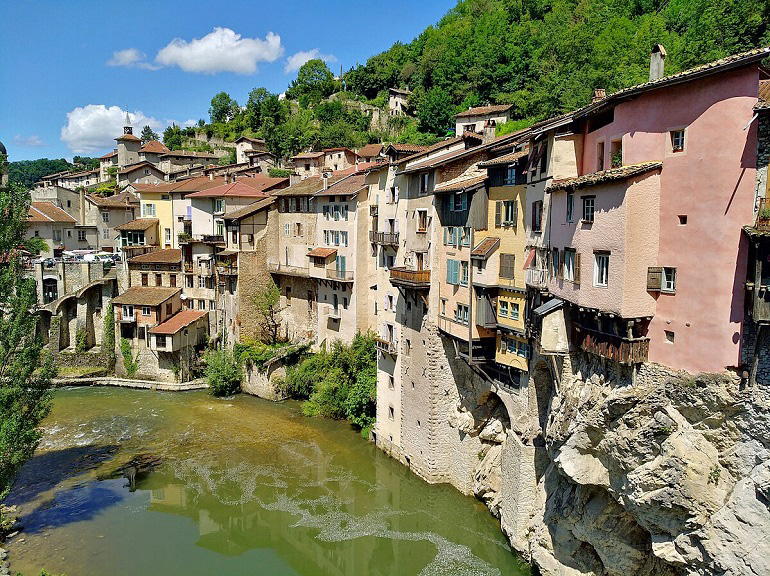
The 16th century marked a transformative period for Pont-en-Royans, witnessing both architectural innovation and religious turmoil. Space constraints on the plateau and the flourishing timber trade necessitated creative building solutions, leading to the construction of the village's iconic suspended houses built directly into the mountainside rockface. These colourful dwellings, now listed as Historic Monuments since 1944, clung precariously to the cliffs above the Bourne River, creating the distinctive silhouette that defines the village today. During the Wars of Religion, Pont-en-Royans endured significant hardship due to its substantial Protestant community, which comprised approximately half the population. A Protestant temple was erected in 1601 but was subsequently destroyed shortly before Louis XIV's revocation of the Edict of Nantes, prompting many residents to emigrate to Switzerland. The village's priory, attached to the church and later converted into a hotel, fell under the jurisdiction of various religious orders, including the monks of Saint-Antoine l'abbaye in 1298 and the Order of Saint-Jean de Jérusalem in 1777.
Industrial Development and Modern Recognition
The 19th century brought unprecedented fame to Pont-en-Royans, which became more renowned than the nearby city of Valence during Napoleon III's reign. The village's international reputation stemmed from the remarkable engineering achievement of carving roads through the Vercors' limestone rock, a feat that showcased French engineering prowess at the first Universal Expositions in Paris. This period necessitated the widening of the ancient bridge and the unfortunate demolition of numerous suspended houses—originally three times more than exist today. The local economy diversified beyond traditional activities, with wood turning using boxwood becoming a primary industry; the Tournerie Mayet, established in 1856, employed up to 120 workers before closing in 1986. In 1918, the Compagnie générale d'électricité introduced electrical equipment manufacturing to the former priory, producing household items such as switches and sockets, an industry that persists today under the Legrand Group. During the Second World War, Pont-en-Royans served as a crucial resistance stronghold, assisting those fleeing forced labour and helping establish maquis camps, though the village suffered two devastating German bombardments. The pioneering work of photographers like the Marquis de Sassenage and Édouard Baldus captured the village's unique architecture on early glass photographic plates, images that inspired artists like Gustave Doré and continue to showcase the settlement's remarkable heritage.
Main Attractions
The Suspended Houses
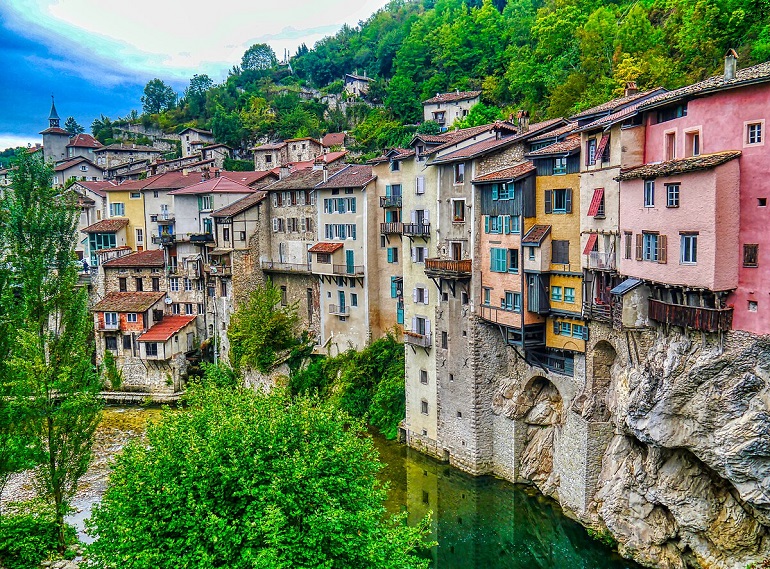
The suspended houses—“maisons suspendues”—are the village’s most iconic feature, and perhaps some of the most remarkable dwellings in France. Dating from the sixteenth century, these brightly painted, half-timbered and stone houses were cleverly constructed into the sheer limestone cliffs above the Bourne River, not only conserving precious land but also facilitating access to water and fish straight from the living room. Their design was primarily driven by the needs of the Vercors timber trade: the timber cut from the surrounding forests floated down the river for processing here. Balconies and outbuildings dangle over open space, some with centuries-old “plank latrines” leading directly down to the river. Their ochre, yellow and pink facades catch the changing sunlight in a picturesque display that has inspired writers like Stendhal. Today, the houses are protected as a historic monument, offering a dramatic sight that draws visitors year-round.
Bourne River Gorges & 13th-Century Bridge
The village sits at the gateway to the Gorges of the Bourne River, a spectacular limestone canyon carved over millennia by the churning waters. The river here is framed by steep cliffs and lush greenery, with walking paths leading to scenic viewpoints, shady picnic spots, and the remains of ancient mills and bridges. Central among these is the mediaeval stone bridge—one of the village’s oldest surviving features—which connected Pont-en-Royans with the plains and facilitated the toll collection for passing merchants. The Bourne’s riverbanks, equipped for relaxation and bathing, are perfect for whiling away a summer afternoon with the sound of waterfalls nearby, or for setting off on breathtaking walks toward Villard-de-Lans via the gorge’s precipitous, tunnel-carved roads. This dramatic landscape also offers rewarding routes for cyclists, naturalists, and anyone hoping to immerse themselves in the tranquillity of the Vercors.

Medieval Centre and Streets
Beyond its riverside marvels, Pont-en-Royans immerses visitors in an intimate and authentic mediaeval centre. Compact, winding streets are bordered by brightly painted homes, timbered arcades, and vaulted passageways. This historic core reflects the adaptations required by both the terrain and centuries of human settlement. Remnants of the old fortifications—including feudal towers and fragments of ramparts—can be spotted as one wanders the narrow lanes. Small squares blossom with weekly markets, while traditional shops and bakeries fill the air with the aromas of fresh local produce. The village’s modest scale, combined with intricate architecture and subtle historical echoes, encourages slow exploration and offers a profound sense of connection with the past.
Jardins des Carmes
An oasis of calm at the edge of the village, the Jardins des Carmes are lovingly maintained in traditional mediaeval style. Divided into distinct areas, visitors find aromatic “simples” (medicinal and culinary herbs), geometric vegetable beds, and a historic orchard with heirloom fruit trees. The gardens flourish beside quiet footpaths, inviting peaceful strolls among bright blooms and fragrant foliage. The setting is particularly evocative at sunrise or dusk, when the far-off cliffs glow and birdsong accompanies the gentle rustle of old leaves.
Panorama des Trois Châteaux
For sweeping views that encapsulate the village and its surroundings, the Panorama des Trois Châteaux is a must. A marked trail leads from the centre to this vantage point, where the colourful jumble of Pont-en-Royans’ rooftops lies framed by the great expanse of the Isère and Royans plains. The panorama also encompasses the lush valley and distant alpine crags—ideally viewed at sunset, when the shifting light bathes the entire landscape in gold. History buffs will appreciate the remnants and legends behind the trio of ancient castles—now reduced to subtle traces—while photographers relish the unique perspective this overlook provides.
Grotte de Choranche
A short drive from the village brings one to the magnificent Grotte de Choranche cave system, a dramatic natural wonder famed for its clarity and beauty. Visitors explore vast underground caverns adorned with delicate soda straw stalactites, shimmering crystal lakes, and rare cave fauna. The grotto, discovered in the late nineteenth century, is a refreshing respite in summer and offers guided tours along subtly illuminated walkways that reveal geological secrets millions of years in the making. Above ground, interpretive trails and lookout points add to the sense of adventure, making this a highlight for travellers interested in natural history and geology.
Top Museums
Pont-en-Royans’s museum experience is centred almost exclusively around the Musée de l’Eau—a dynamic institution that transcends the usual boundaries of a science museum, delivering an immersive, multi-sensory exploration of water in all its forms and meanings.
Musée de l’Eau
Entrance and Architectural Design
The journey begins in dramatic fashion, as visitors enter through a vast pipe reminiscent of hydroelectric conduits, a symbolic nod to the Bourne river’s historical importance for silk weaving and industry in Pont-en-Royans. The initial gallery evokes subterranean worlds, with water appearing at the bottom of a luminous “well of images”, followed by a true climatic corridor. Here, the influence of water on the world’s climates—polar, temperate, and tropical—is decoded through temperature, lighting and tactile exhibits. A glass bridge leads out to a dizzying overlook above the crystalline Bourne, laying bare the power and beauty of water itself.
Permanent Exhibitions
The main exhibition hall unpacks the paradoxical nature of water. The displays guide visitors through water’s life-giving role—its necessity for survival, its fertile powers, but also the dangers of catastrophe, drought, flooding and contamination. Interactive touchscreens, panoramic photographs and a meteorological quiz dome encourage hands-on engagement and playful learning. Get drenched by a “miniature rainfall” when answering incorrectly! The museum exposes both the poetic and the perilous: water as a calming force when serene, but terrifying when unleashed in its fury.
- “Water, Who Are You?”: A playful zone with quizzes and games unravelling the mysteries of water, probing its chemical formula, origins and role within the natural and human worlds.
- Global Water Distribution: Visitors discover the various forms and locations of water on Earth—surface rivers and lakes, underground aquifers, clouds, rain and evaporation—through immersive displays, soundscapes and visual effects.
- Climatic Corridor: Experience the physical sensation of passing from one climate zone to another via temperature and humidity shifts, illustrating water’s role in sustaining planetary weather.
Ecology, Science and Art
The museum places strong emphasis on current ecological challenges, exploring water pollution, conservation and the struggle for access to potable water around the world. The exhibitions are regularly refreshed with contemporary photography, sculpture and installations contributed by guest artists, environmental organisations, and local creative projects.
- Hydroelectricity and Water Engineering: Partnering with Electricité de France, past exhibitions have explored the transformation of water’s kinetic energy into electricity. Demonstrations include models and multimedia content to unravel the secrets of energy production and sustainable power.
- Bourne River and Local Natural History: Special short films (projected in the museum’s cinema) detail the history and ecology of the Bourne, the impact of local floods, and the evolution of water-powered industry. Films such as “Redplast” tackle river pollution directly, illuminating both problems and local solutions.
- Wildlife and Landscapes: From the museum’s terraces and viewing platforms, spot the native flora and fauna of the Vercors, accompanied by themed mini-exhibits and outdoor workshops.
Water Bar and Tasting Experience
A renowned feature is the museum’s Water Bar, which elevates water tasting to an art. Guests sample rare and geographically diverse waters—from Alpine spring water to “dry” water (with ultra-low mineral content)—learning to detect subtle differences in taste, texture and mineral balance. This tasting session is a memorable highlight, combining sensory exploration with practical science.
Educational Activities and Workshops
The museum’s pedagogical vocation is clear. It frequently welcomes school groups, families, and adults, providing tailored programmes that blend films, quizzes, hands-on experiments and even “water-nology” workshops. Creative activities often culminate in outdoor picnics on the Bourne’s banks, reinforcing the day’s lessons in real-world settings. The museum hosts guided village tours, teaching about Pont-en-Royans’s architectural heritage—especially the hanging houses, bridges, and historical water-powered machinery.
Special Events and Temporary Exhibitions
Regular events—concerts, thematic evenings, photographic exhibitions and sculpture installations—reinvigorate the museum’s cultural dimension. It remains closely linked to the rhythm of local and global water-related issues: a venue for stimulating debate, ecological awareness, and artistic celebration. These occasions often bring musicians, scientists, and artists together for a rich interdisciplinary mix.
Local Cuisine
In Pont-en-Royans, menus celebrate the bounty of the Vercors foothills, pairing mountain flavours with river-fresh produce. Begin with delicate ravioles du Royans, minute pasta parcels filled with cheese and herbs, often served afloat in a light chicken broth. Local cheesemongers tempt with creamy Saint-Marcellin and nutty Bleu du Vercors-Sassenage, perfect companions to the renowned Grenoble walnuts that find their way into rustic tarts. Trout caught from the Bourne is pan-fried in butter and thyme, while hearty Gratin Dauphinois warms walkers returning from the gorges. To finish, a slice of almond-fragrant galette aux noix or a spoon of blueberry compote pairs beautifully with a chilled glass of sparkling Clairette de Die, leaving a lingering taste of alpine sunshine.
Getting There
By train The nearest major rail hubs are Grenoble and Valence, both served by high-speed TGV and regional TER services; from either station, you can take a TER train to Saint-Marcellin, then a short taxi ride or local bus to Pont-en-Royans, making rail the most convenient option if you are arriving from Paris, Lyon or beyond.
By coach or bus Several regional coaches operated by Cars Région (route T60) run from Grenoble’s Gare Routière and Valence’s bus station to stops in Pont-en-Royans such as Stade and Village/Pont Picard; this is a practical choice if you are already in the Auvergne-Rhône-Alpes region and prefer a direct, door-to-door service without transfers.
By car Pont-en-Royans lies just south of the A49 motorway between Valence and Grenoble; exit at Baume-d’Hostun or Saint-Marcellin, then follow the scenic D531 through the Bourne Gorge for the final 20-minute drive, which offers flexibility for exploring neighbouring Vercors villages en route.