


Introduction
Located a few kilometres south of Blois, the Renaissance Château de Beauregard encloses an exceptional portrait gallery depicting 327 European monarchs, ministers, clergymen, marshals, diplomats and other notables who lived between the reign of Philip VI (r. 1328) and the death of Louis XIII (1643). 25 nationalities are represented in total. Each portrait measures in average 55 cm on 45 cm.
Among famous individuals portraits are Marie de' Medici, Cardinal Richelieu, Ferdinand of Aragon & Isabella of Castile, Christopher Columbus, Henry VIII of England, Mary Tudor, Elizabeth I of England, Francis Drake, William I of Orange, Visconti and Sforza Dukes of Milan, Cesare Borgia, five Holy Roman Emperors (including Charles V), several Dukes of Burgundy, Popes and Turkish Sultans, and all 15 French kings from Philip VI to Louis XIII.
The estate of Beauregard expands on 70 hectares, 40 of which were laid out as gardens. They contain 400 species of perennials and shrubs and are particularly noted for the 107 varieties of roses, which form one of the largest rose gardens of the Loire Valley.
Interesting Facts about the Château de Beauregard
- The Château de Beauregard near Blois is famed for its extraordinary Galerie des Illustres, a 26-metre Renaissance gallery displaying over 300 portraits of notable European figures across centuries.
- Originally a hunting lodge associated with François I, the estate evolved into a refined Renaissance residence under influential royal ministers in the 16th and 17th centuries.
- Jean du Thier, Secretary of State to Henri II, transformed Beauregard after 1545, commissioning Italianate interiors and refined decorations characteristic of the French Renaissance court milieu.
- The portrait gallery’s painted lapis-blue ceiling and Delft-style tile floor create a striking chromatic contrast that frames the long sequence of historical faces.
- Paul Ardier, Comptroller of Wars under Louis XIII, curated and expanded the portrait collection to narrate European political and cultural history through visages.
- The château sits by the Russy Forest, retaining the atmosphere of a countryside retreat while remaining close to Blois and the great Loire Valley ensembles.
- A whimsical “cabinet des grelots” (bell cabinet) reflects Renaissance taste for scholarly curiosities and master woodwork.
- The landscaped grounds include a contemporary “Jardin des Portraits,” twelve colour-coded garden rooms echoing the themes and epochs of the indoor gallery.
- Architectural evolution is legible in its asymmetries and altered wings, revealing layers from late-medieval origins to 19th-century reworkings.
- Beauregard remains comparatively intimate among Loire châteaux, offering a contemplative encounter with portraits rather than vast ceremonial apartments.
- The estate preserves curios such as an 18th-century whale jawbone, a reminder of the period’s fascination with natural wonders and collectors’ cabinets.
- Designated and restored with care in the modern era, Beauregard exemplifies how a private Loire château can balance heritage, horticulture, and living history.

History
A small manor built at the end of the 15th century was later used by King Francis I as a hunting lodge.
Most of the present castle was built around 1545, when it was bought by Jean du Thiers, Lord of Menars, and Finance Minister to Henri II. Humanist and sponsor of the arts, Jean du Thiers, brought artists and craftsmen from abroad, notably Itay, to decorate the castle. He was also a patron to the great Renaissance poets Joachim du Bellay and Pierre de Ronsard.
After du Thiers's death in 1559, the estate is taken over by Florimond Robertet dAlluye, the new Finance Minister. In 1617, the domain is acquired by Paul Ardier, who served as minister under Henry III, Henry IV and Louis XIII. At the age of 72 he transformed the castle to accommodate the potrait gallery.
Beauregard remained the property of the Ardier family until 1816. It then passed to a succession of owners, including such illustrious families as the Sainte Aldegonde and Talleyrand-Périgord. The château is still in private hands and inhabited by its owners (currently the comtesse du Cheyron du Pavillon) to this day.
Description
Exterior
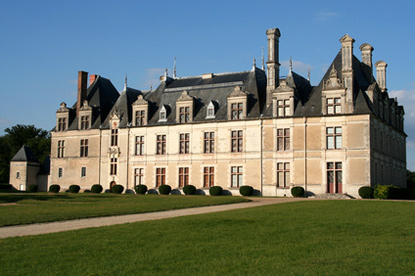
The château’s exterior presents a harmonious blend of Renaissance elegance and restrained grandeur. Its limestone façade is softened by silvery lichen and gracefully climbing ivy, while a series of tall, mullioned windows allow sunlight to spill into the rooms within. The building’s symmetrical composition is offset by elegant turrets at each wing, their conical slate roofs rising above intricate stone cornices. On bright afternoons, the château gleams with a pale golden hue, set off against the deep green of ancient lime and chestnut trees that encircle the lawns.
A broad entrance terrace paved with aged flagstones leads to the main doorway, flanked by twin pilasters and crowned with a sculpted coat of arms. Decorative urns teem with lavender and pelargoniums in the summer months, while the neat beds and geometric box hedges of the parterre garden provide year-round structure. Behind the château, a row of tall, contorted pines frame views out towards the tranquil parkland, with winding gravel paths inviting peaceful strolls and reflection.
Gardens and Parkland
Step outside once more and manicured parterres give way to the open-air Pine Labyrinth, whose concentric rings encourage slow, meditative ambles. Not far off, the Lily Pond mirrors the sky, its edges softened by irises and water-mint. Scattered marble benches provide restful vantage points from which to admire the château’s mellow sandstone façade, framed by billowing curtains of lime and chestnut leaves.
Interior
Entrance Hall
A broad flight of stone steps leads to double doors framed by pale limestone pilasters. Inside, the Entrance Hall greets visitors with a chequered marble floor in soft grey and cream, polished to a gentle lustre. The vaulted ceiling, painted a delicate sky-blue, is bordered by gilt arabesques that catch the light from a wrought-iron chandelier. Here and there, antique trunks and carved benches hint at the château’s centuries-old role as a home of cultured hospitality.
Galerie des Portraits
The celebrated Galerie des Portraits, stretching over twenty-six metres, is unquestionably the château’s centrepiece. More than one hundred and sixty portraits—ranging from Renaissance monarchs to Enlightenment philosophers—line the oak-panelled walls in precise rows. A richly patterned Delft-tile floor reflects the portraits’ muted tones, while a quartz-infused lapis ceiling adds a subtle shimmer overhead. Between portraits, tiny plaques provide succinct notes, allowing visitors to drift from face to face in contemplative silence. At either end, tall mullioned windows invite swathes of natural light, so the gallery changes character with passing clouds.

Salon des Cerfs
Step through elaborately carved walnut doors and the tone shifts dramatically. In the warm, wood-panelled Salon des Cerfs, velvet settees in deep russet face a monumental fireplace carved with frolicking stags. Above, curved antlers form an arresting frieze across the cornice, echoed by oak consoles inlaid with motifs of forest flora. The intimacy of the room is heightened by low lighting from hand-blown glass sconces, which cast dancing shadows across hunter-green walls hung with 17th-century pastoral tapestries.
Cabinet des Livres
The Cabinet des Livres offers a restorative calm. Floor-to-ceiling bookcases in patinated cherry wood embrace a compact octagonal space. A Persian silk rug in dusky rose and indigo muffles footsteps, inviting lingering inspection of the leather-bound volumes—many still bearing gilded family crests. In the western alcove, a narrow desk of marquetry walnut faces a leaded window overlooking the herb garden; quills, a blotter and a weathered inkstand are artfully arranged as though the master has just stepped out for a stroll.
Salle du Conseil
Across the corridor lies the Salle du Conseil, once a venue for weighty deliberations. A long, ebonised table runs its length, flanked by high-backed chairs upholstered in muted damask. Cornflower-blue walls are trimmed with delicate stucco garlands, while a pair of Venetian mirrors amplifies the daylight. In one corner, a brass orrery and a celestial globe offer a nod to the estate’s scholarly past, perfect for visitors with a penchant for astronomy.
King’s Bedchamber
Though modest in scale compared with royal apartments elsewhere, the King’s Bedchamber exudes understated luxury. The four-poster bed, draped in pale silk brocade, sits atop a platform of polished walnut. Powder-pink damask curtains frame a dormer window, through which early morning sunlight floods the room, illuminating the carved gilt headboard that depicts intertwining laurel branches. An adjoining dressing closet contains a series of finely carved walnut wardrobes, each hiding a recess lined with lavender sachets to perfume the linens.
Chapel of Saint-Louis
Tucked away on the ground floor, the Chapel of Saint-Louis provides a moment of quiet contemplation. Whitewashed walls are punctuated by slender stained-glass lancets depicting saints in jewel tones. A small, vaulted apse shelters an alabaster altar, its simplicity contrasting with the gilded candlesticks that flank it. Visitors often pause to listen for the faint resonance of choral music, piped in softly to maintain the space’s reverent hush.
Kitchens and Servants’ Hall
Descending a narrow spiral stair brings you to the vaulted Kitchens, redolent of wood smoke and sweet spices. Copper pans hang in symmetrical rows against cream-coloured stone, their surfaces catching the glow from an immense hearth where seasonal dishes are still prepared during culinary demonstrations. Adjacent, the Servants’ Hall showcases sturdy elm trestle tables and an intriguing wall of chalked menu boards, offering a glimpse into the château’s bustling domestic rhythm.
Getting There
By train The swiftest public-transport option is to take a TER service from Paris Austerlitz (or Orléans) to Blois-Chambord station; from the forecourt, seasonal Azalys shuttle buses and Rémi local buses link with Cellettes village, a short walk from the château’s gates.
By coach or bus In peak months an Azalys château shuttle runs directly from Blois-Chambord station to Château de Beauregard and on to Cheverny; outside summer you can ride Rémi route 2 towards Cheverny, alighting at “Cellettes-Château de Beauregard” for the five-minute stroll up the tree-lined drive.
By car From Blois follow the D956 south for 11km, then local signs to Cellettes and the château; the drive from central Paris via the A10 and exit 17 (Blois) takes about two hours, with free parking set in woodland just beside the entrance avenue.


