


| Contents |
|---|

Introduction
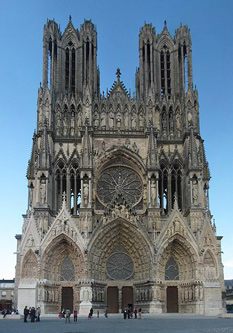
Reims (pop. 181,000) is the capital of the Champagne-Ardenne region. It is the city where the kings of France used to be crowned.
Three of the city's monuments were added to the UNESCO World Heritage Sites in 1991 : the Cathedral of Our Lady of Rheims, the Former Abbey of Saint-Remi, and the Palace of Tau.
Many of the largest Champagne producing houses have their headquarters in Reims, including among others Taittinger, Pommery, Veuve Clicquot Ponsardin, Piper-Heidsieck, Ruinart and Krug. Most are open for tasting and tours by appointment.
Interesting Facts about Reims
- Reims is home to one of France's oldest cathedrals, the Notre-Dame de Reims, which witnessed the crowning of nearly 30 French monarchs.
- The city is known as the birthplace of champagne and boasts a network of about 120 kilometres of wine cellars beneath its streets.
- Reims played a crucial role in ending World War II, as the German Instrument of Surrender was signed there on 7 May 1945.
- The city has a rich Roman heritage, with well-preserved relics like the Porte de Mars, a 3rd-century triumphal arch.
- According to legend, Reims was founded by Remus, the brother of Romulus, who founded Rome.
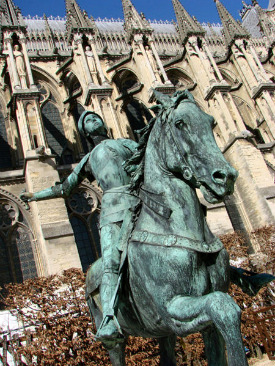
- Joan of Arc succeeded in crowning Le Dauphin Charles VII in Reims on 17 July 1429.
- During World War I, Reims residents took shelter in the champagne cellars, where they set up schools, hospitals, and even performed concerts and operas.
- The city was more than 80% destroyed in World War I but was rebuilt in less than 10 years by over 400 architects.
- A bottle of champagne is opened every 10 seconds in Reims.
- Reims is home to the lighthouse furthest from the sea, Le Phare de Verzenay, which is surrounded by grapevines.
- The city hosts the largest concentration of rare beech trees with twisted, knotted branches, known as Faux de Verzy.
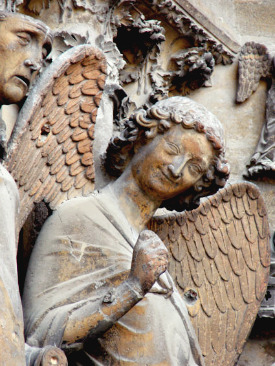
- Reims Cathedral boasts 2,303 statues, more than any other religious building in the world, including the famous Smiling Angel.
History
Before the Roman conquest of Gaul, the city was the capital of the Remi tribe, which gave its name to Reims. Christianity was established in the town by the middle of the 3rd century, at which period the bishopric was founded.
Clovis conquered the remnants of northern Roman Gaul in 486. 10 years later, he converted to Christianity on request of his Burgundian wife, and was baptized by Remi, bishop of Reims.
Under Charlemagne, Turpin becomes the first Archbishop of Reims. In the 10th century, Reims had become a centre of intellectual culture under Archbishop Adalberon, one of the prime authors of the revolution which put the Capetian dynasty in the place of the Carolingians. One of his pupils, a monk known as Gerbert of Aurillac (950-1003), studied at the cathedral school of Reims, then became the teacher of Emperor Otto III and Pope Gregory V, before being himself elected as Pope Silvester II.
From the early 13th century, the Archbishop of Reims took precedence over all the other peers of France.
During the Hundred Years' War, the English had made a futile attempt to take Reims by siege in 1360. The Treaty of Troyes (1420) ceded it to them, but they were soon expelled by Joan of Arc, who in 1429 had Charles VII consecrated in the cathedral.
Reims was damaged during French Revolution (as it was a symbol of the monarchy), as well as in all major wars in the 19th and 20th century : the Napoleonic Wars (1814), the Franco-Prussian War (1870-1), WWI (1914) and WWII (1945). The cathedral was severely damaged by German bombardment and a subsequent fire in 1914. It took 40 years to repair the edifice.
It is in Reims that General Eisenhower and the Allies received the unconditional surrender of the Wehrmacht on 7th May 1945.
Main Attractions
Reims is a fairly compact city, with most of the sights with a 500m radius from the old Roman forum. Apart from two churches and a museum, all the attractions are located in a north-south axis between Mars Gate (on Place de la République) and Tau Palace (next to Place Carnegie).
The train station is north-west of the historical centre. It faces the green Colbert Square , followed by the lively Place Drouet-d'Erlon, which welcomes weary train passengers with its multitude of hotels, restaurants and cafés. The so-called Hautes promenades and Basses promenades, on each side of Colbert Square, are 18th-century parks comprised between the boulevards on the north-west of the city centre, where the city walls once stood.
| Reims Cathedral ※ |
|---|

 The magnificent Gothic cathedral where kings of France were crowned. The magnificent Gothic cathedral where kings of France were crowned. |
| Palace of Tau ※ |
|---|
 The former palace of the Archbishops of Reims.
 |
| Saint Remi Basilica & Abbey ※ |
|---|
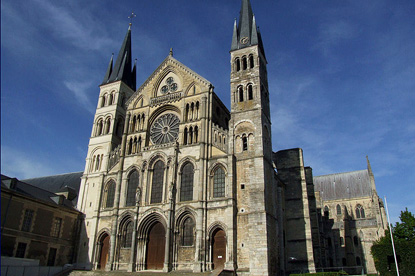 An enormous Romanesque church with abbey and museum attached.
 |
| Hôtel des Comtes de Champagne |
|---|
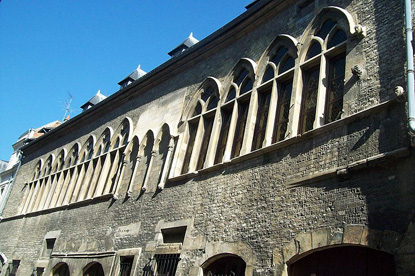
 Gothic-style residence of the Counts of Champagne. It is located on Rue du Tambour and now belongs to the Taittinger family. Gothic-style residence of the Counts of Champagne. It is located on Rue du Tambour and now belongs to the Taittinger family. |
| Hôtel de Ville |
|---|
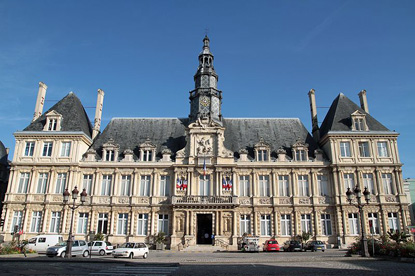 The town hall was reconstructed after being destroyed during WWI, though the 17th-century façade survived.
 |
| Place Royale |
|---|
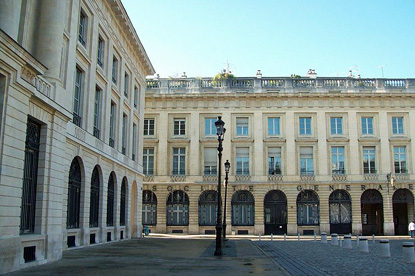 A typical Louis XVI-style square with arcades and balustraded roofs. It is located south of the forum.
 |
| St. James' Church |
|---|
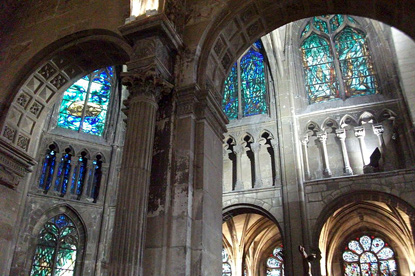 The Église St-Jacques is another superb example of Gothic architecture and stained glass windows. It is located 200m west of the cathedral.
 |
| Porte de Mars |
|---|
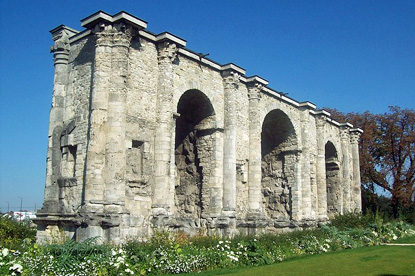
 A 3rd-century Roman triumphal arch that was part of the original Roman city wall. Bas-relief sculptures of Romulus & Remus and other classical themes are still visible. It is located at the northern extremity of Rue de Mars (north of the town hall). A 3rd-century Roman triumphal arch that was part of the original Roman city wall. Bas-relief sculptures of Romulus & Remus and other classical themes are still visible. It is located at the northern extremity of Rue de Mars (north of the town hall). |
| Cryptoportico |
|---|
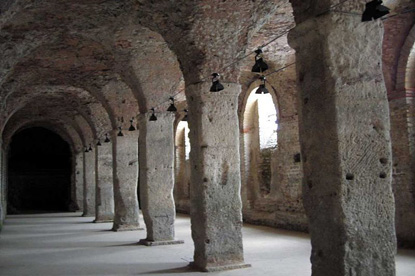 The remains of the old the Gallo-Roman forum. It is located on Place du Forum.
 |
Wine cellars
Most of the local Maisons de Champagne (wine producers) have guided tours (in French or English) of their cellars with the inevitable tasting session at the end. Here are the addresses of the most famous (alphabetically):
- Krug, 5 rue Coquebert - Tel. 03 26 84 44 20.
- Lanson, 66 rue de Courlancy - Tel. 03 26 78 50 50.
- Mumm, 34 rue du Champ de Mars - Tel. 03 26 49 59 70.
- Piper-Heidsieck, 51 boulevard Henry Vasnier - Tel. 03 26 84 43 00.
- Pommery, 5 place du Général Gouraud - Tel. 03 26 61 62 56.
- Louis Roederer, 21 boulevard Lundy - Tel. 03 26 40 42 11.
- Ruinart, 4 rue des Crayères - Tel. 03 26 77 51 51.
- Taittinger, 9 place Saint Nicaise - Tel. 03 26 85 45 35.
- Veuve Clicquot Ponsardin, 1 place des Droits de l'Homme - Tel. 03 26 89 53 90.
Other sights
West of the Gallo-Roman forum stands the Hôtel de la Salle, a Renaissance house built between 1545 and 1556.
On Rue Carnot, starting from the middle of the western side of the square, one can admire the 16th-century Chapter's Gate (Porte du Chapitre) and its mini-turrets, which open a passage toward Place du Chapitre, a small canonical enclosure just behind the cathedral.
Crossing the railway by Avenue de Laon, you reach the Surrender Museum (Salle de Reddition, at 12, Rue Franklin-Roosevelt), the former headquarters of General Eisenhower at the end of WWII, and where the surrender of Nazi Germany was signed on 7th May 1945.
Top Museums
Musée des Beaux-Arts de Reims
The Musée des Beaux-Arts de Reims is a must-visit for art enthusiasts. Located in the former Abbey of Saint-Denis, this museum boasts an impressive collection of artworks spanning from the Renaissance to the 20th century. Visitors can admire paintings, sculptures, drawings, and decorative objects by renowned artists such as Monet, Rodin, Millet, and Claudel. The museum also hosts temporary exhibitions, offering a dynamic and engaging cultural experience.
Palais du Tau
The Palais du Tau is a historical treasure and a UNESCO World Heritage Site. This former archbishop's palace, situated next to the Reims Cathedral, played a significant role in the coronation of French kings. The museum houses an exceptional collection of historical artifacts, including Charlemagne's talisman and the Sainte-Ampoule, which was used in royal coronations. Although currently closed for renovation, it remains a pivotal part of Reims' cultural landscape.
Musée Saint-Remi
Located in the former Abbey of Saint-Remi, another UNESCO World Heritage Site, this museum offers a journey through the history of Reims and its region. The museum features historical reconstructions, models, and an impressive collection of religious objects, including stunning stained glass windows and medieval art. Visitors can explore the evolution of the city from prehistory to the Renaissance, making it a fascinating destination for history buffs.
Musée de la Reddition
The Musée de la Reddition commemorates the unconditional surrender of Germany in World War II, which took place in Reims. The museum showcases artifacts and documents related to this pivotal event, with the Salle de la Signature being a particularly poignant attraction. This room has remained unchanged since the surrender in 1945.
Musée Automobile Reims Champagne
For car enthusiasts, the Musée Automobile Reims Champagne is a treasure trove. Located just outside the city centre, it houses an impressive collection of vintage cars and motorcycles, offering a glimpse into the evolution of automotive history. The museum also features special exhibitions and a vast collection of miniature cars.
FRAC Champagne-Ardenne
The FRAC Champagne-Ardenne is a contemporary art gallery located in the heart of Reims. It showcases a diverse collection of modern art, including paintings, sculptures, photography, and installations from the 1960s to the present. This gallery is an excellent spot for those interested in contemporary art.
Le Vergeur Museum
Le Vergeur Museum, housed in a listed building, offers guided tours of its impressive collection of decorative art. The museum features works by notable artists, including original engravings by Dürer, and provides insights into the history of Reims and its coronations.
Local Cuisine
Reims offers a delightful array of local culinary specialties that showcase the rich flavours of the Champagne-Ardenne region. No visit to Reims is complete without sampling the famous jambon de Reims, a succulent ham dish seasoned with nutmeg, shallots, and parsley, often served as an appetiser or light lunch. For a savoury treat, try the andouillette de Troyes, a traditional sausage with a history dating back to the Middle Ages. Cheese lovers will appreciate the creamy Chaource and the renowned Brie de Meaux. To satisfy your sweet tooth, indulge in the iconic biscuits roses de Reims, pink biscuits perfect for dipping in a glass of the region's world-famous Champagne. For a hearty winter meal, savour the potée Champenoise, a comforting vegetable stew with smoked ham and sausages. Don't forget to pair your meal with a glass of locally produced Champagne for the ultimate Reims dining experience.
Shopping
The pedestrian-friendly Rue de Vesle is lined with boutiques and high-end stores, including Galeries Lafayette, while the Place Drouet d’Erlon features shopping arcades and cafés. For a local experience, the Boulingrin Covered Market provides fresh produce and regional specialities. Beyond the city centre, Espace d’Erlon and Reims Village house popular retail brands. Vintage enthusiasts can explore second-hand shops like Mad Vintage, while markets such as Saint-Thomas and Wilson offer a vibrant atmosphere for bargain hunters.
Nature in and around Reims
The Montagne de Reims Regional Nature Park, spanning 50,000 hectares between Reims and Épernay, features forests, vineyards, and picturesque villages. Within the park, the Verzy Forest is home to the unique Faux de Verzy, a collection of protected dwarf beech trees with unusual twisted shapes. The park boasts 400 km of well-marked hiking routes and educational trails, showcasing over 150 plant species and diverse wildlife. For urban green spaces, Les Hautes Promenades in Reims offers lush pathways, sculptures, and fountains. The nearby Mont Bernon in Epernay provides a 360-degree panorama of the wine region from its 208-metre summit. Additionally, the Coulée verte de Reims, a 24-kilometre green corridor along the canal and River Vesle, offers scenic cycling and walking opportunities.
Getting There & Around
The quickest way to reach Reims from Paris is by TGV, which takes a mere 45 minutes. For those arriving by air, Paris Roissy international airport is just 30 minutes away by TGV. Once in Reims, the city boasts an efficient public transport network operated by Citura, comprising trams, buses, and eco-friendly electric shuttles. The tram system is particularly convenient, connecting key areas including the city centre and both train stations. For those preferring to drive, three park-and-ride facilities are available at the city's entrance, allowing visitors to leave their cars and explore the city via public transport or on foot. Cyclists can take advantage of the Zebullo bike-sharing system. To make the most of your visit, consider purchasing a Reims City Pass, which offers free access to public transport and major attractions, as well as discounts on various activities, including tours of renowned Champagne cellars.
Best Time to Visit
The best time to visit Reims is from mid-May to mid-September, when the weather is warm and sunny, making it ideal for outdoor activities and exploring the city's historical sites. During this period, temperatures range from 18°C to 25°C, perfect for visiting landmarks such as the Reims Cathedral and enjoying the scenic views of the Champagne region. July and August are the warmest months, though they can occasionally be hot. September is particularly appealing as it coincides with the champagne harvest, offering a chance to experience local traditions and vibrant autumn colours. For those who prefer milder weather and fewer tourists, spring is also a lovely time to visit, with blooming flowers and mild temperatures.
| Travel destinations in Champagne-Ardenne | |||||||||||
|---|---|---|---|---|---|---|---|---|---|---|---|
|
|
|
| ||||||||
|
|
| |||||||||


