


Introduction
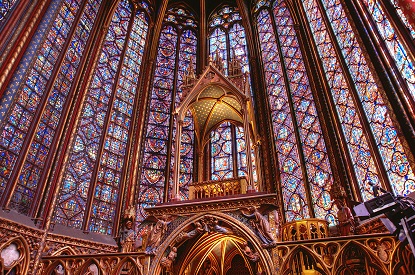
The Sainte-Chapelle stands as one of Paris's finest examples of Gothic architecture, built between 1242 and 1248 by King Louis IX (later Saint Louis) to house his precious collection of Christian relics, including the Crown of Thorns and a fragment of the True Cross. Located on the Île de la Cité within the former royal palace complex, the chapel represents the pinnacle of Rayonnant Gothic style, featuring walls almost entirely composed of stained glass that transform the interior into what was conceived as a massive jewellery box for the royal relics. The two-level structure consists of a lower chapel for palace staff and an upper chapel reserved for the royal family, with the upper level containing fifteen monumental stained glass windows standing 15 metres high that depict over 1,100 scenes from the Old and New Testaments. Consecrated in 1248 after just six years of construction, this architectural masterpiece served both as a religious sanctuary and a political symbol, designed to demonstrate the divine legitimacy of the Capetian monarchy and unite the kingdom under Louis IX's rule.
Interesting Facts about the Sainte-Chapelle
- Built in the mid-13th century by King Louis IX (Saint Louis), Sainte-Chapelle was created to house Passion relics including the reputed Crown of Thorns.
- The chapel was astonishingly completed in about seven years, an exceptionally rapid feat for a Gothic monument of its ambition.
- Its upper chapel is famed for vast stained glass walls comprising more than a thousand panels that narrate biblical scenes across both Testaments.
- The interior is arranged on two levels: a lower chapel once used by palace staff and an upper, jewel-like reliquary space for the king.
- The radiant Rayonnant Gothic design gives the impression that the walls are made almost entirely of coloured glass and light.
- The great rose window dates to the 15th century and dramatically crowns the west end with intricate tracery and apocalyptic imagery.
- The identity of the original architect remains unknown, adding an enduring mystery to the chapel’s creation.
- Sainte-Chapelle suffered damage from fires and during the French Revolution, after which it served ignobly as storage and archives before restoration.
- A major 19th-century restoration led by prominent architects meticulously revived the mediaeval appearance admired today.
- Alongside the nearby Conciergerie, Sainte-Chapelle is one of the last surviving parts of the Capetian royal palace on the Île de la Cité.

History
The Sainte-Chapelle stands as one of Paris's most magnificent Gothic masterpieces, commissioned by King Louis IX (later canonised as Saint Louis) around 1241. Built within the medieval Palais de la Cité, the former residence of French kings on the Île de la Cité, this royal chapel was specifically designed to house the most precious Christian relics of the medieval world, including the Crown of Thorns and a fragment of the True Cross. Construction began sometime after 1238, and the chapel was completed and consecrated on 26 April 1248, achieving this architectural marvel in just seven years—a remarkably short timeframe for such an elaborate Gothic structure. The Crown of Thorns alone cost Louis IX 135,000 livres tournois, approximately half of the annual income of the royal domain, whilst the construction of the entire chapel cost only 40,000 livres tournois—three times less than the relic itself.
Designed as a two-level structure following the Rayonnant Gothic style, the Sainte-Chapelle functioned as both a palatine chapel and a monumental reliquary. The lower chapel was dedicated to palace staff and officers, whilst the magnificent upper chapel served the king and his family, featuring an extraordinary 618 square metres of stained glass windows. These windows comprise 1,113 individual stained glass panels arranged in 15 bays, each reaching 15 metres in height, depicting biblical scenes from both the Old and New Testament with 1,130 biblical figures. The architect's identity remains unknown, though some attribute the design to Pierre de Montreuil, whose tombstone read "Doctor in Stonework". Louis IX's vision extended beyond mere religious devotion; he sought to establish Paris as the "second capital of Christendom" after Rome, creating what he envisioned as a "New Jerusalem".
The chapel's turbulent history began during the French Revolution, when it was severely damaged as revolutionaries smashed portals and royal emblems, viewing it as a symbol of divine monarchy. The building was subsequently repurposed as a flour warehouse, then transformed into an archive depository from 1803 to 1838 for the courts of justice. Many stained glass panels were destroyed, dismantled, or dispersed on the art market, particularly in England. However, thanks to public pressure and advocates like Victor Hugo, the chapel was saved from destruction and underwent exemplary restoration between 1840 and 1863 under architects Duban, Lassus, and Boeswillwald. This restoration project served as a pioneering laboratory for historical monument conservation techniques. The current spire was constructed between 1853-1855, replacing the original that was destroyed during the Revolution. Today, the chapel operates as a museum under the Centre des monuments nationaux and is recognised as containing one of the most extensive 13th-century stained glass collections in the world.
Description
Sainte-Chapelle stands as perhaps the most extraordinary achievement of Gothic architecture, where centuries of structural innovation culminate in a transcendent vision of light made architecture. This royal chapel represents the pinnacle of Rayonnant Gothic design, a luminous sanctuary where the very boundaries between earth and heaven dissolve in cascades of coloured light.
Architectural Genesis and Innovation
The chapel emerges from the medieval Palais de la Cité like a crystalline reliquary scaled to monumental proportions. Measuring precisely 36 metres in length, 17 metres in width, and soaring to 42.5 metres at its apex, the structure achieves remarkable spatial economy whilst creating an overwhelming sense of verticality. The building's proportions follow sophisticated geometric ratios that create both structural stability and aesthetic harmony.
What distinguishes Sainte-Chapelle from all predecessors is its revolutionary approach to structural engineering. The master builders employed an ingenious system of hidden iron chains and rods—centuries ahead of their time—to provide tensile strength that traditional stone construction could not achieve. These metal reinforcements, concealed within the fabric of the building, allow the walls to be replaced almost entirely with glass whilst maintaining structural integrity.
Exterior Refinement and Detail
The exterior presents a study in Gothic restraint and precision. Unlike the flying buttresses that characterise Notre-Dame and other great cathedrals, Sainte-Chapelle relies on massive contreforts (buttresses) that project boldly from the walls. These structural elements, whilst imposing in their scale, are transformed into architectural poetry through exquisite detailing.
Each buttress rises in graduated stages, crowned by elaborate pinnacles that reach skyward with delicate crockets and foliate ornament. The pinnacles serve both structural and aesthetic functions, adding weight to stabilise the buttresses whilst creating a forest of vertical accents that emphasise the building's upward thrust. Openwork balustrades connect the pinnacles, their trefoil arcading creating delicate silhouettes against the sky.
The gables that crown each window bay display the finest Gothic stonework, with crocketted edges that seem to grow organically from the limestone. These gables shelter the great windows whilst providing visual rhythm along the roofline. Fleurons—stylised foliate terminals—cap each gable, their forms echoing the botanical capitals within.
The western façade achieves particular sophistication in its integration of portal, tracery, and rose window. The composition balances horizontal and vertical elements with mathematical precision, creating a façade that reads as both monumental gateway and delicate screen.
The Revolutionary Spire
Crowning the composition, the spire represents a masterpiece of Gothic engineering and artistry. Rising to 33.25 metres above the roof ridge, it brings the total height to nearly 76 metres above ground level. The spire's construction employs sophisticated timber framing techniques, with a stone core surrounded by lead-covered wooden framework that achieves remarkable lightness whilst maintaining structural strength.
The spire's profile displays classic Gothic proportions, beginning with a broad base that contracts in elegant curves toward a needle-sharp finale. Lucarnes (dormer windows) pierce the base at regular intervals, their pointed arches and crocketted gables echoing the chapel's architectural language whilst providing necessary ventilation for the timber frame.
During the 19th-century restoration, the original medieval spire was reconstructed using archaeological evidence and Gothic Revival techniques that attempted to recreate the lost medieval craftsmanship. The current spire, whilst not original, represents one of the finest examples of 19th-century Gothic reconstruction.
The Lower Chapel: Foundation and Sanctuary
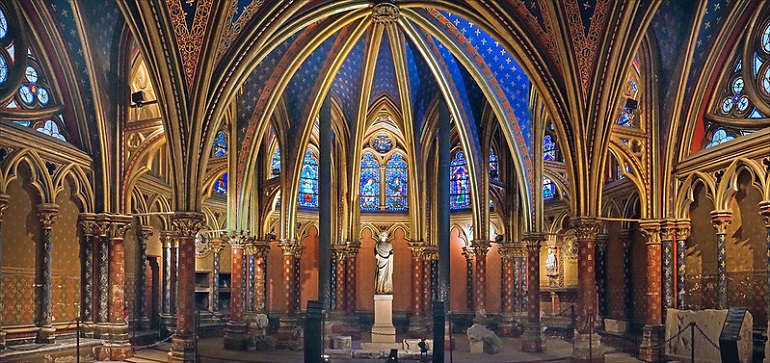
The chapelle basse serves simultaneously as structural foundation and sacred space, a dual function that demonstrates the medieval builders' sophisticated understanding of both engineering and liturgy. With a ceiling height of precisely 6.6 metres, this ground-floor sanctuary creates an atmosphere of intimate devotion that contrasts dramatically with the soaring upper chapel.
The lower chapel's structural system employs slender clustered columns that rise to support the tremendous weight of the upper chapel and its glazing. These columns, whilst appearing delicate, incorporate sophisticated load-bearing principles that distribute weight efficiently through carefully calculated stone courses. The capitals that crown each column represent individual masterpieces of Gothic sculpture, with 140 different compositions that catalogue the medieval stonecutter's botanical vocabulary.
Each capital displays unique foliate arrangements—oak leaves intertwined with ivy, thistle heads emerging from curling stems, and fantastical hybrid plants that blur the boundaries between observation and imagination. The carving achieves remarkable depth and detail, with individual leaves showing veining and surface texture that rivals the finest manuscript illumination.
The vaulted ceiling creates a celestial canopy painted in deep ultramarine blue scattered with golden stars. This decorative scheme, whilst appearing simple, employs sophisticated colour theory to create the illusion of infinite space above the worshipper. The stars follow astronomical patterns that would have been meaningful to medieval viewers, creating a microcosm of the divine order.
Small interior flying buttresses, known as étrésillons, span the nave at clerestory level, providing essential structural support whilst remaining visually unobtrusive. These miniature flying buttresses represent brilliant engineering solutions that transfer the thrust of the upper chapel's vaults down through the lower chapel's structure to the foundation walls.
The lower chapel windows, whilst smaller than their upper counterparts, display distinctive spherical triangle shapes that create unique lighting effects. These windows employ sophisticated tracery patterns that filter daylight into geometric compositions, creating ever-changing patterns of light and shadow throughout the day.
The Upper Chapel: Architectural Transcendence
Ascending the narrow spiral staircases housed within the flanking towers creates a deliberately compressed transition that heightens the drama of emergence into the upper chapel. The stairways themselves represent masterpieces of medieval stonework, with each step cut from solid limestone and supported by sophisticated cantilever principles.
The upper chapel achieves the Gothic ideal of dematerialising solid walls in favour of pure light and colour. The space measures 33 metres by 10.7 metres internally, with four traverses and a seven-sided apse that creates perfect geometric harmony. The plan's simplicity—a single vessel without transepts, side aisles, or ambulatory—focuses attention entirely on the vertical emphasis and luminous effects.
The structural innovation that makes this glazed architecture possible represents one of medieval engineering's greatest achievements. Iron chains and rods are embedded within the stonework at two levels—one at the mid-point of the window bays and another at the top of the lancets. These tensile elements, invisible to casual observation, provide the structural integrity that allows such vast expanses of glass.
Each window support appears as a single slender shaft but actually comprises seven clustered colonnettes that disguise their considerable structural mass. This optical refinement creates the illusion that threads of stone support the immense glazed walls, a visual sleight-of-hand that emphasises the architecture's ethereal quality.
The window heights vary subtly throughout the chapel—15.5 metres in the nave compared to 13.7 metres in the apse—creating a forced perspective that makes the space appear longer than its actual dimensions. This architectural refinement demonstrates the medieval builders' sophisticated understanding of visual psychology.

The Stained Glass Programme: Theology in Light
The fifteen monumental windows of Sainte-Chapelle contain the most complete iconographic programme of 13th-century glazing in existence. Covering nearly 670 square metres of wall surface, the windows transform biblical narrative into luminous spectacle through 1,113 individual scenes that unfold from Genesis through the Apocalypse.
The glazing technique employs only five colours—red, blue, yellow, purple, and green—yet achieves extraordinary chromatic sophistication through masterful manipulation of tone, saturation, and transparency. The medieval glaziers understood colour theory with scientific precision, creating harmonic relationships that remain visually satisfying across eight centuries.
Deep cobalt blues dominate the palette, creating the mysterious, otherworldly atmosphere that contemporaries described as "celestial". These blues are achieved through cobalt compounds that create remarkable clarity and depth, particularly when contrasted with the ruby reds that pulse with inner fire.
The narrative programme begins with the Genesis window on the north side of the nave, unfolding the creation story through medallions that combine theological sophistication with visual drama. Adam and Eve appear not as primitive figures but as courtly personages whose drama resonates with 13th-century viewers.
The Exodus window follows with Moses leading the Israelites from Egypt, scenes that would have carried particular significance for viewers familiar with crusading ideology. The Numbers and Deuteronomy window continues the Old Testament narrative with sophisticated compositions that demonstrate the glaziers' ability to compress complex stories into readable visual forms.
Individual scenes within each window display remarkable artistic sophistication. Figures display naturalistic drapery, architectural backgrounds show contemporary Gothic details, and landscape elements create convincing spatial depth. The glaziers' ability to create convincing narrative through the constraints of leaded glass represents one of medieval art's greatest achievements.
The Joshua window depicts the conquest of the Promised Land through military scenes that reflect contemporary crusading values. The Judges window continues with stories of divine intervention that would have resonated with medieval concepts of just rule and divine kingship.
Royal imagery appears throughout the programme, most notably in the window of the relics that depicts King Louis IX receiving the Crown of Thorns from the Byzantine Emperor. This scene transforms contemporary political events into sacred history, demonstrating the chapel's function as royal propaganda as well as religious instruction.
The Rose Window: Apocalyptic Vision
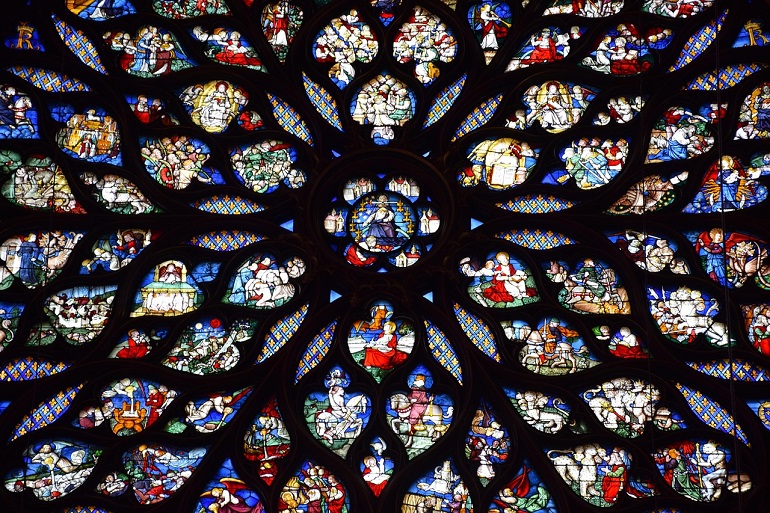
The western rose window, dating from the 15th century, represents the Flamboyant Gothic style at its most sophisticated. Containing 82 petals arranged in mathematical perfection, a href="https://www.sainte-chapelle.fr/en/discover/the-apocalypse-rose-window">the window depicts the Apocalypse of St John through imagery that ranges from the ethereal to the terrifying.
The central medallion shows Christ in Majesty surrounded by the symbols of the Evangelists, while the surrounding petals unfold the cosmic drama of the Last Judgement. Multi-headed beasts appear alongside heavenly choirs, creating a visual tension between salvation and damnation that reflects late medieval theological concerns.
The colour palette of the rose window contrasts deliberately with the 13th-century glazing. Brilliant yellows and golds dominate, creating effects of celestial radiance that seem to emanate from the window itself. These colours, achieved through silver stain techniques developed in the 14th century, create luminous effects impossible in earlier glazing.
The tracery pattern of the rose represents mathematical sophistication that approaches Gothic engineering's limits. Each stone mullion follows precise geometric curves that distribute structural loads whilst creating visual patterns of extraordinary complexity. The tracery reads simultaneously as structural framework and decorative pattern, achieving the Gothic ideal of functional beauty.
Sculptural Programme: Stone Made Flesh
Between the window bays, twelve statues of the Apostles stand beneath elaborate canopies, representing two distinct styles of 13th-century Parisian sculpture. These figures, whilst appearing uniform at first glance, reveal sophisticated individual characterisation upon closer examination.
The earlier group of apostles displays the hieratic dignity of High Gothic sculpture, with drapery that falls in geometric folds and faces that achieve spiritual transcendence through stylistic abstraction. These figures embody theological concepts rather than psychological realism, representing the apostles as eternal witnesses rather than historical personalities.
The later group shows emerging naturalistic tendencies that anticipate Renaissance developments. Drapery begins to suggest actual fabric weight and movement, while facial features display individual character. These stylistic differences reflect changing artistic sensibilities within a single generation of craftsmen.
The canopies that shelter each apostle represent miniature architectural compositions that recapitulate the chapel's larger design principles. Crocketted gables, pinnacles, and tracery patterns create Gothic micro-architecture that demonstrates the style's scalability from monumental to intimate proportions.
Angel figures populate the window archivolts, their wings and drapery carved with extraordinary delicacy. These angels serve both decorative and theological functions, representing the heavenly court that witnesses earthly worship. Their positioning creates visual bridges between the glazed walls and stone framework.
Painted Decoration: Medieval Polychromy
Beyond the stained glass, every stone surface originally received painted decoration that created total environmental richness. The current colour scheme, whilst impressive, represents 19th-century interpretation of medieval polychromy rather than original decoration.
Archaeological evidence suggests that original colours were significantly brighter and more saturated than Victorian restorers preferred. Ultramarine blues, vermillion reds, and gold leaf created chromatic intensity that rivalled the stained glass windows. These colours were applied over carefully prepared ground layers that ensured durability and brilliance.
Decorative patterns covered every available surface—ribs, bosses, capitals, and wall sections received geometric and foliate ornament that transformed architecture into jewellery scaled to monumental proportions. Fleur-de-lis and castle motifs proclaimed royal patronage whilst integrating seamlessly into the overall decorative scheme.
The dado arcade contained painted figures of saints and martyrs executed in techniques that imitated Limoges enamels. These paintings, enhanced with gilded glass inlays, created the illusion of precious metalwork whilst maintaining the cohesive colour harmony of the interior.
Textile hangings would have enhanced the interior's luxury during important ceremonies. Contemporary accounts describe silk tapestries and embroidered altar frontals that complemented the architectural polychromy whilst providing acoustic softening for choral music.
Acoustic Architecture
The upper chapel's hard stone surfaces and carefully proportioned volume create acoustic conditions specifically designed for medieval liturgy. The space amplifies Gregorian chant whilst maintaining clarity of individual voices, allowing complex polyphonic music to achieve maximum emotional effect.
Reverberation patterns vary throughout the space, with the apse providing enhanced resonance for solo voices whilst the nave maintains clarity for congregational responses. This acoustic zoning reflects sophisticated understanding of how architectural space shapes musical experience.
The ceiling height and unbroken volume allow sound to develop the ethereal quality that medieval worshippers associated with angelic choirs. Contemporary accounts describe the chapel's acoustics as creating the impression that earthly and heavenly voices joined in common worship.
Lighting and Atmosphere
The chapel's luminous effects change dramatically throughout the day and seasons, creating an ever-changing kaleidoscope of colour and atmosphere. Morning light from the eastern windows creates cool, contemplative effects that gradually warm as the sun moves westward.
Afternoon light transforms the western rose window into a cosmic explosion of colour that dominates the entire space. The interplay between direct sunlight and reflected colour creates atmospheric effects that seem to make the architecture itself luminous.
Overcast conditions reveal the windows' detailed drawing and grisaille work that remains invisible in direct sunlight. These quieter lighting conditions allow appreciation of the glaziers' linear artistry and sophisticated tonal relationships.
Artificial lighting during evening concerts or special events creates entirely different atmospheric effects, with candlelight and electric illumination revealing architectural details whilst transforming the stained glass into mysterious, jewel-like patterns.
Royal Liturgical Arrangements
The third traverse of the upper chapel contains two small royal alcoves set into the north and south walls, where King Louis IX and Queen Marguerite attended religious services. These intimate spaces, reached by private stairs from the royal apartments, allowed the monarchs to participate in liturgy whilst maintaining ceremonial separation.
The northern alcove reserved for the king displays more elaborate decoration, reflecting medieval concepts of royal dignity. Painted angels in the archivolt announce divine approval of earthly kingship, whilst foliate ornament creates paradisiacal imagery appropriate to sacred kingship.
The southern alcove for the queen achieves equal artistic sophistication whilst employing subtly different iconographic programmes. Marian imagery and female saints create appropriate religious contexts for queenly devotion whilst maintaining the overall decorative harmony.
Conservation and Restoration Legacy
Sainte-Chapelle serves as a laboratory for historical monument conservation, with restoration campaigns spanning over two centuries providing crucial insights into medieval building techniques and decorative practices.
The 19th-century restoration by Félix Duban, Jean-Baptiste Lassus, and Émile Boeswillwald established principles of archaeological accuracy that influenced conservation practice worldwide. Their meticulous documentation and respectful intervention created models for subsequent restoration projects.
Recent conservation work employs sophisticated analytical techniques to understand original materials and techniques. Laser cleaning, micro-chemical analysis, and digital mapping allow increasingly precise interventions that preserve maximum original fabric whilst ensuring structural stability.
Climate control systems protect the medieval glass from atmospheric pollution whilst maintaining the building's function as an active concert venue. This balance between preservation and use reflects contemporary museum practice that keeps historical buildings alive through appropriate contemporary functions.
Seasonal Transformations
Winter light creates particularly magical effects as low sun angles cause the stained glass to glow with interior radiance. The chapel's stone thermal mass moderates temperature variations whilst creating atmospheric conditions that enhance the contemplative experience.
Spring and summer bring longer periods of intense illumination that reveal the full chromatic richness of the medieval glazing. Seasonal liturgical celebrations would have coordinated with these natural lighting changes to create coordinated sensory experiences.
Storm light creates dramatic atmospheric effects as dark clouds alternately obscure and reveal the windows, causing the interior illumination to pulse with almost supernatural intensity. These natural lighting variations would have reinforced medieval concepts of divine presence manifested through natural phenomena.
Viewing Strategies and Hidden Details
Close examination of individual window medallions reveals extraordinary artistic sophistication that rewards careful study. Facial expressions, architectural backgrounds, and decorative details display the glaziers' ability to create convincing narrative within the constraints of leaded glass technique.
Binoculars enhance appreciation of upper window details that remain invisible to casual observation. Grisaille painting, facial modelling, and textile patterns demonstrate artistic refinement that approaches manuscript illumination quality.
Different viewing positions throughout the chapel reveal changing relationships between windows, architecture, and decorative elements. Movement through the space creates cinematic effects as compositions shift and colours blend in kaleidoscopic patterns.
Photography challenges include extreme contrast between brilliant glass and shadowed stone, requiring careful exposure management to capture both architectural and glazing details.
Contemporary Experience
Sainte-Chapelle continues to function as concert venue and tourist destination whilst maintaining its character as sacred architecture. Classical music performances particularly benefit from the space's exceptional acoustics and atmospheric lighting.
Visitor management attempts to balance public access with conservation requirements, using timed entry systems and group size limitations to prevent overcrowding whilst ensuring sustainable tourism revenue.
Educational programmes help contemporary visitors understand medieval religious and artistic concepts that informed the chapel's creation. Guided tours, audio guides, and interpretive materials provide historical context whilst encouraging personal aesthetic response.
Interfaith appreciation recognises the chapel's significance as architectural and artistic achievement that transcends particular religious boundaries whilst respecting its continuing sacred character.
Architectural Influence and Legacy
Sainte-Chapelle established design principles that influenced Gothic architecture throughout Europe. The integration of structure and glazing, sophisticated colour programmes, and unified spatial effects created templates that inspired countless subsequent buildings.
Royal chapel tradition spread throughout medieval Europe, with rulers commissioning similar structures that attempted to rival Sainte-Chapelle's splendour whilst adapting its principles to local traditions and available resources.
Modern architecture continues to grapple with the chapel's fundamental question: how to create transcendent space through manipulation of light, colour, and proportion. Contemporary glass architecture often references Sainte-Chapelle's dematerialisation of solid walls in favour of luminous transparency.
Conservation philosophy developed through work at Sainte-Chapelle influences international preservation practice, establishing principles of documentary accuracy, material authenticity, and functional continuity that guide restoration projects worldwide.
This extraordinary building remains what its medieval creators intended: a vision of the divine made manifest through human artistry and technical mastery, where heaven and earth meet in cascades of coloured light that transform stone architecture into spiritual experience.