


Introduction
The Pantheon is secular neoclassical mausoleum containing in the Latin Quarter, originally constructed between 1758 and 1790 as the Church of Sainte-Geneviève before being transformed into a secular mausoleum during the French Revolution. Located in the Latin Quarter atop the Montagne Sainte-Geneviève, this imposing domed structure serves as the final resting place for some of France's most distinguished citizens, including Voltaire, Rousseau, Marie Curie, and Victor Hugo. Designed by architect Jacques-Germain Soufflot, the building combines Greek and Roman architectural elements with a distinctive 83-metre-high dome that dominates the Left Bank skyline. The interior features notable works including Foucault's Pendulum, which demonstrated the Earth's rotation, and elaborate frescoes depicting scenes from French history, making it both a place of national remembrance and architectural achievement.
Interesting Facts about the Panthéon
- The Panthéon was originally commissioned by Louis XV as a church dedicated to Saint Genevieve, then became a secular mausoleum during the French Revolution.
- Its neoclassical design by Jacques-Germain Soufflot sought to rival St Peter’s in Rome and St Paul’s in London, crowned with a striking three-shelled stone dome.
- From 1790 until the Eiffel Tower’s completion in 1889, the Panthéon was the highest point in Paris.
- Léon Foucault famously demonstrated the Earth’s rotation here in 1851 with his pendulum suspended from the dome.
- The building oscillated between church and civic monument several times in the 19th century before being definitively designated a temple to national heroes after Victor Hugo’s funeral in 1885.
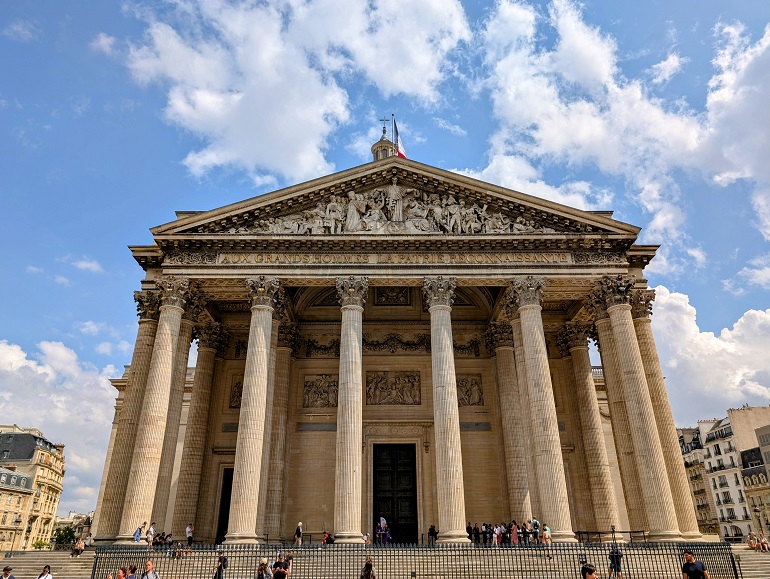
- The inscription on its façade reads “Aux grands hommes la patrie reconnaissante” — “To the great men, the grateful nation.”
- Marie Curie became the first woman interred on her own merits in 1995; today eminent figures such as Voltaire, Rousseau, Victor Hugo, Émile Zola and Jean Moulin rest in its crypt.
- The dome is entirely of stone and actually consists of three nested domes, with the painted ceiling visible on the inner shell.
- The site stands atop the Montagne Sainte-Geneviève in the Latin Quarter, offering panoramic views over the city from its colonnaded drum.
- Changes in regime saw the lantern crowned variously by a cross or flag, reflecting the monument’s shifting sacred and civic identities.
History
The Panthéon stands majestically in the Latin Quarter of Paris as one of France's most significant monuments, serving as both an architectural masterpiece and a national mausoleum. Originally commissioned by King Louis XV in 1755, the building began as a church dedicated to Saint Genevieve, Paris's patron saint, following the king's recovery from a serious illness in 1744. Designed by architect Jacques-Germain Soufflot, construction spanned from 1758 to 1790, though neither Soufflot (who died in 1780) nor Louis XV lived to see its completion. The project was notably financed through an innovative royal lottery system, as the state coffers were empty at the time. Standing at 83 metres tall and measuring 110 metres long by 85 metres wide, the Panthéon held the distinction of being Paris's tallest building from 1790 until the Eiffel Tower's construction in 1889.
The building's transformation from church to mausoleum reflects the turbulent political changes of late 18th-century France. When construction was completed in 1790, the French Revolution was already underway, and the National Constituent Assembly voted in 1791 to transform the Church of Saint Genevieve into a secular mausoleum for distinguished French citizens. This decision was inspired by the ancient Roman Pantheon, which had served a similar purpose since the 17th century. The famous inscription "Aux grands hommes, la patrie reconnaissante" ("To the great men, the grateful homeland") was created by Claude-Emmanuel de Pastoret and adorns the pediment. The first person to be interred was Honoré Gabriel Riqueti, comte de Mirabeau in 1791, though his remains were later removed. However, the building's function alternated repeatedly throughout the 19th century, serving as a church under Napoleon in 1806, reverting to a panthéon in 1830, becoming the "Temple of Humanity" in 1848, and returning to church status during the Second Empire.
The Panthéon's role as France's premier mausoleum was permanently established during the Third Republic, particularly following Victor Hugo's funeral in 1885, which marked its definitive transformation. The building exemplifies neoclassical architecture, with Soufflot's ambitious design attempting to combine the lightness of Gothic cathedrals with classical Roman principles, though his vision of complete transparency was never fully realised. The structure is constructed of stone and marble and features a magnificent dome inspired by classical architecture. Today, the Panthéon houses the remains of France's most revered figures, including Voltaire and Rousseau (interred in 1791 and 1794 respectively), Marie Curie, and Jean Moulin. The most recent addition was Missak Manouchian in February 2024. The building also played a role in scientific history when Foucault's pendulum experiment was conducted there in 1851, demonstrating the Earth's rotation.
Description
Commanding the skyline of the Latin Quarter, the Panthéon epitomises Neoclassical grandeur. Its monumental portico of sixteen fluted Corinthian columns supports a crisp triangular pediment, while a double-shelled dome rises in three graceful tiers, culminating in a stone lantern that crowns the city’s silhouette. The exterior masonry, honey-coloured by day and silvered at dusk, is articulated with pilasters and tall arched windows that hint at the immense volume within.
Architectural Grandeur
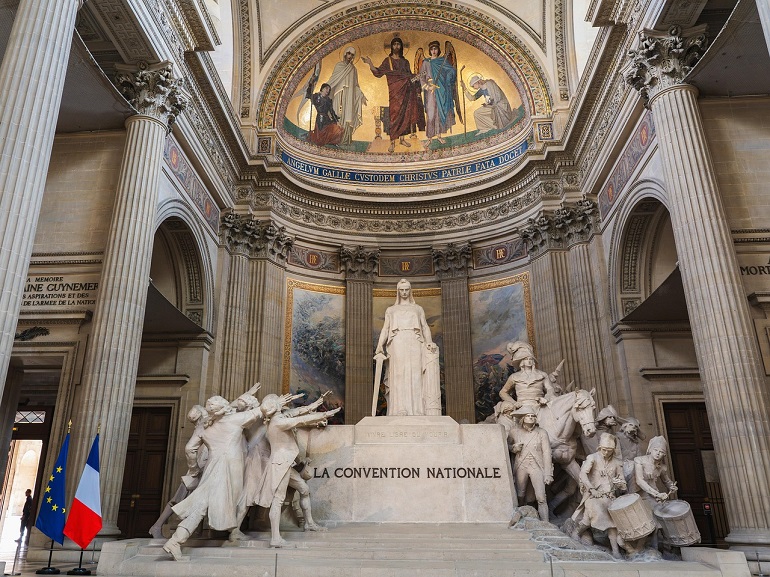
Stepping through bronze doors inlaid with high-relief allegories, visitors enter a rotunda almost cathedral-like in scale. Four colossal piers carry the weight of an 83-metre dome, whose coffered interior is painted in soft creams and pale blues so that daylight seems to dissolve the masonry. A continuous entablature encircles the space, gathering the diagonal thrust of the arches into a single ordered line and reinforcing the building’s harmonious geometry.
The nave and transepts extend from the rotunda in a simple Greek-cross plan. Their barrel vaults are decorated with restrained stucco mouldings that echo the rhythm of the coffers overhead, while polished Bourgogne stone beneath your feet forms a floor-wide marquetry of ochre, grey and black geometric patterns.

Interior Decoration
From the cornice down to the floor, an unfolding narrative of French ideals is expressed in paint, mosaic and sculpture.
- Pendentives: Brooding frescoes depict abstract virtues—Truth, Liberty, Equality and Fraternity—each figure rendered in lapis, terracotta and burnished gold leaf.
- Chapels: In the south-east corner, Puvis de Chavannes’s luminescent murals portray Philosophy and Science conversing amid olive groves, their pastel palette glowing softly in the filtered light. Opposite, a vast mosaic honours Sainte Geneviève in shimmering tesserae of malachite green and sapphire blue.
- Sculpture: Heroic marble friezes flank the nave, their figures carved in low relief yet charged with energy: one sequence shows scholars disputing around a lectern; another captures workers raising the foundations of an idealised city.
- Lighting: Large alabaster globes suspended on wrought-iron chains provide a warm, even glow at dusk, while concealed oculi in the dome admit shafts of daylight that drift slowly across the nave like a celestial sundial.

The Pendulum
Beneath the oculus hangs a slender metal rod supporting a polished brass bob—Foucault’s pendulum—whose silent swing marks the planet’s rotation. A circular rail on the mosaic floor charts the pendulum’s slow procession; every few minutes its polished tip nudges a brass peg, offering a hypnotic illustration of cosmic mechanics played out in real time.
The Crypt
A broad, gently sloping staircase leads to a series of vaulted galleries cut directly into the foundation stone. The air is noticeably cooler and faintly scented with limestone dust.
- Spatial order: Each vault mirrors the cruciform plan above, creating a labyrinthine symmetry that invites silent exploration.
- Atmosphere: Ambient spotlights highlight discreet name-plates in bronze or marble; otherwise, the crypt is lit only by small street-level windows, their shafts of light piercing the gloom like stage spots.
- Notable tombs: Voltaire lies opposite Rousseau in a symbolic dialogue; nearby rest Marie and Pierre Curie in simple polished stone sarcophagi. Further on, you encounter sleek black granite monuments to literary giants such as Victor Hugo and Émile Zola. Despite the illustrious company, the design remains notably austere—no ostentatious sculptures, only the echo of footsteps on stone.
Panoramic Terrace
For those who ascend the internal spiral stair, a narrow balcony rings the drum of the dome before emerging onto an open terrace. The reward is a 360-degree panorama: the Seine’s serpentine course, the serried rooftops of the Marais, the dark green canopy of the Luxembourg Garden, and—far across the river—the delicate lattice of the Eiffel Tower. Weather permitting, light zephyrs move restlessly across the viewpoint, underscoring the building’s elevated perch on the Montagne Sainte-Geneviève.
Acoustics and Ambience
A soft hum envelops the main floor: whispered conversations ricochet across stone surfaces, mingling with the periodic click of the pendulum and the distant rumble of Parisian traffic seeping through half-open doors. The slightest cough seems amplified beneath the dome’s perfect hemisphere, yet the enormous volume swallows noise just as swiftly, returning the space to hushed equilibrium.
Practical Notes for Visitors
- Accessibility: Wide, shallow steps and a lift provide access to the main rotunda; the crypt and rooftop require staircases.
- Photography: Tripods are discouraged inside, but hand-held photography is generally permitted without flash.
- Amenities: A small bookshop clustered beneath the west gallery offers architectural guides, postcards and reproductions of the dome frescoes; restrooms are tucked discreetly beside the north transept.
Overall Impression
The Panthéon is less a museum and more a dialogue between architecture, science and civic pride. Its severe Classical lines, softened by luminous artwork and a constantly changing play of light, cultivate a tranquil, contemplative mood. One leaves with the impression of having stood simultaneously inside a scientific instrument, an art gallery and a vast stone poem inscribed with the ideals of a nation.