


Introduction
Founded in 1669 by Louis XIV, The Opéra Garnier is one of the most famous opera house in the world. It is housed in the Palais Garnier, one of Paris' most sumptuous edifices, built by Napoleon III between 1861 and 1875. Designed by architect Charles Garnier in what became known as the Napoleon III style, the building represents an eclectic blend of Baroque, Renaissance, and classical architectural elements, featuring seventeen different types of materials including multicoloured marble friezes, gilded bronze, and elaborate statuary depicting Greek mythological deities. Originally serving as the primary venue for the Paris Opera and Paris Opera Ballet until 1989, the Palais Garnier now mainly hosts ballet performances whilst also functioning as a museum and tourist attraction. The building gained additional international recognition as the setting for Gaston Leroux's 1910 novel "The Phantom of the Opera" and its subsequent adaptations, and has been classified as a monument historique since 1923.
Interesting Facts about the Opéra Garnier
- The Opéra Garnier, inaugurated on 5 January 1875, was built for the Paris Opera under Napoleon III and is now used mainly for ballet, with 1,979 seats in its sumptuous auditorium.
- Architect Charles Garnier blended Baroque, Renaissance and classical elements into an eclectic “Napoleon III style,” leaving virtually no surface undecorated.
- The Grand Staircase of white, red and green marble divides into two sweeping flights and was designed as a grand social stage for being seen between acts.
- Marc Chagall’s vibrant ceiling paintings encircle the great chandelier in the auditorium, a modern overlay to the 19th‑century décor.
- A real accident in 1896 saw a counterweight from the 7‑tonne chandelier fall into the audience, inspiring a famous moment in The Phantom of the Opera.
- The stage is among the largest in Europe and was built with a slight rake, a 5% incline to improve sightlines for the audience.
- The building’s labyrinth of corridors and foyers was intentionally designed to promote promenading and people‑watching during intermissions.
- Garnier’s name appears on the Rotonde des Abonnés ceiling, often cited as the first time an architect “signed” a building.
- The opulent Grand Foyer, inspired by Versailles’ Hall of Mirrors, was a prime meeting place to sip champagne and socialise between acts.
- The opera’s fame is amplified by Gaston Leroux’s 1910 novel The Phantom of the Opera and its many adaptations, cementing the house as a Paris icon.
- Constructed from 1861 to 1875, work was slowed by budget issues and war, producing a monument that has been a protected historic site since 1923.
- The Palais Garnier houses the Paris Opera’s Library‑Museum, managed by the Bibliothèque nationale de France, and included on self‑guided visits.
- The auditorium’s horseshoe shape emphasises both performance visibility and the social ritual of seeing and being seen.
- Garnier famously quipped his design was “Napoleon III style” after criticism that it was neither Louis XIV, XV nor XVI, embracing eclecticism.
- Today, the Opéra Garnier stands as “probably the most famous opera house in the world,” a symbol of Paris alongside Notre‑Dame and the Louvre.
History
The Opéra Garnier, also known as the Palais Garnier, stands as one of Paris's most magnificent architectural achievements and a symbol of the city's cultural grandeur. Commissioned by Emperor Napoleon III in 1861 following a failed assassination attempt at the previous opera house on Rue Le Peletier, this extraordinary building was designed by the then-unknown 35-year-old architect Charles Garnier. Construction lasted an ambitious 14 years from 1861 to 1875, interrupted by the Franco-Prussian War of 1870 and the fall of the Second Empire. The building project was so significant that it prompted the creation of the Avenue de l'Opéra, a special request from Napoleon III who wanted a direct route from his residence at the Tuileries Palace to the opera house—remarkably, no trees were planted along this avenue to ensure an unobstructed view of Garnier's masterpiece. The opera house was officially inaugurated on 5 January 1875 under the presidency of Marshal MacMahon, with a lavish performance attended by dignitaries including the Lord Mayor of London and King Alfonso XII of Spain.
The architectural splendour of the Palais Garnier represents the Napoleon III style at its most opulent, combining elements from Baroque, Renaissance, and classical Palladian architecture with modern iron framework construction techniques. Garnier employed polychromy and an extraordinary variety of materials, including seventeen different types of stone and marble, porphyry, and gilded bronze to create the elaborate façade. The building follows the Napoleon III principle of leaving no space undecorated, with the exterior featuring elaborate multicoloured marble friezes, columns, and lavish statuary depicting Greek mythological deities. Inside, the opera house boasts a magnificent grand staircase and an auditorium that seats 1,979 people, crowned by a stunning ceiling painted by Marc Chagall. The building required innovative engineering solutions, including a double foundation system with an enormous concrete cistern to deal with unexpectedly high groundwater levels—this underground reservoir later inspired the legendary lake beneath the opera house in Gaston Leroux's novel. Notably, the Palais Garnier was the first building in history to bear its architect's signature, which can still be seen on the ceiling of the Rotonde des Abonnées.
The cultural legacy of the Opéra Garnier extends far beyond its architectural magnificence, having served as the primary theatre of the Paris Opera and Paris Opera Ballet until 1989, when performances moved primarily to the new Opéra Bastille. The building has been designated a monument historique since 1923 and houses the Bibliothèque-Musée de l'Opéra de Paris, managed by the Bibliothèque Nationale de France. Throughout its history, the venue has welcomed legendary artists including Maria Callas, Rudolf Nureyev, and Luciano Pavarotti. The opera house gained additional worldwide fame as the setting for Gaston Leroux's 1910 novel "The Phantom of the Opera" and its subsequent adaptations, particularly the popular 1986 musical. Today, whilst the company uses the Palais Garnier mainly for ballet performances, the building continues to enchant visitors and has been described as "probably the most famous opera house in the world, a symbol of Paris like Notre Dame Cathedral, the Louvre, or the Sacré Cœur Basilica". Among all the buildings constructed in Paris during the Second Empire, it remains "the most expensive" and "unquestionably a masterpiece of the first rank".
Description
Exterior Architecture
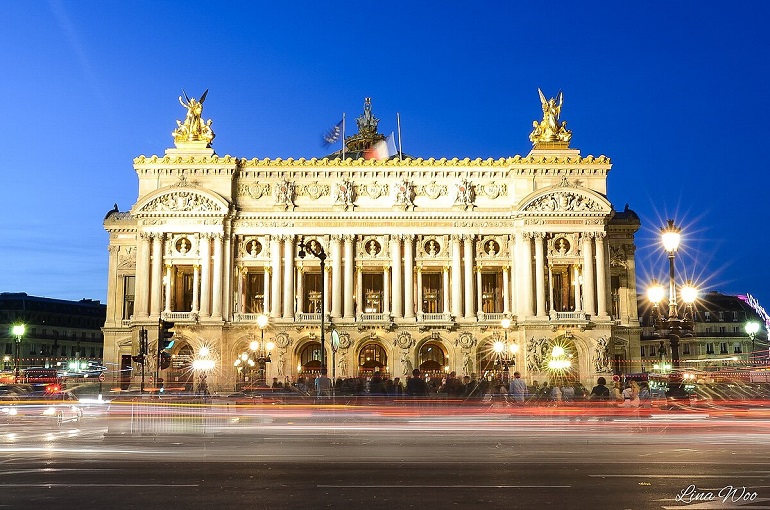
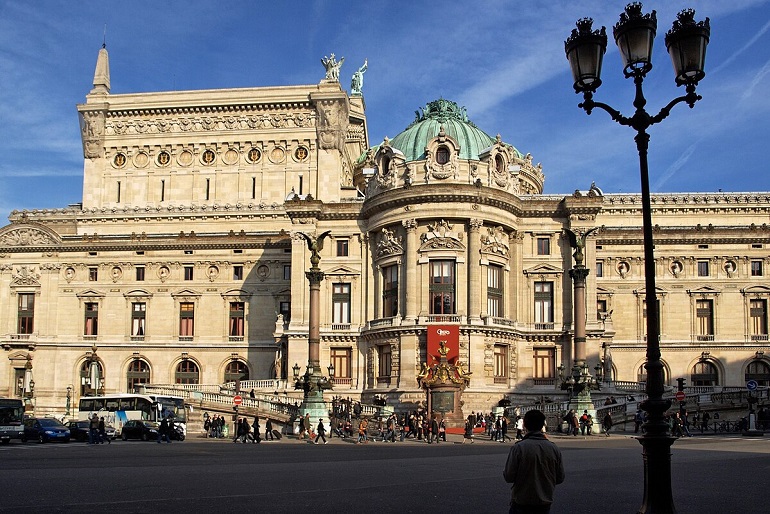
The façade of the Opéra Garnier presents a breathtaking synthesis of architectural styles that Charles Garnier described as "Napoleon III style" – an eclectic blend of Baroque, Renaissance, and Classical elements. The building's exterior showcases seventeen different types of materials, creating a polychromatic masterpiece that catches the light in ever-changing patterns throughout the day.
The elaborate façade features Corinthian columns crafted from stone quarried in Ravières, supporting an ornate structure adorned with an impressive collection of sculptural works. Between the columns, bronze busts of great composers including Mozart, Rossini, Beethoven, and Meyerbeer create a gallery of musical genius. The central roof group, "Apollo, Poetry, and Music", was sculpted by Aimé Millet, whilst the two gilded figural groups representing Harmony and Poetry were designed by Charles Gumery. At either end of the gable, bronze Pegasus figures by Eugène-Louis Lequesne add mythological grandeur to the composition.
The façade incorporates major multifigure sculptural groups that represent various artistic disciplines. François Jouffroy's "Harmony", Jean-Baptiste Claude Eugène Guillaume's "Instrumental Music", and Jean-Joseph Perraud's "Lyrical Drama" demonstrate the building's dedication to the arts, whilst Jean-Baptiste Carpeaux's controversial "The Dance" brings dynamic movement to the stone façade.
The Grand Staircase
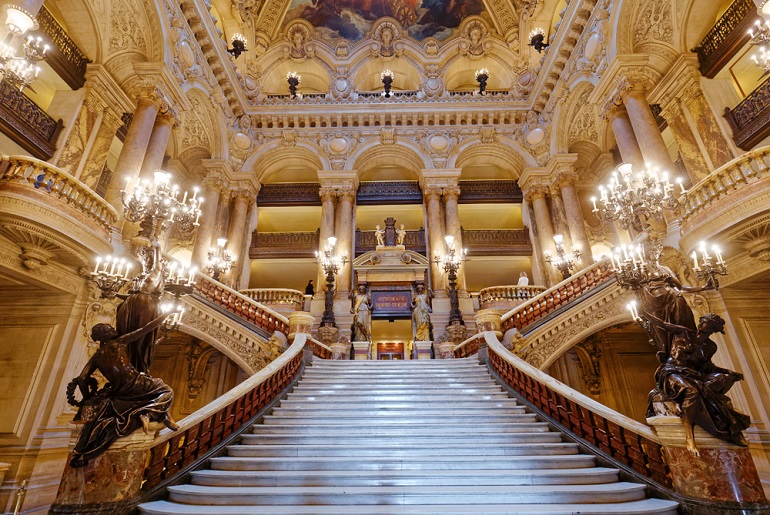
Upon entering the opera house, visitors encounter the Grand Staircase – arguably the most spectacular interior feature of the entire building. This ceremonial staircase, constructed from white marble with balustrades of red and green marble, creates a dramatic ascent that was inspired by Victor Louis's grand staircase at the Théâtre de Bordeaux.
The staircase divides into two divergent flights that sweep upward with theatrical grandeur, flanked by female torchères created by Albert-Ernest Carrier-Belleuse. These sculptural figures, positioned at the pedestals of the staircase, hold bouquets of light that illuminate the space with warm, golden radiance. The structure rises within a massive nave that could easily accommodate a 2,000-seat auditorium, demonstrating Garnier's understanding that "the opera is the staircase."
Above this architectural marvel, the ceiling painted by Isidore Pils depicts allegorical scenes including The Triumph of Apollo, The Enchantment of Music Deploying its Charms, Minerva Fighting Brutality Watched by the Gods of Olympus, and The City of Paris Receiving the Plan of the New Opéra. The ceiling required extensive reworking when Pils, at age 61, had to adjust the paintings in situ to achieve the proper luminosity for the space.
The Grand Foyer
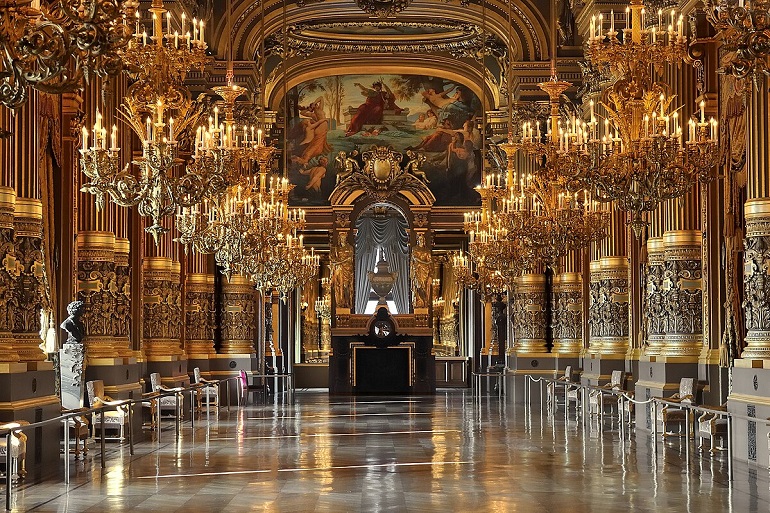
The Grand Foyer extends along the length of the building's façade, measuring an impressive 154 metres in length, 13 metres in width, and 18 metres in height. This palatial space, often compared to the Hall of Mirrors at Versailles, was conceived as a promenade area where opera-goers could socialise during intermissions whilst seeing and being seen.
The foyer's walls and ceiling showcase an extraordinary array of frescoes by Paul-Jacques-Aimé Baudry, created between 1866 and 1874. These paintings celebrate themes of music and dance, with the central ceiling fresco depicting The Triumph of Apollo, reinforcing the cultural significance of the space. The hall gleams with mirrors, marbles, chandeliers, gilt, and statuary, creating an atmosphere of unparalleled luxury.
Ten magnificent chandeliers illuminate the Grand Foyer, visible from the Avenue de l'Opéra through the grand windows. The lyre motif appears throughout the decorative scheme – in capitals, heating grates, and door handles – creating a cohesive musical theme. A bust of Charles Garnier presides over the centre of the foyer, overlooking the avenue that bears the opera house's name.
The Auditorium
The auditorium represents the heart of the Palais Garnier, designed in the classic Italian horseshoe configuration that Garnier determined to be the optimal balance between acoustics and sightlines. With seating for 2,101 spectators arranged across multiple tiers of boxes, the hall creates an intimate yet grand atmosphere enhanced by its red velvet upholstery.
Garnier deliberately chose red velvet for the seating and box decorations, believing that this colour would create the most flattering reflection on women's complexions. The material was carefully selected to produce "an effect of coolness and health" through its pink reflections on faces and shoulders.
The auditorium's most striking feature is the ceiling painted by Marc Chagall in 1964, which covers the original 19th-century ceiling by Eugène Lenepveu. Spanning 240 square metres across twelve panels, Chagall's vibrant, dreamlike composition pays homage to fourteen major composers including Mozart, Wagner, Verdi, Bizet, and Debussy. The ceiling's whimsical figures and brilliant colours – featuring winged characters, Parisian monuments, and musical instruments – create a magical canopy above the performers and audience.
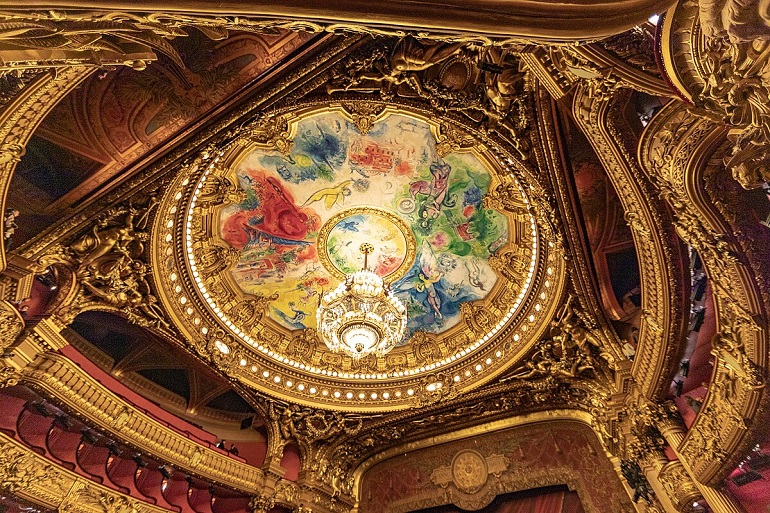
At the centre of the auditorium hangs the famous chandelier, a seven-ton creation of bronze and crystal designed by Garnier himself. Crafted by Lacarière, Delatour & Cie at a cost of 30,000 gold francs, this magnificent fixture serves as both illumination and artistic centrepiece, perfectly complementing Chagall's celestial ceiling above.
Additional Architectural Spaces
The Rotonde des Abonnés (Subscribers' Rotunda) serves as a circular vestibule beneath the auditorium, originally designed to welcome spectators arriving by carriage. This space features magnificent marble mosaics on the floor and houses La Pythonisse – a sculpture representing the Pythia, priestess of Apollo, underlining the mythological themes that permeate the building.
The rotunda's deliberately subdued lighting creates a dramatic contrast with the brilliance of the Grand Staircase above, allowing visitors to experience the full impact of the architectural progression from darkness to light. The ceiling bears Charles Garnier's signature, making the Opéra Garnier the world's first signed building.
The Avant-Foyer connects various spaces within the opera house, its ceiling decorated with shimmering mosaics on a gold background. The Loggia provides views over the Avenue de l'Opéra, whilst smaller salons such as the Salon de la Lune and Salon du Soleil offer poetic transitions between the building's different areas.
Architectural Scale and Proportions
The Palais Garnier commands impressive dimensions that reflect its monumental ambitions. The building measures 173 metres in length and 125 metres in width, covering a total area of 11,237 square metres. The statue of Apollo crowns the building at a height of 73.60 metres above ground level.
The stage represents one of the largest in Europe, measuring 49 metres in width by 27 metres in depth, with a total height of 60 metres from floor to ceiling. This vast performance space can accommodate up to 450 artists simultaneously, reflecting the grand scale of 19th-century opera productions.
The Opéra Garnier stands as an unparalleled synthesis of architecture, sculpture, painting, and decorative arts, where every surface tells a story and every detail contributes to an overwhelming sense of theatrical magnificence. Its opulent interiors, from the marble grandeur of the Grand Staircase to the celestial beauty of Chagall's ceiling, create an experience that begins the moment visitors enter and continues to inspire long after they depart.