


Introduction
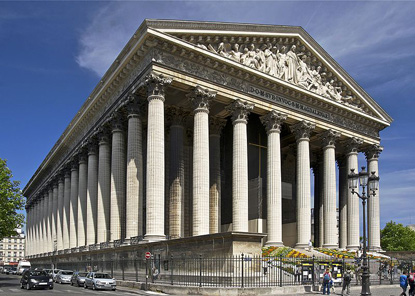
La Madeleine, officially the Église Sainte-Marie-Madeleine, is a Roman Catholic church that resembles a Greco-Roman temple more than a traditional church due to its neoclassical design featuring 52 towering Corinthian columns and no visible crosses or bell towers. The current structure represents the culmination of a complex 78-year construction process that began in 1764 under Louis XV, was interrupted by the French Revolution, and was dramatically redesigned by Napoleon in 1806 as a temple to honour his Grande Armée before being completed as a church dedicated to Saint Mary Magdalene in 1842. The building's striking exterior, modelled after the ancient Roman Maison Carrée in Nîmes, houses a dimly lit interior with a single nave, three hidden domes, and notable features including Jules Ziegler's fresco "History of Christianity" above the altar and one of Paris's finest organs, whilst its prestigious history includes hosting the funerals of notable figures such as Frédéric Chopin and more recently Johnny Hallyday.
Interesting Facts about Sigmaringen Castle
- The building is 108m long, 43m wide and is lined with 52 Corinthian columns, each 20m high.
- Napoleon initially intended the building to be a “Temple of Glory” celebrating the Grande Armée rather than a church.
- Work on the site began in the 1760s, stalled during the French Revolution, and the edifice was finally consecrated as a church in 1842.
- The church famously hosted Frédéric Chopin’s funeral in 1849, with Mozart’s Requiem performed for the ceremony.
- Unlike most churches, La Madeleine’s main entrance faces south, emphasising its temple-like civic grandeur over traditional ecclesiastical orientation.
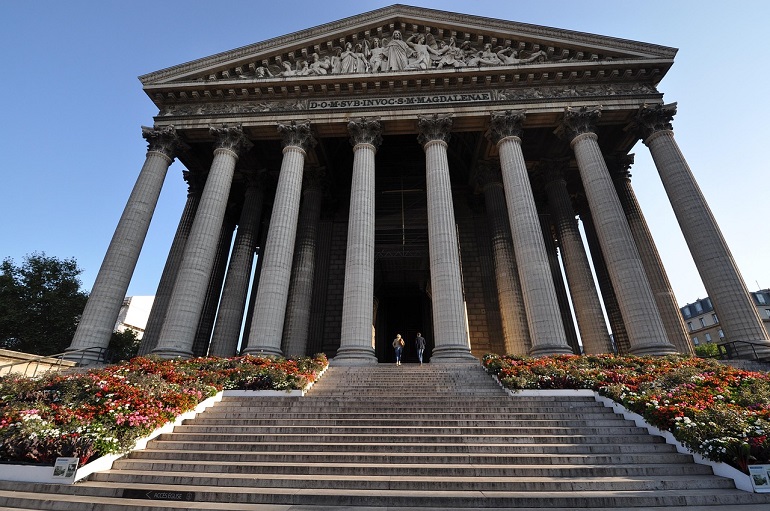
- The monumental pediment depicts the Last Judgement, with Mary Magdalene pleading for mercy for sinners.
- Inside, three coffered domes span a single vast nave, an arrangement not visible from the exterior.
- A celebrated Cavaillé-Coll organ resides in La Madeleine and remains one of Paris’s finest historic instruments.
- A rare fresco inside includes the figure of Napoleon, an unusual subject in a Parisian church.
- The high altar features Charles Marochetti’s dramatic sculpture of Mary Magdalene being borne heavenward by angels.
History
Origins and Early Construction
La Madeleine's site has been consecrated to Mary Magdalene since 1182, with an original 13th-century church located on Avenue Malesherbes. By the 1760s, this modest church could no longer accommodate the growing population of the neighbourhood, which had been annexed to Paris in 1722. King Louis XV authorised the construction of a grand new church in 1763, laying the first stone for what would become one of Paris's most distinctive religious monuments. The original design by Pierre Contant d'Ivry proposed a large dome atop a Latin cross structure, similar to Les Invalides. However, when d'Ivry died in 1777, his pupil Guillaume Martin Couture abandoned the initial plans, demolished much of the early work, and began designing a simpler, more classical structure modelled after ancient Greek or Roman temples.
Napoleon's Vision and Transformation
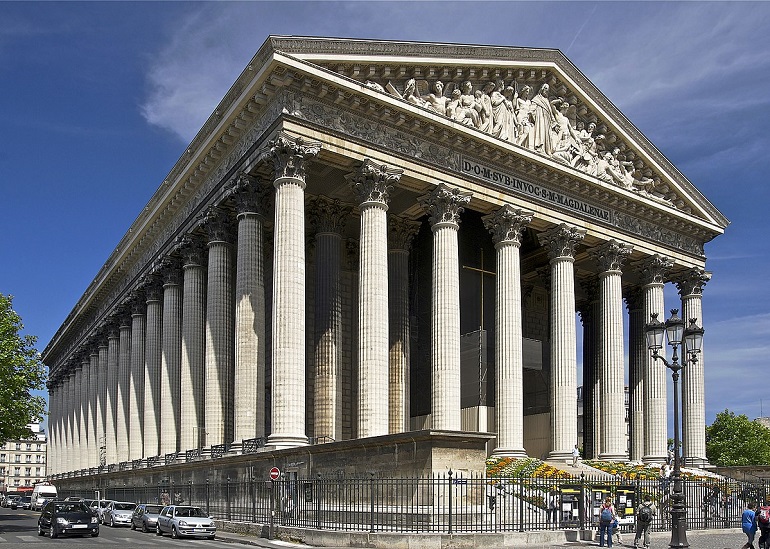
The French Revolution halted construction entirely, leaving the project in limbo until Napoleon Bonaparte dramatically transformed its purpose. In 1806, the Emperor ordered a competition to design not a church, but a "Temple to the Glory of the Army" - specifically his Grande Armée following their victory at the Battle of Austerlitz in 1805. Napoleon selected architect Pierre-Alexandre Vignon, who had trained under the great Neoclassical architect Claude Ledoux, to create what he demanded should be "as severe as possible". Vignon's design was essentially a scaled-up version of the ancient Roman Maison Carrée in Nîmes, featuring a peripteral temple surrounded by 52 towering Corinthian columns, each standing 20 metres high. The building's distinctive neoclassical façade resembles an ancient Greek temple more than a traditional church, deliberately lacking crosses, bell towers, transepts, or side aisles.
Completion as a Church and Modern Legacy
After Napoleon's fall in 1814, the building's destiny changed once again when King Louis XVIII resumed construction, initially intending it as an expiatory chapel for the sins of the Revolution and the execution of Louis XVI. However, this concept was eventually abandoned in favour of dedicating the structure to Saint Mary Magdalene. The architect Vignon died in 1828 before completion, and Jacques-Marie Huvé took over the project. Despite a bizarre 1837 proposal to convert the unfinished building into Paris's first railway station - which was deemed expensive and impractical - the church was finally consecrated on 24 July 1842, Saint Mary Magdalene's feast day, after an extraordinary 78-year construction period. The interior, completed between 1828-42, was modelled on Roman baths and features three domes invisible from the outside, plus the famous fresco "History of Christianity" by Jules Ziegler, which uniquely depicts Napoleon receiving the Concordat - making La Madeleine the only Parisian church to feature the Emperor in its religious artwork. The church has since hosted prestigious ceremonies, including the funerals of Frédéric Chopin in 1849 and more recently Johnny Hallyday, cementing its status as both an architectural marvel and cultural landmark.
Description
Architectural Vision in Detail
- Dimensions and Plan – The building measures roughly 108 metres from north to south and 43 metres across, resting on a podium that raises it nearly ten metres above street level. Its plan is that of a single-cell Roman temple elongated into basilican proportions, yet without transepts or ambulatory, reinforcing the perception of an indivisible, processional space.
- Peripteral Colonnade – Fifty-two fluted Corinthian columns, each twenty metres tall, encircle the structure in an unbroken rhythm. Deep entasis in the shafts counters optical distortion, while finely carved acanthus leaves crown the capitals. Walking the perimeter feels akin to circling an ancient forum, the columns framing shifting vistas of Haussmann boulevards and Parisian rooftops.
- Entablature and Pediment – The entablature comprises a dual architrave, a continuous frieze of laurel garlands and cherubic putti, and a bold cornice punctuated by dentils. Above, the tympanum hosts a dramatic high-relief Last Judgement: Christ enthroned at the centre, the Archangel Michael weighing souls to one side, the repentant Magdalene kneeling on the other. The sculptural masses project strongly, their shadows sharpening under the Parisian sun.
- Bronze Portals – The great doors, cast in solid bronze, display tablets of the Ten Commandments amid lush foliate scrolls. At close range one notices the warm patina, testament to decades of polishing hands.
Interior Spatial Drama
Nave and Triple Domes
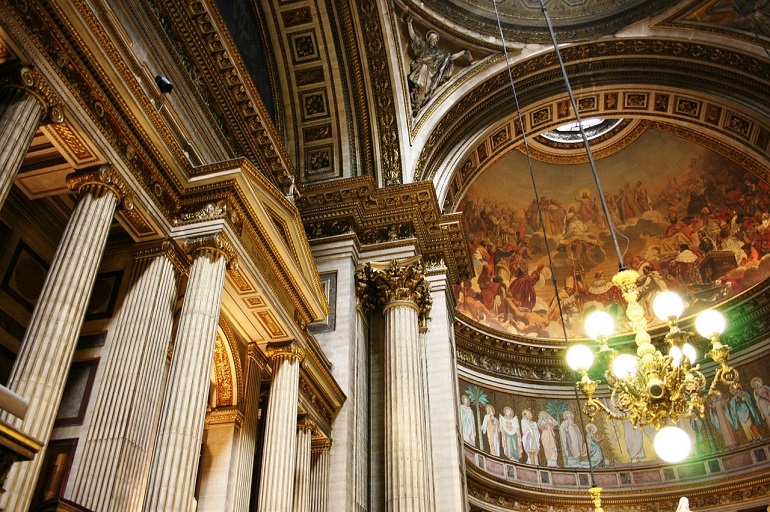
Inside, the surprise is immediate: a vast, opulent hall gilded from narthex to apse. Three coffered domes succeed one another down the axis, each pierced by an oculus that funnels daylight like spotlights onto stage sets. Pendentives carry colossal stucco figures – prophets, saints and virtues – their white surfaces glowing against the darker coffers. The domes recall the Baths of Caracalla while the barrel-vaulted aisles of classical basilicas echo in the background, creating an architectural hybrid both ancient and Romantic.
Light, Colour and Materials
The palette moves from cool greys of veined marble at ground level to the burnished gold of cornices and friezes aloft. Candles and electric chandeliers mingle warm amber with cooler shafting daylight, shifting the perceived colour of the marbles throughout the day. Ornate mosaics glint in side chapels; mother-of-pearl tesserae pick up the slightest glimmer, lending a jewelled nuance to otherwise massive stone surfaces.
Main Altar Ensemble
At the far end stands Carlo Marochetti’s marble group of the Ascension of Mary Magdalene, raised heavenwards by sweeping angels. The sculpture rests on a podium flanked by monumental candlesticks and a gilded crucifix, drawing every visitor’s gaze toward the sanctuary. Above, Jules-Claude Ziegler’s half-dome fresco The History of Christianity unfurls a kaleidoscope of biblical and historical figures, Napoleon included, beneath a molten sky of ochre and ultramarine.
Chapels and Side Altars
Six richly appointed chapels punctuate the nave walls. Highlights include:
- Baptism of Christ by François Rude, where chisel marks still reveal the sculptor’s vigorous hand.
- Martyrdom of Saint Catherine in mosaic, its tesserae catching candlelight like gemstones.
- The Chapel of the Sacred Heart, edged in rose-coloured Algerian marble and crowned by a stained-glass oculus that bathes the altar in soft crimson at sunset.
Acoustic and Musical Life
Suspended above the entrance is the celebrated Cavaillé-Coll organ, 4,500 pipes arranged in a mahogany case garlanded with gilded statuary. Its tonal spectrum—silvery flutes, thunderous reeds, velvety strings—was tailored to exploit the twelve-second reverberation of the nave. Regular recitals range from Bach to contemporary compositions, and the annual Dimanches Musicaux draw Parisians who appreciate the church as both spiritual haven and concert hall.
Sensory Impressions
Step inside on a rainy afternoon and the aromatic blend of beeswax, frankincense and wet stone envelops you. Footfalls echo lightly across the marble floor; hushed voices dissolve into the vaults. During mass, Gregorian chant floats beneath the domes; at a lunchtime recital, the organ thunder vibrates in your ribcage. Even in silence, the soft hissing of votive candles adds a subtle auditory texture.
Practical Notes for Visitors
- Access and Flow – An ample flight of 28 steps leads to the main portal; a discreet side entrance equipped with a lift provides step-free access. Once inside, the wide central aisle accommodates wheelchairs easily.
- Dress and Decorum – Modest attire is expected. Photography without flash is generally permitted except during liturgical services.
- Concert Etiquette – Performances are usually free; arrive early for unreserved seating in the forward pews. Programmes are often available for a small donation.
Surroundings and Vantage Points
Pause atop the front steps: Rue Royale drops away towards the obelisk of Place de la Concorde, beyond which the gold dome of Les Invalides gleams. Turn north and the Opéra Garnier crowns the vista. Encircling pavements host renowned chocolatiers, florists and épiceries fines—ideal for a post-visit indulgence that mirrors the church’s own synthesis of art and appetite.
Concluding Perspective
Viewed close-up, La Madeleine’s austere classical lines dissolve into a tapestry of sculptural and decorative detail; experienced from within, its cavernous interior transforms into a living theatre of light and sound. The building thus rewards both the casual passer-by seeking a striking photograph and the contemplative traveller ready to linger, listen and look upward.