


Introduction
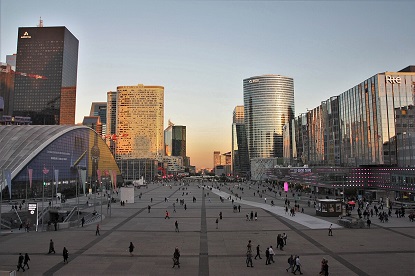
La Défense is is Europe's largest purpose-built business district. Covering 560 hectares, the district accommodates 180,000 daily workers across 72 glass and steel buildings, including 20 completed skyscrapers, alongside 3.5 million square metres of office space. The area serves as the westernmost point of Paris's Axe historique, a monumental axis that extends from the Louvre through the Champs-Élysées and Arc de Triomphe, culminating at La Défense's iconic Grande Arche. Beyond its primary business function, La Défense houses approximately 50,000 permanent residents, 75,000 students, and attracts eight million tourists annually, featuring significant amenities including Westfield Les Quatre Temps shopping centre and the Paris La Défense Arena, Europe's largest indoor arena. Named after Louis-Ernest Barrias's 1883 statue commemorating the defence of Paris during the Franco-Prussian War, the district developed from the late 1950s onwards as part of France's modernisation efforts, transforming former industrial land into a concentrated business hub designed to preserve central Paris's historic character.
Interesting Facts about La Défense
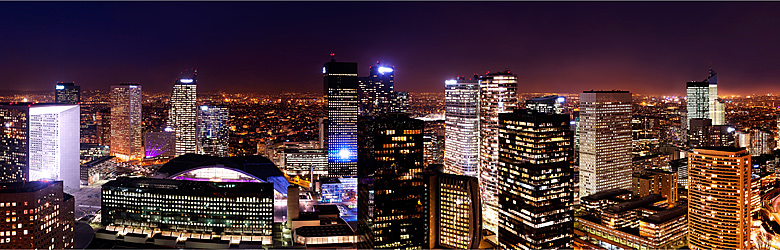
- La Défense is Europe’s largest purpose-built business district, spanning roughly 560 hectares with a skyline of glass-and-steel towers.
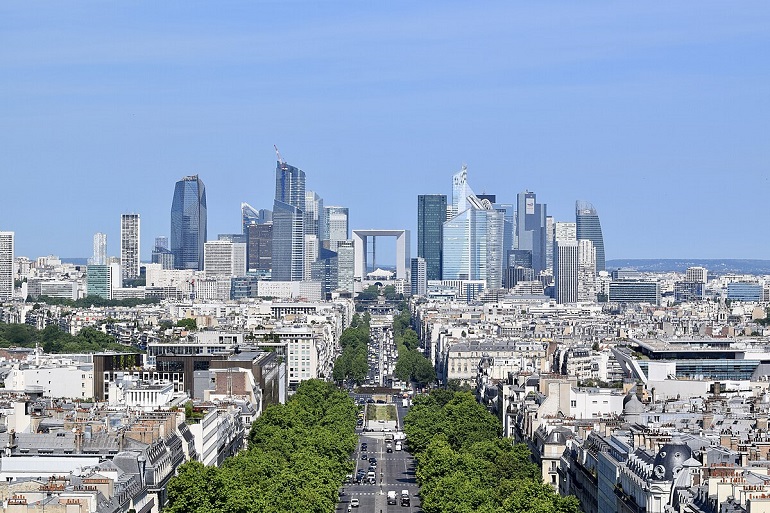
- The district crowns Paris’s 10 km Axe historique, aligning with the Louvre, the Champs-Élysées and the Arc de Triomphe.
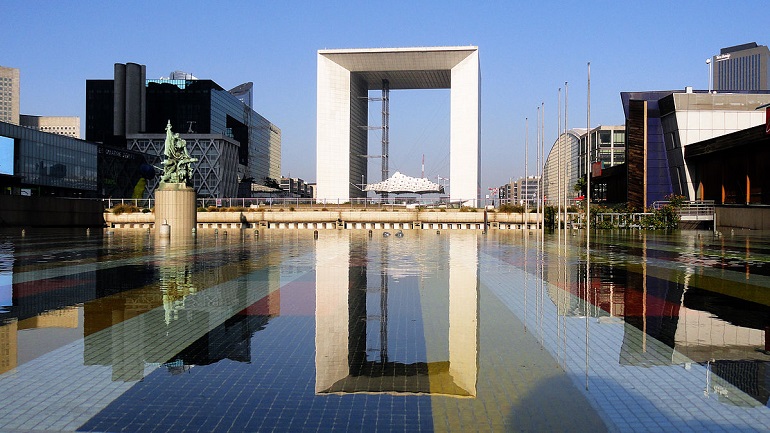
- The vast Grande Arche, a modern counterpart to the Arc de Triomphe, anchors the esplanade and frames views back to central Paris.
- The name “La Défense” comes from the 1883 statue La Défense de Paris, commemorating the city’s defenders in the Franco-Prussian War.
- The CNIT (Centre of New Industries and Technologies), opened in 1958, is a pioneering vaulted structure that kick-started the area’s modern development.
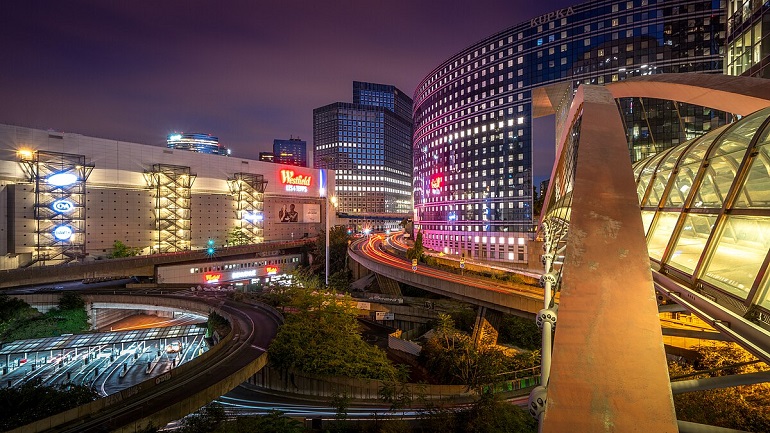
- Westfield Les Quatre Temps, one of Europe’s busiest shopping centres, sits at the heart of the district with hundreds of shops and restaurants.
- Paris La Défense Arena, inaugurated in 2017, is among Europe’s largest indoor arenas and hosts major concerts and sporting events.
- A vast raised pedestrian “dalle” hides roads and rail lines beneath, creating an almost car-free open-air urban plateau.
- The area is an open-air museum featuring dozens of public artworks and monumental sculptures scattered among the towers.
- Public transport links are excellent, with Metro Line 1, RER A, Transilien trains and the T2 tram converging at La Défense.
- Height limits that protect historic Paris don’t apply here, allowing some of the region’s tallest skyscrapers to cluster together.
- Beyond business, La Défense is a lived-in neighbourhood with residents, students, parks and seasonal events enlivening its plazas.
History
Early Origins and Naming
La Défense, now Europe's largest purpose-built business district, takes its name from a historical statue that commemorates one of France's most significant military endeavours. The area was originally situated along the ancient path leading to the château of Saint-Germain-en-Laye, the countryside residence of French monarchs who used the surrounding vast forests for hunting. During the 15th century, the idea emerged to create a direct road linking the Louvre to Saint-Germain-en-Laye over the small hill of Chantecoq, with the crossing of the River Seine at Neuilly facilitated first by a ferry and later by a stone bridge after King Henri IV's coach dramatically fell into the water in 1605. Under Louis XIV's reign, this axis became the obligatory route to reach the Saint-Germain forest and was carefully aligned with the Historical Axis that architect Le Nôtre had developed from the Tuileries. Urban architect Perronet later formalised this vision in 1766 by laying out the road in a direct line from the Champs-Élysées to the summit of Chantecoq hill, creating a round intersection similar to Place de l'Étoile called "Étoile de Chantecoq" or "Place de la Demi-Lune".
The Statue and Its Legacy
The district's definitive name derives from the Franco-Prussian War of 1870-1871, when Paris endured a brutal siege lasting over six months. Following the failed Battle of Buzenval on 19th January 1871, where French troops made a desperate final attempt to break the German siege, the armistice was signed on 28th January. In 1878, the General Council for the Seine organised a prestigious competition to create a monument commemorating the defenders of Paris, attracting submissions from renowned sculptors including Rodin, Gustave Doré, and Bartholdi. Louis-Ernest Barrias ultimately won with his powerful sculpture "La Défense de Paris," which was unveiled before a crowd of 100,000 people on 12th August 1883 at the site where the National Guard had assembled before the Battle of Buzenval. This statue, depicting the spirit of resistance in an academic style, was originally positioned at the centre of a large roundabout in the perspective of the Arc de Triomphe, and its name gradually extended to encompass the entire district. The monument has been relocated several times throughout its history and since January 2017 has stood on the esplanade, positioned midway between the Grande Arche and the Seine.
Modern Development and the Business District
The transformation of La Défense from a modest hill into a gleaming business centre began in earnest during the 1950s when French authorities decided to create a significant commercial hub outside Paris. The first major structure was the CNIT (National Centre for Industries and Technologies), constructed in 1958 with its distinctive triangular vault resting on just three supports. In September 1958, the Public Establishment for Installation of La Défense (EPAD) was established, initiating construction of the first generation of skyscrapers, beginning with the Esso Tower, which gradually replaced the area's factories, shanties, and remaining farms. The Nobel Tower, completed in 1966, became the district's first office skyscraper, whilst the opening of RER line A in 1970 connected La Défense directly to Étoile. The 1973 economic crisis temporarily halted development, but construction resumed with vigour in the early 1980s, culminating in the creation of Europe's largest shopping centre at the time, Quatre Temps, in 1981. The crowning achievement came with the Grande Arche, designed by Danish architect Johann Otto von Spreckelsen and inaugurated in 1989 as part of the French Revolution's bicentennial celebrations—this modern interpretation of the Arc de Triomphe, twice its size and capable of housing Notre-Dame Cathedral within its cubic structure, was dedicated to humanitarian ideals rather than military victories. To preserve the magnificent vista of the Historical Axis whilst accommodating modern transport needs, engineers constructed "La Dalle," an ingenious concrete platform that slopes gently from Pont de Neuilly to the Grande Arche, concealing motorways, railways, and metro lines beneath a vast pedestrian area offering spectacular views towards the Arc de Triomphe.
Description
La Défense is Paris’s dazzling statement of twenty-first-century ambition, a vast open-air gallery of steel, glass and polished stone that stretches westward along the historic axis of the Champs-Élysées. While firmly rooted in commerce, the district delights leisure travellers with an ever-changing blend of architecture, public art, shopping, dining and green retreats.
Architectural Panorama
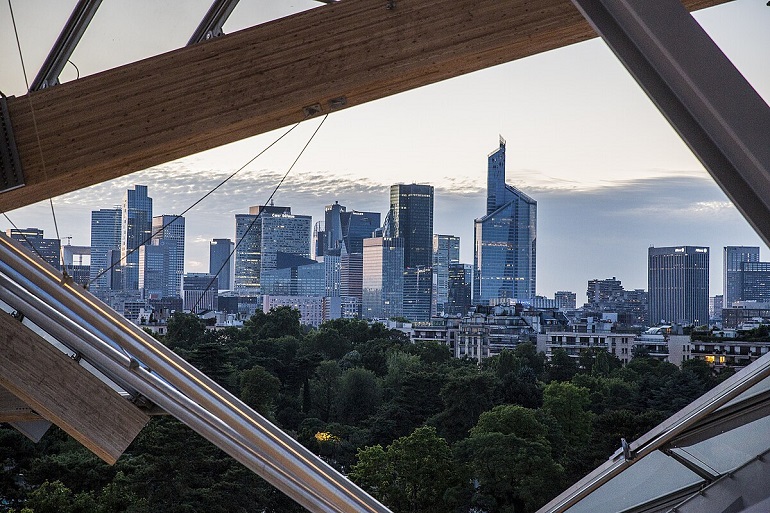
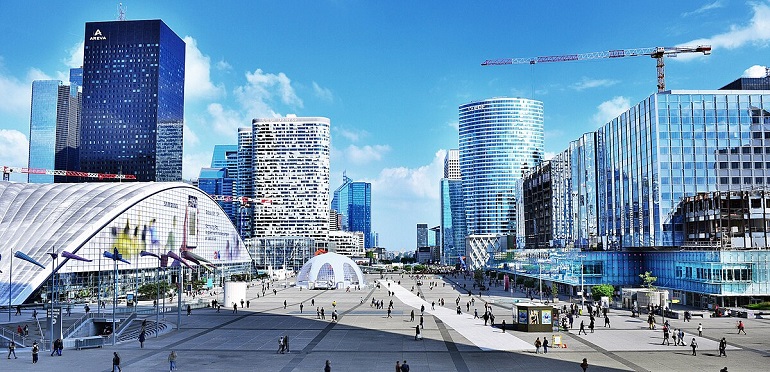
The skyline is crowned by the Grande Arche, a colossal 110-metre frame of gleaming marble that aligns perfectly with the Arc de Triomphe beyond the river. Around it rises a forest of towers—some angular like crystalline shards, others spiralling or tapering like ships’ prows—that showcase the latest advances in sustainable engineering. Many incorporate living walls, photovoltaic façades or rooftop orchards, offering striking evidence of Paris’s drive towards eco-responsible urbanism. Evening light shows projected onto several façades bathe the esplanade in colour, turning everyday strolls into immersive experiences.
Urban Layout and Public Spaces
At ground level, traffic disappears into underground lanes, leaving pedestrians to roam freely across the Esplanade de La Défense—a two-kilometre promenade paved in granite and dotted with ornamental pools. The district’s planners have curated more than 70 hectares of car-free terraces, stairways and belvederes, punctuated by benches carved from white limestone. Look out for the circular steps of the Agam Fountain, whose 86 coloured columns ripple with water, and the footbridge linking the Terrasses Boieldieu, where street artists often sketch the skyline.
Open-Air Museum of Contemporary Art
Over 70 monumental artworks are scattered throughout the precinct, forming one of Europe’s largest permanent collections outside a museum. Highlights include Alexander Calder’s red steel Stabile, César’s welded Thumb, Joan Miró’s moon-blue Personnage and Takis’s luminous Forest of Signals, whose slender poles sway gently in the wind. Free guided art walks depart daily from the information kiosk beside the Grande Arche, but spontaneous exploration often yields the most delightful surprises: a mirrored steel labyrinth reflects passing clouds; a bronze minotaur lurks behind a hedge; kinetic sculptures spin idly above café terraces.
Retail Therapy
Shoppers gravitate towards Les Quatre Temps, a multi-storey retail temple where more than 250 brands span fashion, cosmetics, electronics and gourmet groceries. A vast domed atrium stages live catwalks and product launches, while pop-up stalls on the mezzanine showcase French artisan chocolatiers and perfumers. Adjoining the Grande Arche, the CNIT complex offers a calmer atmosphere with concept stores, design showrooms and a state-of-the-art IMAX cinema. Seasonal craft fairs spill onto the plazas, especially in December when wooden chalets sell mulled wine, raclette sandwiches and handcrafted toys.
Culinary Delights
Food lovers can eat their way across continents within a single block. Trendy poke-bowl counters sit opposite traditional crêperies; Lebanese bakeries waft aromas of za’atar-dusted flatbreads through the concourse; and Michelin-listed brasseries plate refined classics such as sole meunière and mousse au chocolat tableside. Office workers pour into salad bars and pâtisseries at midday, but evenings belong to rooftop cocktail lounges and wine bars, many with live jazz trios or skyline DJs. A handful of food-hall stalls stay open till late, serving steaming ramen, vegan tacos and hand-rolled sushi for night owls.
Cultural High Notes
Beyond the daily bustle, La Défense nurtures a lively arts calendar. Summer brings open-air film screenings on giant LED walls, complete with deckchairs and gourmet popcorn. Autumn’s Jazz à La Défense festival transforms plazas into concert venues, where saxophone riffs echo between towers. Winter introduces immersive light trails that weave through courtyards, accompanied by projection-mapped storylines narrated in several languages. Throughout the year, the district’s 4,000-seat concert hall hosts pop concerts, ballets and stand-up comedy, ensuring there is always an excuse to linger after sunset.
Green Pockets and Outdoor Leisure
Landscaped terraces and pocket parks soften the corporate veneer. The Jardin de l’Arche features raised lawns perfect for impromptu picnics, while the Terrasses de l’Esplanade boast aromatic herb borders, pergolas and ping-pong tables. Fitness stations line the riverside Promenade, where joggers circle reflecting pools at dawn and yoga groups unfurl mats at twilight. Those seeking a quieter escape can ascend to rooftop vegetable gardens—often open to visitors during weekend open days—to sip herbal infusions brewed from the very plants surrounding them.
Family-Friendly Fun
Families will find plenty to occupy younger explorers: a dinosaur-themed minigolf course winds beneath footbridges, a digital playground projects interactive games onto the pavement, and indoor climbing walls cater to budding acrobats. School holidays see free science workshops pop up in glass pavilions, where children build solar cars or craft kaleidoscopes. Prams glide effortlessly across the flat esplanade, and lift access to observation decks means panoramic views are accessible to all ages.
Business Facilities and Services
La Défense’s corporate DNA brings practical advantages for travellers. Free public Wi-Fi blankets the promenades, multilingual signage is clear and plentiful, and tourist reception centres distribute maps alongside device-charging hubs. Cash-point machines, chemists and bakeries operate extended hours to serve the commuter rush, ensuring essentials are always close at hand. Several co-working lounges offer day passes, ideal for visitors mixing work with sightseeing.
Atmosphere and Vibe
Mornings pulse with kinetic energy: cyclists zip past in designated lanes, baristas pull flat whites at pavement kiosks, and distant church bells from suburban courtyards mingle with the soft hum of escalators. By mid-afternoon the mood mellows, as office windows reflect drifting cumulus clouds and buskers serenade passing crowds with acoustic covers of French classics. Nightfall brings a subtle buzz—tower lights mirror in granite pavers, friends gather for after-work apéritifs, and couples drift towards the river’s edge to watch the Eiffel Tower sparkle on the horizon.
Traveller Tips
- Wear comfortable footwear; sightseeing often entails several kilometres of level walking.
- For postcard-worthy panoramas, head to the Grande Arche’s rooftop terrace an hour before sunset.
- Mobile snack carts appear between 11 am and 3 pm—ideal for grabbing a fresh baguette sandwich while admiring outdoor sculptures.
- Artworks are easiest to photograph early in the morning, when polished surfaces reflect the pastel sky and crowds are minimal.
- Public toilets are discreetly located beneath the central esplanade; follow the blue “WC” icons on lamp posts.
In essence, La Défense offers travellers a richly layered experience: a dramatic architectural stage where art, retail, gastronomy and gardens dance together beneath Paris’s newest skyline. It is a place to gaze upward in wonder, linger over a crème brûlée on a sun-soaked terrace, and discover just how gracefully a modern metropolis can welcome those in search of urban adventure.