


Introduction
The Jardin des Plantes is a historic botanical garden located in Paris's 5th arrondissement that was established in 1626 as a royal garden of medicinal plants and opened to the public in 1650. Covering 68 acres, this renowned botanical complex houses over 10,000 plant species across its outdoor gardens and greenhouse facilities, making it one of the world's foremost botanical institutions.
The site encompasses four natural history museum galleries, including the Grande Galerie de l'Évolution, the Galerie de Minéralogie et de Géologie, the Galerie de Paléontologie et d'Anatomie Comparée, and the Galerie de Botanique, which collectively form part of the Muséum National d'Histoire Naturelle.
The gardens also feature specialised areas such as the Alpine Garden with over 3,000 mountain species, tropical greenhouses, a rose garden, and the Ménagerie du Jardin des Plantes, one of the world's oldest zoos founded in 1795. Beyond its collection of living plants, the facility maintains one of the world's largest herbarium collections with over six million dried specimens and continues to serve as both a research centre and educational institution, offering courses in botany and natural sciences to visitors and students alike.
Interesting Facts about Jardin des Plantes
- The Jardin des Plantes is France’s main botanical garden, founded in 1626 as the royal garden of medicinal plants and opened to the public in 1650.
- It spans about 28 hectares on the Left Bank of the Seine and forms part of the Muséum national d’Histoire naturelle complex.
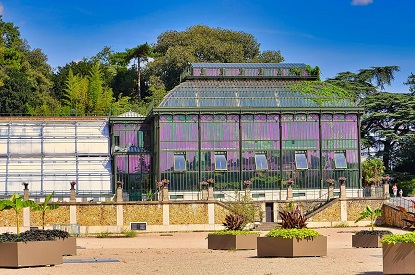
- The garden cultivates tens of thousands of plant species and includes themed areas such as an Alpine Garden, a Rose Garden, and historic tropical greenhouses known as the Grandes Serres.
- Its herbarium and botany collections rank among the world’s largest, with millions of preserved specimens supporting scientific research.
- The on-site Ménagerie, founded in 1795 from animals of the Versailles menagerie, is one of the oldest zoos still in existence.
- Four major galleries—Evolution, Mineralogy and Geology, Palaeontology and Comparative Anatomy, and Botany—present natural history across grand 19th- and 20th-century museum spaces.
- The Mexican and Australian greenhouses (1834–36) pioneered iron-and-glass architecture in Paris, predating similar structures at Les Halles by about 15 years.
- A cedar of Lebanon dating to a 1734 seed from Kew Gardens and an acacia from 1647 still grow in the grounds, linking living trees to centuries of botanical exchange.
- Artist Henri Rousseau drew inspiration from frequent visits here, which helped shape the dreamlike jungles of his paintings despite never travelling to the tropics.
- The garden contains a historic labyrinth crowned by the Gloriette de Buffon, offering elevated views over the orderly parterres and promenades.
History
The Jardin des Plantes stands as one of Paris's most historically significant botanical institutions, with roots stretching back to the early 17th century. Originally founded in 1635 by royal edict of King Louis XIII, it began life as the Royal Garden of Medicinal Plants under the authority of the king's physician, Guy de la Brosse. The garden was first opened to the public in 1640, making it one of the earliest publicly accessible botanical spaces in Europe. Guy de la Brosse, a well-connected physician who had lobbied for the garden's creation since 1616, drew inspiration from existing medical gardens in Montpellier and Padua. The establishment was staffed by a group of "demonstrateurs" who lectured visitors, particularly future physicians and pharmacists, on botany, chemistry, and geology.
Under Louis XIV, the garden underwent significant expansion and modernisation, particularly under the direction of Guy-Crescent Fagon, the great-nephew of the original founder. In 1673, a new amphitheatre was constructed where dissections and medical courses were conducted, featuring lectures by celebrated figures such as Claude Perrault, who was renowned both as a physician and as the architect of the Louvre's façade. The early 18th century brought further development, with additional floors added to house collections and enlarged greenhouses to accommodate plants brought back from scientific expeditions worldwide. The garden's transformation into a major scientific centre reached its pinnacle under Georges-Louis Leclerc, Comte de Buffon, who served as superintendent from 1739 to 1788 and greatly expanded the facility, adding features such as a maze and labyrinth that remain today.
The French Revolution marked a crucial turning point in the garden's history, as it was transformed from a royal institution into a republican centre of scientific learning. In June 1793, a revolutionary decree established the Muséum d'Histoire Naturelle, creating what was known as a "Republic of Professors" with twelve professorial chairs. The gardens were renamed simply the Jardin des Plantes, and a major addition came with the creation of the Ménagerie in 1792, proposed by Bernardin de Saint-Pierre to rescue animals from the abandoned royal menagerie at Versailles. The menagerie faced initial difficulties, with many animals dying before Napoleon provided adequate funding and facilities. The institution gained international fame in 1827 when it received a giraffe as a diplomatic gift from the Khedive of Egypt to King Charles X—an animal that became a Parisian celebrity after walking 900 kilometres from Marseilles to Paris. By the mid-19th century, the complex housed impressive collections, including over 200,000 specimens in its zoology gallery, which was considered superior to the British Museum's collection.
Description
The Jardin des Plantes is more than a pleasant green space: it is an immersive botanical, zoological and scientific universe spread across 28 hectares on the Left Bank. Below you will find a detailed look at everything waiting beyond its gates, from secluded flowerbeds to interactive galleries and family-friendly diversions.
1. Layout and Orientation
- Central Grand Allée
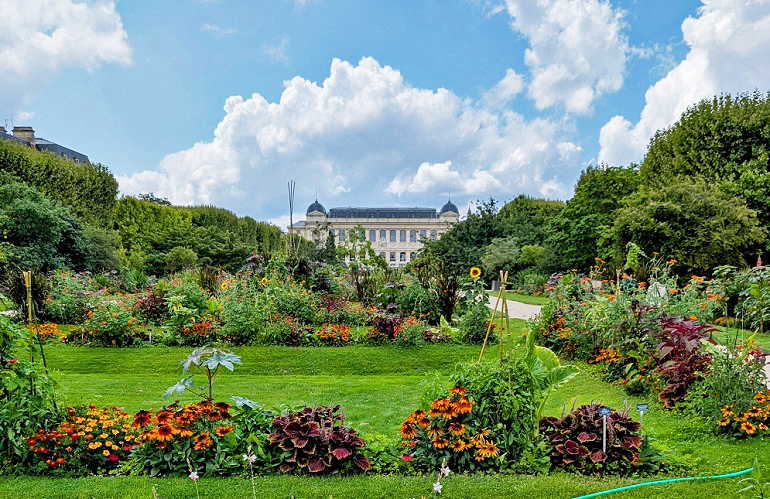
A straight, tree-lined promenade runs from the main entrance to the Natural History galleries. Formal parterres on either side change colour with the seasons, while wrought-iron benches offer ample spots to pause. - Perimeter Walks
Gravel paths loop around the entire site, linking quieter corners such as the Alpine Garden and riverside terraces. Direction panels and large illustrated maps at each junction make self-navigation straightforward. - Labyrinth & Gloriette
Near the eastern edge, a spiral path climbs a planted mound to a dainty iron pavilion. The vantage point reveals treetops, greenhouse roofs and, on a clear day, the dome of the Panthéon.
2. Themed Botanical Areas
| Garden | Key Features | Atmosphere | Approx. Time |
|---|---|---|---|
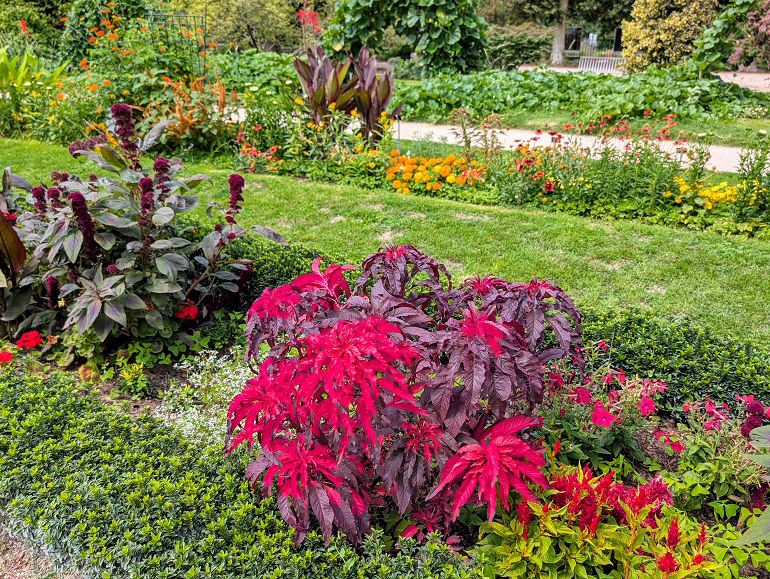
| French Formal Beds | Symmetrical borders, topiary cones, seasonal bulbs | Grand yet relaxed | 20 min |
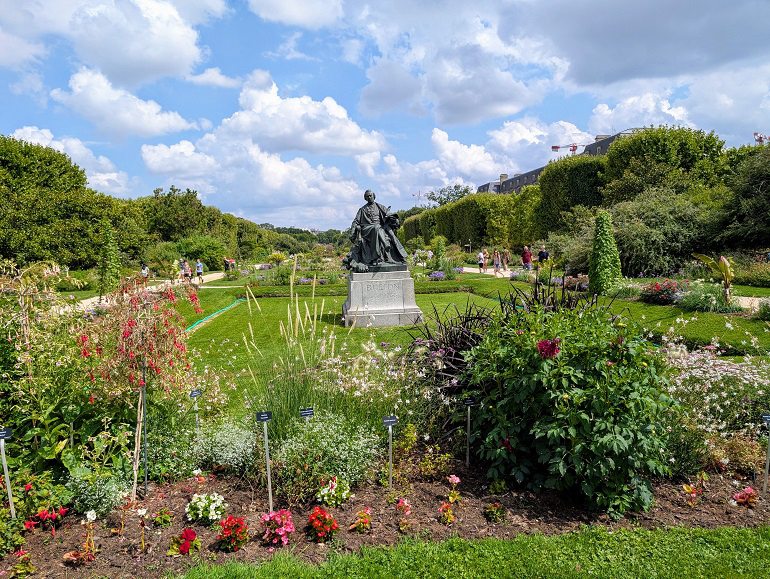
| School of Botany | Over 4,500 labelled species grouped by family; medicinal and aromatic plots | Educational | 30 min |
| Rose Garden | Hundreds of heritage and modern cultivars, pergolas dripping with climbers | Fragrant & photogenic | 15 min |
| Alpine Garden | 2,000 mountain plants arranged among authentic rock strata and a hidden tunnel entrance | Secretive & cool | 20 min |
| Ecological Garden | Re-created French wetlands, meadows and woodland clearings; bird-hide for quiet observation | Wild & contemplative | 25 min |
| Fruit Orchard & Apiary | Espaliered pear and apple trees, beehives producing garden honey sold in the shop | Bucolic | 10 min |
Small information panels appear in both French and English, and QR codes link to an online plant database for deeper dives.
3. Grandes Serres – The Great Greenhouses
Four inter-connected iron-and-glass halls provide a climate-controlled tour of global flora:
- Tropical Rainforest – A raised walkway slips through palms, tree ferns and spectacular orchids while misting jets maintain jungle humidity.
- Deserts and Arid Lands – Saguaro, agave and living stones display ingenious water-saving adaptations under a blazing artificial sun.
- New Caledonia – Endemic species such as araucarias and blue-green ferns reveal one of the planet’s biodiversity “hot-spots.”
- History of Plants / Winter Garden – A chronological planting narrative leads from primitive ferns to flowering angiosperms beside an art-deco pond of Amazonian water-lilies.
Interpretive screens highlight conservation projects and seed-bank partnerships linked to each biome.
4. Natural History Galleries
Grande Galerie de l’Évolution
A vast nave where suspended whales, elephants and shoals of model fish dramatise ecological networks. Interactive tables let visitors explore habitat loss, DNA and climate data at their own pace.
Galerie des Enfants
A dedicated children’s space with touch-screens, crawl-through burrows and scientific experiments scaled for inquisitive minds aged 6–12.
Galerie de Paléontologie et d’Anatomie Comparée
A two-storey parade of skeletons: towering sauropods, a full mammoth, and side-by-side comparisons of vertebrate limb bones.
Galerie de Géologie et de Minéralogie
Vaulted cabinets glitter with meteorites, raw diamonds and iridescent opals, while an interactive “crystal factory” demonstrates mineral formation.
5. The Ménagerie (Zoo)
- Scale & Setting – Occupying a leafy enclave, it favours intimate enclosures over sweeping savannahs, creating close-range encounters without crowding.
- Star Residents – Red pandas, snow leopards, tree kangaroos, Komodo dragons and rare cranes share the spotlight with a vibrant reptile house and walk-through aviary.
- Animal Care – Keepers run daily talks and enrichment feedings; signage details each species’ conservation status and ongoing re-wilding programmes.
- Heritage Buildings – The big-cat house, monkey rotunda and romantic wrought-iron aviaries add architectural charm without delving into historical narrative.
6. Family-Friendly Extras
- Dodô Manège Carousel – Children ride replicas of dodos, trilobites and triceratops beneath a jungle-painted canopy.
- Playgrounds – Two sand-and-slide areas lie discreetly beside the central beds and the zoo exit.
- Story Trails – Laminated boards dotted through the gardens form a self-guided treasure hunt about pollination and seed dispersal.
7. Dining, Shopping & Rest Facilities
- Café de la Baleine – A light-filled brasserie serving salads, quiches and pastries opposite the Gallery of Evolution.
- Pavillon des Valadeurs – Quick-service hatch for crêpes, ice cream and fresh lemonade midway along the main path.
- Picnic Spots – Lawns are off-limits, but wooden tables and discreet benches abound beneath plane trees and alongside the Seine fence.
- Boutique du Muséum – Books, ethically sourced gemstones, plush toy pandas and seed packets inspired by the gardens.
- Restrooms & Water Fountains – Clearly signposted; all major blocks include baby-change tables and at least one accessible cubicle.
8. Events and Programmes
- Nocturnal Light Trail – An after-dark lantern walk scattered with giant luminous animals (late autumn and winter).
- Temporary Exhibitions – Rotating displays explore topics from pollinator decline to polar exploration inside modular pavilions.
- Horticultural Workshops – Half-day sessions on urban composting, rose pruning and balcony gardening, available in English on selected dates.
- Guided Tours – Botanist-led walks, zoo keeper “behind-the-scenes” mornings and mineral handling sessions bookable online or at kiosks.
9. Accessibility and Sustainability
- Smooth, step-free circuits and lift access in all major galleries.
- Wheelchairs and folding stools loaned free at entrances (ID required).
- Large-print maps, braille labels, induction loops and sensory gardens assist visitors with visual or auditory impairments.
- Solar panels on gallery roofs, composting of green waste and rain-water harvesting support the site’s eco-credentials.
- On-site beehives and bird-boxes enhance urban biodiversity, while café menus emphasise seasonal, responsibly sourced produce.
10. Visitor Tips at a Glance
- Outdoor areas are free, while the greenhouses, zoo and galleries each require individual tickets or a good-value combined pass.
- Allow three hours for a relaxed garden stroll, or a full day to include glasshouses, galleries and the zoo.
- Contactless payment is accepted everywhere, and digital ticketing minimises queuing.
- Maps, audio guides and Wi-Fi hotspots across the grounds help visitors tailor their experience in real time.
Final Word
With its mosaic of themed gardens, pioneering glasshouses, family-size zoo and world-class museums, the Jardin des Plantes compresses an entire planet of biodiversity into a single Parisian postcode. Plan ample time, wear comfortable shoes and prepare for a day of botanical discoveries, scientific wonder and quiet, leafy respite from the city beyond the gates.