


| Contents |
|---|
Introduction
The Élysée Palace, official residence of the President of the French Republic, is an 18th‑century mansion tucked behind gilded gates on rue du Faubourg Saint‑Honoré at the heart of Paris’s political life. Built in 1722 and remodelled over time, its mirrored salons, tapestries and formal gardens have hosted state visits, crisis meetings and historic announcements. While closed to the public for most of the year, it opens during European Heritage Days each September, when queues are long and security is tight; at other times, visitors admire the ornate façade, note the tricolour above the cour d’honneur, and explore the chic surrounding district of boutiques, galleries and embassies. This guide outlines the palace’s history, architecture and contemporary role, with practical advice for viewing it respectfully and making the most of the neighbourhood.
Interesting Facts about the Élysée Palace
- The Élysée Palace began as the Hôtel d’Évreux, built between 1718 and 1722 for the Count of Évreux in what was then a semi-rural edge of Paris.
- It became the official residence of the President during the Second Republic in 1848 and later the enduring seat of the presidency under the Third Republic.
- The palace is famed for having 365 rooms, including ceremonial salons and offices used for state affairs.
- Marquise de Pompadour once owned the estate, transforming its grounds before later owners reshaped the gardens into an English-style landscape.
- The palace’s Council of Ministers meetings are traditionally held in the Salon Murat, while presidential inaugurations take place in the grand Salle des Fêtes.
- Its name recalls the nearby Champs-Élysées and the Elysian Fields of Greek mythology, symbolising honour and repose.
- The basement “Jupiter” command post, adapted from an air-raid shelter, is associated with national defence and nuclear command continuity.
- A long tradition of fine French craftsmanship is visible inside, from Baccarat crystal and grand-cru service to ornate tapestries and gilded décor.
- The gardens span about two hectares, with some trees predating the French Revolution and a celebrated wrought-iron cockerel gate added in the early 20th century.
- Félix Faure, President of the Republic in the 1890s, famously died in the palace, a story that has become part of its lore.

History
The Élysée Palace stands as one of Paris's most historically significant buildings, constructed between 1718 and 1722 by the renowned architect Armand-Claude Mollet. Originally known as the Hôtel d'Évreux, it was built for Louis Henri de La Tour d'Auvergne, Count of Évreux, who had been appointed governor of Île-de-France in 1719. The palace was situated in what was then the almost rural Faubourg-du-Roule neighbourhood in the current eighth arrondissement, built upon the site of a former vegetable farm. The Count financed this ambitious project by marrying the daughter of shipping magnate Antoine Crozat, considered the wealthiest man in France at the time, whose fortune was built upon slavery and trade with Louisiana. Following the Count's death in 1753, the palace passed to the famous Marquise de Pompadour, Louis XV's favourite mistress, who transformed it into a lavish symbol of her considerable influence.
The palace's fortunes changed dramatically during the turbulent revolutionary period and Napoleonic era. In 1787, Bathilde d'Orléans, Duchess of Bourbon, purchased the property for 1,300,000 livres and renamed it the Élysée, also constructing a group of cottages in the gardens called the Hameau de Chantilly. During the French Revolution, the Duchess fled the country and the palace was confiscated and transformed into a venue for eating, drinking, dancing, and gambling. The building's imperial destiny began in 1805 when Joachim and Caroline Murat (Napoleon's sister) acquired it, undertaking major renovations to create a more grand and imperial residence. In 1808, when Murat became King of Naples, the palace was transferred to Emperor Napoleon himself and renamed the Élysée-Napoléon. Most significantly, it was here that Napoleon signed his second abdication on 22nd June 1815 following the Battle of Waterloo, departing three days later.
The palace's transformation into the seat of French presidential power began during the Second Republic when, on 12th December 1848, the National Assembly passed a law designating it as the official residence of the President of the French Republic. Louis-Napoleon Bonaparte (the future Napoleon III) became the first president to reside there, moving in on 20th December 1848. Under Napoleon III's reign, extensive renovations were carried out between 1853 and 1867 by architect Joseph-Eugène Lacroix, creating the present-day structure and giving the building its distinct features of French classicism. Since 1873, the Élysée Palace has served as the official residence of every French President, hosting 25 different heads of state over its 170-year presidential history. The palace has witnessed countless pivotal moments in French and global history, from state banquets to crucial political meetings, remaining a powerful symbol of French governance and continuing to serve as both the official residence and workplace of the President of France.
Description
The Magnificent Exterior and Approach
The palace presents an imposing and deliberately secretive face to the world. The main entrance is dominated by a monumental gate featuring four majestic Ionic columns, flanked by high protective walls that shield the residence from public view. This grand entrance opens onto the expansive Cour d'Honneur (Courtyard of Honour), a vast semicircular ceremonial courtyard paved with elegant stone that creates a dramatic approach to the main building.
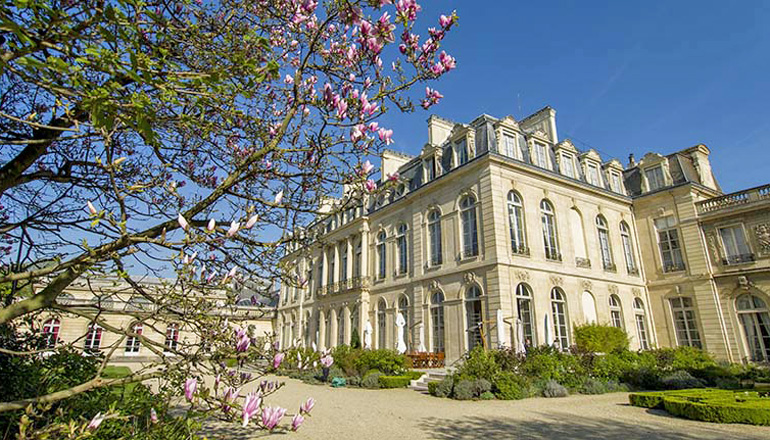
The principal façade exemplifies the refined elegance of French neo-classical architecture. Designed by architect Armand-Claude Mollet, the structure consists of a central three-storey pavilion flanked by two harmonious single-storey wings, creating a perfectly balanced composition. The building's cream-coloured limestone façade features symmetrical rows of tall French windows, each framed by delicate stone mouldings and crowned with triangular pediments. The central section rises majestically above the wings, topped with a traditional mansard roof of dark slate that catches and reflects the Parisian light throughout the day.
The palace's exterior architectural details include ornate carved stone decorations, classical pilasters, and elaborate cornices that demonstrate the finest craftsmanship of the period. Iron balconettes grace many of the first-floor windows, adding both decorative appeal and subtle security features. The building's proportions follow the golden ratio principles beloved by classical architects, creating a sense of perfect harmony that has influenced French architectural standards for centuries.
Ground Floor: The State Apartments
The Vestibule d'Honneur (Hall of Honour) serves as the grand ceremonial entrance to the palace. This magnificent hall welcomes visiting heads of state, dignitaries, and world leaders. The space features imposing Doric pilasters crafted from white marble, creating a sense of classical grandeur. The floor is adorned with an intricate pattern of white and red marble tiles arranged in geometric designs that draw the eye towards the centre of the room. A striking sculpture titled "Tribute to the French Revolution" by renowned artist Arman adds contemporary artistic gravitas to this historic space.
The Salon d'Argent (Silver Room) occupies a privileged position in the eastern wing and serves as the official entrance to the private apartments. Decorated in elegant hues of lilac and silver that recall the refined tastes of Caroline Murat, Napoleon's sister, this room exudes aristocratic sophistication. The chamber's name derives from the distinctive silver-coloured edges adorning wall features, mantelpieces, tables, sofas, and armchairs. The furniture, dating from 1813, includes exquisite pieces by master cabinetmaker Jacob Desmalter, with armchairs featuring delicate swan sculptures carved into their sides. The original fabrics have remarkably retained their soft, delicate shades, perfectly complementing the white gold and silver tones of the room's panelling.
The Salon Murat (Murat Room) holds particular constitutional significance as the weekly meeting place for the Council of Ministers. Every Wednesday, this chamber witnesses the President presiding over France's government alongside the Prime Minister and cabinet members. The room also bears historical importance as the site where German Chancellor Konrad Adenauer signed the pivotal Élysée Treaty in 1963, cementing Franco-German cooperation in post-war Europe.
The Salon Cléopâtre (Cleopatra Room) derives its exotic name from a magnificent Gobelins tapestry depicting the famous "Meeting of Antony and Cleopatra at Tarsus" that dominates one wall. Meticulously renovated in 1992, this chamber originally served as the Marquise de Pompadour's dressing room before being transformed into Napoleon III's private study. The room also houses a distinguished portrait of Maria Amalia, Duchess of Parma, painted by the celebrated artist Alexandre Roslin.
The Salon des Ambassadeurs (Ambassadors' Room) represents one of the palace's most prestigious spaces, where the President officially receives foreign ambassadors and diplomatic representatives. Originally designed as Murat's ballroom, the chamber showcases exceptional period furnishings including a magnificent astronomical clock adorning the marble fireplace mantelpiece. This remarkable timepiece displays not only the hours and minutes but also the month, lunar phases, and zodiac signs, representing the pinnacle of 18th-century clockmaking artistry. The room features a bronze statuette of Roman Emperor Marcus Aurelius and is illuminated by a spectacular chandelier dating from the Bourbon Restoration period. A luxurious carpet, specially woven in 1990 by the prestigious Manufacture Nationale de la Savonnerie, adds contemporary craftsmanship to this historically rich environment.
The Salon Pompadour originally served as the state bedroom of the influential Marquise de Pompadour and later as Napoleon I's private bedchamber. Today, it functions as an audience chamber where the President receives distinguished guests. The room showcases a portrait of the Marquise herself, surrounded by exquisite 17th-century tapestries. The furnishings, carefully selected to represent the finest examples of Louis XV and Louis XVI craftsmanship, transport visitors to the golden age of French aristocratic refinement.
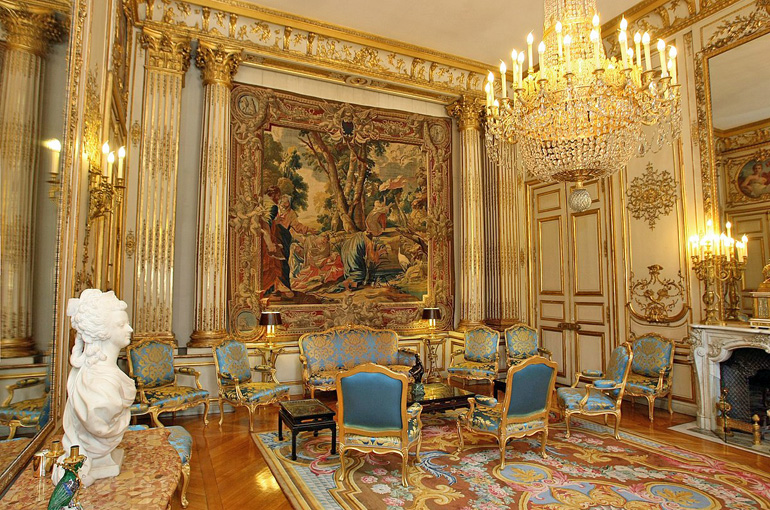
The Salon Bleu (Blue Room) serves as the official office of the First Lady of France, decorated in various shades of blue that create a serene yet dignified working environment.
The Salle des Fêtes (Hall of Festivities) occupies the entire western wing and represents the palace's grandest ceremonial space. This immense banqueting hall hosts state dinners, official receptions, and presidential inaugurations. The room's soaring ceiling features painted panels completed in 1896 by Guillaume Dubufe, depicting allegorical scenes of French glory and prosperity. The walls are adorned with 18th-century Gobelins tapestries produced by the Manufacture Nationale des Gobelins, showcasing the finest examples of French textile artistry. Expansive French windows flood the space with natural light, creating an airy atmosphere despite the room's grand proportions.
The Jardins d'Hiver (Winter Gardens) was constructed in 1883 as an elaborate greenhouse for cultivating exotic plants. Today, this glass-roofed conservatory serves as an extension of the Hall of Festivities, providing additional space for official banquets. The room features a Gobelins tapestry and three magnificent crystal chandeliers that create magical light patterns throughout the space.
The Salle à Manger Paulin (Paulin Dining Room) presents a startling contrast to the palace's traditional decoration. Designed in the 1970s by avant-garde designer Pierre Paulin for President Georges Pompidou and his wife Claude, this futuristic private dining room features walls composed of 22 prefabricated polyester panels in soft, organic shapes. The furniture includes innovative single-pedestal chairs with round bases and a circular glass dining table. The ceiling incorporates illuminated panels decorated with glass balls and rods, creating an otherworldly dining experience within the historic palace walls.
First Floor: The Presidential Quarters
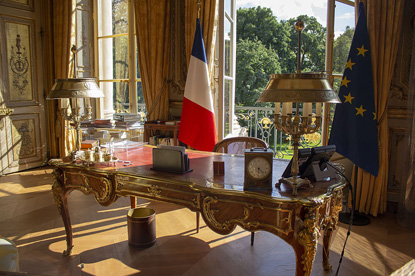
The Salon Doré (Golden Room) serves as the President's principal study and unquestionably lives up to its magnificent name. Located at the heart of the mansion, this chamber has meticulously preserved its original décor, crafted in 1861 by the renowned painter Jean-Louis Gogon for Empress Eugénie. Every surface gleams with gold-leaf detailing on walls, doors, tables, and chairs, creating an atmosphere of imperial grandeur. The room showcases priceless Gobelins tapestries, sumptuous carpets from the Manufacture Nationale de la Savonnerie, and a spectacular Napoleon III crystal chandelier that casts rainbow reflections throughout the space. The room's centrepiece is a magnificent Louis XV-style desk, a masterpiece created by the celebrated 18th-century cabinetmaker Charles Cressent, where France's most important decisions of state are made. An exquisite chest of drawers by André Boulle adds to the room's collection of priceless furniture.
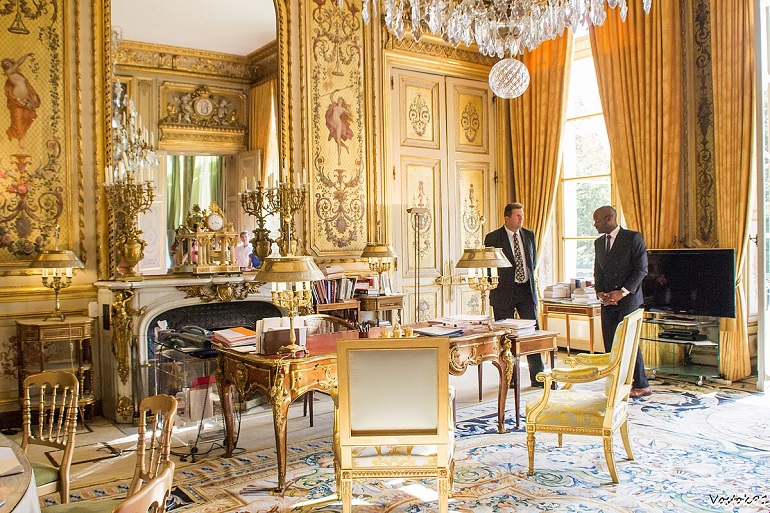
The Salon Vert (Green Room) communicates directly with the Golden Room and takes its name from the distinctive green silk curtains and upholstery that complement the gold-edged doors, chairs, tables, and wall features. This chamber serves as a meeting room where the President consults with close advisers around a large oval table. The room gained romantic notoriety when President Nicolas Sarkozy married his second wife, Carla Bruni, in an intimate ceremony held within its green silk-lined walls.
The Salon Angle (Angle Room) occupies a corner position and has served since 2007 as the office of the Secretary-General of the Élysée, one of the most powerful positions in French government. Originally designed as a dining room, this space has been adapted for administrative purposes while maintaining its elegant period features.
The Salon de Fougères (Fern Room) derives its name from the delicate floral-patterned wallpaper that covers its walls, creating a garden-like atmosphere within the palace. The room houses a distinguished portrait of King Louis XV painted by Charles-André van Loo, representing royal artistic patronage at its finest.
The Salon des Portraits (Portrait Room) provides direct access to the palace terrace and derives its name from a remarkable collection of eight portraits adorning its upper walls. These paintings depict some of the 19th century's most significant European monarchs and leaders: Pope Pius IX, Emperor Franz Joseph of Austria, King Victor Emmanuel of Italy, Tsar Nicholas I of Russia, Queen Victoria of England, King Frederick William of Prussia, Queen Isabella II of Spain, and King William I of Württemberg. This diplomatic gallery reflects France's central position in 19th-century European politics. The room features a contemporary desk crafted by designers Chaix and Morel, which served as President Sarkozy's private study.
The Ancienne Chambre de la Reine and Ancienne Chambre du Roi were the former royal bedchambers, representing the palace's monarchical heritage. The King's former bedchamber previously housed the Secretary-General's office before its relocation to the Salon Angle.
Six additional rooms in the eastern wing of the first floor comprise the President's private living quarters, shielded from public view and providing intimate family spaces within this grand official residence.
The Magnificent Gardens
Behind the palace lies a secret world spanning nearly two hectares of meticulously landscaped gardens, invisible from the bustling Parisian streets. These private grounds represent one of Paris's most exclusive green spaces, containing over 100 different species of trees and plants carefully selected for their beauty, rarity, and symbolic significance.
The garden's formal French design centres on a perfectly aligned central pathway that extends the palace's architectural axis deep into the landscaped grounds. This main avenue, flanked by geometric flowerbeds planted with seasonal blooms, leads the eye through a series of garden rooms, each with its own distinct character and plantings. Ancient chestnut trees form natural corridors and provide dappled shade during summer months, while their spring blossoms create spectacular floral displays.
The gardens extend eastward towards the Avenue des Champs-Élysées and connect to the Avenue Gabriel through the magnificent Grille du Coq (Rooster Gate), a breathtaking masterpiece of Belle Époque ironwork. This ornate gateway, crowned with the French national symbol, represents one of Paris's finest examples of decorative metalwork from the late 19th century.
Water features throughout the gardens create peaceful sounds that mask the urban noise beyond the palace walls. Carefully positioned fountains and reflecting pools add movement and light to the landscape, while formal parterres showcase the geometric precision beloved in French garden design. Hidden pathways wind through more naturalistic plantings, providing private spaces for contemplation and informal meetings.
The gardens' design incorporates both formal and English landscape styles, reflecting changing tastes in garden fashion over the palace's long history. Ancient trees, some dating back centuries, provide living links to previous eras, while contemporary plantings ensure the gardens remain vibrant and relevant to current tastes.
Architectural Details and Treasures
The palace houses an extraordinary collection of decorative arts representing the finest examples of French craftsmanship across three centuries. Throughout its 365 rooms, visitors encounter 2,000 pieces of precious furniture, including 200 historic tapestries that tell the story of French artistic achievement. Over 320 antique clocks throughout the building mark the passage of time with mechanical precision and artistic beauty.
The palace maintains 6,500 pieces of official tableware and 90 different tablecloths for state entertaining. More than 2,000 bottles of grand cru wines are served annually in 3,000 Baccarat crystal glasses, representing the pinnacle of French luxury and hospitality.
The building spans 11,179 square metres and is maintained by a staff of 800, including 350 military personnel who ensure the palace's security and ceremonial functions. This magnificent residence continues to serve as both a working government building and a living museum of French artistic and political heritage, embodying the nation's commitment to preserving its cultural treasures while adapting to contemporary needs.
Getting There
By train Alight at Miromesnil station on Métro lines 9 or 13, exit onto Rue de Miromesnil, then stroll south-west along Rue du Faubourg Saint-Honoré for about ten minutes to the palace gates.
By coach or bus Board RATP bus routes 28, 32, 52, 80 or 93 to the Matignon-Saint-Honoré stop, which sits beside the palace railings, leaving only a short walk to the entrance.
By car Approach via Boulevard Haussmann, turn onto Avenue de Marigny, and use public car parks around Place de la Madeleine or Place de la Concorde, as on-street parking is heavily restricted outside the palace.
Best Time to Visit
The best time to visit the Élysée Palace is during European Heritage Days, which occur on the third weekend of September each year. This is the only time when France's presidential residence opens its doors to the public, offering a rare glimpse into the historic palace that serves as the official residence of the French President. To secure entry, advance registration is absolutely essential, as the palace does not accommodate walk-in visitors during this exclusive weekend. Registration typically opens approximately one week before Heritage Days via the official Élysée website, and spaces are extremely limited given the overwhelming demand from visitors worldwide. For the best experience, it's advisable to register for the earliest available time slot, beginning at 8am, as this helps avoid the substantial queues that can extend to several hours later in the day. The palace remains open to visitors until 5:30pm on both Saturday and Sunday of Heritage Weekend. Given that this opportunity arises just once annually and attracts enormous crowds, early planning and prompt registration when bookings open are crucial for anyone hoping to explore this magnificent presidential palace and its beautifully appointed state rooms, gardens, and historic collections.