


Introduction
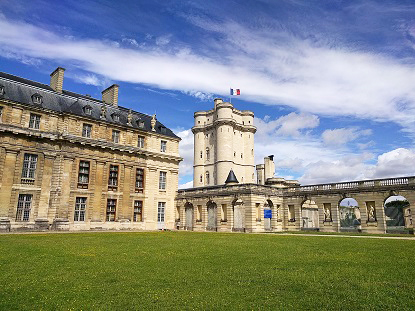
The Château de Vincennes stands as France's most complete surviving medieval royal fortress, located on the eastern outskirts of Paris. Originally established as a hunting lodge by Louis VII in the 12th century, it was transformed into a formidable fortress during the 14th century under Charles V, who built the imposing 52-metre keep—one of the tallest medieval structures in Europe—completed in 1369. The château served as a royal residence from the 12th to 18th centuries and witnessed significant historical events, including the marriages of Philippe III and IV, the deaths of three 14th-century kings, and later functioned as a state prison housing notable figures such as Denis Diderot and the Marquis de Sade. The complex features remarkably preserved medieval architecture including defensive walls with towers, a working drawbridge, deep moats, and the stunning Sainte-Chapelle de Vincennes, a Gothic chapel modelled after its Parisian counterpart and commissioned by Charles V.
Interesting Facts about Château de Vincennes
- The Château de Vincennes began as a royal hunting lodge in the 12th century before evolving into a formidable medieval fortress.
- Its towering donjon, rising to about 50–52 metres, is among the tallest medieval keeps in Europe.
- The Sainte-Chapelle de Vincennes, begun in 1379 and completed in the 16th century, showcases exquisite Flamboyant Gothic architecture.
- French kings used Vincennes as a principal residence from the 14th to 16th centuries, valuing its security and proximity to Paris.
- The fortress’s massive enceinte, moat, and nine towers reflect Charles V’s ambition to create a seat of royal power and safety.
- Vincennes later served as a state prison, holding notable figures such as Denis Diderot, Honoré Mirabeau, and the Marquis de Sade.
- During the French Revolution and Napoleonic era, the site became military barracks and the Paris arsenal.
- In 1939–1940, the château functioned as the command centre of the French General Staff.
- Several medieval monarchs were married or died at Vincennes, underlining its role in dynastic history.
- Today, the keep and Sainte-Chapelle are restored and open to visitors, offering a rare, intact example of a medieval royal fortress near Paris.
History
Medieval Origins and Royal Development
The Château de Vincennes began its illustrious history in the 12th century as a modest hunting lodge established by Louis VII in 1178. The site was strategically chosen for its proximity to excellent hunting grounds in the surrounding forest, access to two former Roman roads to Sens and Lagny, and water access via the Marne and Seine rivers. The manor truly flourished under Louis IX (Saint Louis) between 1226 and 1270, who used it as his preferred secondary residence after the Palais de la Cité in Paris. During this period, the château served as a seat of governance where Louis IX held meetings of the royal council, whilst Queen Margaret of Provence and their children often resided there during his absences. The château holds particular religious significance as it temporarily housed the Crown of Thorns when Louis IX purchased this revered relic from the Emperor Baldwin of Constantinople, before its transfer to the Sainte-Chapelle in Paris. Three 14th-century kings died at Vincennes - Louis X in 1316, Philip V in 1322, and Charles IV in 1328 - whilst Philip III in 1274 and Philip IV in 1284 were both married there.
The Great Fortress of Charles V
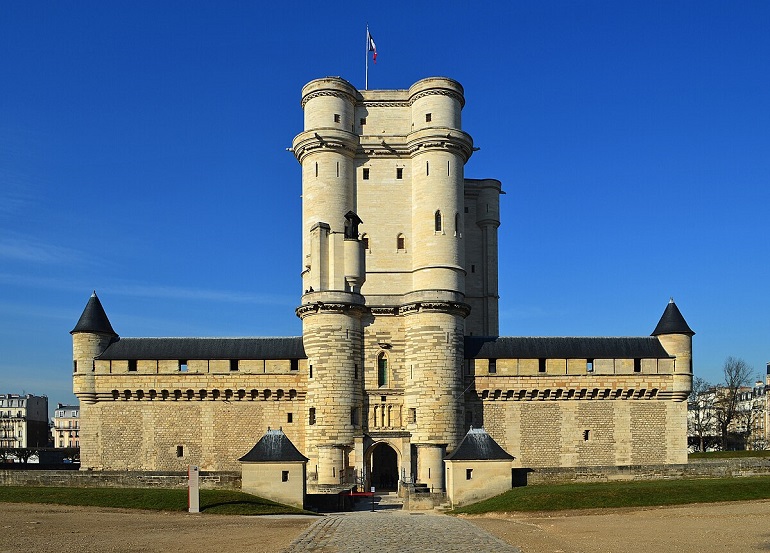
The château's transformation from a comfortable manor into Europe's most formidable fortress began in response to the turbulent events of the 14th century, including defeats during the Hundred Years' War and uprisings by Parisian merchants under Étienne Marcel between 1357 and 1358. Following a violent attack on the Palais de la Cité on 22nd February 1358, the future Charles V recognised the urgent need for a more secure residence near Paris. Construction of the massive fortress commenced around 1337 under John II the Good, but it was Charles V who became the principal architect of Vincennes after ascending the throne in 1364. The centrepiece of this ambitious project was the imposing keep, standing 52 metres high and completed in just 10 years - making it the tallest fortified structure in Europe when finished in 1369-70. Charles V moved into his apartments in 1367 or 1368 whilst construction continued, permanently abandoning the Palais de la Cité. The king's vision extended beyond the keep, as he ordered the construction of a second, more extensive enclosure over a kilometre in length, completed between 1372 and 1385, which housed additional buildings including the Sainte-Chapelle de Vincennes, begun in 1379 to hold the sacred relics originally obtained by Louis IX.
From Royal Residence to Military Fortress
The château's role evolved dramatically through subsequent centuries, serving as a refuge for troubled monarchs during France's most turbulent periods. Following the English victory at Agincourt in 1415, the Treaty of Troyes in 1420 granted the château to the English, and Henry V of England died there of dysentery in 1422 at age 35. After Charles VII of France reclaimed the fortress, later monarchs preferred the Loire Valley, though Louis XI constructed a new royal residence within the walls extending the entire length of the southeast wall. The Sainte-Chapelle, begun in 1379, remained unfinished until the 16th century when Francis I resolved to complete it in 1520 to celebrate the birth of his heir, with the work finally concluded in 1552 under Henry II. By the early 18th century, the royal departure led to various industrial uses, including a porcelain manufactory in the Devil's Tower from 1740 to 1756, an armaments factory, and an industrial bakery. The French Revolution transformed Vincennes into a military base and prison, a role it maintained when Napoleon I converted it into barracks and an arsenal. Throughout its history, the château served as a prison for notable figures including the future Henry IV in 1574, Nicolas Fouquet in 1661, and writer Denis Diderot.
Description
The Fortress Complex
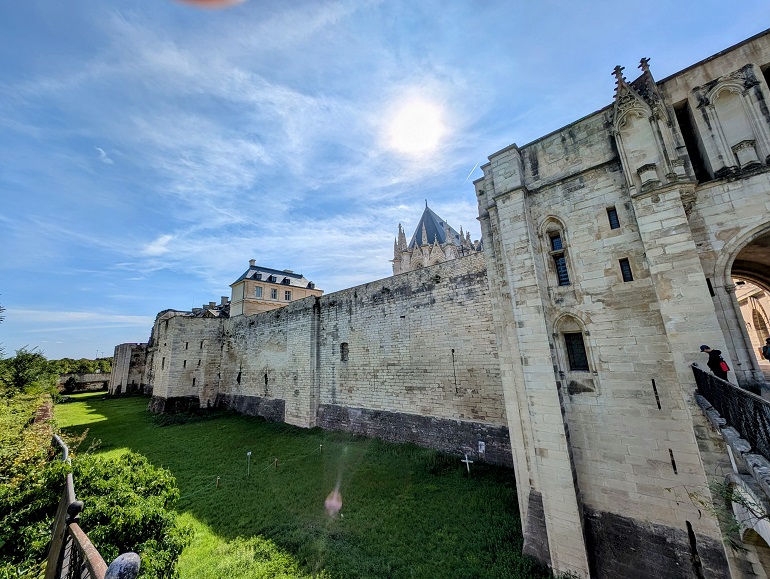
The Château de Vincennes stands as the most extensive and best-preserved royal fortress in France, forming a vast rectangular enclosure that resembles a fortified city rather than a traditional castle. The massive stone walls extend over 1,100 metres in length, encompassing an area of approximately six hectares and providing protection for what was once home to several thousand inhabitants during medieval times.
The fortress is surrounded by deep moats that originally served multiple defensive purposes. These impressive water-filled ditches, measuring 27 metres wide and originally 11 metres deep, created a formidable barrier around the entire perimeter. The moats received water from springs captured on the heights of Montreuil and also functioned as part of the castle's sewerage system, receiving waste water and rainwater from the buildings within the enclosure.
Nine imposing towers punctuate the defensive walls, each originally standing 40 to 42 metres high. These towers served dual functions as both defensive structures and comfortable living quarters, equipped with fireplaces, latrines, and decorative sculptures for the king's guests and close associates. Seven of these towers were later reduced in height during Napoleon's conversion of the fortress into a military stronghold, though the Tour du Village on the north side remains at its original elevation. This particular tower, standing 42 metres tall, serves as the main gateway and features exceptional carved decoration of remarkable quality. A historic clock by the renowned French horologist Jean-André Lepaute adorns the external face, with dials showing different dates - one from 1768 facing the city and another from 1818 facing the courtyard.
The Donjon
The magnificent keep represents the architectural centrepiece of the fortress and stands as the tallest medieval fortified tower in Europe at 50 metres high. This imposing square structure measures 16.2 metres on each side, with walls an extraordinary 3.26 metres thick at the base. Four corner tourelles, each 6.6 metres in diameter, flank the main tower and provide both structural support and additional defensive capabilities.
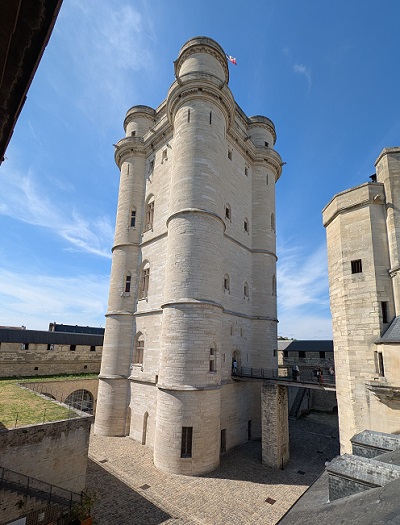
The keep showcases remarkable engineering innovations for its era. More than two and a half kilometres of iron reinforcement bars were integrated into the structure, surrounding the entire tower at ground, fifth, and sixth levels, whilst also strengthening doorways, windows, and corridor ceilings. This early use of metal reinforcement makes the Vincennes keep one of the first known examples of rebar usage in European architecture.
The interior comprises six floors, each featuring a central chamber approximately ten metres square with vaulted ceilings reaching seven to eight metres in height. The lower four floors are supported by decorated central columns that were originally painted in bright colours and adorned with sculpture. Access to the keep in medieval times was exclusively via the first floor, reached by crossing a bridge from the châtelet terrace where the king's administrative offices were located.
The keep served as both a defensive stronghold and a luxurious royal residence. The second floor housed the king's private apartments, including a magnificent bedchamber decorated with oak panelling sourced from the Baltic region and vaulted ceilings painted with golden fleurs-de-lis against a brilliant blue background made from precious lapis lazuli. A small oratory is set into the north wall, whilst the chamber includes a treasure room where the king's gold and finest silverwork were stored.
The keep is surrounded by its own defensive wall, creating a rectangular stone enclosure approximately 50 metres on each side and 11.5 metres high. This wall features a crenellated walkway originally open to the elements but later covered with a tile roof and subsequently the present slate covering. Four échauguettes (small watchtowers) project from each corner to provide enhanced surveillance of the walls below.
The Sainte-Chapelle
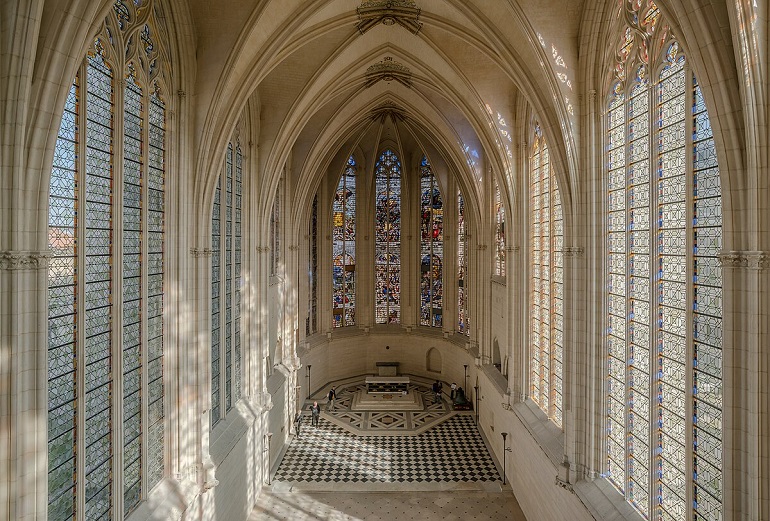
The royal chapel represents a masterpiece of Gothic architecture, modelled on the famous Sainte-Chapelle of the Palais de la Cité in Paris but constructed on a single level rather than two. The chapel measures 20 metres in height, 40 metres in length, and 12 metres in width, creating a space of breathtaking vertical proportions.
The architectural style evolves from Rayonnant Gothic in the choir to Flamboyant Gothic in the nave and façade. The structure features soaring windows separated by massive buttresses, each crowned with ornate spires that provide additional weight and stability. The west front exemplifies late Gothic Flamboyant style with three gabled arches stacked one above another, framing and echoing the elaborate curving designs of the rose window.
The interior once contained magnificent stained glass windows reflecting these changing Gothic styles - Rayonnant glass in the choir and Flamboyant glass in the nave. Though much of the original glazing was destroyed during the French Revolution, the chapel's stone architecture remains largely intact. The exterior walls demonstrate the sophisticated engineering of Gothic construction, with enormous buttresses supporting the high walls and allowing for the large window openings that flood the interior with light.
The Royal Pavilions
The south end of the fortress is distinguished by two elegant classical buildings facing each other across a formal courtyard - the Pavillon du Roi and the Pavillon de la Reine. Both structures were designed by the renowned architect Louis Le Vau, with the King's Pavilion constructed from 1654 to 1661 and the Queen's Pavilion built from 1658 to 1660 as an architectural mirror of its counterpart.
These magnificent three-storey buildings represent the transformation of the medieval fortress into a classical palace suitable for the court of Louis XIV. Each pavilion features fifteen window bays per floor, with the openings framed by doubled pilasters that are particularly prominent in the central sections. The rooflines are adorned with distinctively elegant pot-à-feu ornaments that create striking silhouettes against the sky.
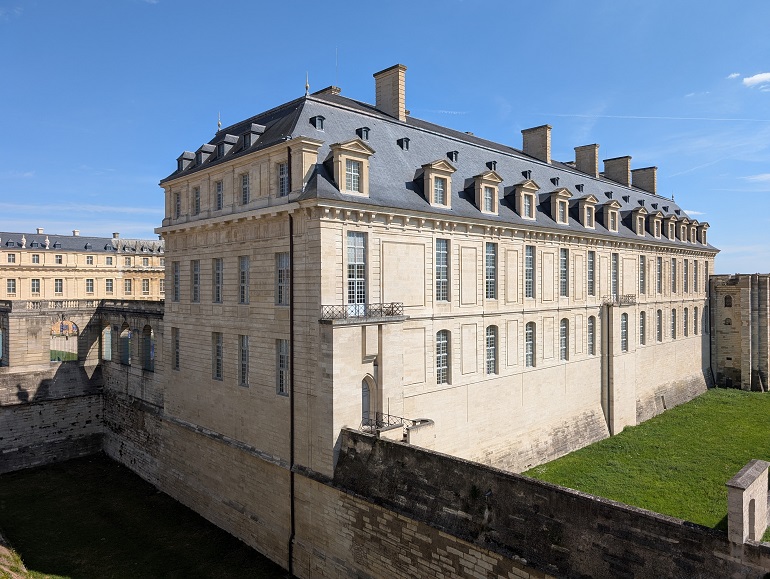
The pavilions are connected by graceful porticoes that create an enclosed court of honour between the two buildings. Two subtle projecting sections, marked by slight recesses, frame the central portions of each façade, adding architectural complexity to the otherwise symmetrical composition. The King's Pavilion houses the Service Historique de la Défense and includes the remarkable Salle des Emblèmes, which served as Louis XIV's throne room and now displays 182 emblems of dissolved military units.
The fortress represents a unique synthesis of medieval military architecture and classical palatial design, creating one of Europe's most remarkable and complete royal residences. Its combination of defensive strength and residential luxury demonstrates the evolution of royal architecture from the martial necessities of the 14th century to the ceremonial grandeur of the age of Louis XIV.
The Château de Vincennes unfolds as a self-contained fortified town, its sheer scale and architectural variety offering far more than a fleeting glance can reveal.
- Fortress Enclosure and Moat
A stone curtain wall over a kilometre in length encircles the six-hectare site, creating a vast, roughly rectangular compound. Deep moats—now usually dry for maintenance—still emphasise the chasm that once separated courtly life from the surrounding forest. Walkways atop the ramparts allow sweeping views across the entire enclosure, punctuated by nine towers whose battered bases, arrow-slit embrasures and machicolations showcase the full medieval defensive toolkit. - Gatehouse (Châtelet)
Entry is through the Tour du Village, a soaring 42-metre gateway tower that blends raw military strength with refined sculpture. A pair of pointed arches forms a tidal entrance: the outer for carriage traffic, the inner for pedestrians. Carved figures of saints and heraldic beasts—some original, others meticulously restored—act as silent sentinels. Above, an eighteenth-century clock by the Lepaute brothers still marks the passing hours, its twin dials facing both town and court. - The Donjon (Keep)
At the heart of the enclosure rises the monumental square keep, fifty metres high—a masterpiece of vertical engineering. The structure is laced internally with iron tie-bars that reinforce walls over three metres thick. Six stacked storeys share an identical plan: a grand vaulted hall framed by slender central columns, flanked by chambers hidden within the corner tourelles. - Ground Level: once provision stores, now exhibits illustrate royal daily life.
- First Floor: former council chamber, panelled in Baltic oak, its vault keystones carved with angels and armorial fleurs-de-lis.
- Second Floor: King’s private apartment, complete with a stone oratory and surviving fragments of lapis-blue ceiling paint.
- Upper Floors: more austere, later repurposed as state prison cells; visitors can still decipher elaborate graffiti etched by former inmates.
- Inner Enceinte of the Keep
The donjon is defended a second time by its own eleven-metre curtain wall. Four petite échauguettes project from each corner, offering eye-level inspection of the moat below. A covered wall-walk invites visitors to pace the very route once used by royal archers. - Sainte-Chapelle de Vincennes
Set just east of the keep, the royal chapel dazzles through light rather than mass. Its single-level design stretches forty metres end to end, held aloft by slender flying buttresses crowned with crocketted pinnacles. Inside, rib vaults soar to a height of twenty metres, their stone ribs painted a soft ivory to amplify reflected light. Restored stained glass floods the nave in jewel tones, the Rayonnant choir windows depicting biblical kings while later Flamboyant panes in the nave swirl with expressive tracery. Listen for an echo that lingers almost four seconds—evidence of the chapel’s exceptional acoustics. - Classical Royal Pavilions
Beyond the Gothic heart lie the seventeenth-century Grand Apartments. Louis Le Vau’s Pavillon du Roi and Pavillon de la Reine face one another across a cobbled court of honour, their pale limestone façades edged with pilasters and crowned by steep slate roofs. Bronze pot-à-feu urns punctuate the balustrades. Inside the King’s Pavilion, the Salle des Emblèmes showcases 182 gilded crests of regiments disbanded during successive French conflicts—a pageant of military heraldry set beneath a coffered ceiling. The Queen’s counterpart retains an elegant grand staircase of cantilevered stone steps whose wrought-iron balustrade curls like musical notation. - Supporting Buildings and Grounds
Stables, kitchens and service corridors stretch along the southern curtain, while a dovecote and powder magazine occupy discreet corners near the eastern towers. Grassed bailey spaces have been landscaped into lawns edged with plane and chestnut trees; picnic benches sit in the shade where knights once drilled. Interpretive panels describe the ingenious hydraulic system that funnelled spring water into the moats and supplied fountains in the royal gardens. - Atmosphere and Visual Impressions
Expect continual contrast: massive fortified masonry juxtaposed with delicate tracery; dim, stone-scented passages opening into sun-drenched courts; rattling shutters of prison cells just metres from jewel-bright stained glass. On overcast days, the pale limestone walls appear almost silver against the sky, while sunset bathes the entire complex in warm honey-coloured light.
A narrow spiral staircase threads the south wall, eventually reaching a parapet terrace that rewards the ascent with uninterrupted panoramas of eastern Paris and the Bois de Vincennes.
Taken together, the Château de Vincennes offers a layered architectural narrative—part fortress, part palace, part sacred space—presented on a scale unmatched within the Paris region. A day spent exploring its walls, towers and ceremonial rooms provides not only an immersion into medieval and classical design but also an intriguing lens through which to read five centuries of royal ambition.