| Contents |
|---|
Introduction
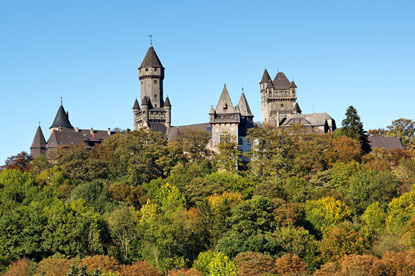
Majestically perched atop a basalt crag 100 metres above the Lahn valley, Braun Castle presents a fairy-tale silhouette of steeply pitched roofs, spires and ornate bay-windows. It was first erected in 1246 as a defensive fortress against the Counts of Nassau by the Counts (and later Princes) of Solms-Braunfels. Expanded between the 15th and 17th centuries, the castle suffered a lot during Thirty Years' War, changing hands seven times between 1621 and 1641. Following the Romantic movement, Braunfels was remodelled in the Gothic Revival style in 1880. Still owned by the Solms-Braunfels family, the castle is open to guided tours of its state rooms, Knight’s Hall and family museum, offering visitors a view of its historic architecture and collections. The painting gallery has works by Dutch and Flemish Masters, including Jan van Eyck.
Interesting Facts about Braunfels Castle
- Braunfels Castle has stood atop a basalt hill above the Lahn valley since the mid-13th century, first documented in 1246 as “Castellum Brunenvelsz”.
- The castle has remained in the hands of the same noble family—the Counts and later Princes of Solms-Braunfels—for nearly 800 years, a rare continuity among European castles.
- Still a private residence, Braunfels Castle is partly open to the public, uniquely blending a living home with a museum and cultural site.
- In 1679, a devastating fire largely destroyed the castle, prompting major reconstruction under Count Heinrich Trajektin.
- Its current neo-Gothic silhouette with many towers and bay windows largely stems from 19th-century renovations by “Hunting Prince” Ferdinand and subsequently Prince Georg.
- The castle church, a late Gothic hall church completed in 1501, has survived centuries nearly intact and today serves both as a museum and an occasional parish church.
- Braunfels Castle boasts a family museum with artefacts such as medieval armour, the ring of Elizabeth of Hungary, and a notable collection of Dutch paintings including works by van Eyck.
- During the Thirty Years’ War, Braunfels Castle was conquered three times, demonstrating both its strategic importance and the turbulent history of the region.
- The castle grounds once included a hunting and game park, Forsthaus Tiergarten, established in 1704, which still features wild boar, mouflon, and fallow deer.
- With its imposing architecture and fairytale presence, Braunfels Castle has inspired legends, ghost stories, and even served as a filming location in modern times.

History
Originally constructed as a defensive stronghold against the Counts of Nassau, it soon became the principal residence for the noble family of Solms-Braunfels from the late 13th century onwards. In the following centuries, the fortress was constantly enhanced and reinforced; by the 14th century, improvements included the addition of robust circular walls, defensive towers, and fortified ramparts—adaptations spurred by the advancement of firearms.
The castle endured turbulent episodes throughout its history, most notably during the Thirty Years’ War in the 17th century, when it suffered damage and changed hands multiple times. In 1679, a devastating fire razed much of the fortress, leading to an extensive Baroque-style reconstruction under Count Heinrich Trajektin. In the early 18th century, further transformation was overseen by Count Wilhelm Moritz, who renovated the residence and expanded its grandeur with a baroque character. The castle chapel, dating from 1504, and remnants like the late Gothic castle church, remain testament to its medieval origins.
The 19th century brought a period of romantic revival and significant architectural evolution. Beginning in 1845, “Hunting Prince” Ferdinand of Solms-Braunfels initiated a neo-Gothic restoration using the original foundation, followed by the reconstruction of the Knight’s Hall. From 1880, under Prince Georg, the castle acquired its iconic fairy-tale silhouette, adorned with towers, oriels, and bay windows that define its present appearance. Despite shifting political control over the centuries, Braunfels Castle has remained in the ownership of the same family line for nearly 800 years, and today welcomes visitors eager to explore its storied corridors, art collections, and panoramic views.
Description
Exterior and Setting
The castle’s honey-coloured sandstone walls and dark slate roofs rise in successive terraces above the old town of Braunfels. From every approach, its slender towers, turrets and oriels punctuate the skyline against a backdrop of rolling woodland. A broad enceinte of crenellated ramparts encircles the main complex, while the inner courtyard, dominated by a carved stone lion at its centre, provides a sheltered forecourt to the principal entrance. On clear days, panoramic vistas open out across wooded hills and the Lahn River meandering through the valley below.
Architectural Highlights
- Keep: A soaring 48-metre tower retains its original medieval core and offers commanding views across the Hessian countryside (visits by prior arrangement).
- Defensive Walls: Thick curtain walls, punctuated by cylindrical towers and arrow-slits, attest to the site’s origins as a fortress, now softened by decorative crenellations and mock-machicolations typical of 19th-century restoration.
- Ornamental Features: Elaborate stone tracery, pointed arches and finial-topped pinnacles enhance the castle’s fairytale character. The careful interplay of light and shade on carved mouldings lends a sense of depth and richness to the exterior.
Interior Rooms and Ambience
Visitors embark on a guided tour through a series of sumptuously appointed chambers, each reflecting princely taste and the art-collecting heritage of the Solms family.
- Knight’s Hall: A grand vaulted chamber resplendent with polished weaponry and armour spanning the 13th to 19th centuries. The hall’s lofty ceiling and flagstone floor evoke medieval martial splendour.
- Stairways Hall and State Rooms: Ascending a sweeping stone staircase, one encounters galleries hung with portraits, tapestries and gobelins. The adjoining state rooms display period furniture, sculpted marble busts and glittering baroque chandeliers, casting a warm glow on oil paintings of former residents.
- Altenberger Rooms: Here, sacred relics include the Gothic shrine of the Altenberger Altar and the legendary ring of Saint Elisabeth, preserved within intricately carved wooden cabinets.
- Deikergalerie: Named for the court painter Johannes Deiker, this gallery showcases dramatic hunting scenes—red deer stalking through dense forest, wild boar in mid-charge—captured on vast canvas backdrops.
- Blue Parlour: An intimate salon decorated in cool cerulean tones, featuring marble busts of Queen Luise of Prussia and her sister Princess Friederike, set beneath stucco cornices and ornate mirrors.
Surrounding Grounds
Beyond the ramparts lie extensive parklands once reserved for princely hunts. Meandering paths lead through shaded glades to the nineteenth-century wildpark, where free-roaming deer, mouflon and boar inhabit a natural enclosure. In summer months, open-air operas and chamber concerts enliven the castle courtyard, while fragrant flowerbeds and clipped lawns offer tranquil spots for contemplation.
Getting There
By train The nearest railway station to Braunfels Castle is Leun/Braunfels on the Gießen–Limburg line, with trains running roughly every hour and sometimes more frequently during peak periods. From the station, Braunfels Castle lies about 4km away, which can be reached on foot, by local taxi, or potentially by connecting bus routes.
By coach or bus There are frequent bus services to Braunfels from the nearby city of Wetzlar, with the line 185 bus travelling directly to Braunfels Busbahnhof; this journey typically takes around 35 minutes and buses run hourly, making this a convenient public transport option, especially if connecting from the main train station at Wetzlar.
By car Braunfels Castle is easily accessible by car via the A3, A5, or A45 motorways, depending on your origin. Take the appropriate exit for B49 and follow the signs for Braunfels. Upon arrival in the town, follow local signage to the castle’s dedicated parking area located just beside the castle walls, where free parking is readily available.
Best Time to Visit
The best time to visit Braunfels Castle is during the late spring to early autumn months, particularly from April to October. During this period, the weather is generally pleasant, and the castle offers regular guided tours in both German and English, allowing visitors full access to its grand interiors and picturesque grounds. The surrounding town of Braunfels comes alive with charming cafés and bustling market squares, making for a delightful day out. While the castle remains open year-round, winter tours are more limited and may require advanced booking, with some areas occasionally closed to the public. Visiting during the summer also provides the opportunity to explore the scenic Hessian countryside and enjoy outdoor festivals or local events, enhancing the overall experience.