



| Contents |
|---|
Introduction
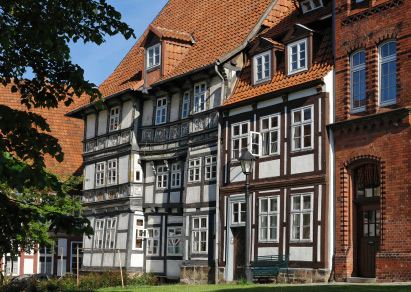
Hildesheim (pop. 101,500) is at the same time one of North Germany's oldest and newest cities. Pictures of the superb traditional timber-framed buildings on its market square hints at a well preserved historical centre. Yet Hildesheim was razed to the ground in 1945, and the market square was the only part of town reconstructed to its former glory, and not until the 1980's. So all the old building are in fact fairly new - though few visitors seem to care, as they are truly charming.
Sadly the rest of town is pretty much undescript and soulless, apart from a few outstanding medieval stone churches scattered in the western and southern part of the city, including Hildesheim Cathedral (Mariendom), St. Michael's Church, St. Andrew's Church and St. Godehard Church. Also of interest is the Roemer- und Pelizaeus-Museum Hildesheim, which is mostly dedicated to Ancient Egyptian and Ancient Peruvian art, but also boasts the second largest collection of Chinese porcelain in Europe.
Interesting Facts about Hildesheim
- The city boasts two UNESCO World Heritage Sites: Hildesheim Cathedral and St Michael’s Church.
- St Andrew’s Church (St Andreas) has the highest church tower in Lower Saxony, offering panoramic views over the city.
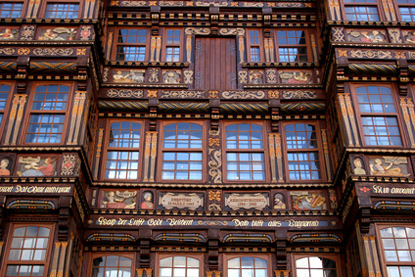
- Hildesheim’s historic market square is famed for its reconstructed half-timbered houses, including the ornate Butchers’ Guild Hall.
- A legendary “thousand-year-old” rosebush grows by Hildesheim Cathedral, symbolising the city’s resilience.
- The Roemer- und Pelizaeus-Museum in Hildesheim houses one of Europe’s notable collections of Ancient Egyptian artefacts.
- Once a Hanseatic city, Hildesheim was a medieval trading hub linked to important routes between Cologne and Magdeburg.
- Much of Hildesheim’s old town was destroyed in a 1945 air raid, but key historic buildings and squares have been painstakingly rebuilt.
- The Innerste River runs through Hildesheim, with the city lying about 30km south-east of Hanover.
- Hildesheim is celebrated for its picturesque half-timbered districts and the themed “Route of the Roses” walking trail.

History
Hildesheim stands as one of the oldest cities in Northern Germany, with its origins deeply rooted in the early medieval period when the Holy Roman Emperor Louis the Pious founded the Bishopric of Hildesheim in 815 CE. According to tradition, the city was named after its founder Hildwin and may have been established when the bishop relocated from Elze to a strategic ford across the River Innerste, which served as an important market along the Hellweg trade route. The settlement rapidly developed around the cathedral on the so-called Domhügel, and by 983, King Otto III had granted the growing town market rights. This early commercial success was further enhanced when Hildesheim's first marketplace was established around the church of St. Andreas, eventually expanding to accommodate the city's growth to approximately 5,000 inhabitants by the 13th century.
During the medieval period, Hildesheim emerged as a significant religious and political power centre, obtaining city status in 1249 and becoming one of the largest cities in Northern Germany at the time. The city was ruled by clergy for four centuries before citizens gained influence through the construction of a Town Hall beginning in 1268. Hildesheim's commercial importance was recognised when it joined the Hanseatic League in 1367, cementing its position as a major trading hub. The city experienced particular cultural flourishing under great prelates such as Bishop Bernward (993-1022) and Bishop Gotthard (1022-1038), who transformed Hildesheim into a renowned cultural centre during the 11th century. However, the city faced challenges during the Reformation period, becoming Lutheran in 1542, whilst the cathedral and several surrounding villages remained Roman Catholic.
The modern era brought both triumph and tragedy to Hildesheim's rich historical landscape. The city passed from Prussian control in 1803 to the Kingdom of Hanover in 1815, before being annexed by Prussia following the Austro-Prussian War in 1866. A remarkable archaeological discovery occurred in 1868 when Prussian soldiers unearthed the Hildesheim Treasure, a collection of approximately 70 Roman silver vessels that provided invaluable insights into the region's ancient past. Tragically, World War II brought devastating destruction to the historic city, with British air raids in March 1945 destroying 29% of the houses and damaging 45%. The medieval city centre, which had retained its character until then, was almost completely levelled, with only 200 of the original 800 half-timbered houses surviving. Post-war reconstruction prioritised practical housing over historical preservation, though the 1980s saw a renewed commitment to restoring the historic centre, including the reconstruction of the iconic Upended Sugarloaf building and the replacement of concrete structures with faithful replicas of original buildings.
Main Attractions
Market Square (Marktplatz)
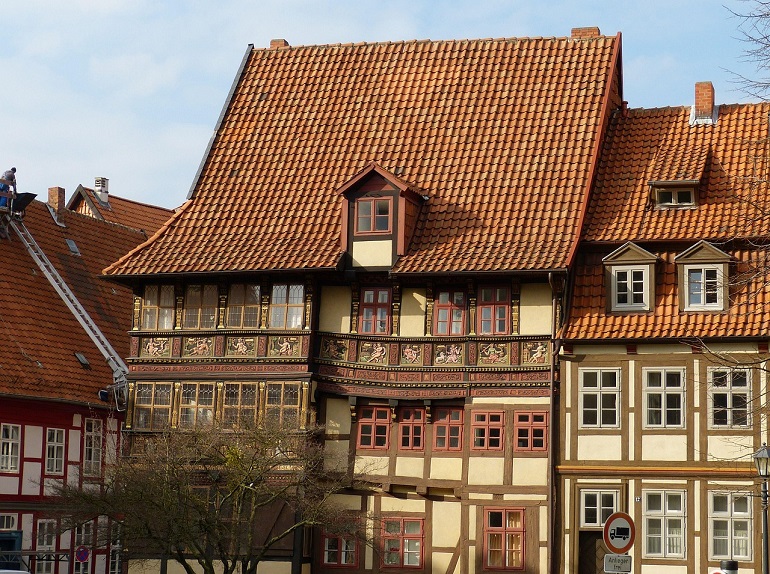
Hildesheim’s Market Square is a reconstructed ensemble of timber-framed and stone-fronted buildings that restores the medieval and early modern outline lost in 1945. The space is framed by notable merchant houses and the Rathaus, with façades rebuilt from archival measurements and photographs during the late 20th century. The square functions as the city’s central civic space, hosting markets and events, and provides direct views of landmark buildings such as the Knochenhaueramtshaus and Wedekindhaus. Paving, statuary and wells reference historic features while meeting contemporary accessibility standards. The urban layout reflects the city’s mercantile past and the post-war emphasis on historically accurate reconstruction.

Knochenhaueramtshaus
The Butchers’ Guild Hall occupies a prominent position on the Market Square and is one of the city’s most elaborate half-timbered reconstructions. Originally dating to the 16th century and destroyed in 1945, it was rebuilt in the 1980s to its historical profile using traditional carpentry techniques and documented decorative programmes. The multi-storey façade features richly carved beams, inscriptions and polychromy that illustrate the status of the guild within civic life. Its volume, gables and jettying exemplify representative urban timber architecture of the late Renaissance period. The building today serves mixed cultural and hospitality functions while preserving its guild-hall character.
Wedekindhaus
Wedekindhaus is a Renaissance merchant’s house on the Market Square known for its sculptural timber framing, projecting upper storeys and detailed façade carving. The original structure dates to the mid-16th century and, like its neighbours, was reconstructed after the Second World War following historical documentation. The façade includes allegorical figures, ornamental friezes and inscription bands that reflect the wealth and civic role of Hildesheim’s patriciate. Its plan and elevations typify high-status domestic-commercial buildings of the period, with street-facing representation and functional rear ranges. The property remains a key reference point in the square’s architectural composition.
Rolandbrunnen (Roland Fountain)
The Roland Fountain is a historic well and sculptural feature associated with the medieval tradition of Roland figures that signified market rights and civic autonomy in many German towns. Situated on or near the Market Square, it combines a functional water source with a column or figure element referencing legal and commercial freedoms. The present structure reflects phases of alteration and restoration consistent with wider post-war renewal of the square. Its placement and iconography link Hildesheim’s civic identity to broader Hanseatic and imperial legal customs. The fountain continues to serve as an orientation point within the historic centre.
Rathaus (Town Hall)
Hildesheim’s Rathaus forms the administrative anchor of the Market Square and exhibits a layered building history with Gothic origins and later adaptations. The exterior presents a balanced façade facing the square, integrating stonework and timber elements characteristic of regional civic architecture. Interiors have been modernised for municipal use while retaining representative halls suited to council functions and ceremonies. The building, damaged during the war and restored afterwards, contributes to the coherent historical silhouette of the square. Its position and scale articulate the traditional relationship between civic governance, market regulation and urban representation.

Other Historical Buildings
Half-Timbered Quarter and Wernersches Haus
The half-timbered quarter preserves traditional timber construction that survived or was reconstructed after the Second World War. Wernersches Haus is among the most elaborately decorated buildings, with carved beams and inscriptions indicative of craftsmanship and social status. The area demonstrates typical early modern urban housing forms and decorative conventions.
Kehrwiederturm
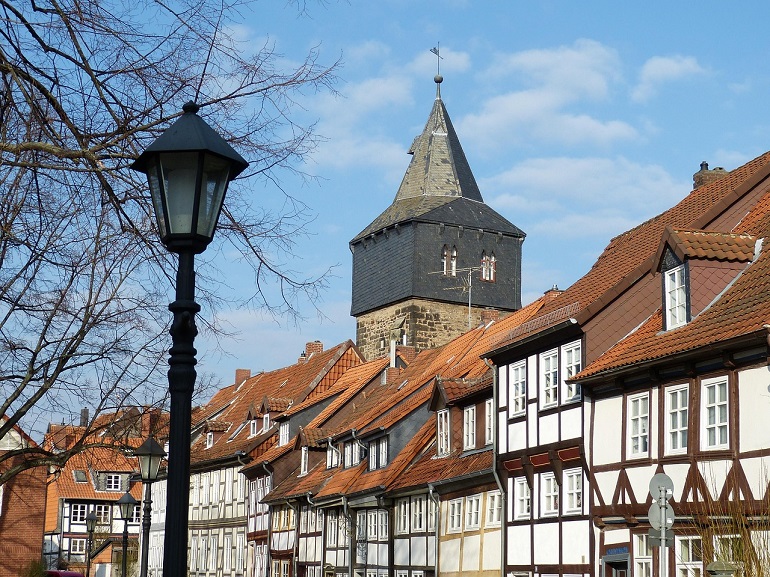
The Kehrwieder Tower is the last surviving city gate tower from Hildesheim’s medieval fortifications. Dating to the late Middle Ages, it once formed part of a defensive system of walls, moats and bastions. The tower illustrates urban development and defensive strategies and now stands amid preserved and reconstructed half-timbered buildings.
Huckup Monument
The Huckup is a bronze sculpture depicting a thief burdened by a goblin representing his guilty conscience, alluding to a local moralising tale. Installed in the city centre, it forms part of Hildesheim’s public art and folklore landscape, embedding traditional narratives within urban space.
Kaiserhaus Façade
The façade known as the Kaiserhaus displays reliefs and portrait medallions of Roman figures and emperors, reflecting Renaissance decorative programmes. Although the original building was lost, preserved or reconstructed façade elements convey the former prestige of the site and add to the architectural variety around the market area.
Churches
St Mary’s Cathedral (Hildesheimer Dom)
Hildesheim Cathedral is a Romanesque church renowned for the Bernward Doors, the Hezilo chandelier and other medieval artworks. In the cathedral courtyard grows the famous thousand-year rosebush linked to the founding legend of the bishopric. The complex, reconstructed and conserved several times, has served as the centre of diocesan life from the early Middle Ages to the present.
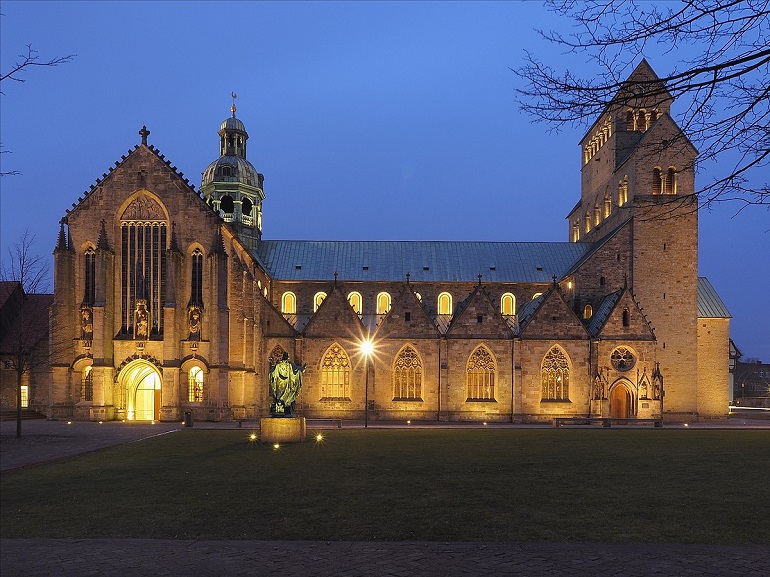
Cathedral Rosebush (Tausendjähriger Rosenstock)
Situated at the cathedral’s apse, the rosebush is traditionally described as more than a thousand years old and famously regrew after being burnt in 1945. Botanically a Rosa canina, it symbolises continuity and resilience and has been carefully conserved as a living monument entwined with the city’s founding legend.
St Michael’s Church (Michaeliskirche)
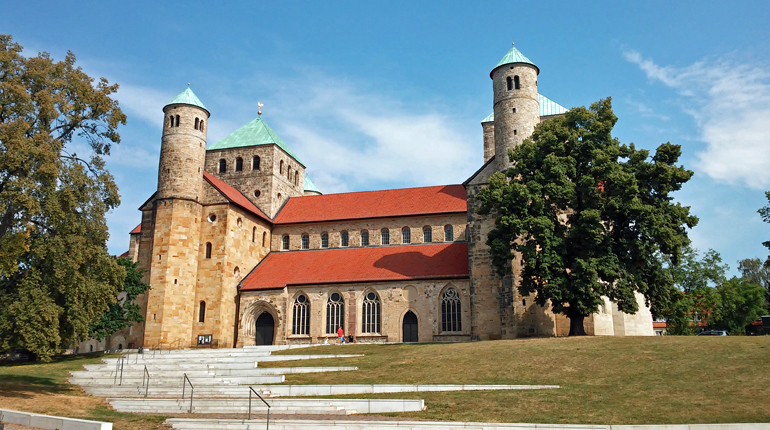
An early-11th-century Romanesque basilica founded under Bishop Bernward, St Michael’s is noted for its symmetrical double-choir layout, painted wooden ceiling depicting Christ’s genealogy, and massive westwork towers. Together with the cathedral, it forms Hildesheim’s UNESCO World Heritage ensemble designated in 1985. The church reflects Ottonian architecture and monastic history and was extensively restored after wartime damage to preserve its original spatial proportions and decorative programme.
St Andrew’s Church (Andreaskirche) and Tower
The Gothic St Andrew’s Church features a tower reaching 114.5 m, the tallest church steeple in Lower Saxony. Rebuilt after heavy damage in 1945, the tower’s spiral staircase leads to a viewing platform offering panoramic views of the historic core and surrounding landscape, making the church a dominant element of Hildesheim’s skyline.
St Godehard’s Church
Consecrated in the 12th century, St Godehard’s is a Romanesque basilica with a clear three-aisled layout and sturdy masonry. Associated with a Benedictine abbey founded in honour of Bishop Godehard, the church remains one of the best-preserved Romanesque ecclesiastical buildings in Hildesheim despite later alterations and restorations.
Holy Cross Church (Heilig Kreuz)
This parish church combines a Romanesque core with Gothic and Baroque side aisles resulting from phased expansions. The layered construction documents liturgical and stylistic changes over centuries, while interior fittings illustrate local interpretations of broader European trends.
St Lambert’s Church
A late Gothic church distinguished by its Peter-and-Paul altar and Baroque organ, St Lambert’s encapsulates the transition between medieval and early modern ecclesiastical art. The building’s fabric reveals the city’s confessional and artistic developments, and its furnishings show continuity of parish worship through periods of change.
Parks & Gardens
Magdalenengarten
Originally a monastic garden and later redesigned in Baroque style, the Magdalenengarten features geometric parterres, fruit trees and ornamental plantings. The 18th-century layout reflects convent horticultural aesthetics and urban leisure spaces, while seasonal rose displays link to Hildesheim’s rose traditions, offering a historical green space near the old town.
Ernst-Ehrlicher-Park, Hohnsensee and River Innerste
Hildesheim’s urban green and water landscapes include Ernst-Ehrlicher-Park and the Hohnsensee, a lake near the centre used for bathing and recreation, connected by paths along the Kalenberger Graben. The River Innerste runs through the city, supporting canoeing and linking urban and natural areas, integrating leisure with the city’s historic topography and former ramparts.
Top Museums
World Cultures & Antiquity
Roemer- und Pelizaeus-Museum Hildesheim
A heavyweight in European archaeology, the Roemer- und Pelizaeus-Museum is best known for its ancient Egyptian holdings, which encompass mummies, sculpture, everyday objects, and an immersive presentation of funerary culture that has long distinguished the collection. It also presents one of Europe’s significant assemblages of ancient Peruvian artefacts, spanning textiles, ceramics, and ritual objects that illuminate Andean civilisations. Beyond these pillars, the museum houses the second-largest collection of Chinese porcelain in Europe, offering a sweeping view of form, technique, and trade history through its glazes and kiln traditions. Its broader collections extend into ethnology, natural history, applied arts, archaeology of other regions, and works on paper. The museum stages changing special exhibitions, which in past years have ranged from art-focused shows to thematic displays that connect material culture with science, technology, and everyday life. The institution’s modern building provides generous, well-lit galleries designed for both landmark permanent displays and ambitious temporary projects.

Sacred Art & Ecclesiastical Heritage
Hildesheim Cathedral Museum (Dommuseum Hildesheim)
Serving as both cathedral treasury and diocesan museum, the Hildesheim Cathedral Museum presents over a millennium of ecclesiastical art and craftsmanship. Its centrepiece is the cathedral treasury, a collection of liturgical vessels, reliquaries, textiles, manuscripts, and goldsmiths’ work tied to the city’s medieval stature. Masterpieces associated with Bishop Bernward’s era reveal the artistic heights reached around the 11th–12th centuries, while later Baroque splendours show the evolving language of devotional display. The museum’s galleries, integrated with historic cathedral spaces, interweave medieval treasures with modern and contemporary artworks—particularly graphic art and bronze—framing a dialogue between past and present. As part of Hildesheim’s UNESCO ensemble, the museum contextualises the city’s famed sacred monuments—such as St Mary’s Cathedral and St Michael’s Church—by situating their liturgical objects and imagery within broader narratives of faith, patronage, and artistic innovation.
Urban History & Civic Identity
Stadtmuseum Hildesheim (City Museum)
Housed in the evocative setting of the historic market square, the Stadtmuseum chronicles Hildesheim from its medieval roots to contemporary times. The displays explore civic identity through objects of daily life, guild traditions, trade, and urban reconstruction, with particular attention to the city’s timber-framed architecture and the remarkable post-war rebuilding of the Marktplatz. Expect a mix of material culture, documents, models, and photographs that bring street plans, crafts, and household life into focus. The museum also addresses Hildesheim’s modern evolution—industrial changes, cultural life, and the shaping of the urban fabric—making it a rewarding stop for understanding how the city’s renowned sacred heritage sits within a lived, civic story.
Music Heritage & Cultural Dialogue
University of Hildesheim – Center for World Music
Part research hub, part collection, the Center for World Music is dedicated to the preservation, study, and presentation of global musical cultures. Its holdings include instruments, recordings, and archival material that support ethnomusicological research while inviting public engagement through exhibitions and curated listening. While scholarly in foundation, its programmes often spotlight the social lives of instruments and sound archives, revealing how music binds communities across borders and generations. Visitors interested in sound heritage, decolonising collections, and the intersections of migration and music will find the centre’s perspective particularly compelling.
Additional Heritage and Specialist Collections
- Bistumsarchiv (Diocesan Archive): A significant repository of ecclesiastical documents, charters, and records that underpin research into the diocese’s long history. While primarily archival, it illustrates the administrative, pastoral, and artistic life of the bishopric through centuries of documentation.
- Stadtarchiv (City Archive): The civic counterpart to the diocesan archive, preserving records that trace Hildesheim’s urban development, governance, trades, and lives of its residents. Researchers and genealogists will find extensive source material here; exhibitions are occasional but illuminating when staged.
- Local Galleries and Art Spaces: Institutions such as the Kunstverein Hildesheim and independent galleries contribute a contemporary art thread to the city’s cultural fabric, hosting exhibitions that range from regional to international, and from emerging to established practices.
How to Use This Guide
- For antiquity and world cultures: Prioritise the Roemer- und Pelizaeus-Museum for its Egyptian, Peruvian, and Chinese porcelain strengths.
- For sacred art and UNESCO context: Visit the Cathedral Museum to see treasury masterpieces and understand Hildesheim’s global significance in medieval art.
- For urban history and architecture: Explore the Stadtmuseum to connect the city’s market square, reconstruction, and civic traditions.
- For music heritage and global perspectives: Seek out the Center for World Music’s exhibitions and programmes.
This overview focuses on each institution’s character and collections rather than practicalities; for current exhibitions, special displays, and access details, consult the institutions’ official pages or the Hildesheim tourism office before planning a visit.
Local Cuisine
Visitors to Hildesheim can enjoy hearty dishes such as Grünkohl mit Bregenwurst, a winter speciality of kale served with a robust smoked sausage, or Buchweizenpfannkuchen, buckwheat pancakes that reflect the rustic flavours of the countryside. Local bakeries tempt with Hildesheimer Pumpernickel, a dense rye bread baked slowly for a rich, malty taste, while sweet-toothed visitors should try Bienenstich, a cake filled with custard cream and topped with caramelised almonds. Paired with a glass of Einbecker beer, brewed nearby and famed as the cradle of bock beers, Hildesheim’s cuisine is the perfect way to experience Lower Saxon hospitality.
Getting There
By train Hildesheim is very well connected by rail, with frequent regional and long-distance trains running from major German cities such as Hanover, Hamburg, and Berlin. The central railway station lies close to the old town, making onward travel easy and convenient.
By coach or bus Travellers can also reach Hildesheim by long-distance coach services, which stop at central locations and often link the city with Hanover and other urban hubs. Local and regional buses provide further connections from the surrounding towns and villages.
By car For those driving, Hildesheim is accessible via the A7 motorway, which runs north to south and connects it to Hanover, Kassel, and beyond. Well-maintained secondary roads also make it straightforward to approach from other parts of Lower Saxony and the neighbouring regions.


