



| Contents |
|---|

Introduction
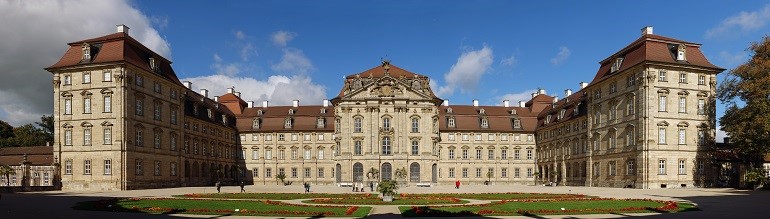
Schloss Weißenstein is an early-18th-century Baroque palace in Pommersfelden commissioned by Lothar Franz von Schönborn, Prince-Bishop of Bamberg and Archbishop of Mainz, and completed in 1718. Designed principally by Johann Dientzenhofer with input from Maximilian von Welsch, the residence is renowned for its three-storey ceremonial staircase, original stucco work by Johann Michael Feuchtmayer and one of Germany’s oldest private picture galleries, which preserves paintings by Rubens, van Dyck and Dürer. Still owned by the Schönborn family, the estate opens to visitors from spring to autumn, offering guided tours of its state rooms, chapel and landscaped park that combines formal Baroque terraces with later English-style grounds. Situated about 20 km south-west of Bamberg and conveniently reached via the A3 and A73 motorways, the palace fits easily into day excursions from Nuremberg, Würzburg or Munich.
Interesting Facts about Weißenstein Palace
- Schloss Weißenstein was built between 1711 and 1719 as a private summer residence for Lothar Franz von Schönborn, Prince-Bishop of Bamberg and Archbishop of Mainz, using his personal wealth rather than church funds.
- The palace's name "Weißenstein" (meaning "white stone") derives from the colour of the local sandstone materials used in its construction.
- The grand staircase at Schloss Weißenstein was the first Baroque-style stairway ever built in Germany, personally designed by Count Lothar Franz himself.
- The palace was constructed by a remarkable team of architects including Johann Dientzenhofer (who had built Fulda Cathedral), Johann Lukas von Hildebrandt (court architect of Emperor Karl VI), and Maximilian von Welsch.
- Schloss Weißenstein houses one of Germany's largest private Baroque art collections, featuring approximately 500-600 paintings by masters such as Rembrandt, Rubens, Titian, Dürer, van Dyck, and Artemisia Gentileschi.
- The palace remains in the ownership of the Schönborn family after more than 300 years and is still used as their summer residence today.
- During the Seven Years' War, Prussian troops attacked and damaged the palace, but it was subsequently restored and survived Europe's many other conflicts.
- The original Baroque park was transformed into an English landscape garden in the early 19th century, following a plan by Balthasar Neumann that was only partially realised.
- Count Lothar Franz von Schönborn helped secure the election of Emperor Karl VI in 1711, who rewarded him with a gift of 100,000 gulden that helped fund the palace's construction.
- The palace is considered a masterwork of Baroque architecture and remains one of the best-preserved Baroque palaces in the world.
- To preserve the palace for future generations, it was integrated into a non-profit foundation in 1996 by the Schönborn family.
- The interior artwork was completed in 1723, featuring contributions from renowned artists including Johann Michael Rottmayr, Johann Rudolf Byss, and Giovanni Francesco Marchini.
History
Schloss Weißenstein stands as one of Germany's most magnificent Baroque palaces, constructed between 1711 and 1719 in the village of Pommersfelden, Bavaria. The palatial residence was commissioned by Lothar Franz von Schönborn, Prince-Bishop of Bamberg and Archbishop of Mainz, who financed the ambitious project from his personal wealth. The construction was made possible partly through a generous gift of 100,000 gulden from Emperor Karl VI, whom Schönborn had helped secure election in 1711. Built as a private summer residence, the palace was designed by a distinguished team of architects including Johann Dientzenhofer, who had previously worked on Fulda Cathedral and the church at Kloster Banz, and Johann Lukas von Hildebrandt, the court architect of Emperor Karl VI. The palace takes its name from the local sandstone materials used in its construction, whose distinctive colour earned it the designation "white stone".
The architectural significance of Schloss Weißenstein cannot be overstated, as it represents a masterwork of Baroque architecture with several pioneering features. Most notably, the palace boasts Germany's first grand stairway built in the Baroque style, personally designed by Count Lothar Franz himself and spanning three floors. The staircase hall, conceptually designed as a grand room with plans first drawn up in 1712, was later reworked by Johann Lucas von Hildebrandt. The palace's interior decoration was completed in 1723, featuring contributions from renowned artists including Johann Michael Rottmayr, Johann Rudolf Byss, and Giovanni Francesco Marchini. Prince-Bishop Lothar Franz, a passionate art collector, assembled an impressive gallery containing approximately 500 paintings, including outstanding Italian and German works as well as Dutch and Flemish masterpieces from the 16th to 18th centuries. The collection features works by renowned masters such as Rubens and van Dyck.
Following Lothar Franz von Schönborn's death in 1729, the palace passed to his nephew Friedrich Karl von Schönborn, who commissioned the expansion of the park, though plans by Balthasar Neumann were only partially realised. The palace weathered the Seven Years' War, during which it was attacked and damaged by Prussian troops, yet remarkably survived without complete destruction. In the early 19th century, the formal Baroque gardens were transformed into an English landscape garden, reflecting changing tastes of the period. The palace has remained in the Schönborn family for over 300 years, serving as their summer residence to this day. Minor restoration work was undertaken in the late 19th century, followed by more comprehensive preservation efforts between 1975 and 2003. In 1996, the palace was integrated into a non-profit foundation by the family to ensure its preservation for future generations.
Description
The Palace Architecture
Exterior Design and Construction
The palace presents a striking façade constructed from local sandstone, whose light colour gave rise to the name "Weißenstein" (white stone). Built between 1711 and 1719, the main building (corps de logis) is elegantly flanked by two wings that open towards an inner courtyard through graceful arcades. The central pavilion of the main wing sits prominently on a pedestal-like ground floor, featuring two full upper floors with tall, impressive windows.
The façades are adorned with light grey sandstone, whilst sculptures and window frames are crafted from distinctive yellow-greenish sandstone. The triangular gable facing the garden displays the Schönborn family coat of arms, flanked by colossal statues of Endymion and Diana. The gable is crowned by a statue of Atlas holding up the sky, creating a dramatic silhouette against the Bavarian countryside.
Sculptural Decoration
Four magnificent sculpture groups in sandstone grace the ground floor of the main pavilion, likely crafted by Burkard Zammels who worked at the palace between 1718 and 1720. On the garden front, visitors can admire statues depicting Pluto and Proserpina on the left, and Apollo and Daphne on the right. The courtyard side features allegorical figures representing Justice & Victory and Vigilance & Truth. A charming detail includes a carved dog wearing a collar with the initials "LFC", referring to the builder, Lothar Franz Churfürst.
The Grand Staircase
The palace's most celebrated architectural feature is its grand staircase, which extends through all three floors of the main pavilion and was the first such Baroque staircase structure built in Germany. As suggested by Johann Lukas von Hildebrandt, galleries overlook the stairwell on both upper floors, creating a sense of theatrical grandeur and transforming the space into a monumental vaulted hall.
The staircase hall features a magnificent ceiling fresco by Johann Rudolf Byss from 1713, depicting the four then-known continents arranged around a central sun wagon of Phoebus Apollo. The space is further enhanced by sculptures of Jupiter, Juno, Urania and Cosmos created by Zammels, whilst decorative vases, putti and pairs of children by P. Benkert and his workshop add delicate detail. The stucco work throughout was executed by Daniel Schenk, and painted railings that extend the real architectural features were created by Giovanni Francesco Marchini.
Interior Splendours
The Marble Hall (Marmorsaal)
The first floor houses the palace's main hall, the Marmorsaal, which faces the garden. This impressive space features pilasters and columns of red stucco marble set against green walls. Stucco figurines by Zammels depicting allegories of various monarchies adorn the window sills - the Turkish and Persian monarchies on the inner wall and the Roman and Greek monarchies on the outer wall. In the corners, the Four Ages are represented.
The ceiling fresco by Franz Michael Rottmayr shows Aurora being greeted by Juno, Venus and Dionysus, with virtues of Justice, Strength, Industry and Wisdom displayed on each wall. The stucco work by Daniel Schenk features putti, vases and eagles, creating a harmonious blend of architectural and decorative elements.
The Garden Hall (Gartensaal)
The ground floor Gartensaal showcases remarkable trompe-l'œil work by Giovanni Francesco Marchini, accessed between the two flights of stairs. The western hall features painted Ionic columns flanking views of idealised Italian landscapes beneath skies populated by Flora and Pomona floating on clouds. The eastern hall presents painted columns offering views of angels facing a "collapsing" entryway.
The central hall was transformed into an enchanting grotto by Georg Hennicke, who applied semi-precious stones and seashells to the walls, complemented by various animal and putti figures. Four larger-than-life stucco statues represent the four elements, created by Burkard Zammels. The ceiling fresco showing the allegorical "times of the day" was painted by Johann Jakob Gerbhardt.
The Palace Gallery and Collections
The right wing houses an extraordinary gallery of paintings and library, featuring stucco work by D. Schenk and G. Hennicke completed after 1713. The gallery walls are completely covered with paintings hung in up to four vertical rows, showcasing a remarkable collection of contemporary works, many of them Dutch. Lothar Franz von Schönborn especially treasured paintings of members of his family, of the Habsburgs and other rulers, and rare animal motifs.
The palace also displays an impressive collection of East Asian porcelain delivered en masse by members of the Jesuits whom Schönborn supported. Other notable collections include Delft faiences, glassware and seashells. The palace chapel features three significant works of art: an Italian Lamentation of Christ from the 17th century, a Spanish Man of Sorrows from around 1730, and a late-Gothic Mother of God.
The Hall of Mirrors
Among the palace's notable features is the Hall of Mirrors, designed by the cabinetmaker Ferdinand Plitzner. This represents Germany's oldest intact mirror cabinet, showcasing the sophisticated craftsmanship and luxury that characterised the Baroque period.
The Shell Room
The palace contains an ornate 'Shell Room', which is normally closed to the public but represents one of the most extraordinary decorative spaces within the palace. This room exemplifies the Baroque fascination with exotic materials and elaborate ornamentation.
The Marstall (Stables)
The Marstall building, located south of the main courtyard, presents a concave front facing the courtyard and is connected to the palace wings by wrought-iron railings. Built by Johann Dientzenhofer based on plans by Maximilian von Welsch between 1714 and 1717, it was constructed with one floor fewer than originally intended.
This elegant structure features double columns adorning the central section, topped by a distinctive clock tower. Below the tower lies an oval hall with a ceiling fresco depicting Perseus and Andromeda by G.F. Marchini. The Marstall demonstrates the comprehensive planning that went into the entire palace complex, ensuring that even utilitarian buildings maintained the highest architectural standards.
The Palace Gardens
Historical Development
The palace grounds have undergone a fascinating transformation over the centuries. Construction of the formal garden was begun by Maximilian von Welsch in 1715. After 1722, on the suggestion of his nephew Friedrich Carl, Schönborn summoned Abraham Huber from Salzburg, who by 1723 had the fountains running. The statuary was added only after Lothar Franz's death in 1741.
Garden Transformation
Originally designed as formal Baroque gardens, they were later converted into an English landscape garden during the early 19th century. Transformation of the formal Baroque garden into an English landscape garden began as early as 1786 under Hugo Damian Erwein von Schönborn-Wiesentheid and was completed in the 19th century. This transformation created a charming contrast between the structured Baroque architecture and the naturalistic garden design.
Garden Features
The gardens feature a magnificent linden avenue planted in 1768 with 200 linden trees from the Aischer Wald, creating a grand approach to the palace. The transformation from formal Baroque gardens to English landscape style has resulted in extensive grounds where deer roam freely near the palace, adding to the pastoral charm of the estate.
The original formal garden design included fountains and statuary, elements that were integrated into the later English landscape design. The gardens provide visitors with peaceful walking paths and varied perspectives of the palace's impressive façade, whilst the park setting offers a tranquil environment for contemplation and leisurely strolls.
Architectural Significance and Collaboration
Weißenstein Palace represents a masterwork of Baroque architecture, showcasing the collaborative genius of renowned architects Johann Dientzenhofer and Johann Lukas von Hildebrandt. The palace was built in a record five years, demonstrating exceptional organisational skills and artistic coordination. The local head of construction was the Jesuit priest Nikolaus Loyson (1676–1720).
The palace demonstrates the sophisticated artistic tastes of the German ecclesiastical nobility and stands as a testament to the cultural achievements of the Baroque period in Bavaria. The building represents European importance in terms of architectural achievement, employing some of the best known architects of the time.
Artistic Contributions
The palace's interior decoration, completed in 1723, features contributions from master artists including Johann Michael Rottmayr, Johann Rudolf Byss and Giovanni Francesco Marchini. This collaborative effort created a unified artistic vision that seamlessly blends architecture, painting, sculpture and decorative arts into a harmonious whole. The viewer is presented with an aesthetic cornucopia comprising painting, plasterwork, and architecture.
The staircase hall was conceptually designed as a grand room, with Dientzenhofer first drawing up plans in 1712. His original idea for the ceiling was a vast fresco, with stairs running around to open up the scenes optically to the observer. A year later, the plans were handed over to Johann Lucas von Hildebrandt for reworking.
Historical Context and Legacy
The palace was commissioned by Lothar Franz von Schönborn, Prince-Bishop of Bamberg and Archbishop of Mainz, as a private summer residence, paid for from his personal wealth. In 1711, he had helped ensure the election of Karl VI who rewarded him with a gift of 100,000 gulden. This financial support enabled the construction of one of Germany's most magnificent Baroque palaces.
After Lothar Franz's death in 1729, the palace passed to his nephew Friedrich Karl von Schönborn who had the park expanded. During the Seven Years' War, the palace was attacked and damaged by Prussian troops. Minor restoration work was undertaken in the late 19th century, with more comprehensive preservation work carried out between 1975 and 2003.
The palace remains a private residence of the Schönborn family whilst serving as a remarkable example of preserved Baroque grandeur. It has been occupied by the same family since its construction in the 18th century: the House of Schönborn. The palace continues to offer visitors an authentic glimpse into the refined world of 18th-century German court culture, representing not just architectural achievement but also the cultural aspirations and artistic patronage of the German ecclesiastical nobility.
Today, Weißenstein Palace stands as one of Germany's greatest Baroque buildings, featuring prominently in popular culture including the Netflix series The Empress, where it serves as a principal royal residence. The palace's enduring appeal lies in its successful integration of architectural grandeur, artistic excellence, and historical significance, making it an essential destination for understanding the cultural heritage of Baroque Germany.
Getting There
Schloss Weißenstein, located in the charming village of Pommersfelden in Bavaria's Upper Franconia region, is easily accessible by various transport methods. By car, the castle sits conveniently near the A3 motorway - simply take the Pommersfelden exit and follow the B505 towards Bamberg, then look for the brown tourist signs directing you to Schloss Weißenstein. For public transport, the most practical route involves taking a train to either Bamberg (18 minutes away) or Nuremberg (approximately 40km distance), followed by local bus connections. From Bamberg, a taxi to the castle costs between €50-€65 and takes about 18 minutes. The nearest bus station to the castle is conveniently named "Schloß Weißenstein" and requires only a 4-minute walk to reach the palace grounds. For those preferring a scenic approach, the castle is accessible via hiking trails from Pommersfelden village, offering visitors a pleasant walk through the Franconian countryside before arriving at this magnificent Baroque masterpiece. Once there, ample parking facilities are available for both cars and tour buses.
Best Time to Visit
The best time to visit Schloss Weißenstein is during the warmer months from April through October, when the castle is open to the public for guided tours. This magnificent Baroque palace in Pommersfelden operates on a seasonal schedule, remaining closed to visitors from November through March, making the spring-to-autumn period your only opportunity to explore its opulent interiors and impressive art collection. The summer months of June, July, and August offer the most pleasant weather conditions, with temperatures ranging from 13-25°C (56-78°F), creating ideal circumstances for both touring the castle's lavishly decorated rooms and strolling through its English-style park gardens. During these peak months, the castle operates Wednesday through Sunday from 11:00 AM to 5:00 PM, providing ample opportunity to experience the stunning three-storey baroque staircase, the unique grotto room designed for cooling off during hot summer days, and the extensive picture gallery featuring works by Rubens and van Dyck. Visitors should note that the castle can only be accessed through guided tours, and it's advisable to check the official website before travelling, as there may be occasional closures for special events or filming.


