| Contents |
|---|

Introduction
Eberbach Abbey (Kloster Eberbach) is a former Cistercian monastery founded in 1136 by Bernard of Clairvaux. Situated near Eltville am Rhein and roughly 20 kilometres west of Wiesbaden, the complex comprises one of Europe’s best-preserved ensembles of Romanesque and early Gothic buildings. Over the centuries the abbey amassed considerable wealth through viticulture and wool production, and its extensive medieval wine cellars remain in use today under the administration of the Hessian State Wineries. Following secularisation in 1803, the site has served varied functions—including prison, asylum and military recovery home—and now operates as a cultural venue and tourist attraction, offering guided tours, and wine tastings. The interior scenes of the 1985-6 film 'The Name of the Rose' were shot in the abbey.
The abbey serves as one of the two main venues of the Rheingau Musik Festival, an international summer music festival mostly dedicated to classical music.
Interesting Facts about Eberbach Abbey
- Eberbach Abbey was founded in 1136 by Saint Bernard of Clairvaux as the first Cistercian monastery on the east bank of the Rhine.
- The monks of Eberbach Abbey were pioneers of wine-making in the region and helped lay the groundwork for what is now Germany’s world-famous Riesling industry.
- It became one of the largest and richest monasteries in medieval Germany, housing around 100 monks and 200 lay brothers at its peak.
- The abbey showcases stunning Romanesque and early Gothic architecture, with its vast basilica, cloisters, and dormitories still impressively intact.
- Eberbach Abbey's wine cellars, some still in use today, once housed an enormous barrel said to hold up to 100,000 litres of wine.
- The abbey served as a filming location for the 1986 film adaptation of Umberto Eco’s novel "The Name of the Rose".
- After the dissolution of the monastery in 1803, the buildings were used variously as a prison, asylum, and now as a cultural venue and museum.
- The abbey’s vast vineyards, originally the largest in medieval Europe, are currently managed by the state of Hesse and produce some of Germany’s finest wines.
- The monastic complex includes the largest surviving Romanesque secular room in Europe – the lay-brothers’ dormitory, over 80 metres in length.
- Medieval records from Eberbach Abbey, such as the “Oculus Memoriae,” provide invaluable insights into monastic life and property in the 13th century.
History
The history of Eberbach Abbey stretches back nearly nine centuries, beginning with its foundation in 1136 by Bernard of Clairvaux as the first Cistercian monastery on the east bank of the Rhine. The site itself has even earlier monastic origins, as it was initially established around 1116 as an Augustinian canons' monastery by Archbishop Adalbert of Mainz, before being transferred to the Benedictines in 1131. The Cistercian community, led by Abbot Ruthard and comprising twelve monks, transformed the existing settlement into what would become one of medieval Europe's most prosperous religious institutions. The abbey's construction proceeded in stages between 1140 and 1200, creating an impressive complex that showcased both Romanesque and early Gothic architectural styles.
During the medieval period, Eberbach Abbey flourished as one of the largest and most influential monasteries in Germany, with its population reaching an estimated 100 monks and over 200 lay brothers at its height in the 12th and 13th centuries. The abbey's extraordinary wealth stemmed primarily from wine production and wool trading, with the monks cultivating some of the largest vineyards in Europe, covering approximately 300 hectares during the Middle Ages. The Cistercian brothers were instrumental in developing the Rheingau's wine industry, initially growing red grape varieties such as Grobrot before the region became famous for its Riesling production. From Eberbach, the Cistercians established numerous daughter houses, including Schönau Abbey near Heidelberg in 1142, Otterberg Abbey in the Palatinate in 1144, and Arnsburg Abbey in the Wetterau in 1174. The abbey also gained fame for housing an enormous wine barrel around 1525, with a capacity estimated between 50,000 and 100,000 litres, which was notably emptied by rebellious peasants during the German Peasants' War.
The abbey's decline began with the devastation of the Thirty Years' War, when Swedish forces attacked in 1631, forcing the monks to flee and leaving only 20 to return in 1635 for reconstruction. Despite a period of economic recovery in the 18th century, the French Revolution ultimately sealed the monastery's fate. On 18 September 1803, Eberbach Abbey was formally dissolved through the Reichsdeputationshauptschluss and became the property of Prince Friedrich Augustus of Nassau-Usingen. After secularisation, the buildings served various secular purposes, including functioning as an asylum until 1873 and as a prison until 1912. Today, the remarkably well-preserved complex operates as a cultural centre and event venue, gaining international recognition as the filming location for Umberto Eco's "The Name of the Rose" in 1985-1986. The state of Hesse has maintained the vineyard operations, whilst a non-profit foundation has overseen the conservation of the historical buildings since 1998.
Description
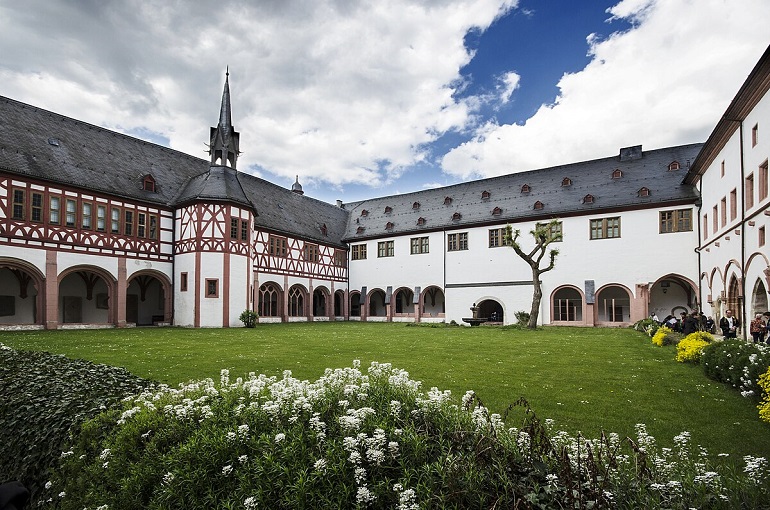
Eberbach Abbey rests tranquilly amid the vine-clad slopes of the Rheingau, its pale-stone façades and graceful arcades a serene counterpoint to the bustle of modern life. The long, low silhouette of the former Cistercian complex unfolds beside the Rhine, its architecture spanning the transition from sturdy Romanesque to soaring Gothic. A continuous cloister gallery frames an inner courtyard, where clipped box hedges and stone-flagged walkways invite reflective wanderings.
Stepping into the abbey church—an unadorned three-aisled basilica suffused with soft daylight—visitors sense the space’s exceptional acoustics: a whispered footstep carries with clarity, and the faintest note lingers in the vaulted ceiling long after it is sung. Beyond the nave, the only surviving medieval stained-glass window glows in tones of grey and lead, a testament to the Cistercian ideal of simplicity.
Across the cloister, the former monks’ dormitory stretches nearly 75 metres, its gently rising floor creating an optical illusion of vastness. Today its empty expanse is punctuated by occasional exhibitions or installations, allowing the full scale of the hall to be appreciated without distraction. Adjoining this is the former warming room, where the grisaille glazing lends a hushed ambience to the chamber’s pointed arches.
In the monks’ refectory, rich plasterwork and decorative stucco attest to later Baroque influence, while robust wooden tables hint at communal meals now long past. Opposite, the chapter house’s star-vaulted ceiling encloses stone benches once occupied by the monastic community—a quiet space that now hosts cultural events beneath its elegant ribs.
Perhaps the Abbey’s most distinctive character emerges underground, in the cool, vaulted wine cellars. Ancient presses and rows of stone arches extend for hundreds of metres, their cool, dimly lit passages still in use by the Hesse State Wineries. Here, tastings range from crisp Rieslings to fuller whites, each sip evoking centuries of vine cultivation that continues to this day.
Getting There
By train Eberbach Abbey is best accessed from Frankfurt by taking a regional train to Eltville station. Once at Eltville, you can enjoy a pleasant walk of about 30 minutes or, for greater ease, transfer to the hourly bus 172 which will take you directly to the Kloster Eberbach stop. This makes rail travel both scenic and straightforward, with clear signposting at Eltville station to guide you.
By bus From Eltville station, the local bus line 172 departs hourly and provides a direct connection to the Kloster Eberbach stop, situated near the Abbey grounds. This convenient bus service ensures visitors can seamlessly continue their journey from the train or reach the monastery from Eltville or nearby towns, minimising walking distance while keeping the trip stress-free.
By car Arriving by car, follow the A66 and B42 from Frankfurt or Wiesbaden towards the Rheingau region, exiting at Kiedrich where signs to Kloster Eberbach are clearly marked. Continue on local roads through Kiedrich, following the brown “Kloster Eberbach” signs until the abbey comes into view in a picturesque valley. Ample signposting along the route ensures a straightforward and enjoyable drive.
Best Time to Visit
The ideal time to explore Eberbach Abbey is in late spring (May to June) or early autumn (September to October), when the weather is, the surrounding vineyards are either in full bloom or heavy with ripening grapes, and visitor numbers remain relatively low. During these shoulder-season months, daytime temperatures hover comfortably around 15–25 °C, perfect for wandering the cloisters and wine cellars without the summer crowds. Weekdays—particularly early mornings or late afternoons—offer an even quieter, more contemplative experience, allowing you to savour the Abbey’s tranquillity, its centuries-old architecture, and the fragrant vines at their most photogenic.