Germany Guide  |
|---|
|
| | Top German Cities |
|---|
|
| | Top National Parks |
|---|
|
| | Photos |
|---|
|
| | German States |
|---|
|
| | Europe Guide |
|---|
|
| | Travel Tools |
|---|
|
|
|
|
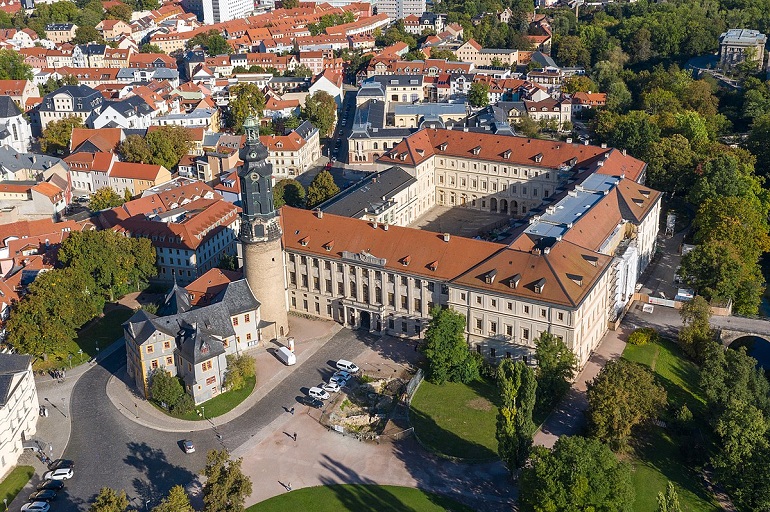 Aerial view of Weimar's City Palace. Aerial view of Weimar's City Palace.
Introduction

With a land area of 16,172 km² and 2.2 million inhabitants, Thuringia (Thüringen in German) is the smallest and second least populous state of former East Germany. Its capital is Erfurt.
The state's most famous city is undeniably Weimar. Capital of Germany between 1919 and 1933, it was the place where the nation's first democratic constitution was signed after WWI. From 1772 to 1805, a cultural and literary movement known as Weimar Classicism attempted to establish a new humanism by synthesizing Romantic, classical and Enlightenment ideas, with writers Goethe and Schiller as their most famous representatives. Weimar was also the birthplace of the Bauhaus movement, founded in 1919 by Walter Gropius, with artists Wassily Kandinsky, Paul Klee, Oskar Schlemmer, and Lyonel Feininger teaching in Weimar's Bauhaus School.
With the Hainich National Park and the Thuringian Forest taking up most of the west and south of the state, Thuringia has earned the nickname of 'green heart of Germany'. The country's most famous hiking trail, the Rennsteig, runs through the Thuringian Forest and Thuringian Highland, and marks the traditional boundary between the medieval Duchy of Franconia with the Landgraviate of Thuringia.
The winter sports centre and health resort of Oberhof has held many European and World Luge Championships. Germany has won more Winter Olympics gold medals than any other country in the last 20 years, and half of Germany's gold medals have been won by Thuringian athletes.
The illustrious royal house of Saxe-Coburg-Gotha, to which belongs the British and Belgian royal families, and the former royal families of Portugal and Bulgaria, originated in the so-called Saxon duchies of Thuringia. With the division of the House of Wettin in 1485, Thuringia went to the senior Ernestine branch of the family, which subsequently subdivided the area into a number of smaller states, according to the Saxon tradition of dividing inheritance amongst male heirs. Among them were the states of Saxe-Weimar, Saxe-Eisenach, Saxe-Jena, Saxe-Meiningen, Saxe-Altenburg, Saxe-Coburg, and Saxe-Gotha, named after the Thuringian towns in which each was based. Note that Coburg, now in Bavaria, was a Thuringian town until 1920.
History of Thuringia
Early Origins and Medieval Development
Thuringia's history stretches back to ancient times, with the region taking its name from the Thuringii, a Germanic tribe that occupied the area around 300 CE. The Germanic Thuringians first appeared after approximately 350 AD and were conquered by the Huns in the second quarter of the 5th century. By 500 CE, they had established a large kingdom stretching from the Harz mountains to the Danube. This expansive realm came to an abrupt end in 531 AD when their king, Irminfrid, was defeated at Burgscheidungen on the Unstrut River by the Frankish kings Theodoric I and Chlotar I, reducing their territory to the Harz mountains and Thuringian Forest region under Frankish rule. The Frankish Duchy of Thuringia was formally established around 631 AD by King Dagobert I. During the early 8th century, the duchy was divided into countships to reassert royal authority, and St. Boniface converted the Thuringians to Christianity. In 908, the Thuringian March, a frontier district established by Charlemagne against the Slavs, was seized by Otto, duke of Saxony, whose son Henry I later halted a Magyar invasion at Riade in 933.
The Wettin Dynasty and Religious Transformation
Thuringia became a landgraviate in 1130 CE when the grandson of Louis the Bearded of the Ludowing family was made landgrave by King Lothar II. After the extinction of the reigning Ludowingian line in 1247 and the subsequent War of the Thuringian Succession (1247-1264), the western half broke away to become independent Hesse. Most of the remaining territory came under the rule of the Wettin dynasty through Henry III (the Illustrious), margrave of Meissen, who invested his son Albert with Thuringia in 1265. The Wettins would control Thuringia for centuries, and with the division of the house of Wettin in 1485, the region went to the senior Ernestine branch, which subdivided it into numerous smaller states known as the "Saxon duchies," including Saxe-Weimar, Saxe-Eisenach, Saxe-Jena, Saxe-Meiningen, Saxe-Altenburg, Saxe-Coburg, and Saxe-Gotha. Thuringia embraced the Protestant Reformation, with Roman Catholicism being suppressed as early as 1520. Churches and monasteries were largely destroyed, particularly during the German Peasants' War of 1525, and Catholic priests were driven away. The Catholic faith only survived in the Eichsfeld district, ruled by the Archbishop of Mainz, and to a small degree in Erfurt.
Modern State Formation and 20th Century Upheavals
The modern state of Thuringia was established in 1920 during the Weimar Republic through the merger of seven Thuringian free states: Saxe-Weimar-Eisenach, Saxe-Meiningen, Saxe-Altenburg, Saxe-Gotha, Schwarzburg-Rudolstadt, Schwarzburg-Sondershausen, and the People's State of Reuss. Weimar became the capital of this newly unified state, which covered 11,763 square kilometres. However, the borders remained complex, with Erfurt still attached to the Prussian province of Saxony and various enclaves scattered throughout the region. After World War II, Thuringia fell under Soviet occupation and became part of East Germany, with rationalised frontiers and Erfurt as the new capital. In 1952, the East German government dissolved the state system, dividing Thuringia between the districts (Bezirke) of Erfurt, Suhl, Gera, Halle, and Leipzig. The state was formally dissolved in December 1958. Following German reunification, Thuringia was reconstituted as a federal state in 1990 with boundaries similar to its post-World War II predecessor, formed from the former East German districts of Suhl, Erfurt, and Gera, plus small parts of the Leipzig and Halle districts.
|
Clickable Tourist Map of Thuringia
Note that dots, castle icons and national parks are not clickable on the mobile version. Please use the desktop version for optimal navigation. Blank map of Saxony by Grundkarte TUBS, Relief by Alexrk2. Tourist locations by Maciamo. CC BY-SA 3.0.
Attractions
Attractions are listed geographically, from west to east (left to right) and north to south (top to bottom).
Northwest Thuringia
| Hainich National Park |
|---|

 Hainich National Park offers visitors the chance to explore Germany's largest contiguous deciduous forest through its renowned 540-metre canopy walkway, which provides elevated views above ancient beech trees that represent some of Europe's last remaining primeval woodlands. The park's unique character stems from its unusual history as a restricted Soviet military zone until 1991, which inadvertently preserved vast areas of undisturbed forest that now showcase natural woodland succession rarely seen in Central Europe. Beyond the treetop trail, attractions include the Wildcat Village with its rare European wildcat enclosures, adventure trails featuring German folklore at 14 themed stations along the Fairytale Nature Path, and the 44-metre Hainichblick observation tower. |
| Eisenach ※ |
|---|

 Set in the northern foothills of the Thuringian Forest, the charming Renaissance town of Eisenach (pop. 42,500) is famous for being the birthplace of Johann Sebastian Bach. Martin Luther spent his childhood here too, and spent ten months in hiding at Wartburg Castle, where he translated the New Testament from Greek to German, the first translation into a modern language in over a millennium. Richard Wagner's opera Tannhäuser is based on the famous Minstrels' Contest that took place at Wartburg around 1207. |
| Mühlhausen |
|---|

Once a Free Imperial City, Mühlhausen (pop. 36,000) is one of the oldest towns in Thuringia. It is still enclosed with its 3 km long city wall and has a good number of timber-framed houses. The town served as an important centre during the Middle Ages and features more than ten churches within its old town, including the prominent St. Mary’s Church and St. Blaise’s Church. |
| Bad Langensalza |
|---|

A spa town reputed for its curative sulphur baths, Bad Langensalza (pop. 16,500) will reward visitors with its half-timbered houses, ruined medieval castle, the delightful little Friederikenschlösschen, and several themed gardens, including Japanese and rose gardens. Situated near the Hainich National Park, a UNESCO World Heritage Site, Bad Langensalza also offers visitors opportunities for walking and nature excursions. |
Southwest Thuringia
| Schloss Wilhelmsburg |
|---|

 Wilhelmsburg Castle, situated on a gentle foothill above the medieval town of Schmalkalden, was erected between 1585 and 159 as a secondary residence for Landgrave William IV of Hesse-Kassel. Designed in the late Renaissance style with a nearly square, four-winged layout, the castle remains largely unaltered since its completion in 1618. Unimpressive from the outside, the castle's interior is beautifully decorated by Renaissance murals and stucco. |
| Meiningen |
|---|

 Capital of the Duchy of Saxe-Meiningen from 1680 to 1918, Meiningen (pop. 25,000) is a town of culture renowned for its theatre and orchestra. The Meiningen Court Orchestra, one of the oldest orchestras in Europe, was founded in 1690 by Duke Bernhard I with Hans von Bülow as conductor (and later Richard Strauss and Max Reger). The ducal palace, Elisabethenburg, houses the Music Museum as well as important Renaissance art collections. |
Central Thuringia
| Erfurt |
|---|

 Erfurt (pop. 216,000), the capital of Thuringia, is a city known for its well-preserved medieval old town. Once called the "Thuringian Rome", the city is home to numerous notable landmarks including the impressive Erfurt Cathedral and St Severus Church, both located on Cathedral Hill. The Krämerbrücke, a medieval bridge lined with half-timbered houses, is one of the city’s most famous sights. The University of Erfurt, dating back to 1379, was the first university in what is now Germany. C |
| Gotha |
|---|

An attractive historic town, Gotha (pop. 46,000) was the capital of the Duchy of Saxe-Gotha from 1640, the the co-capital of the Duchy of Saxe-Coburg-Gotha from 1826 to 1918. The main sight is the grand, monumental Schloss Friedenstein, the former ducal palace. Erected between 1643 and 1655, it is Germany's oldest baroque palace and houses the oldest surviving baroque theatre in the world. Gotha also has a well-preserved old town, with notable buildings such as the town hall and St. Margaret’s Church. |
Other attractions
Friedrichroda
 Ilmenau
| Weimar ※ |
|---|

Cultural capital of the German Enlightenment, first democratic capital of Germany, and cradle of the Bauhaus movement, Weimar (pop. 65,000) has a lot to be proud of. Yet this modest town is not the country's most beautiful one, nor does it have any breathtaking sight. Weimar's attraction is more intellectual, a sort of pilgrimage site for the German nation in the footsteps of Goethe, Schiller and others. |
| Heidecksburg Palace |
|---|

Heidecksburg Palace stands on a rocky spur 60 metres above the historic town of Rudolstadt in Thuringia. Originally founded in the 13th century, the present three-winged Baroque palace was built after a fire in 1735 under Prince Friedrich Anton of Schwarzburg-Rudolstadt to the designs of Johann Christoph Knöffel and completed by Gottfried Heinrich Krohne. Today it houses the Thuringian State Museum, with richly decorated Rococo and Baroque interiors, a porcelain gallery, a historical armory and the “Rococo en miniature” exhibition. |
| Saalfeld |
|---|

The historical town of Saalfeld (pop. 29,000) is situated on the Saale River about 48km south of Weimar and just north of the Thuringian Highland. Documented since 899, Saalfeld is among Thuringia’s older towns and retains a compact, walkable historic centre within medieval walls. It is especially known for its Feengrotten (Fairy Grottoes), 1.5 km out of town, listed by the Guinness Book of Records as the world's most colourful grottoes. |
| Dornburger Schlösser |
|---|

Perched dramatically on a shell limestone cliff 90 metres above the meandering Saale Valley, the Dornburger Schlösser comprise one of Thuringia's most remarkable architectural ensembles. This unique collection of three palaces, each representing a different historical era, offers visitors an extraordinary journey through centuries of German architectural evolution whilst providing breathtaking panoramic views across the surrounding countryside. |
| Jena |
|---|

Situated along the Saale River, Jena (pop. 100,000) is Thuringia's second largest city. It is known for its strong academic heritage as the home of Friedrich Schiller University, founded in 1558, and for its historical significance in scientific research and optics, with companies like Carl Zeiss and Schott AG originating there. |
| Schloss Leuchtenburg |
|---|
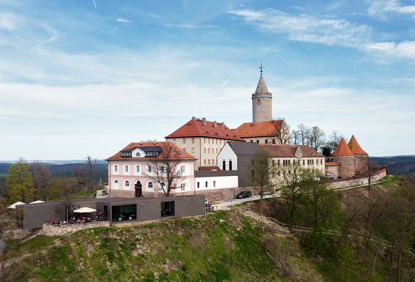
Leuchtenburg Castle stands on a wooded hilltop 400 metres above the Saale Valley near the village of Seitenroda, close to Kahla in central Thuringia. First in the early 13th century as the seat of the Lobdeburg family, the castle ensemble has been restored to retain its medieval ramparts, towers and curtain walls. Today it houses a museum dedicated to Thuringian porcelain, including the immersive Porcelain Worlds exhibition and the 20-metre Skywalk of Wishes, alongside a traditional castle restaurant. |
Eastern Thuringia
| Altenburg Palace |
|---|
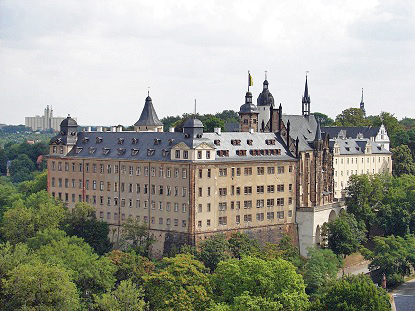
Altenburg Palace, or Residenzschloss Altenburg, stands on a porphyry hill overlooking the town of the same. Originating as medieval castle, it became the ducal residence of Saxe-Altenburg and reflects nearly a millennium of architectural styles, from its Gothic palace church of St George (completed in 1414) to its Baroque state apartments remodelled in the 18th century. |
| Greiz |
|---|
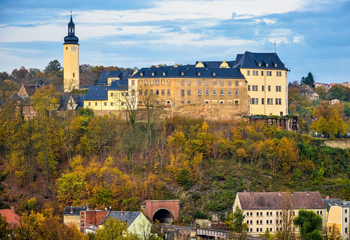
Greiz (pop. 20,500), the former seat of the Principality of Reuss-Greiz until 1918, is located approximately 100km east of Erfurt on the White Elster river. Noteworthy for its historical architecture, Greiz features the Upper Castle (Oberes Schloss), Lower Castle (Unteres Schloss), and the Summer Palace, as well as an extensive central park designed in the English garden style. |
|




 : Local interest
 : Moderately interesting
 : Outstanding place
 : Must-see in the country
 : Top cities in Europe