



| Contents |
|---|

Introduction
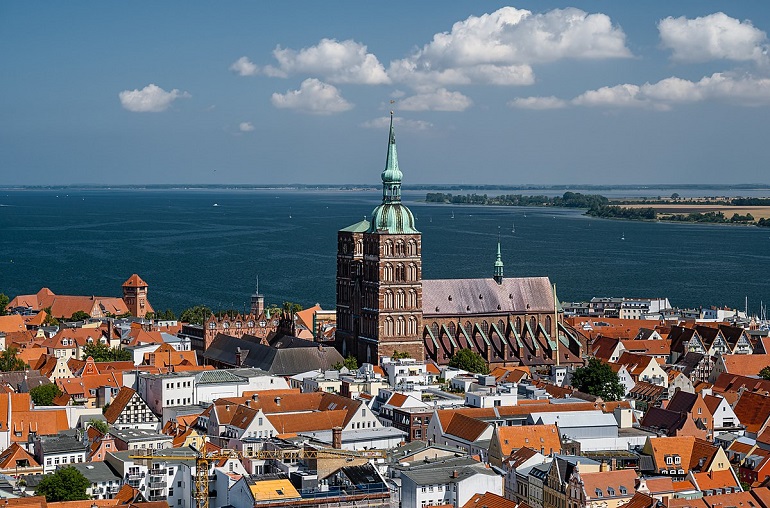
Stralsund (pop. 59,000) is a historic city enjoying a unique location on an inlet of the Baltic Sea separating the island of Rügen from the mainland. It the late Middle Ages Stralsund was the second most powerful port of Hanseatic League after Lübeck. It The old town is almost completely surrounded by water and is recognised as a UNESCO World Heritage Site for its significant Brick Gothic architecture. In addition to its historical centre, Stralsund is home to the German Oceanographic Museum and its popular aquarium, the Ozeaneum, which focuses on the marine life of the North and Baltic Seas.
Interesting Facts about Stralsund
- Stralsund belonged to Sweden between 1648 and 1815.
- Granted city rights in 1234, Stralsund rose to prominence as a powerful Hanseatic trading city in the 14th and 15th centuries.
- St Mary’s Church was the world’s tallest structure from 1625 to 1647, with a tower reaching about 104 metres.
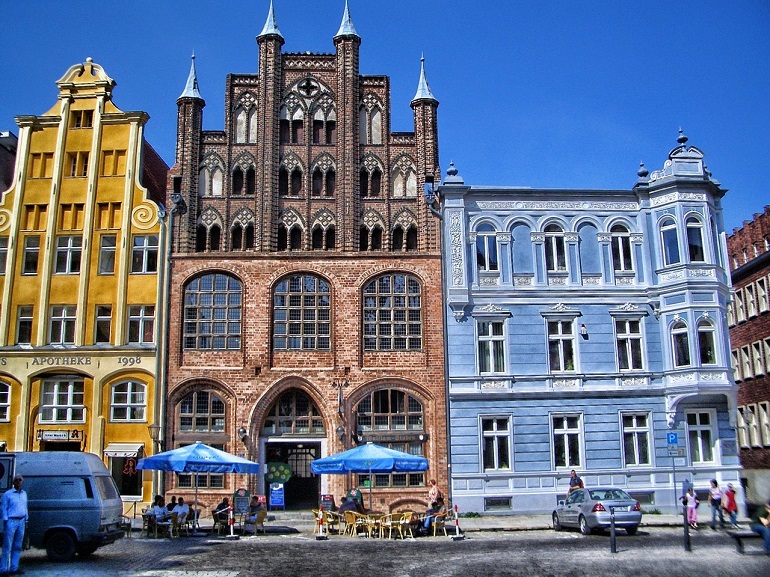
- The Gothic Town Hall on the Alter Markt, begun in the 13th century, is renowned for its ornate show façade symbolising the city’s medieval wealth.
- Stralsund sits on the Strelasund strait and is often called the “gateway to Rügen,” connected to Germany’s largest island by the Rügendamm and the 4.1 km Rügenbrücke (opened 2007).
- The former Gorch Fock I, a German Navy sail training ship, serves as a museum ship in Stralsund’s harbour.
- The Ozeaneum, part of Stralsund’s network of marine museums, was named European Museum of the Year in 2010.
- Elements of Swedish rule (1628–1807) remain visible in buildings like the Baroque Commandantenhus on the Alter Markt.
- Despite heavy damage in World War II, Stralsund preserved its medieval street plan and monumental Brick Gothic churches.
- More than 500 buildings in the Old Town are protected monuments, showcasing styles from Brick Gothic to Renaissance, Baroque, Historicist and Jugendstil.
History
The Medieval Foundation of Stralsund
The coastal city of Stralsund traces its origins to the early 13th century when Prince Wizlaw I of Rügen granted city rights to the settlement known as "Stralow" in 1234, making it the oldest city in Pomerania. Prior to this formal founding, the area was inhabited by West Slavic peoples and featured a fishing village on Dänholm isle, with the name derived from a Slavic word meaning "arrow". The strategic location between the German mainland and Rügen island made Stralsund a natural hub for maritime trade and ferry services to the island. However, the young city's prosperity soon attracted the ire of the powerful Free City of Lübeck, which burnt Stralsund to the ground in 1249. The resilient inhabitants rebuilt their city with formidable defences, including massive town walls, 11 town gates, and 30 watchtowers, whilst also incorporating the Neustadt suburb by 1361.
The Hanseatic Golden Age
In 1293, Stralsund joined the prestigious Hanseatic League, marking the beginning of its golden age as one of northern Europe's most prosperous trading centres. By the 14th century, approximately 300 ships flying Stralsund's flag cruised the Baltic Sea, demonstrating the city's remarkable maritime power and influence. The city became the most important Baltic trading hub aside from Lübeck itself, with wealthy merchants constructing impressive Gothic churches and warehouses that still dominate the skyline today. This period of unprecedented prosperity culminated in 1370 with the signing of the Peace of Stralsund between the Hanseatic League and King Waldemar IV of Denmark, which confirmed the League's dominance over Baltic trade and secured Stralsund's position as a major European port. During this era, the distinctive "Sundische Gotik" architectural style developed between 1330 and 1380, symbolising the city's political power and economic growth within the Hanseatic League.
Swedish Rule and Prussian Integration
The Thirty Years' War brought dramatic changes to Stralsund's political allegiance when the city successfully resisted a siege by Imperial forces under Albrecht von Wallenstein in 1628, with crucial support from Danish and Swedish troops. This defence marked the beginning of Swedish rule, which lasted with brief interruptions from 1648 to 1815, making Stralsund the capital of Swedish Pomerania from 1720. The Swedish period left a lasting Scandinavian influence on the city's culture and architecture, including new defensive works and public buildings. During the Napoleonic Wars, Stralsund changed hands multiple times, being occupied by French forces in 1807 and briefly by Danish troops in 1814 before finally becoming part of the Prussian Province of Pomerania in 1815. The 19th century saw modernisation under Prussian rule, including the arrival of the railway in 1863, whilst World War II remarkably left the city largely intact, preserving its medieval architectural heritage. Following German reunification in 1990, extensive restoration work culminated in 2002 when Stralsund's historic centre was designated a UNESCO World Heritage Site alongside Wismar, recognising its exceptional preservation of Hanseatic urban design and brick Gothic architecture.
Main Attractions
Stralsund Old Town (Altstadt)
The Old Town of Stralsund is a UNESCO World Heritage Site recognised for its dense ensemble of brick Gothic townhouses, churches, and civic buildings arranged on a medieval street grid. Many façades display stepped and curved gables typical of Hanseatic merchant architecture, while narrow lanes link larger squares such as Alter Markt and Neuer Markt. The historic fabric reflects Stralsund’s role as a major Baltic trading hub, with restored warehouses, former guild buildings, and granaries illustrating maritime commerce. The Altstadt is compact and walkable, allowing straightforward routes between ecclesiastical sites, market squares, and the harbour. Plaques and information boards at key buildings provide concise historical context, and the general preservation level makes it suitable for architectural study and urban heritage walks.
Alter Markt (Old Market Square) and Rathaus (Town Hall)
Alter Markt operates as the principal historic square and is bordered by patrician houses and civic monuments from the late Middle Ages to the Baroque period. The Town Hall dominates the eastern side, notable for its perforated brick screen façade with traceried blind arches and integrated coats of arms, a characteristic display element of North German Gothic civic architecture. Arcaded ground floors historically sheltered market activity and provided covered circulation. The square remains an orientation point in the city plan, with sightlines to major churches and access to adjacent streets containing further merchant dwellings. Seasonal markets and civic functions continue to use the space, maintaining its traditional role as an administrative and commercial centre.

Wulflamhaus
The Wulflamhaus on Alter Markt is a mid-14th-century patrician residence built in brick Gothic style, easily identified by its prominent gable articulation and decorative brickwork. Historically associated with the Wulflam family, the building underscores the wealth and civic involvement of merchant elites in Stralsund. The façade’s vertical emphasis and blind-arcade patterns align with contemporary Hanseatic design language, while the internal plan reflects combined residential and representative functions typical of urban patrician houses. Its continued use maintains the continuity of the square’s historic building stock.
Raths-Apotheke and Historic Commercial Frontages
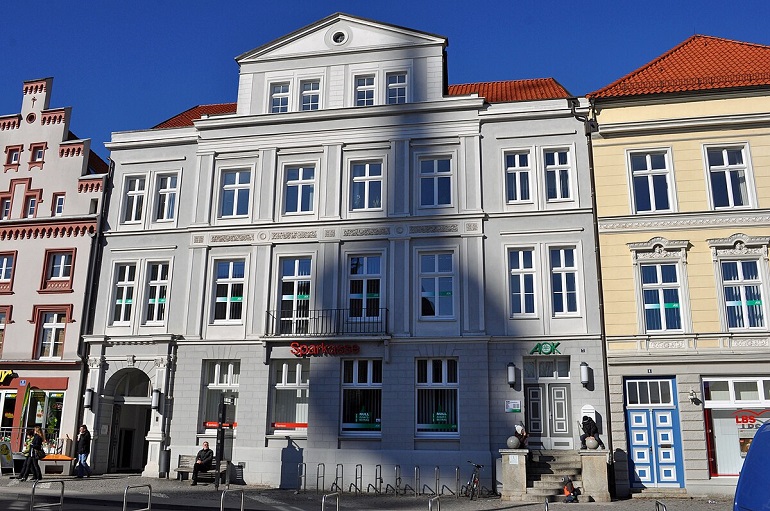
The Raths-Apotheke near the market area exemplifies the continuity of commercial use in central plots associated with civic functions. The building’s frontage, signage, and interior adaptations demonstrate the interface between historic structures and ongoing retail operations. Observing these properties in sequence around the market squares helps explain how service-oriented trades embedded themselves within the medieval street network and persisted through later urban reforms.
Neuer Markt and Holy Spirit Heiliggeistkloster Ensemble
Neuer Markt is a secondary historic square framed by townhouses and municipal buildings that illustrate the city’s growth beyond the immediate vicinity of Alter Markt. Close by, the Heiliggeistkloster complex, historically a hospital and charitable institution, represents medieval social infrastructure with monastic buildings arranged around courtyards. Surviving ranges display brick construction with simple Gothic openings and later Baroque adaptations. The ensemble offers insight into healthcare and poor relief in a Hanseatic city, with utilitarian architecture contrasting with the grandeur of the churches and Rathaus.
Historic Gabled Houses on Mönchstrasse and Ossenreyerstrasse
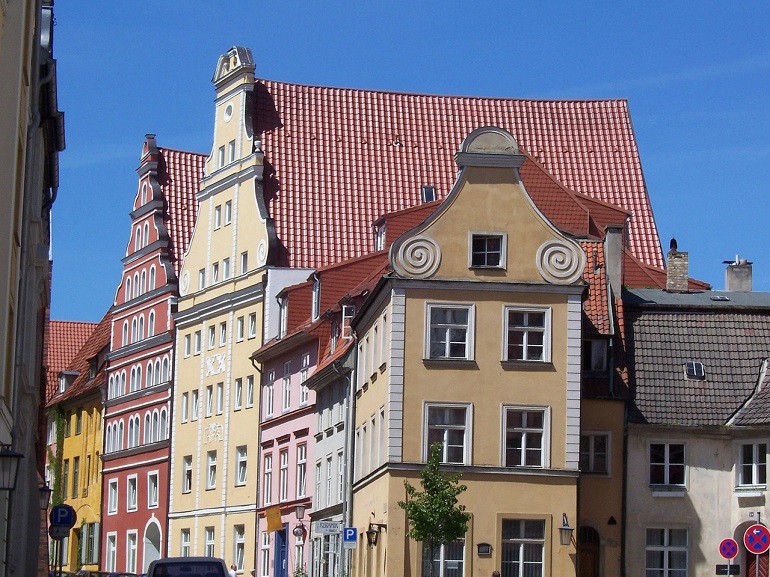
Mönchstrasse and Ossenreyerstrasse contain sequences of medieval and early modern gabled houses with varied roof pitches and façade ornamentation that convey the development of bourgeois domestic architecture. Plot widths and building depths illustrate historic parcel structures, while occasional courtyard wings indicate combined residential and workshop functions. Façade restorations often reveal differing brick bonds, limewash residues, and timber elements. Ground floors frequently host contemporary retail, preserving active street frontage in line with historic commercial use.
Stralsund Harbour (Stadthafen)
The Stadthafen extends along the Strelasund strait and has historically facilitated trade, fishing, and shipbuilding. The waterfront includes former warehouses, quays, and mooring facilities, some converted to contemporary uses while retaining original volumes and façades. The harbour setting provides views to the Rügen Bridge and the island of Rügen, and functions as a starting point for scheduled boat tours on the Strelasund. Wayfinding is straightforward along the promenade, with interpretive displays explaining harbour evolution, hydrology of the strait, and the city’s maritime economy. The area is active throughout the day, supporting both working maritime activities and leisure use.
Gorch Fock I
Gorch Fock I is a three-masted barque launched in 1933 as a sail training vessel, now permanently moored as a publicly accessible historic ship. The steel-hulled vessel illustrates early 20th-century naval training practices, including rigging layouts, navigation spaces, crew quarters, and safety features. Onboard interpretation typically covers the ship’s construction, service history, and later preservation. The ship complements the harbour’s industrial and maritime narrative, offering practical examples of sail handling and cadet life. Deck access and interior compartments are generally arranged for self-guided or guided visitation, with safety restrictions in confined areas.

Old Port Warehouses and Granaries
Several historic warehouses and granaries near the water’s edge survive as evidence of storage and transhipment functions central to Hanseatic-era logistics. Their massing, repetitive window openings, and robust brickwork reflect utilitarian design for bulk goods such as grain, salt, and timber. Many have undergone internal adaptation for contemporary uses, but external walls, rooflines, and loading features like hoist beams and large doors frequently remain. The proximity of these buildings to quays illustrates efficient historic urban design for freight handling.

Harbour Cranes and Maritime Equipment Displays
Along the waterfront, preserved or reconstructed cranes and bollards represent historic cargo-handling technology. Their placement illustrates working distances between quay edges, warehouses, and transport routes into the city. Information panels, where present, explain lifting capacities, power sources, and changes from manual to mechanised operations. These elements contribute to an understanding of Stralsund’s logistical systems and the technical evolution of its port infrastructure.
Churches & Monasteries
St Nicholas’ Church (Nikolaikirche)
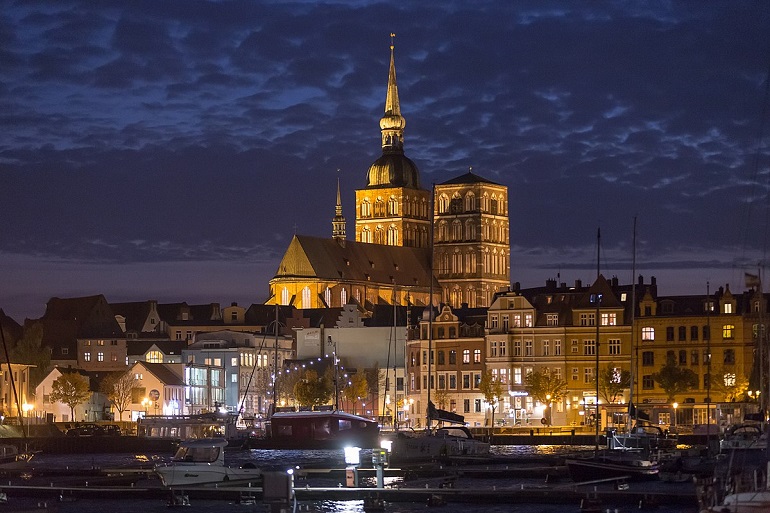
St Nicholas’ Church is a brick Gothic hall church originating in the 13th century, distinguished by its twin-tower west front and a spacious interior with ribbed vaulting. The church historically served the merchant community and incorporates fittings reflecting the city’s trade wealth, including carved altars and period epitaphs. An astronomical clock from the 14th century survives as a noted technical and liturgical artefact, representing medieval timekeeping in a religious context. The plan arrangement, masonry techniques, and decorative brickwork are representative of the Baltic brick Gothic tradition. Access typically includes the nave and aisles, with interpretive materials outlining construction phases and subsequent restorations.
St Mary’s Church (Marienkirche)
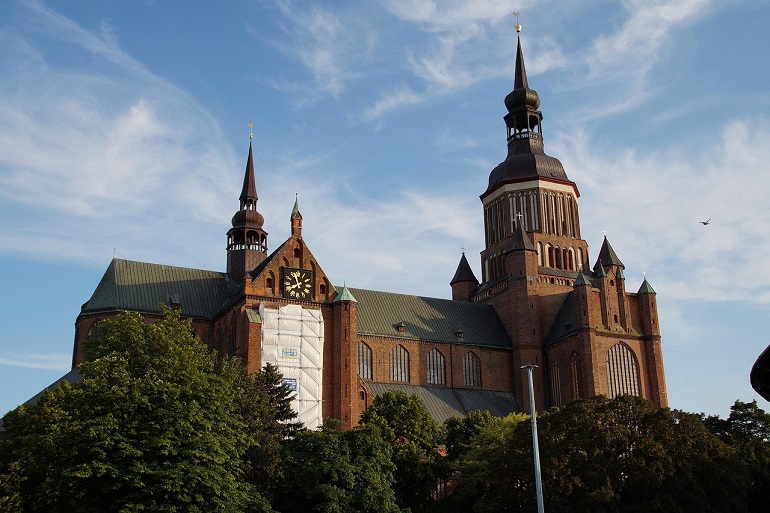
St Mary’s Church, documented by the late 13th century, exemplifies the scale of North German parish churches, with a dominant tower and extensive nave volumes. The structure reflects successive medieval building campaigns, evident in masonry coursing, buttressing, and window tracery variations. Historically recorded as one of the tallest structures of its time, the church tower provides an observation platform with clear views across the Old Town, harbour, and the Strelasund. Interior features include medieval and later-period furnishings, organ installations, and sculptural work typical of large urban parish churches in the Hanseatic sphere. Its prominence in the skyline serves as a visual anchor for urban orientation.
St James’ Church (Jakobikirche)
St James’ Church, another of Stralsund’s medieval parish churches, presents a simpler exterior compared to St Mary’s and St Nicholas’, reflecting its historical parish function and later alterations. The building showcases brick Gothic construction with restrained decorative elements on façades and portals. Over time, the church has undergone adaptive re-use and restoration, with selected interior spaces used for cultural functions when active ecclesiastical use was reduced. The exterior massing contributes to the townscape sequence of towers and gables, and its footprint demonstrates the distribution of parish territories in the medieval city.
Johanniskloster (St John’s Monastery)
Johanniskloster, founded by Franciscans in the 13th century, preserves elements of monastic architecture including cloister walks, refectory spaces, and ancillary buildings adapted over centuries. Surviving Gothic details include pointed arches, brick vaulting, and modest tracery, demonstrating the order’s functional and restrained architectural approach. The complex has experienced phases of secularisation and reuse, with sections accessible for cultural events, exhibitions, and quiet courtyard access. The site contributes to understanding religious institutions’ roles in education, charity, and community life in medieval Stralsund.
St John’s Hospital (Heiligen-Geist-Hospital) Courtyard
The Heiligen-Geist-Hospital complex includes a courtyard and façades representative of medieval charitable institutions, with elongated ranges that once housed hospital wards and associated facilities. Architectural characteristics include simple brick elevations, practical rooflines, and minimal ornamentation consistent with institutional functions. The courtyard setting provides a clear view of building alignments and subsequent adaptations, offering a case study in long-term reuse within a preserved urban framework.
City Fortifications & Gates
Knieper Gate (Kniepertor)
Kniepertor is one of the remaining city gates integrated into Stralsund’s former defensive ring, which once included walls, towers, and ditches. The gate’s brick construction and gateway passage illustrate medieval urban defence strategies and the control of movement and trade through the city perimeter. Nearby stretches of fortifications and earthworks, where preserved or reconstructed, provide a sense of the city’s defensive footprint. The gate’s location aids in reading the historic boundary between the dense medieval core and later suburban extensions.
Kütertor and Northern Fortification Remains
Kütertor is another preserved gate that, together with knee walls and earthworks in the northern sector, contributes to the legibility of Stralsund’s defensive system. The gate exemplifies defensive brickwork, including arrow slits and controlled passage elements. Adjacent open spaces and water features reflect the historic moat and ditch network that complemented the walls. These components collectively show the layered approach to urban defence used in Hanseatic towns, combining masonry barriers with engineered water defences.
Other Sights
Rügen Bridge (Rügenbrücke) and Rügendamm
The Rügen Bridge, a cable-stayed structure opened in the early 21st century, and the older Rügendamm causeway and bridge system together form the fixed link between Stralsund and the island of Rügen. The modern bridge provides a high navigational clearance for maritime traffic and is visible from various harbour vantage points. The ensemble demonstrates the evolution from rail and road causeways to contemporary multi-lane infrastructure. Pedestrian viewpoints along the harbour and shoreline offer clear perspectives on the bridge’s pylons, deck, and alignment across the Strelasund.

Rügenblick Viewpoints and Shoreline Paths
Designated viewpoints along the northern and eastern shoreline provide clear sightlines across the Strelasund to the southern coast of Rügen. These points are useful for landscape orientation and for observing shipping channels, sandbanks, and the bridge alignment. Paths are generally level and suitable for extended walks, linking small piers, seating areas, and incidental beaches. The sequence of viewpoints supports reading the relationship between Stralsund’s urban core and its maritime setting.
Sundpromenade and Beach Section
The Sundpromenade follows sections of the shoreline, providing continuous pedestrian access with seating, lawns, and small beach segments used for bathing in suitable weather. The promenade offers unobstructed views of harbour operations, the bridge structures, and the low-lying coastlines opposite Stralsund. Interpretive signage in certain stretches provides information on local birdlife, coastal processes, and the brackish character of the Strelasund waters. The area functions as an accessible green and blue space directly adjacent to the historic centre.
Dänholm Island Military Heritage
Dänholm, a small island in the Strelasund between the Old Town and Rügen, has historic military associations including former barracks, training grounds, and maritime facilities. The island’s position controlled approaches to the harbour and bridge passages. Surviving buildings and traces of fortifications outline its strategic function across different political periods. Access is available via bridges, and the shoreline provides views back to Stralsund’s skyline and across to Rügen, making it useful for understanding regional military geography.
Old Cemetery and Green Spaces near Tribseer Tor
Green spaces surrounding former gate areas such as Tribseer Tor provide insight into the conversion of defensive perimeters into parks during the 19th and early 20th centuries. Pathways trace former ramparts while tree plantings and lawns repurpose military zones for recreation. Memorials and funerary monuments in adjacent cemeteries document local historical figures and events, connecting landscape design with urban memory. These spaces offer quiet routes linking the western approaches to the Old Town grid.
Top Museums
OZEANEUM Stralsund
Housed in an architecturally striking modern building near Stralsund’s harbour, the OZEANEUM offers a mesmerising journey through the marine worlds of the northern seas. Visitors are immersed in grand aquarium displays featuring Baltic and North Sea life, interactive exhibitions on oceanography, and impressively staged whale models. Family-friendly by design, the museum hosts live performances, boasts a restaurant, and provides a variety of amenities to ensure an engaging experience for all ages.

German Oceanographic Museum (Deutsches Meeresmuseum)
Set inside a beautifully restored former monastery, this museum is a cornerstone of Stralsund’s reputation as a centre for oceanographic research. The exhibitions focus on marine biology, environmental science, and maritime ecosystems, complemented by extensive aquarium displays housing diverse marine species. The German Oceanographic Museum is especially appealing to those with an interest in scientific discovery and conservation.

Nautineum
Situated on the tiny island of Dänholm, the Nautineum invites visitors to explore the world of research and fishing. This open-air museum displays research, fishing, and diving equipment, as well as large maritime artefacts and vessels. It is an ideal destination for those intrigued by maritime technology and how humans interact with the sea. The picturesque setting offers fantastic views over Stralsund and the Strelasund strait.
Marinemuseum Dänholm
Also located on Dänholm island, the Marinemuseum brings to life the military and naval history of Stralsund and its strategic maritime position. The museum offers an array of authentic naval artefacts, models, and exhibitions, guiding visitors through centuries of local nautical tradition and shipbuilding expertise.
Stralsund Museum of Cultural History (Stralsund Museum)
This museum, housed across several historic buildings, including the former monastery of St. Catherine and other locations, provides the most comprehensive overview of Stralsund’s history—from its Hanseatic roots to the present day. Original artworks, medieval artefacts, and interactive displays celebrate the city’s emergence as a trading power and its ongoing cultural evolution.
Museumshaus
Step back in time in this meticulously restored burgher’s house, which offers a vivid glimpse into domestic life in Stralsund centuries ago. The Museumshaus features authentic interiors and exhibits reflecting day-to-day existence in the Hanseatic era, providing insight into the city’s urban and social history.
Stralsund Playing Card Factory (Stralsunder Spielkartenfabrik)
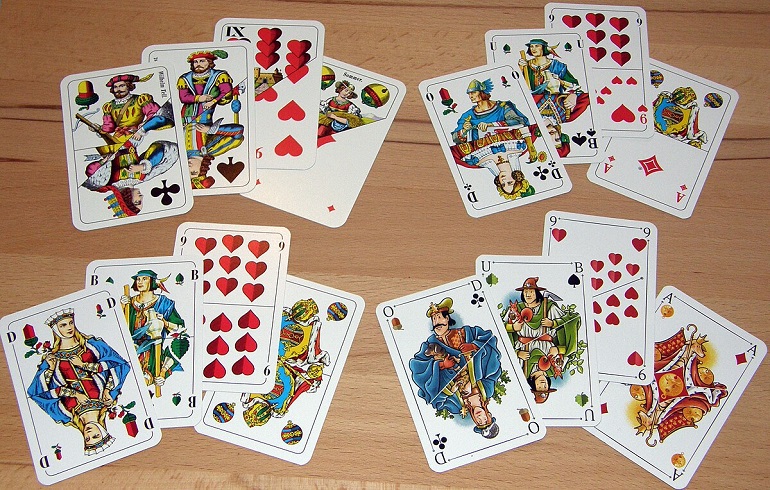
A unique highlight, this museum and active workshop celebrates the traditional craft of playing card production. Visitors can observe historical equipment in operation and even try their hand at the manufacturing process, making it especially popular with families and anyone interested in craftsmanship and local industry.
Museumswerkstatt Stralsund Museum
Designed as an interactive workshop space, the Museumswerkstatt targets young visitors and school groups with hands-on educational projects and creative activities. It enhances the museum experience through practical engagement, linking history with artistic expression.
Welterbe-Ausstellung
Dedicated to Stralsund’s status as a UNESCO World Heritage site, this small yet compelling exhibition presents the city’s outstanding architectural heritage and the global significance of its historic old town. It is an excellent first stop for those wanting to understand why Stralsund is celebrated on the world stage.
Local Cuisine
Freshly caught fish is at the heart of many dishes, with Bismarckhering (pickled herring) and Matjes (young salted herring) being local favourites, often served with onions and potatoes. Another speciality is Fischbrötchen, simple yet delicious fish rolls that are perfect for a quick snack by the harbour. Traditional restaurants also serve hearty plates of Sanddorn (sea buckthorn) desserts and juices, a tart and vitamin-rich berry native to the region. With its blend of hearty fare and the freshness of the sea, Stralsund’s cuisine perfectly reflects its Hanseatic heritage.
Getting There
By train Stralsund is well connected to the German rail network, with frequent services from Berlin, Hamburg, and regional cities, making it an easy and comfortable journey directly to Stralsund Hauptbahnhof, which lies close to the historic centre.
By coach or bus Long-distance coaches link Stralsund with several major German cities, offering an alternative for those seeking straightforward connections, while regional buses serve neighbouring towns and smaller Baltic destinations, ensuring flexibility for travellers.
By car Driving to Stralsund is convenient via the A20 motorway, which links the town to Hamburg and Berlin, with further routes branching off towards the Baltic coast, allowing travellers to explore the surrounding countryside and islands at their own pace.


