| Germany Guide |
|---|
|
| | Top National Parks |
|---|
|
| | German States |
|---|
|
| | Europe Guide |
|---|
|
|
|
|
 Frankfurt am Main at sunset. Frankfurt am Main at sunset.
Introduction

Hesse (Hessen in German) is the richest German non-city state in terms of GDP per capita. Its largest city is Frankfurt-am-Main, Germany's financial capital. The political capital of Hesse, though, is Wiesbaden. Darmstadt and Kassel played that role until 1945, when the modern state of Hesse (aka Greater Hesse) was formed out of the Prussian provinces of Hesse-Darmstadt and Hesse-Nassau.
The cultural region of Hesse is larger than the state and includes the area known as Rhenish Hesse in the neighbouring state of Rhineland-Palatinate, from which it is separated by the Rhine River. The oldest and second largest Hessian city, Mainz, is in Rhenish Hesse.
Hesse has a surface area of 21,100 km² (8,100 sq mi), roughly like Israel or the U.S. state of New Jersey. It has a population of 6,077,000 inhabitants, slightly more than Denmark, and the equivalent of the U.S. state of Missouri.
Before the dissolution of the Holy Roman Empire in 1806, what is now Hesse belonged to a multitude of small independent states, such as the Landgraviate of Hesse-Kassel, the Landgraviate of Hesse-Darmstadt, the Landgraviate of Hesse-Homburg, the Landgraviate of Hesse-Rotenburg, the Duchy of Nassau, the Principality of Waldeck, the County of Isenberg, the Prince-Bishopric of Fulda, the Free Imperial City of Wetzlar, or the Free Imperial City of Frankfurt.
Famous people from Hesse include (chronologically): the writer and politician Johann Wolfgang von Goethe, the academics and authors Jakob and Wilhelm Grimm, the confectioner Henri Nestlé, the founder of the Reuters news agency Paul Reuter, the automobile entrepreneur Adam Opel, the aircraft manufacturer Willy Messerschmitt, and the F1 driver Sebastian Vettel.
History of Hesse
Archaeological excavations have revealed a 7,000-year-old Linear Pottery culture settlement at Wetzlar-Dalheim, whilst Bell Beaker pottery fragments discovered in Rüsselsheim, Offenbach, Griesheim and Wiesbaden suggest human habitation in southern Hesse approximately 4,500 years ago. During the Roman era, the region was inhabited by the Chatti, a Germanic tribe from whom the modern name "Hesse" likely derives, as the area was known in medieval times as Hessengau or Pagus Hassorum. In the early Holy Roman Empire, what is now Hesse corresponded broadly with Western or Rhenish Franconia, forming part of the western half of the stem duchy of Franconia.
The political foundations of Hesse were established in 1264 with the creation of the Landgraviate of Hesse, which emerged as a German principality of the Holy Roman Empire following the partition of the Landgraviate of Thuringia after the War of the Thuringian Succession. The landgraviate expanded significantly in 1479 when it acquired the County of Katzenelnbogen, though this territorial gain led to the lengthy War of the Katzenelnbogen Succession in 1500 following a dispute with Nassau. A pivotal moment in Hessian history occurred in 1568 when Landgrave Philip I died, resulting in the division of the Landgraviate of Hesse among his four sons into the separate lines of Hesse-Kassel (originally spelled Cassel), Hesse-Marburg, Hesse-Rheinfels and Hesse-Darmstadt. However, when Philip II of Hesse-Rheinfels and Louis IV of Hesse-Marburg died without heirs in 1583 and 1604 respectively, their territories were absorbed into Hesse-Kassel.
The Napoleonic era brought dramatic changes to the Hessian territories, as in July 1806, Hesse-Darmstadt, Nassau-Weilburg, Nassau-Usingen, and the Principality of Isenburg became founding members of Napoleon's Confederation of the Rhine. Hesse-Darmstadt was elevated to the status of Grand Duchy during this period, whilst Hesse-Kassel was occupied by French forces in October 1806, with much of its territory being annexed to the Kingdom of Westphalia in 1807. Following Napoleon's defeat in the German campaign of 1813, the Hessian states were restored, and the 1815 Congress of Vienna resulted in significant territorial reorganisations, with Hesse-Kassel gaining Fulda whilst Hesse-Darmstadt acquired Rhenish Hesse on the left bank of the Rhine, centred on Mainz. The modern state of Hesse was eventually formed in 1945 as "Greater Hesse," combining most of Hessen-Darmstadt, Frankfurt am Main, the Waldeck area, and the former Prussian province of Hesse-Nassau, establishing the territorial boundaries that exist today.
|
Clickable Tourist Map of Hesse
Note that dots, castle icons and national parks are not clickable on the mobile version. Please use the desktop version for optimal navigation.
Blank map of Saxony by Grundkarte TUBS, Relief by Alexrk2. Tourist locations by Maciamo. CC BY-SA 3.0.
Attractions
Attractions are listed geographically, from west to east (left to right) and north to south (top to bottom).
North Hesse
| Kellerwald-Edersee National Park ※ |
|---|
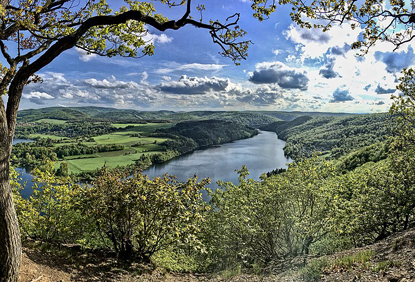
 Kellerwald-Edersee National Park is known for its extensive beech forest, which is part of the ancient beech forest UNESCO World Heritage site. The park covers around 57 square kilometres and features diverse landscapes including dense woods, hills, and the Edersee reservoir. It offers a range of outdoor activities such as hiking, cycling, and wildlife observation, with marked trails and visitor centres providing information about the area’s natural environment. The park supports a variety of flora and fauna, including protected species such as capercaillie and wildcats, making it an important site for conservation. |
|
Kassel (※) |
|---|

 Kassel is principally known for the Bergpark Wilhelmshöhe, a UNESCO World Heritage site. This vast hillside park is distinguished by the Hercules monument at its peak and elaborate water features that cascade down towards Wilhelmshöhe Palace, which houses the Old Masters Picture Gallery. The city's international profile is also defined by documenta, a significant exhibition of contemporary art held every five years. Kassel has a strong connection to the Brothers Grimm, who lived and worked in the city compiling many of their famous tales; their life and work are presented in the GRIMMWELT museum. Further attractions include the large Karlsaue park, which contains the Orangerie palace along the Fulda River. |
|
Homberg an der Efze |
|---|

 Homberg an der Efze is a small castle town with plenty of traditional timber-framed houses dating from the 15th to the 18th centuries. In 1526, Philip the Magnanimous converted the Landgraviate of Hesse to Protestantism while attending a synod in Homberg's St. Mary's Church, which earned it the nickname of "Reformation Church of Hesse". Overlooking the town are the ruins of Hohenburg Castle, which contains the deepest brick-lined castle well in Germany. Other key structures include the Gothic St. Mary's Church and parts of the old town wall. |
Central Hesse
|
Limburg an der Lahn |
|---|

 Limburg an der Lahn is one of the most famous timber-framed towns in Germany. The characteristic white-and-red buildings date from between the 13th and 18th century and include the oldest free-standing house in Germany. The town's most prominent landmark is Limburg Cathedral, a building of late Romanesque and early Gothic design that sits on a rock overlooking the Lahn river and is distinguished by its seven towers. Visitors can also cross the 14th-century stone Lahn Bridge and visit the Diocesan Museum, which contains the cathedral's treasury and other religious art. The town's layout is suitable for exploring on foot. |
|
Braunfels Castle |
|---|

 Sitting atop a basalt rock, Braunfels Castle has remained under the ownership of the same noble family for over 800 years and is still partially inhabited today. The site features a distinctive silhouette and an extensive collection of artefacts, including armour, weapons, and fine furnishings from various centuries, which can be seen on guided tours of the richly decorated rooms. Visitors can also view the castle’s courtyard, the Knights’ Hall, and the cannon terrace, while the adjacent museum displays family artefacts and historical items. The castle sits at the centre of Braunfels’ old town, surrounded by medieval architecture, half-timbered houses, and historic town gates, creating a notable destination for those interested in Germany’s cultural and architectural heritage. |
|
Wetzlar |
|---|
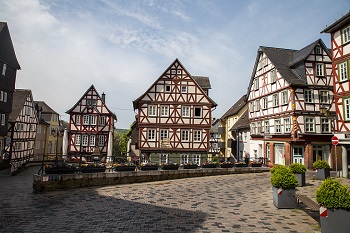
Wetzlar is situated on the River Lahn and is a principal centre of the country's optics industry. The town is also known for its connection to Johann Wolfgang von Goethe, whose work at the former Imperial Chamber Court (Reichskammergericht) here provided the setting for his novel The Sorrows of Young Werther. The well-preserved Old Town (Altstadt) contains half-timbered houses, medieval squares, and the Wetzlar Cathedral, a large church which remains architecturally incomplete and is used by both Catholic and Protestant congregations. Museums in the town cover its optical, legal, and literary heritage. |
|
Marburg |
|---|

Marburg is a delightful, unspoilt university town squeezed between the picturesque Lahn River and its castle hill. Founded by the Landgrave of Hesse in 1527, the Philipp University is the world's oldest Protestant university, where the Brothers Grimm studied and gathered regional folk tales. The medieval old town, known as the Oberstadt, which is located on a hill and consists of a network of narrow, cobbled streets and half-timbered houses. Key structures include the Landgrafenschloss, a castle dating to the 11th century that now houses a museum, and St Elisabeth's Church, one of Germany's first purely Gothic churches. The Oberstadt can be reached by a series of steep staircases or by public lifts that ascend the hill. |
|
Alsfeld |
|---|

Halfway between Marburg and Fulda, Alsfeld (pop. 16,000) is a charming small town with a 16th-century town hall and an exceptionally well-preserved medieval town centre, which features over 400 half-timbered buildings dating from the 13th to 17th centuries. The oldest timber-framed house dates from 1350, making it one of the oldest in the country. The town's picturesque market square, dominated by the Gothic town hall built in 1512-1516, serves as the heart of the old quarter and has earned Alsfeld recognition as part of the German Timber-Frame Road tourist route. The town is perhaps most famously associated with the Brothers Grimm fairy tales, as it claims to be the inspiration for Little Red Riding Hood's village, adding a cultural dimension to its appeal as a destination for history and literature enthusiasts. |
| Friedberg in der Wetterau |
|---|
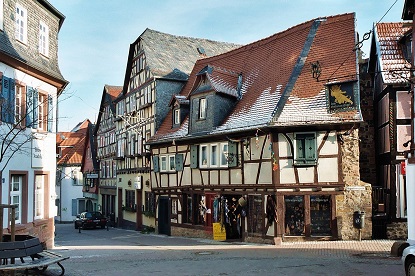
 Located approximately 30 kilometres north of Frankfurt am Main in the fertile Wetterau valley, Friedberg (pop. 31,000) occupies a prominent position on a basalt outcrop along the River Usa just before it joins the Wetter. The town's rich history dates back to Roman times, evidenced by archaeological remains of the ancient Castra Kapersburg, whilst its medieval heritage is preserved in the well-maintained old town featuring traditional half-timbered buildings and remnants of the medieval city walls. Friedberg's most prominent landmark is the imposing former imperial castle complex, which houses both the Adolf-Bartels-Museum and offers panoramic views over the surrounding countryside. |
|
Lauterbach |
|---|

Lauterbach (pop. 2,700) is a small town at the foot of the Vogelsberg Mountains. The main attraction is Schloss Eisenbach, a 15th-century castle located 4 km south of the centre. It has belonged to the same family for nearly 600 years. The area features traditional half-timbered houses and offers recreational opportunities like hiking and cycling, particularly in the nearby nature parks. |
|
Fulda |
|---|

Fulda is a beautiful baroque town that grew around a Benedictine monastery of Fulda, founded in 774 as an outpost for Charlemagne's conquest and Christianisation of Saxony. The city's focal point is Fulda Cathedral, the burial place of Saint Boniface, which makes it a significant pilgrimage site. Adjoining the cathedral is the City Palace (Stadtschloss), the former residence of the prince-abbots, and the formal Palace Gardens. These structures form a distinct 18th-century architectural quarter. Nearby, the much older St. Michael's Church provides a contrast with its pre-Romanesque elements. The main sights are concentrated in a compact area, making the city straightforward to explore on foot. |
South Hesse
|
Wiesbaden |
|---|

Wiesbaden (pop. 290,000) is the capital of Hesse and one of the oldest spa towns in Europe, with thermal springs that have been used for bathing since Roman times. It once boasted 27 hot springs, 15 of which are still in operation. Goethe, Dostoyevsky, Wagner, and Brahms all came to bathe here. The historic city centre features elegant 19th-century architecture, including the neoclassical Kurhaus, which houses a famous casino, and the Russian Orthodox Church with its distinctive golden domes, whilst the surrounding Rheingau wine region produces some of Germany's finest Riesling wines. The cityscape is also defined by the Neroberg, a hill overlooking the town that features a church and is accessible by a unique water-powered funicular railway. |
|
Eberbach Abbey |
|---|

Eberbach Abbey is a former Cistercian monastery founded in 1136 by Bernard of Clairvaux. Its Romanesque and early Gothic architecture make of it one of the most significant historical sites in Hesse. Throughout the Middle Ages, it was an important site for both religious life and wine production, a tradition that continues today with 200 hectares of vineyards managed by the Hessische Staatsweingüter. The abbey served various roles after monastic life ended in 1803 and is now known as a cultural venue and event space, regularly hosting guided tours, wine tastings, and festivals. Its authentic medieval setting has also been featured as a filming location, notably in the 1986 film “The Name of the Rose.” Visitors can explore the grounds year-round, with seasonal variations in opening hours. |
|
Frankfurt am Main |
|---|
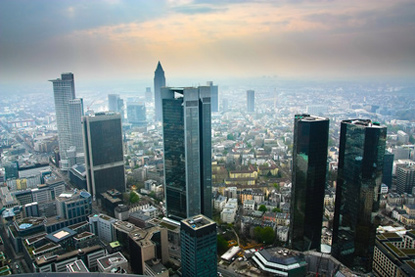
Frankfurt am Main (pop. 755,000; urban 2.3 million), Germany's fifth-largest city, is a vibrant metropolis known for its unique blend of historic charm and modern sophistication. Situated on the banks of the River Main, this financial powerhouse boasts a striking skyline that has earned it the nickname "Mainhattan". Frankfurt is a multicultural hub where old and new coexist harmoniously. The city centre features the restored Römerberg square with its half-timbered buildings, whilst the surrounding areas are dotted with world-class museums, beautiful parks, and a thriving cultural scene. Home to the European Central Bank and one of the world's busiest airports, Frankfurt serves as a major transportation nexus. Visitors can explore attractions such as the Gothic-style Frankfurt Cathedral, the Goethe House museum, and the modern Main Tower for panoramic city views. The city is also renowned for its trade fairs, including the Frankfurt Book Fair, and its traditional apple wine taverns in the Sachsenhausen district. |
|
Saalburg Roman Fort ※ |
|---|
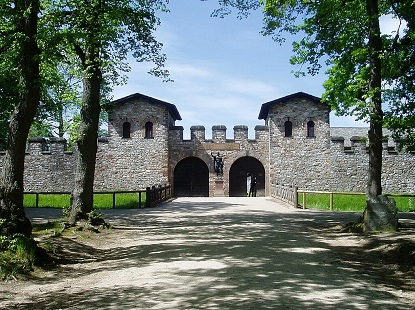
Saalburg is the most completely reconstructed cohort fort on the Limes and part of a UNESCO-recognised frontier system. Within its rebuilt walls lie barracks, granaries and the principia, giving a clear sense of military layout, while the museum displays excavated weapons, everyday objects and a rare collection of working artillery replicas. Walking through the stone gateways, visitors can explore the bathhouse, temple remains and the neighbouring civilian settlement that once served the 600-strong garrison, gaining insight into the intertwined lives of soldiers and traders. Regular demonstrations, craft workshops and seasonal festivals add practical context to the archaeology, making the site engaging for families as well as history enthusiasts. |
|
Bad Homburg |
|---|

Bad Homburg vor der Höhe is a spa town renowned for its medically used mineral waters. First popular with the Russian aristocracy in the mid 19th century, Kaiser Wilhelm II made it an Imperial summer residence in 1888, where his uncle, the future King Edward VII of England, was a frequent guest. The town features the 14th-century Landgraves’ Castle with its distinctive White Tower, various museums, and well-preserved half-timbered houses in the old town. Bad Homburg’s Casino, opened in 1841, is considered one of Germany’s oldest. Popular attractions include the Saalburg Roman Fort, the Church of the Redeemer with its neo-Byzantine interior, and several cultural sites and green spaces. |
|
Hanau |
|---|

Hanau (pop. 101,000) is the southern starting point of the Märchenstraße (German Fairy Tale Road), as well as the birthplace of the writers Jakob and Wilhem Grimm, who collected and published many of the world's most famous fairy tales in the early 19th century. Founded in 1143, Hanau serves as an important regional centre for goldsmithing and jewellery making, earning it the nickname "Goldschmiedestadt" (City of Goldsmiths). The town features a well-preserved historic centre with notable attractions including the New Town Hall and Philippsruhe Castle with its baroque gardens. The German Goldsmith House (sometimes mistaken for the old town hall) is one of the most ravishing timber-framed buildings in the region. |
|
Darmstadt (※) |
|---|

Darmstadt is the historical capital of the County of Hessen-Darmstadt, then the Grand Duchy of Hesse from 1806. It is one of few German cities which does not lie close to a river, lake or coast. Darmstadt was dubbed "city of science" thanks to its celebrated Technical University and the numerous aerospatial and engineering centres, such as the European Space Operations Centre (ESOC), which controls satellite and space probe missions, and the GSI Helmholtz Centre for Heavy Ion Research, where the element Darmstadtium was first synthesised. Alongside its scientific focus, the city is a significant site for Art Nouveau architecture, with the Mathildenhöhe Artists' Colony recognised as a UNESCO World Heritage Site, featuring landmarks such as the Wedding Tower and the Russian Chapel. Other architectural points of interest include the colourful Waldspirale residential complex designed by Friedensreich Hundertwasser and the former ducal Residenzschloss in the city centre./div>
|
|
Lorsch Abbey ※ |
|---|

The former Imperial Abbey of Lorsch, 10 km east of Worms, was one of the most renowned monasteries of the Carolingian Empire. Though ruined today, the abbey's remains are among the most important pre-Romanesque buildings in the country, whiched earned it a UNESCO World Heritage status. The most notable surviving structure is the Torhalle, or gate hall, which is a rare and well-preserved monument from the Carolingian period. Visitors can also see the outline of the original monastic church, a herb garden based on the medieval Lorsch pharmacopoeia, and a museum centre that details the site's extensive history. |
|



 : Local interest
 : Moderately interesting
 : Outstanding place
 : Must-see in the country
 : Top cities in Europe